
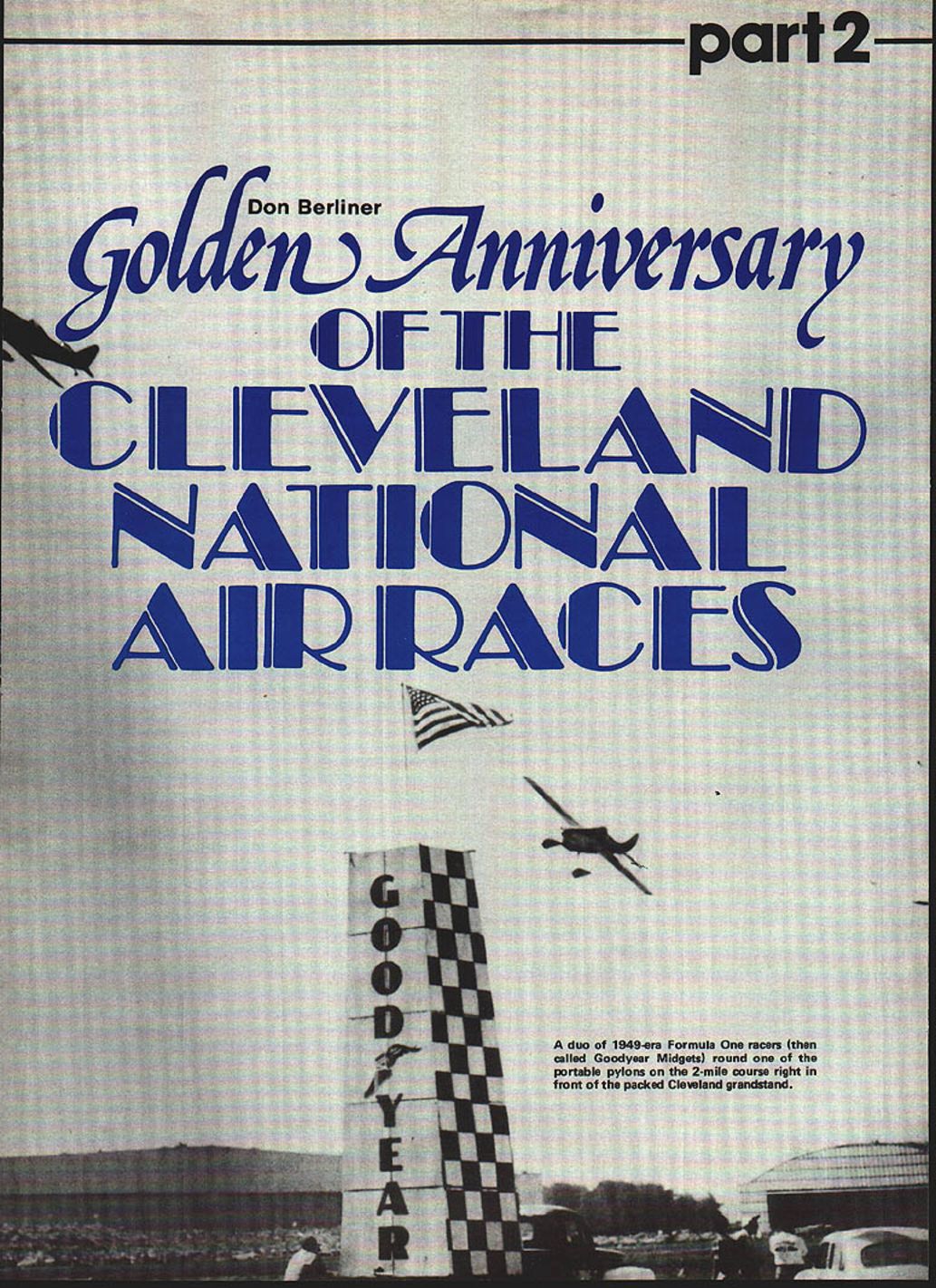
Golden Anniversary of the Cleveland National Air Races
By Don Berliner
The war was over and the races would never be the same—the old races died with yet another war, the Korean conflict. Lightnings, Mustangs, Corsairs, Airacobras, et al., had abounded—then even jets swooshed on stage. As the public grew bored, the pert Goodyears became a lasting sensation, and finally all of it came down to this year's celebrational races—air racing appears destined to remain part of the American aeronautical scene.
Postwar transformation (1946)
When World War II ended, life returned to normal, except that it was a very different kind of normal. The war had been so severe and had killed so many tens of millions of people that nothing would ever be the same. Even something as innocent as the National Air Races experienced permanent, drastic changes in its prewar shape and size. A single prewar racing plane competed after the war. The impossibly low‑slung Crosby Racer entered Cleveland in 1946 but never showed.
There remained a few people—Tony LeVier, Steve Wittman, Earl Ortman, Art Chester—older, wiser but no less eager. So too Jackie Cochran and Paul Mantz. The airplanes that flew bore no similarity to the exciting machines raced a few years before. In fact, the flight line at Cleveland Hopkins Airport looked like a bunch of gremlins had slipped in the previous night and sprayed red, blue and yellow paint over the Army's and Navy's best fighter planes—what everyone would fly. Civilianized P‑38 Lightnings, P‑39 Airacobras, P‑51 Mustangs, P‑63 Kingcobras, and F4U Corsairs weren't racers, of course, but were much faster than anything Cleveland's pylons had ever seen.
A cheap, low‑time Mustang could be bought from the government for $1,000; you could walk down the line and pick the one you wanted. Uncle Sam tried to unload surplus; legions of war‑trained pilots never wanted to see a military airplane again. Few did—yet Cleveland Labor Day weekend 1946 saw quantity; fans had a special opportunity to see the famed fighters in action and maybe settle some old arguments about the fastest.
The hallowed tradition of the weekend speed events began with the Bendix Race from Los Angeles. The entry list was the longest ever—14 P‑38s, 4 P‑51s, 2 P‑63s, a Corsair and a Douglas A‑26. Two veterans of the old days were ready—Cochran and Mantz—with beautifully cleaned‑up Mustangs. Another well‑known figure in the line‑up was Indianapolis 500 racer Rex Mays in a P‑38. It was a sad day for custom‑built racers of the old days—the winner covered 2,048 miles in less than five hours. Paul Mantz, in a P‑51C with its wings sealed and filled with gas so it could make the run non‑stop without drag‑producing drop tanks, averaged 435.5 mph, adding a whopping 153 mph to the old record. Cochran was second at 421 mph. Four Mustangs took the first four places; it was obvious the Thompson Trophy Race would be just different.
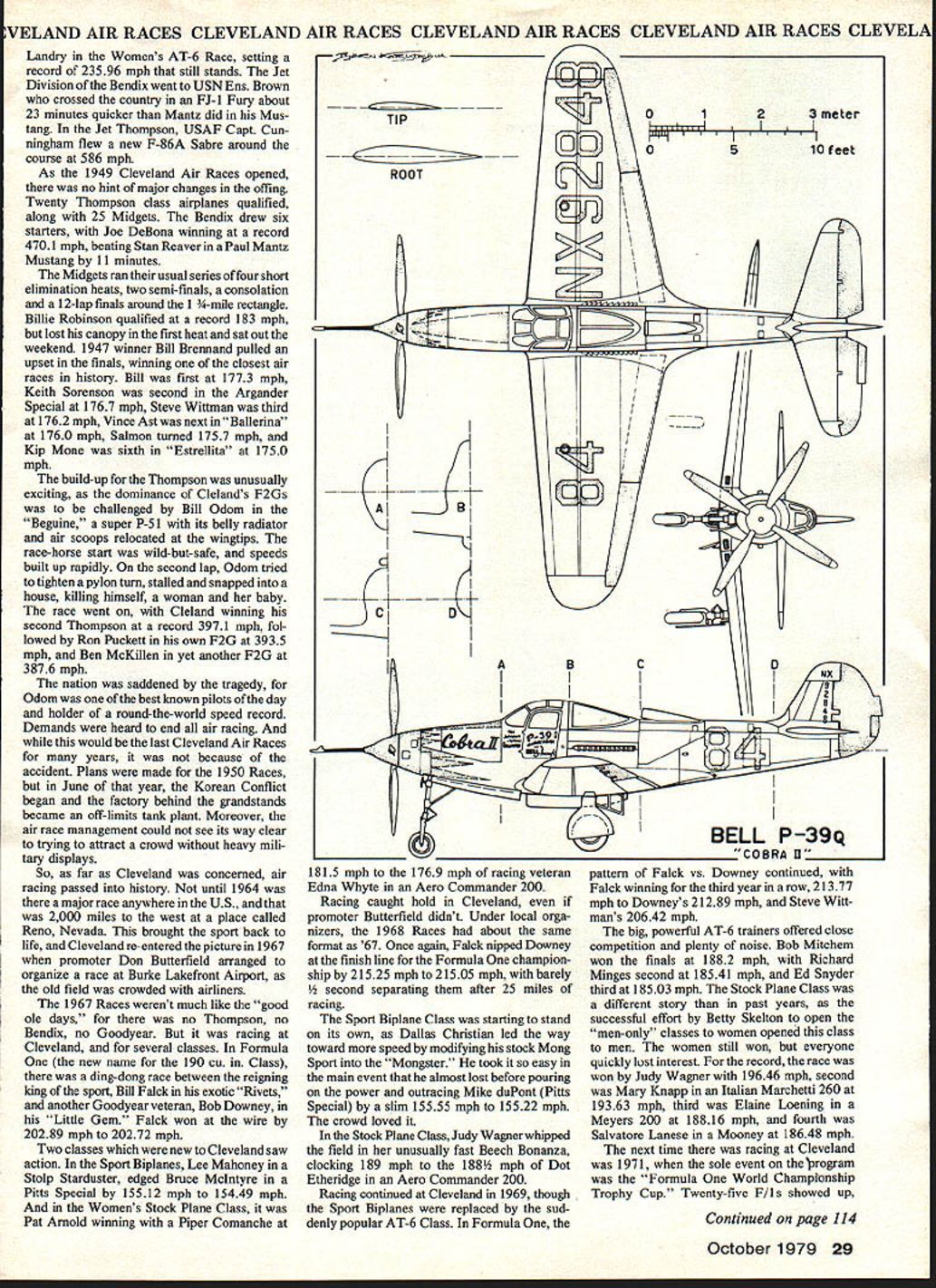
Alvin "Tex" Johnston, later Boeing's chief test pilot, ruled time trials in a souped‑up P‑39Q "Cobra II" with a lap of 409 mph and led from start to finish, setting a race record of 373.9 mph—90 mph faster than Roscoe Turner's best seven years before. A big surprise was Tony LeVier, now a Lockheed test pilot, who pushed the big red P‑38 into second place ahead of the Mustangs. Earl Ortman was 20 seconds back. Steve Wittman managed to work his way up to eighth place in a nearly stock Kingcobra. Ten of twelve starters finished the race thanks to airframes and engines proven under wartime conditions. Delicate, souped‑up engines and flimsy landing gears of prewar racers were a thing of the past. Unfortunately, individuality and personality were diminished—the airplanes of 1946 looked pretty much alike and sounded a lot alike.
Crowds gasped at the speed, then yawned at the sameness. Some got up and started to walk out. The dedicated racing fan found it a bit boring. Total attendance was enormous—hundreds of thousands, perhaps 300,000 parked in farmers' fields watching.
The birth of a restricted class (1947)
So the Professional Race Pilots Association dusted off a 1939 idea and presented it to the Air Foundation and Race Director Ben Franklin. It was a radical idea, calling for severe restrictions on the design and power of small racers, instead of the beautiful freedom that had prevailed for so long. But that freedom was no longer working.
The new idea got the quick backing of the Goodyear Tire & Rubber Co., with a guarantee of a $25,000 race each of the next three years. The word went out in February 1947, and at the end of August there were 13 Goodyear Class airplanes at Cleveland, ready to race. Five were modified prewar racers and three others were the products of experienced racing people. Response to the announcement was amazing, and it is estimated that several hundred racers were begun throughout the country.
But when the 1947 Cleveland Air Races opened, the 190 cu. in. class was still just an idea. Emphasis was on what are now called "warbirds" in the Bendix, Thompson and other races. The Bendix drew 12 starters, as most of the P‑38 pilots from 1946 had learned their lesson. Paul Mantz won his second in a row, upping his record to 460 mph as he narrowly edged Joe DeBona who turned 458 mph. There were six Mustangs entered, and they took the top six places.
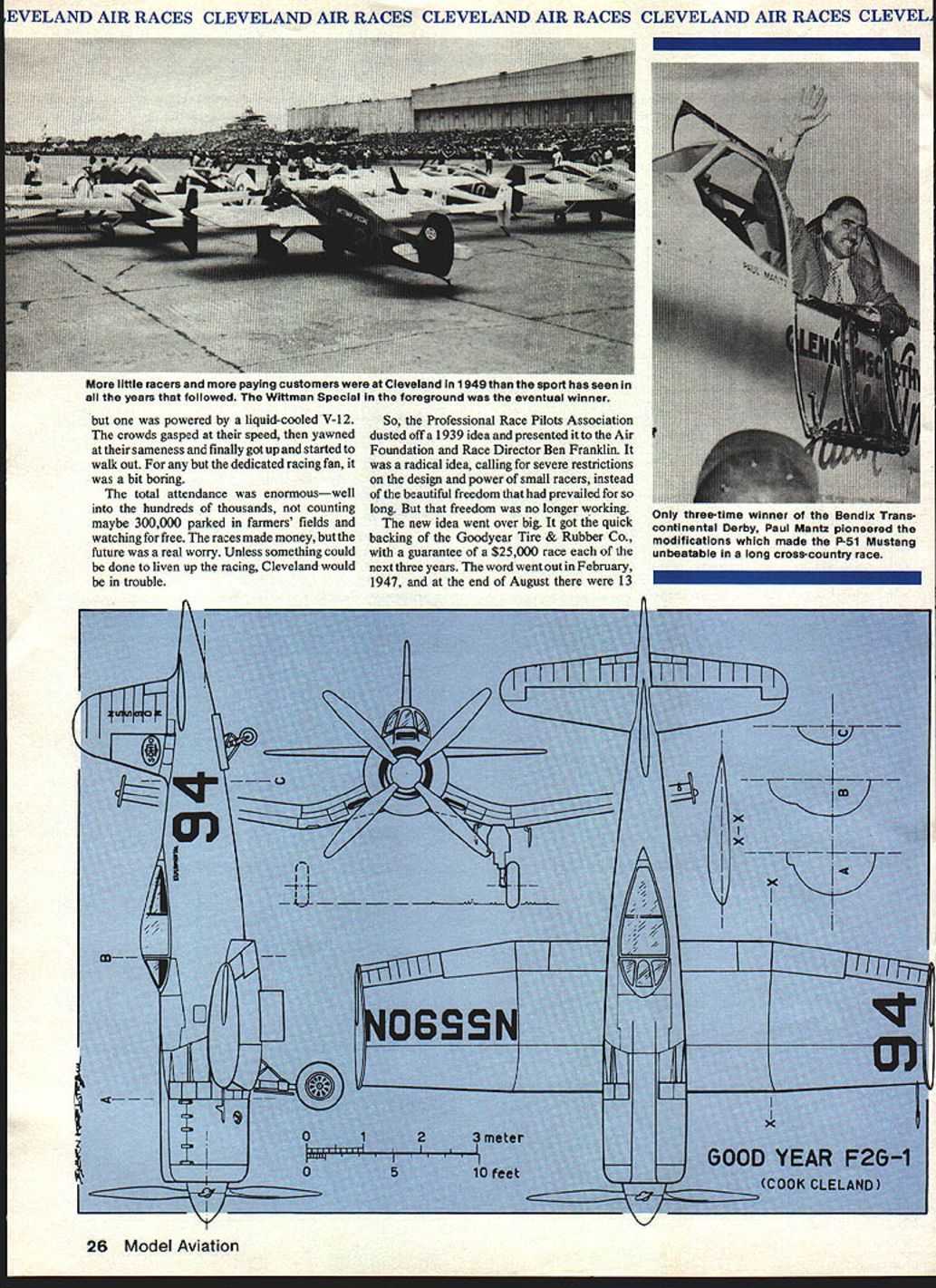
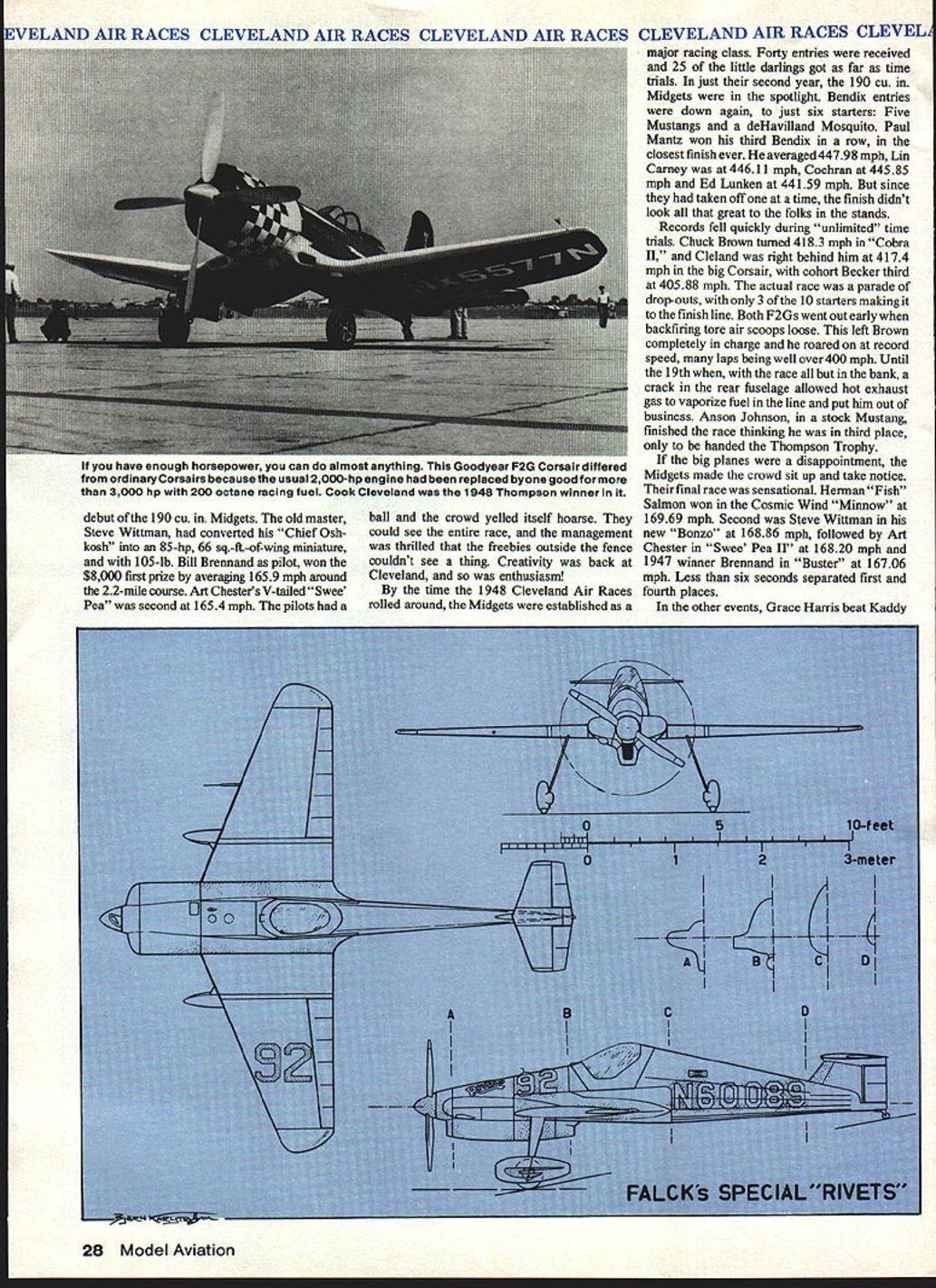
Among the big planes, the Goodyear F2G—a Corsair with a huge 4,360 cu. in. Pratt & Whitney engine producing over 3,000 hp—attracted attention. Cook Cleland had entered three, with his and Dick Becker's leading time trials at 402 mph and 401 mph, respectively. Once again, it looked like a battle between monster radial engines and smaller inlines, just as it had been in the 1930s.
Cleland's Corsairs busted things wide open. Cook won the Thompson at a record 396 mph, with Becker second at 390 mph. Jay Deming was third in "Cobra II," only a few seconds back, while the fastest Mustang trailed the muscular Corsairs by almost two laps.
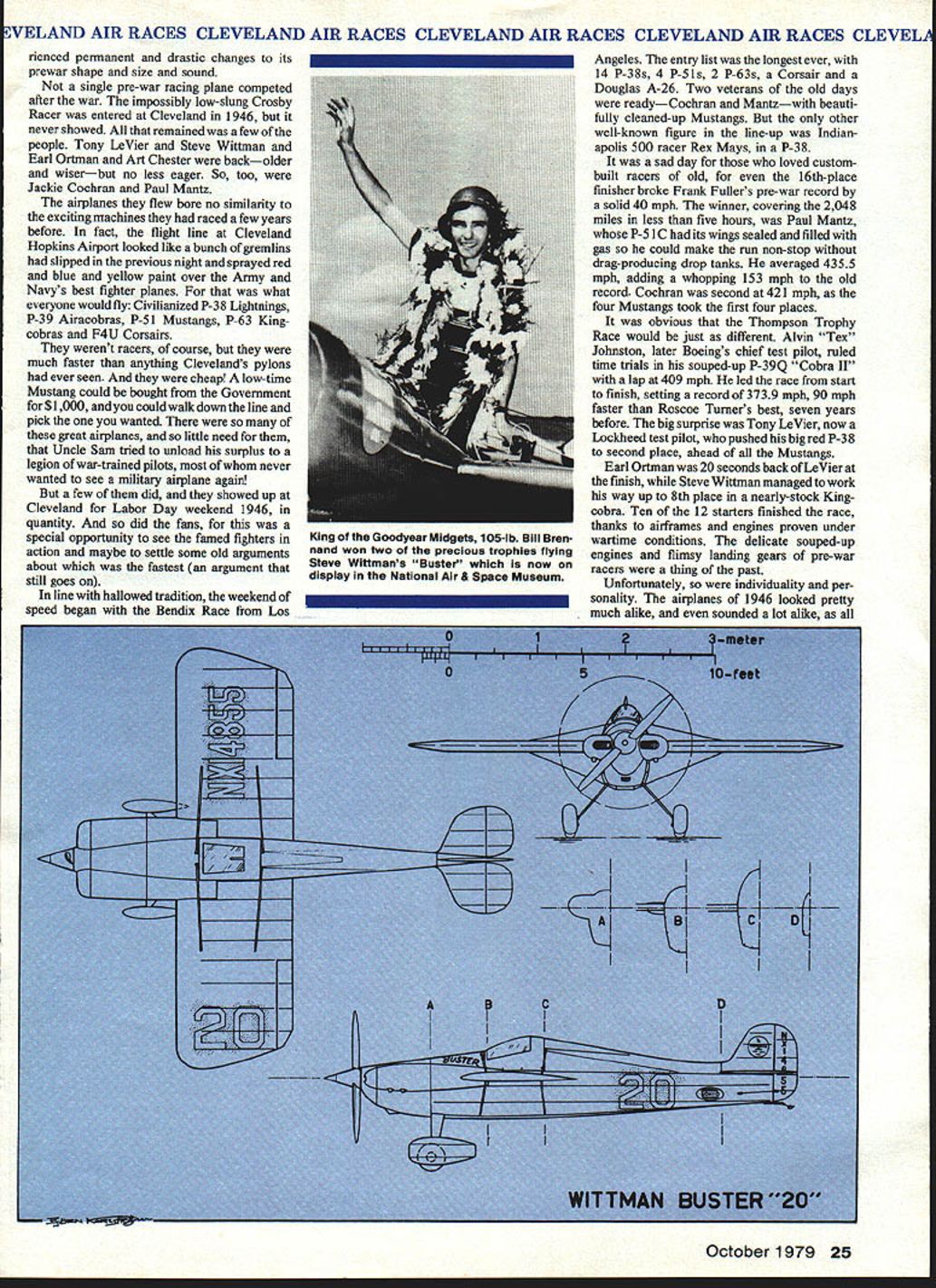
Contrasted to this brute horsepower was the debut of the 190 cu. in. Midgets. The old master Steve Wittman had converted his "Chief Oshkosh" into an 85‑hp, 66‑sq.‑ft.‑of‑wing miniature, and with 105‑lb. Bill Brennand as pilot, won the $8,000 first prize by averaging 165.9 mph around the 2.2‑mile course. Art Chester's V‑tailed "Swee' Pea" was second at 165.4 mph. The pilots had a ball and the crowd yelled itself hoarse. They could see the entire race, and the management was thrilled that the freebies outside the fence couldn't see a thing. Creativity was back at Cleveland, and so was enthusiasm.
Midgets established and the 1948 races
By 1948 the Midgets were established as a major racing class. Forty entries were received and 25 of the little darlings got as far as time trials. In just their second year, the 190 cu. in. Midgets were in the spotlight.
Bendix entries were down to six starters: five Mustangs and a de Havilland Mosquito. Paul Mantz won his third Bendix in a row, in the closest finish ever. He averaged 447.98 mph, Lin Carney was at 446.11 mph, Cochran at 445.85 mph and Ed Lunken at 441.59 mph. But since they had taken off one at a time, the finish didn't look all that great to the folks in the stands.
Records fell quickly during "unlimited" time trials. Chuck Brown turned 418.3 mph in "Cobra II," and Cleland was right behind him at 417.4 mph in the big Corsair, with Becker third at 405.88 mph. The actual race was a parade of dropouts, with only 3 of the 10 starters making it to the finish line. Both F2Gs went out early when backfiring tore air scoops loose. This left Brown completely in charge and he roared on at record speed, many laps being well over 400 mph. On the 19th, with the race all but in the bank, a crack in the rear fuselage allowed hot exhaust gas to vaporize fuel in the line and put him out of business. Anson Johnson, in a stock Mustang, finished the race thinking he was in third place, only to be handed the Thompson Trophy.
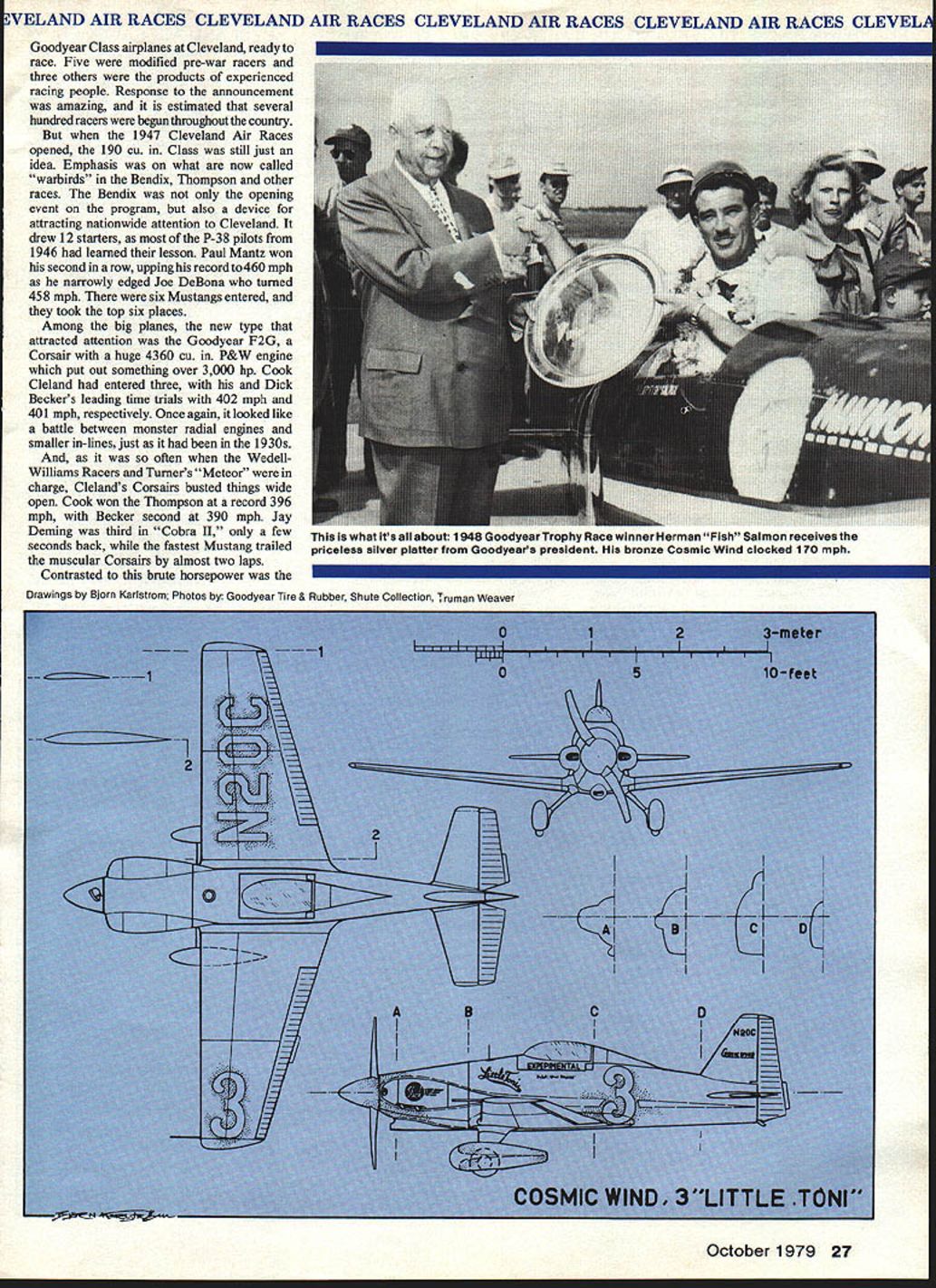
If the big planes were a disappointment, the Midgets made the crowd sit up and take notice. Their final race was sensational. Herman "Fish" Salmon won in the Cosmic Wind "Minnow" at 169.69 mph. Second was Steve Wittman in his new "Bonzo" at 168.86 mph, followed by Art Chester in "Swee' Pea II" at 168.20 mph and 1947 winner Brennand in "Buster" at 167.06 mph. Less than six seconds separated first and fourth places.
In other events, Grace Harris beat Kaddy Landry in the Women's AT-6 Race, setting a record of 235.96 mph that still stands. The Jet Division of the Bendix went to USN Ens. Brown who crossed the country in an FJ-1 Fury about 23 minutes quicker than Mantz did in his Mustang. In the Jet Thompson, USAF Capt. Cunningham flew a new F-86A Sabre around the course at 586 mph.
1949: records, tragedy and the end of an era
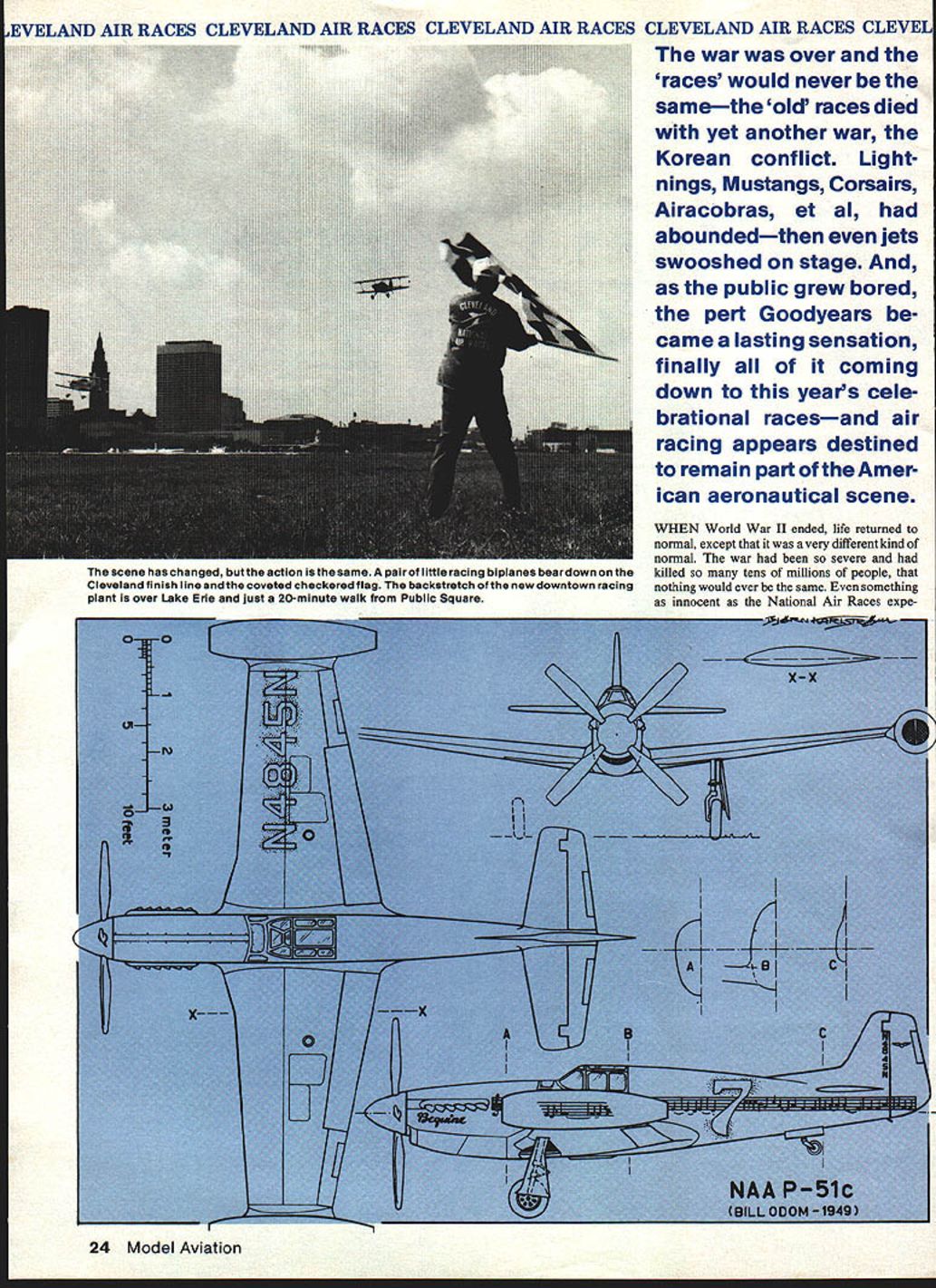
As the 1949 Cleveland Air Races opened, there was no hint of major changes in the offing. Twenty Thompson class airplanes qualified, along with 25 Midgets. The Bendix drew six starters, with Joe DeBona winning at a record 470.1 mph, beating Stan Reaver in a Paul Mantz Mustang by 11 minutes.
The Midgets ran their usual series of four short elimination heats, two semi-finals, a consolation and a 12‑lap final around the 1 1/4‑mile rectangle. Billie Robinson qualified at a record 183 mph, but lost his canopy in the first heat and sat out the weekend. 1947 winner Bill Brennand pulled an upset in the finals, winning one of the closest air races in history.
Finals results (selected):
- 1st: Bill Brennand — 177.3 mph
- 2nd: Keith Sorenson (Argander Special) — 176.7 mph
- 3rd: Steve Wittman — 176.2 mph
- 4th: Vince Ast ("Ballerina") — 176.0 mph
- 5th: Herman "Fish" Salmon — 175.7 mph
- 6th: Kip Mone ("Estrellita") — 175.0 mph
The build-up for the Thompson was unusually exciting, as the dominance of Cleland's F2Gs was to be challenged by Bill Odom in the "Beguine," a super P‑51 with its belly radiator and air scoops relocated at the wingtips. The race‑horse start was wild but had been used safely many times. On the second lap, Odom tried to tighten a pylon turn, stalled and crashed into a house, killing himself, a woman and her baby. The race went on, with Cleland winning his second Thompson at a record 397.1 mph, followed by Ron Puckett in his own F2G at 393.5 mph, and Ben McKillen in yet another F2G at 387.6 mph.
The nation was saddened by the tragedy, and demands were heard to end all air racing. While this would be the last Cleveland Air Races for many years, it was not solely because of the accident. Plans were made for the 1950 Races, but in June of that year the Korean Conflict began and the factory behind the grandstands became an off‑limits tank plant. Moreover, air race management could not see its way clear to attract a crowd without heavy military displays.
So, as far as Cleveland was concerned, air racing passed into history. Not until 1964 was there a major race anywhere in the U.S., and that was 2,000 miles to the west at a place called Reno, Nevada. This brought the sport back to life, and Cleveland re‑entered the picture in 1967 when promoter Don Butterfield arranged to organize a race at Burke Lakefront Airport, as the old field was crowded with airliners.
Revival in the 1960s
The 1967 races weren't much like the good old days—there was no Thompson, no Bendix, no Goodyear—but it was racing at Cleveland, and for several classes. In Formula One (then the new name for the 190 cu. in. class) there was a ding‑dong race between the reigning king of the class, Bill Falck in his exotic "Rivets," and another Goodyear veteran, Bob Downey, in his "Little Gemini." Falck won at the wire by 202.89 mph to 202.72 mph.
Two classes new to Cleveland saw action:
- Sport Biplanes: Lee Mahoney in a Stolp Starduster edged Bruce McIntyre in a Pitts Special, 155.12 mph to 154.49 mph.
- Women's Stock Plane: Pat Arnold won with a Piper Comanche at 181.5 mph; Edna Whyte was second in an Aero Commander 200 at 176.9 mph.
Racing caught hold in Cleveland, though promoter Butterfield did not continue. Under local organizers, the 1968 races followed a similar format; Falck again nipped Downey for the Formula One championship by 215.25 mph to 215.05 mph, separated by roughly half a second after 25 miles of racing.
The Sport Biplane Class began pushing for more speed. Dallas Christian modified his Mong Sport into the "Monsterg" and narrowly beat Mike duPont (Pitts Special) by 155.55 mph to 155.22 mph. In the Stock Plane Class, Judy Wagner clocked 189 mph in a Beech Bonanza to top Dot Etheridge in an Aero Commander 200.
Racing continued in 1969 with the Sport Biplanes replaced by the suddenly popular AT‑6 class. Formula One again saw Falck beat Downey—Falck's third straight win—213.77 mph to 212.89 mph, with Steve Wittman at 206.42 mph.
AT‑6 results (selected):
- 1st: Bob Mitchem — 188.2 mph
- 2nd: Richard Minges — 185.41 mph
- 3rd: Ed Snyder — 185.03 mph
The Stock Plane Class grew competitive and diverse after Betty Skelton's effort opened formerly men‑only classes to women. Judy Wagner won at 196.46 mph; Mary Knapp (Marchetti 260) was second at 193.63 mph; Elaine Loening (Meyers 200) third at 188.16 mph; Salvatore Lanza (Mooney) fourth at 186.48 mph.
The 1970s: Formula One focus and new leadership
Racing returned to Cleveland in 1971 with the lone event the "Formula One World Championship Trophy Cup." Twenty‑five F1s showed up—the best turnout since Goodyear days. After a dozen heats on the lake shore course and within shouting distance of downtown Cleveland, Bill Falck remained on top. He outran Bob Downey by 213.0 mph to 212.2 mph. Jim Wilson was third in a taper‑wing Cassutt at 211.30 mph, and Nick Jones fourth in a Cassutt at 210.25 mph.
The more recent Cleveland Air Races had been run out of City Hall, which was hardly ideal—politicians do things for their own reasons, usually not in the best interests of air racing. This was the main reason for the gap between 1971 and 1977. Then a new group was in charge—the Eastern Region of the U.S. Air Racing Association (the new name for the Professional Race Pilots Association), spearheaded by Jack Dianska and, until his death in a non‑racing accident, race pilot/builder Marion Baker.
For Labor Day 1977, the only racing in the annual air show would be Formula One. The FAA safety official felt the usual race‑horse start was too dangerous and demanded formation flying starts—over loud protests. Prior to the first heat, as the planes were trying to get into formation, 30‑year Cleveland veteran Bill Falck got too slow in his tricky "Rivets," stalled and dove into Lake Erie. The loss of perhaps the finest race pilot of all time led to serious soul‑searching, but the races went on, as Bill would have wanted. Flying starts were discontinued.
The championship race on Monday was cancelled due to dense haze over the lake, so prizes were awarded on the basis of heat speeds:
- 1st: Bob Moeller ("BooRay") — 224.1 mph
- 2nd: Bob Downey ("Falcon") — 219.5 mph
- 3rd: Chuck Andrews ("Moonshiner") — 210.5 mph
- 4th: Jimmy Miller ("Texas Gem") — 207.3 mph
A second Cleveland Air Races organized by USARA's Eastern Region was conducted on Labor Day weekend, 1978. This time the Formula Ones were joined by their new little brothers, the Formula Vees, powered by more‑or‑less stock 1600‑cc Volkswagen engines. Thanks to the airport's outstanding location on the shore of Lake Erie, the crowd numbered over 100,000, many of whom remembered the old days.
The first Cleveland F/Vee race was an old story to those who have followed the sport. Steve Wittman toyed with the field, winning the championship heat in his green‑and‑yellow "Vee Witt" at a record‑setting 162.57 mph. Second was Vern Willingham in a Renegade at 158.13 mph, and third was F1 ace Bob Downey in E. C. Fisher's Sonera "Blueberry."
The feature race was the championship heat for Formula Ones, which produced close and exciting racing and history's first win for a radical‑design raceplane. Jimmy Miller's all‑fiberglass pusher "Texas Gem" was a shade too fast for Don Beck's Cassutt "Gnat," with Miller turning a Cleveland record 233.26 mph to Beck's 232.26 mph on the 3‑mile oval. Bob Moeller was third at 231.76 mph, and Downey fourth at 230.28 mph. This kind of close racing is why Formula One remains popular not only in the U.S. but in Europe after more than 30 years of action.
Golden Anniversary: 1979 plans
With that, the stage was set for the 50th Anniversary of the Cleveland Air Races, to be held Sept. 1–2–3, 1979, at Burke Lakefront Airport. There were to be old race planes on display, and probably some old race pilots as well. Racing was planned for Formula One and Formula Vee and, hopefully, the Sport Biplane Class, according to racing director Jack Dianska.
And, of course, there would be Steve Wittman and his flying Vee. There can't very well be a Cleveland Air Races without Steve. He was there in a Pheasant biplane when it all began in 1929. He built and raced his "Chief Oshkosh" and "Bonzo" all through the 1930s. He tried a Bell P‑63 in the early post‑war Thompson Trophy Races, then switched to the 190 cu. in. class with his little "Bonzo," which he still uses. Now it's the newest of air race classes that is receiving the benefit of Steve's experience, wisdom and life‑long know‑how.
Come Labor Day 1979, the Cleveland Air Races would be 50 years old and its star performer 75. They had made it through some very great times and some very difficult times. With racing poised on the verge of heaven‑knows‑what, neither gives any indication of quitting.
Transcribed from original scans by AI. Minor OCR errors may remain.

