
Gopher Canyon
In this age of urbanization, modelers who take a more sophisticated, whole-sound approach to measuring noise have the edge in achieving quiet flight. This San Diego club association won a flying site partly by doing just that.
Like many success stories, this one grew out of hard work, innovation, and perseverance. The story of Gopher Canyon is about how a dedicated group of RC fliers overcame local opposition to secure a much-needed club flying site. That this happened in San Diego makes it all the more notable.
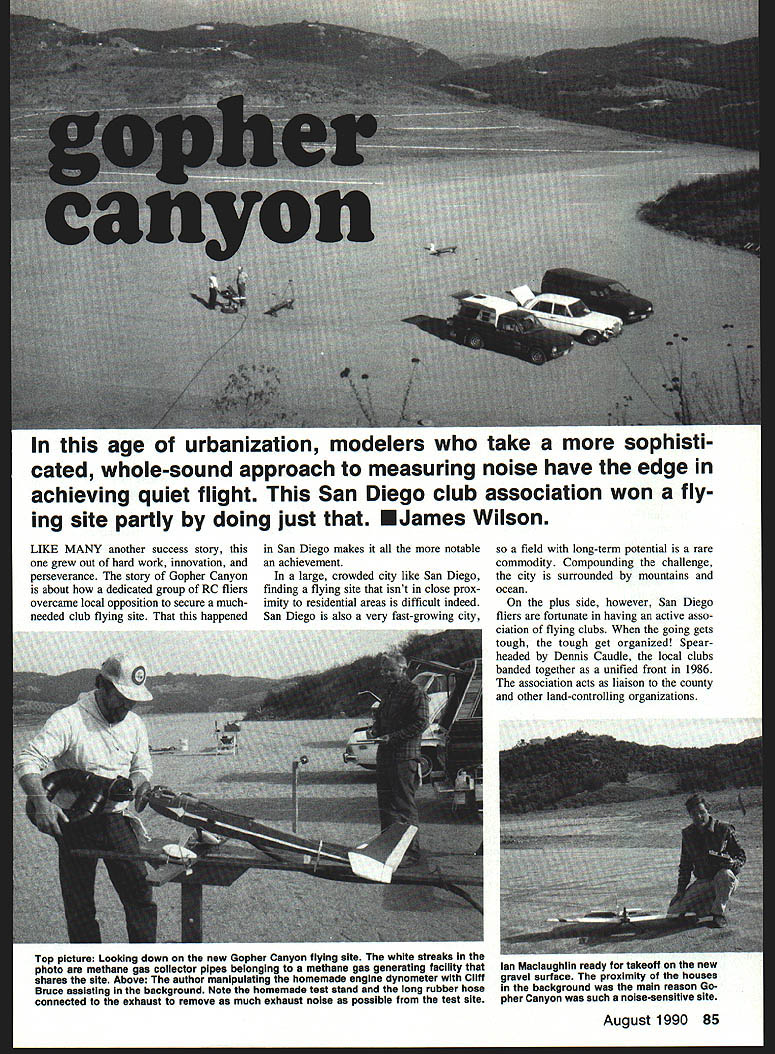
In a large, crowded city like San Diego, finding a flying site that isn't in close proximity to residential areas is difficult. San Diego is also a very fast-growing city, so a field with long-term potential is a rare commodity. Compounding the challenge, the city is surrounded by mountains and ocean.
Organizing to find and secure a site
San Diego fliers are fortunate in having an active association of flying clubs. Spearheaded by Dennis Caudle, the local clubs banded together as a unified front in 1986. The association acts as liaison to the county and other land-controlling organizations.
Gopher Canyon was one of a number of sites investigated by the association. The first report on the site stated that it was unusable because methane gas collectors covered the surface. Subsequent examinations reassured the modelers that, with a little tweaking, a runway could be squeezed on the upwind side, making the wellheads only a minor inconvenience. With that decided, the association went to work.
Negotiations to acquire the site began. Numerous meetings with the county, town council, and local homeowners association were held. The final hurdle was a flight demonstration for the neighbors — and a showing of our presence.
No question about it, we were shaken, and some of us were ready to give up. But remembering that the first rule of site search is, "You aren't beat until you quit," we rallied, regrouped, and pushed on.
Demonstrating quiet and winning neighbors
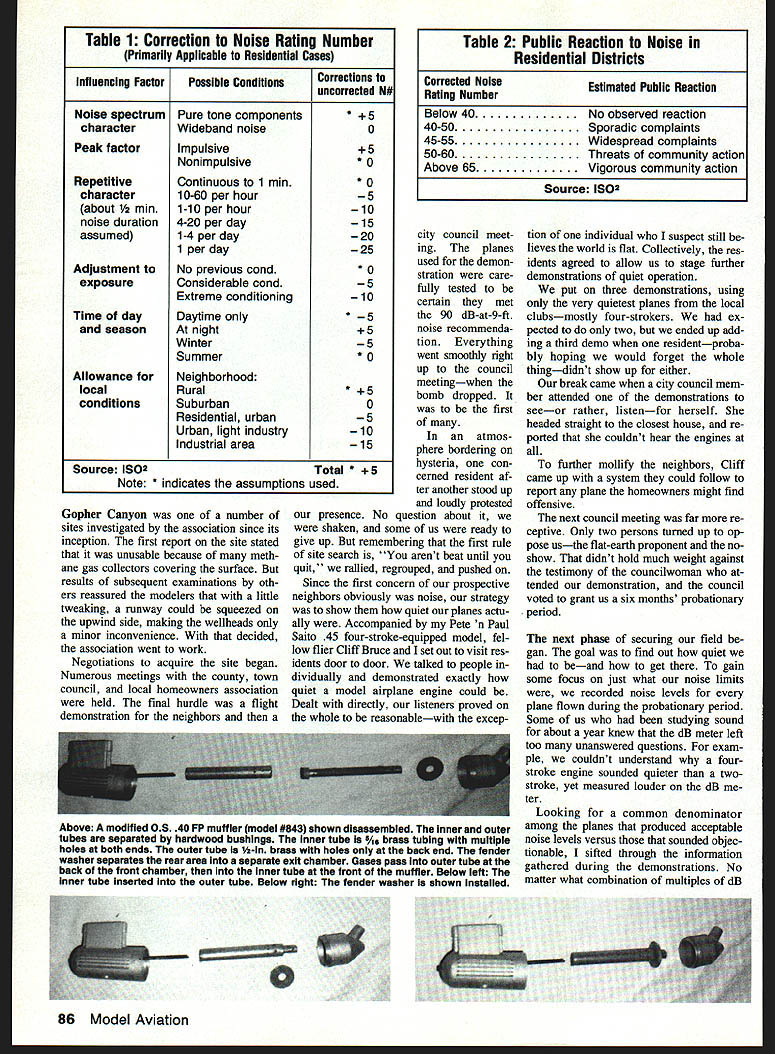
Since the first concern of prospective neighbors was obviously noise, our strategy was to show them how quiet our planes actually were. Accompanied by Pete and Paul Saito (with a .45 four-stroke-equipped model), fellow flier Cliff Bruce and I visited residents door-to-door. We talked to people individually and demonstrated exactly how quiet a model airplane engine could be. Dealt with directly, our listeners proved on the whole to be reasonable — with the exception of one individual who I suspect still believes the world is flat. Collectively, the residents agreed to allow us to stage further demonstrations.
We put on three demonstrations, using only the very quietest planes from the local clubs — mostly four-strokers. We had expected to do only two, but added a third when one resident didn't show up for either of the earlier demos.
Our break came when a city council member attended one of the demonstrations to see — or rather, listen — for herself. She reported that she couldn't hear the engines at all. To further mollify the neighbors, Cliff devised a system they could use to report any plane the homeowners might find offensive.
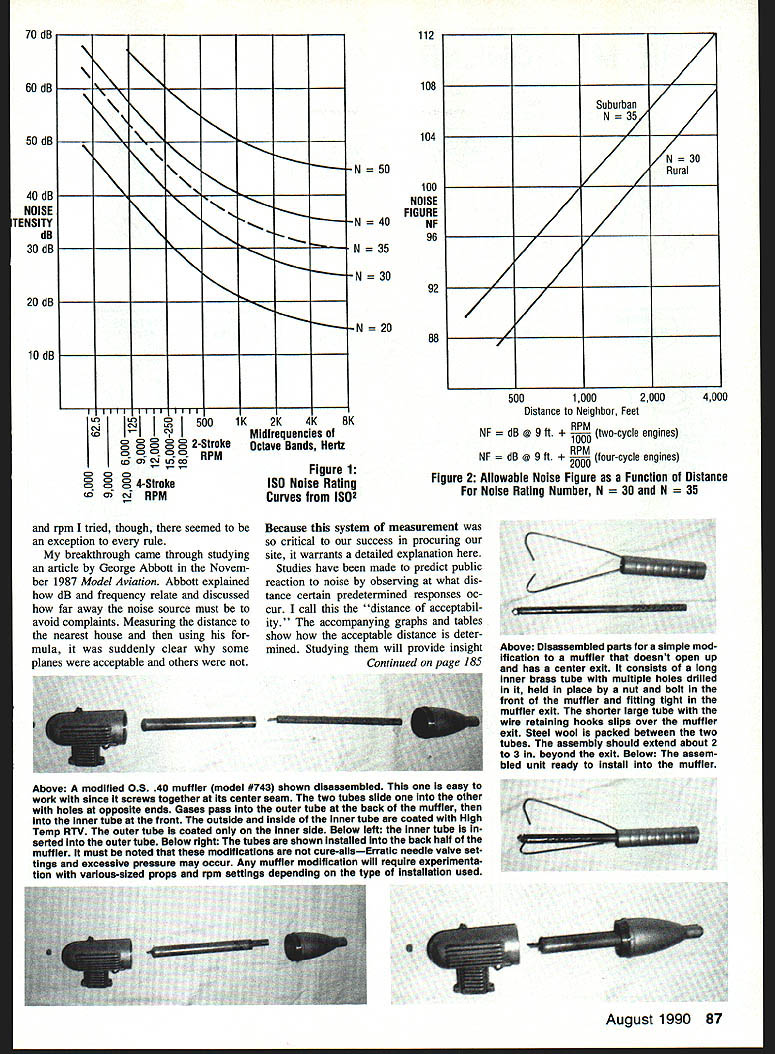
At the next council meeting, only two persons turned up to oppose us — the flat-earth proponent and one other persistent objector. That didn't hold much weight against the testimony of the councilwoman who had attended our demonstration, and the council voted to grant us a six-month probationary period.
Measuring noise: the "distance of acceptability"
The next phase was to determine how quiet we had to be and how far away to fly. To focus on our noise limits, we recorded noise levels for every plane flown during the probationary period. Some of us had been studying sound for about a year and knew that the dB meter left too many unanswered questions. For example, we couldn't understand why a four-stroke engine sounded quieter than a two-stroke, yet sometimes measured louder on the dB meter.
A breakthrough came from studying an article by George Abbott (Model Aviation, Nov. 1987). Abbott explained how dB and frequency relate and discussed how far away the noise source must be to avoid complaints. Measuring the distance to the nearest house and then using his formula made it clear why some planes were acceptable and others were not.
Studies have been made to predict public reaction to noise by observing at what distance certain predetermined responses occur. I call this the "distance of acceptability." Figure 1 (not shown here) presents curves that relate noise intensity and frequency to a noise rating number, N. From corresponding tables, one can estimate public reaction to various N numbers.
For example, if we desire no public reaction we select a corrected noise rating of less than 40 — say, 35. From the correction table we find an appropriate noise-rating correction factor to subtract from the measured noise rating. If the field is suburban rather than rural, different correction factors apply. The corrected N value is then used with the curves to determine allowable noise intensity at a given frequency.
Examples based on engine rpm (two-cycle fundamentals shown):
- A two-cycle engine speed of 12,000 rpm produces an exhaust fundamental frequency near 200 Hz. Following the N = 30 line to 200 Hz yields an allowable noise intensity of about 44 dB. If our airplane measures 90 dB at 9 ft., we need a reduction of 46 dB. According to the inverse-square law, this requires a distance ratio of about 200, so the neighbor must be roughly 9 ft. × 200 = 1,800 ft. away.
- At 18,000 rpm (fundamental ≈ 300 Hz), the allowable noise intensity might be about 38 dB. This requires a drop of 52 dB, translating to a distance ratio near 398 and a neighbor distance of roughly 9 × 398 = 3,600 ft.
- At 6,000 rpm, the distance of acceptability drops to about 90 ft.
Note: these calculations are based on flat "C" weighting (not "A" weighting), because the weighting is accounted for in the ISO curves.
It should be apparent that measuring sound power in dB alone is fundamentally inadequate for a noise-sensitive field. Considering frequency as well as dB — measuring sound in its totality — is a better, more realistic method. As rpm increases, the dB must be reduced to maintain the same acceptability distance; at lower rpm, the dB can be higher.
From the chart we calculated the effect of raising or lowering rpm by 6,000 while keeping the distance of acceptability constant: the resulting change was about 6 dB in each case. This implies that roughly 1,000 rpm is equivalent to 1 dB in terms of perceived annoyance. Therefore, if the field limit is 90 dB at 12,000 rpm, a pilot flying at 18,000 rpm must reduce to about 84 dB to be equivalent; if turning only 6,000 rpm, a pilot could fly at about 96 dB and produce the same perceived effect at the neighbor's property line.
To simplify calculations, you can add the dB and the rpm (in thousands) together and use the sum as a field limit. For instance, 90 dB and 12,000 rpm equals 102. Any dB and rpm combination adding to 102 or less would be acceptable by this criterion. This gives a club much better noise control and allows fliers to use the field without conforming to an unreasonable dB level.
This is especially important for low-frequency planes with large two- or four-stroke engines. Four-stroke engines have the advantage that their audio frequency is only half the rpm. Thus, when using the dB-plus-rpm method with four-strokes, calculate only one-half the measured rpm. This is why four-strokes often sound quieter than two-strokes even when their dB reading is higher.
Implementing limits and technical solutions
For the Gopher Canyon site, we set the noise limit (NF) at 96 using the combined metric:
- For two-stroke engines: NF = dB + (rpm / 1,000)
- For four-stroke engines: NF = dB + (rpm / 2,000)
This NF was determined by the proximity of a neighbor about 1,000 ft. from our overfly area in a rural setting.
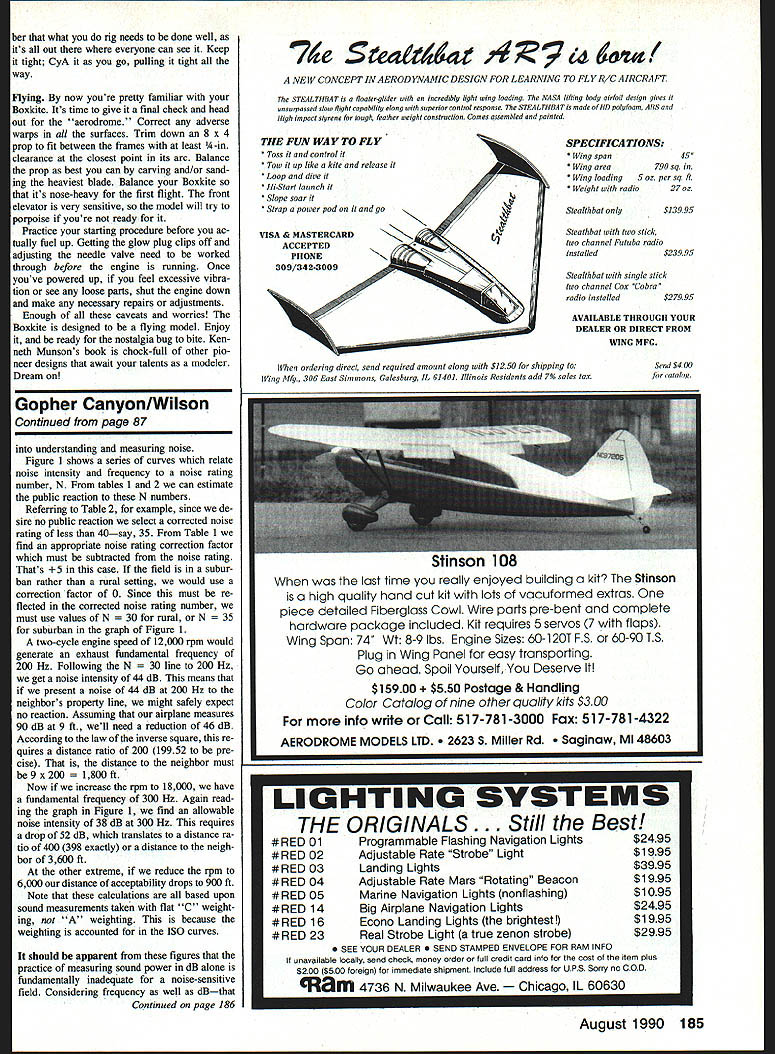
To meet that standard, our club set out to invent new mufflers. The response from members was terrific, with many varied designs. Dennis Caudle even wrote a computer program to assist in designing tuned mufflers. We found success using simple additional internal chambers, sound-absorbing coatings, and lowering rpm. To our surprise, we seem to be having more success with two-stroke engines than with four-strokers.
Outcome and ongoing testing
As of this writing, the city council has voted unanimously to give us full use of the field. Testing continues, and Gopher Canyon has become the headquarters for studying sound in San Diego County. Our latest experiments with a spectral analyzer have yielded interesting results.
Most clubs fly from sites more than 4,000 ft. from residential areas; for them, the AMA-recommended limit of 90 dB at 9 ft. is reasonable. However, as urbanization continues and residential growth closes in on more of our flying fields, accurate knowledge about the levels of noise we produce will be essential. Measuring total sound output, rather than merely dB levels, is a positive step in controlling noise before it causes the loss of a flying site.
References
- Ernest J. McCormick, Human Factors Engineering, 3rd ed. (New York: McGraw-Hill Book Co., 1970), pp. 525–528.
- ISO, Technical Committee 43, Acoustics, "Rating Noise with Respect to Hearing, Conversation, Speech Communication and Annoyance." Secretariat-189, August 1961.
- G. F. Abbott, "Flying Field Layout to Meet Noise Criteria," Model Aviation, Nov. 1987, pp. 24–35.
Editor: We are grateful to George F. Abbott for checking the manuscript for the Gopher Canyon article and offering several suggestions that were incorporated.
Transcribed from original scans by AI. Minor OCR errors may remain.

