
The Gossamer Albatross
By Frank G. Kelly
Most of you will recall that a team headed by Paul MacCready won the £50,000 Kremer Prize in August 1977 by flying a man-powered aircraft (MPA) over a figure-8 course. For 20 years people all over the world had tried and failed, but the Gossamer Condor made it. British industrialist Henry Kremer told MacCready at the award ceremony, "I have never in my life had so much fun with my money!" He reflected on this later, and created a new competition for MPAs: £100,000 for the first to cross the 22-mile English Channel. This is the largest award of its kind in history, and clearly a monumental challenge. Like the earlier prize, the rules are simple. A qualifying flight of 400 meters in a straight line is required. Then takeoff in England from not over 60 meters altitude, and land in France. Pilot flotation gear is also required. Kremer, now in his mid-60s but much younger in appearance and spirit, expected this goal to be achieved within five years. It may, in fact, have occurred before this article was printed.
The MacCready team set to work and ultimately designed and built "Son of Gossamer Condor," commonly called the Gossamer Albatross.
Background
By the time this article was prepared, the Albatross should have made its attempt to cross the English Channel—and perhaps it succeeded before this appeared in print. In any case, this detailed look at its design and fabrication should be of interest.
"Son of Condor" is stronger, lighter, has a higher-aspect-ratio main wing, and is more readily repairable and transportable. This last feature is important. When the time came to send the Gossamer Condor to the Smithsonian National Air and Space Museum (where it now resides wing tip to wing tip with the Spirit of St. Louis), the team was forced to use a hacksaw to subdivide the wing into pieces that would fit in a van. They reconstructed it in the museum with their usual splices of tape and hose clamps.
Team
The team is mainly the same group as before. Contributors included:
- Paul MacCready (team lead)
- MacCready's sons, Parker and Tyler
- Taras Kiceniuk, noted hang-glider designer
- Kirke Leonard (plastic layup)
- Bill Watson
- Bryan Allen (pilot)
- Paul McKibben, who directed ergometric studies
Materials and Structure
The Gossamer Albatross is basically similar in appearance to the Gossamer Condor but includes many technical refinements, notably graphite fiber reinforced plastic (GFRP) instead of aluminum in most places. GFRP is a modern material that can be made twice as strong and half as heavy as aluminum (and about 20 times as expensive).
The main wing, canard, and propeller all have D-tube construction with polystyrene foam beadboard leading edges. The main wing and canard have 2-inch-diameter round GFRP spars; the propeller has a similar 1-inch spar. These are made by wrapping delicate graphite cloth pre-impregnated with epoxy around an aluminum mandrel. After high-temperature curing, the aluminum is dissolved out. The main wing and canard have 0.022-inch-diameter stainless steel wires for trailing edges, and all covering is attached using what might be called double-sided pressure-sensitive tape—except this tape consists only of a single adhesive layer, without the usual paper substrate.
The main wing, canard, and nacelle skins are a sandwich of Mylar, foam, and Mylar. The foam is extruded polystyrene, 1/4 inch thick (Dow Styrofoam). The skins are laminated with 1/2 oz. fiberglass and epoxy. The nacelle is built up in sections and joined with overlapping tape splices. The pilot's seat is adjustable and the pedals are mounted to a removable plate so the aircraft can be used by pilots of different heights. The pilot lies in a recumbent position and pedals a large 9 ft 6 in diameter propeller made of carbon fiber and foam core.
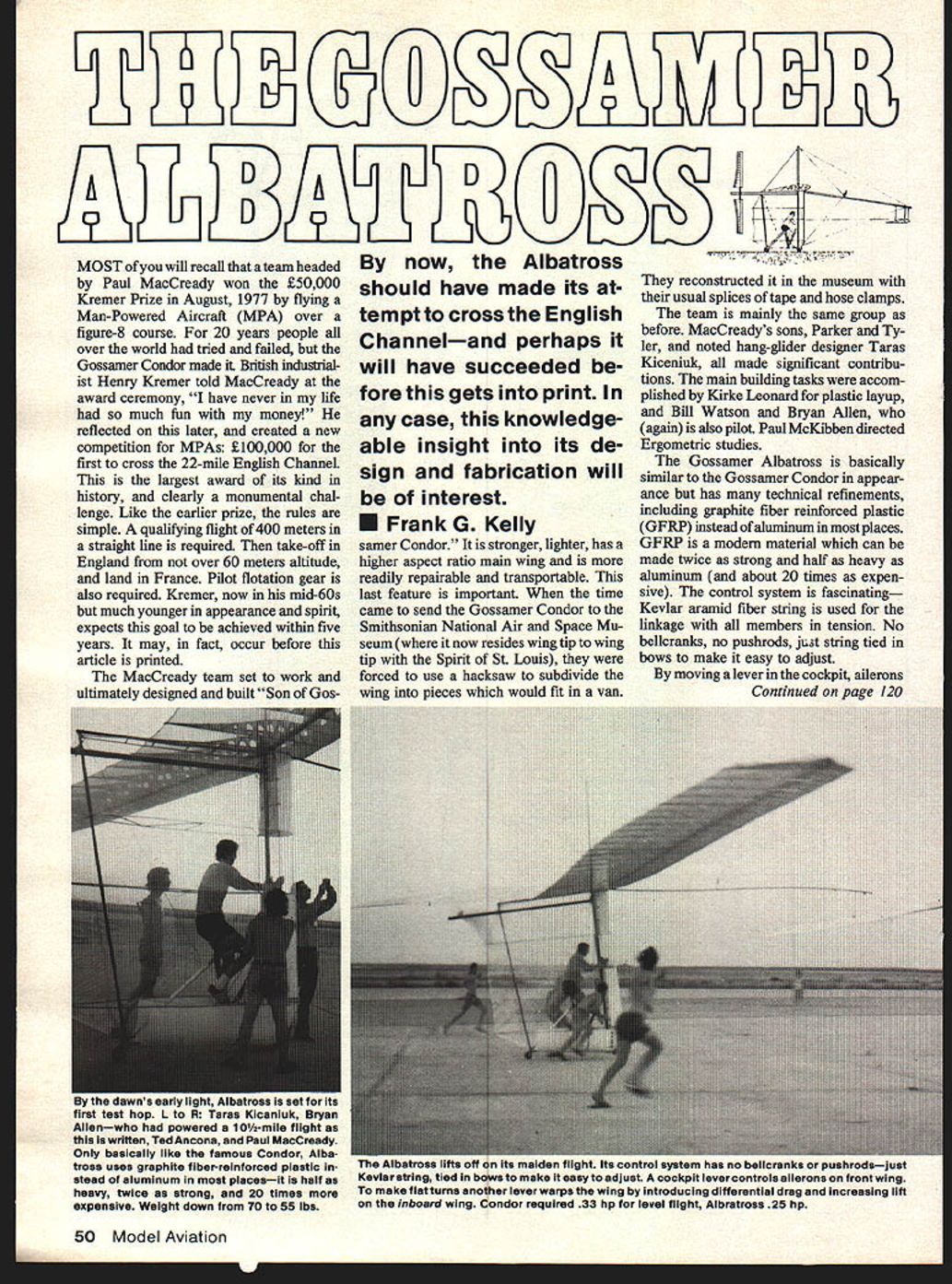
The overall empty weight was reduced from 70 to 55 lb, and the power required to maintain level flight was reduced by a third, from 0.33 to 0.25 hp. These improvements did not come easily. The new aircraft has more ribs to provide a better airfoil contour, but many smaller changes—like using Kevlar in place of piano wire for the control system and a new urethane material to replace the conventional bicycle chain—produced incremental weight reductions that together totaled about 15 lb. The total weight of the thousand or so lightening holes in the foam ribs was only 5 oz.
Controls and Systems
The control system is fascinating—Kevlar aramid fiber string is used for the linkage with all members in tension. There are no bellcranks, no pushrods; just string tied in bows to make adjustments easy. By moving a lever in the cockpit, ailerons on the canard (front wing) are controlled. This causes the canard to roll independently of the rest of the airframe. Canard pitch control is more straightforward: it is a full-flying control surface. Another lever warps the main wing to make flat turns by introducing differential drag and increased lift on the inboard wing.
The propeller drive arrangement initially used a GFRP drive shaft, which later proved vulnerable to torsional failure and was temporarily replaced with an aluminum shaft; the present version reverts to a GFRP drive shaft after subsequent work.
The main wing upper surface is covered with clear half-mil Mylar; the underside has quarter-mil material. By way of comparison, MonoKote is two mils thick.
Propeller
Any modeler can relate to the propeller of the Gossamer Albatross. It resembles an RC sailplane wing. Each blade has a constant chord with 16 balsa ribs. The constant chord adds inertia to assist the pilot on the two-hour run. The total span is 13 feet and an obvious twist is intentional. Bill Watson described the pitch as 15 degrees, which works out to about 7 feet. One blade is covered in yellow MonoKote; the other is yellow. In flight, the propeller turns about 90 rpm.
Originally the team planned to call the aircraft the Gossamer Pelican, but changed it to Albatross because the condor is the land bird with the greatest wingspan, while the albatross is the sea bird with the greatest wingspan. The term "Gossamer Pelican" is now reserved for a projected sport model for home builders; MacCready planned to have plans available soon.
Flight Trials
One evening in July 1978 at tiny Shafter Airport near Bakersfield, the sun was below the horizon but it was not yet dark. The Gossamer Albatross was ready for its maiden flight and there was barely a whisper of wind. The great hangar doors opened wide and the craft was brought out. A tube protrudes from the sides to aid in handling. There are two tiny wheels like casters, but the craft was placed on a small wagon for the short trip to the runway. The bowsprit and wingtips were controlled by various individuals using ropes to avoid bumping or ground looping the awkward monster.
Out on the runway all was readied. Bryan Allen, the pilot, mounted the bicycle seat and was immediately sealed in with quarter-mil Mylar held on by double-back tape and shrunk in place. There was no door. Bryan fired up the "engine" by pedaling. The Gossamer Albatross moved forward and promptly left the ground. It went about 100 meters on its first flight, not more than half a meter off the ground. No control problems were evident, but at the end of the run it was noted that the wing-warp lever bracket had broken. Paul passed a roll of duct tape to Bryan, who repaired the fitting. The craft was carried farther back for a longer run and this time Bryan went a good 300 meters. He flew at about 3 meters altitude and had no trouble making some gentle turns to feel out the newly hatched fledgling. It landed successfully and the happy crew parked the craft in the hangar and went out to dinner.
The following morning the Gossamer Albatross was rolled out with the sun. Again there was almost no wind, but what little there was came from the other direction. By this time, a Velcro closure was evident around the door that had been created to let Bryan out the night before. The craft was carried down to where it had landed previously, and everything was readied. Bryan applied more power to make an even better flight, and suddenly he pitched forward in the cockpit and the spinning propeller wobbled slowly to a halt. The GFRP drive shaft had broken in the classical failure mode of a tubular member under excessive torsional stress. After a brief discussion they decided to pull off the propeller and make a hand-launched Gossamer Glider. Two assistants ran along beside it with the handles while Bryan flew back to the hangar. Paul assessed the situation and resolved to replace the drive shaft with aluminum. He did temporarily, but the present version has a GFRP drive shaft.
Preparations for the Channel
Much additional work has been done since those flights. A complete set of spare parts has been built—enough to build an entire second aircraft. Bryan has continued his physical training designed to peak with the first suitable weather break over the English Channel. Plans for a suitable hangar near Dover were abandoned, since the team can now set up in five minutes. They planned to move to England in April.
I'm looking forward to the big attempt. I think they'll make it!
Transcribed from original scans by AI. Minor OCR errors may remain.

