
Gossamer Condor
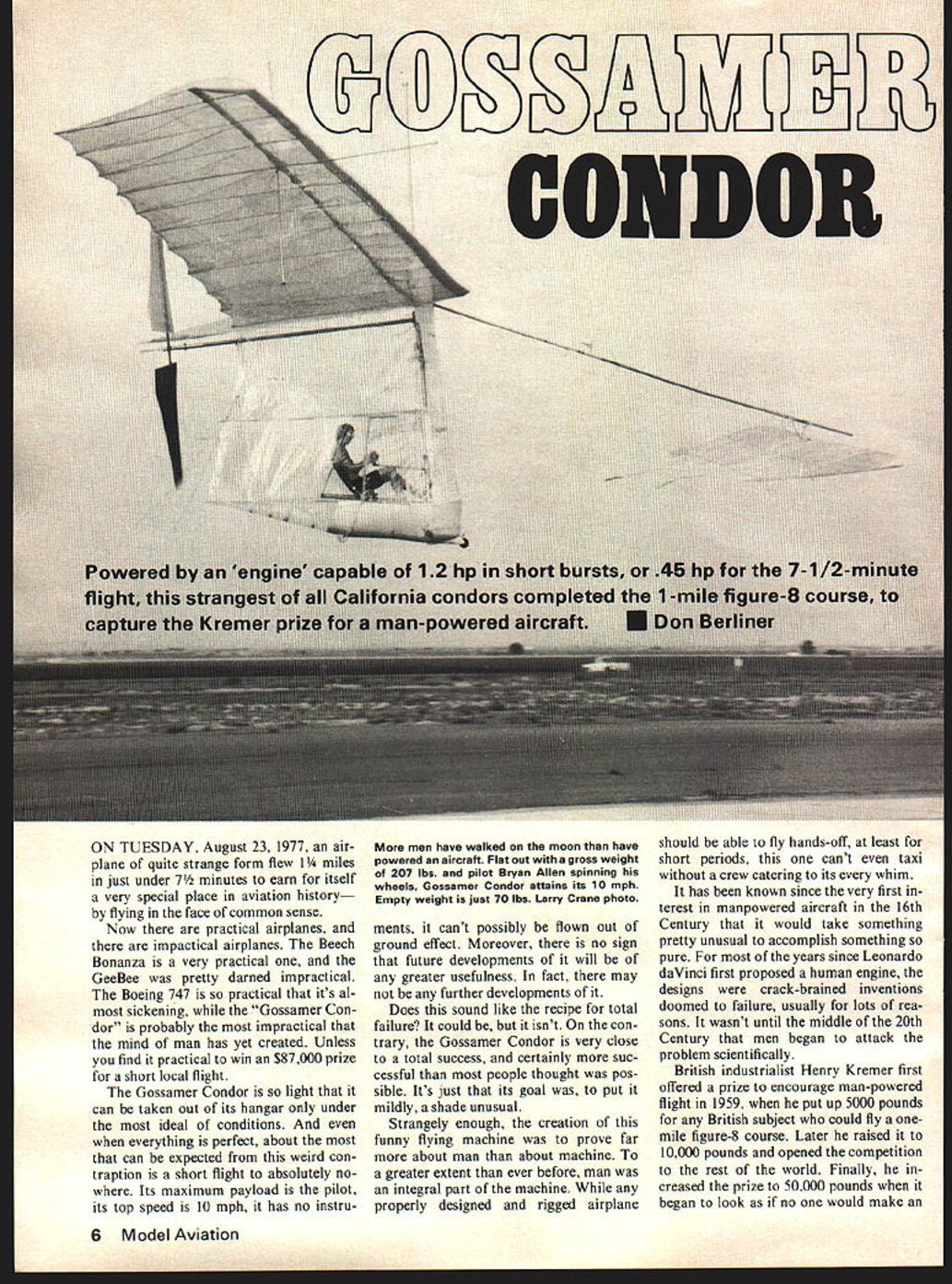
ON TUESDAY, August 23, 1977, an airplane of quite strange form flew 1 1/4 miles in just under 7 1/2 minutes to earn for itself a very special place in aviation history—by flying in the face of common sense.
Now there are practical airplanes, and there are impractical airplanes. The Beech Bonanza is a very practical one, and the GeeBee was pretty darned impractical. The Boeing 747 is so practical that it's almost sickening, while the "Gossamer Condor" is probably the most impractical thing the mind of man has yet created. Unless you find it practical to win an $87,000 prize for a short local flight.
The Gossamer Condor is so light that it can be taken out of its hangar only under the most ideal of conditions. And even when everything is perfect, about the most that can be expected from this weird contraption is a short flight to absolutely nowhere. Its maximum payload is the pilot; its top speed is 10 mph, it has no instruments, it can't possibly be flown out of ground effect. Moreover, there is no sign that future developments of it will be of any greater usefulness. In fact, there may not be any further developments of it.
Does this sound like the recipe for total failure? It could be, but it isn't. On the contrary, the Gossamer Condor is very close to a total success, and certainly more successful than most people thought was possible. It's just that its goal was, to put it mildly, a shade unusual.
Strangely enough, the creation of this funny flying machine was to prove far more about man than about machine. To a greater extent than ever before, man was an integral part of the machine. While any properly designed and rigged airplane should be able to fly hands-off, at least for short periods, this one can't even taxi without a crew catering to its every whim.
It has been known since the very first interest in man-powered aircraft in the 16th Century that it would take something pretty unusual to accomplish something so pure. For most of the years since Leonardo da Vinci first proposed a human engine, the designs were crack-brained inventions doomed to failure, usually for lots of reasons. It wasn't until the middle of the 20th Century that men began to attack the problem scientifically.
British industrialist Henry Kremer first offered a prize to encourage man-powered flight in 1959, when he put up 5,000 pounds for any British subject who could fly a one-mile figure-8 course. Later he raised it to 10,000 pounds and opened the competition to the rest of the world. Finally, he increased the prize to 50,000 pounds when it began to look as if no one would make an attempt. Through it all, the Royal Aeronautical Society has held the money, issued the rules, and passed judgment on any attempts.
The end result of tens of thousands of hours of very clever effort by a lot of terribly talented people is the Gossamer Condor, which bears little similarity to anything that went before it. From stem to stern, it is radically different. Every dimension and shape forces the traditional aviator to shake his head in puzzlement.
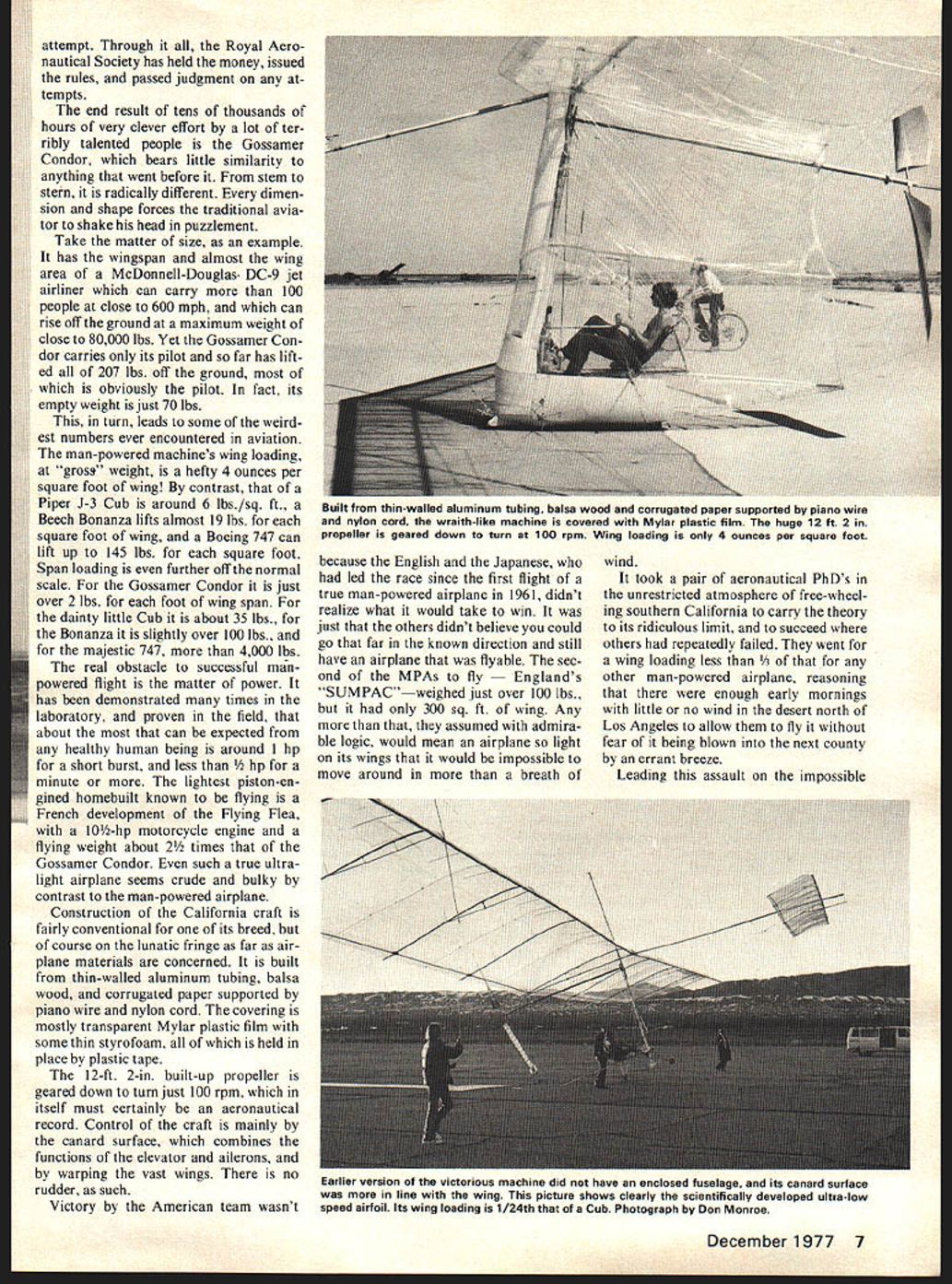
Take the matter of size, as an example. It has the wingspan and almost the wing area of a McDonnell-Douglas DC-9 jet airliner which can carry more than 100 people at close to 600 mph, and which can rise off the ground at a maximum weight of close to 80,000 lbs. Yet the Gossamer Condor carries only its pilot and so far has lifted all of 207 lbs. off the ground, most of which is obviously the pilot. In fact, its empty weight is just 70 lbs.
This, in turn, leads to some of the weirdest numbers ever encountered in aviation. The man-powered machine's wing loading, at "gross" weight, is a hefty 4 ounces per square foot of wing! By contrast, that of a Piper J-3 Cub is around 6 lbs./sq. ft., a Beech Bonanza lifts almost 19 lbs. for each square foot of wing, and a Boeing 747 can lift up to 145 lbs. for each square foot. Span loading is even further off the normal scale. For the Gossamer Condor it is just over 2 lbs. for each foot of wing span. For the dainty little Cub it is about 35 lbs., for the Bonanza it is slightly over 100 lbs., and for the majestic 747, more than 4,000 lbs.
The real obstacle to successful man-powered flight is the matter of power. It has been demonstrated many times in the laboratory, and proven in the field, that about the most that can be expected from any healthy human being is around 1 hp for a short burst, and less than 1/2 hp for a minute or more. The lightest piston-engined homebuilt known to be flying is a French development of the Flying Flea, with a 10-1/2 hp motorcycle engine and a flying weight about 2-1/2 times that of the Gossamer Condor. Even such a true ultralight airplane seems crude and bulky by contrast to the man-powered airplane.
Construction of the California craft is fairly conventional for one of its breed, but of course on the lunatic fringe as far as airplane materials are concerned. It is built from thin-walled aluminum tubing, balsa wood, and corrugated paper supported by piano wire and nylon cord. The covering is mostly transparent Mylar plastic film with some thin styrofoam, all of which is held in place by plastic tape.
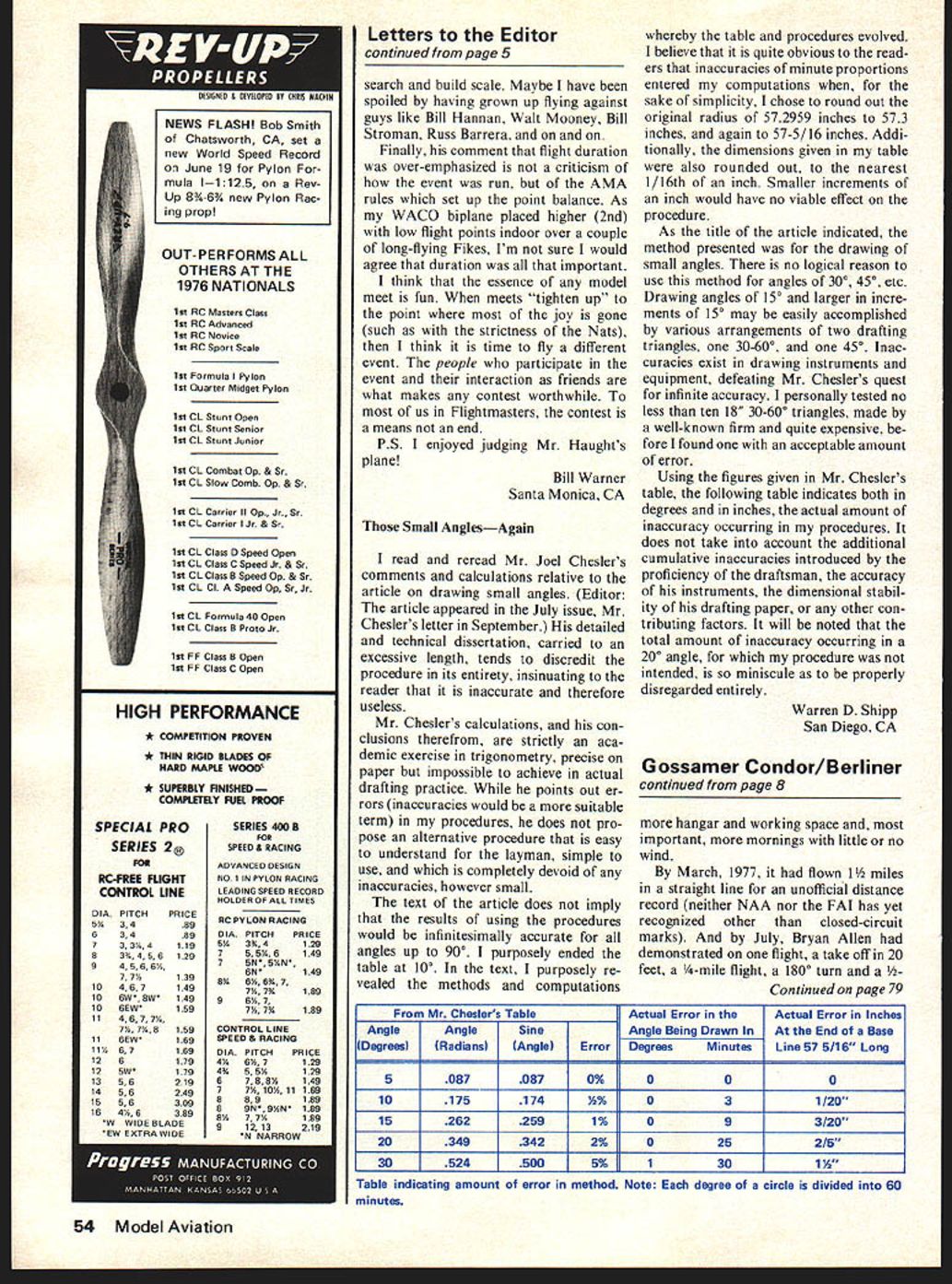
The 12-ft. 2-in. built-up propeller is geared down to turn just 100 rpm, which in itself must certainly be an aeronautical record. Control of the craft is mainly by the canard surface, which combines the functions of the elevator and ailerons, and by warping the vast wings. There is no rudder, as such.
Victory by the American team wasn't because the English and the Japanese, who had led the race since the first flight of a true man-powered airplane in 1961, didn't realize what it would take to win. It was just that the others didn't believe you could go that far in the known direction and still have an airplane that was flyable. The second of the MPAs to fly — England's "SUMPAC" — weighed just over 100 lbs., but it had only 300 sq. ft. of wing. Any more than that, they assumed with admirable logic, would mean an airplane so light on its wings that it would be impossible to move around in more than a breath of wind.
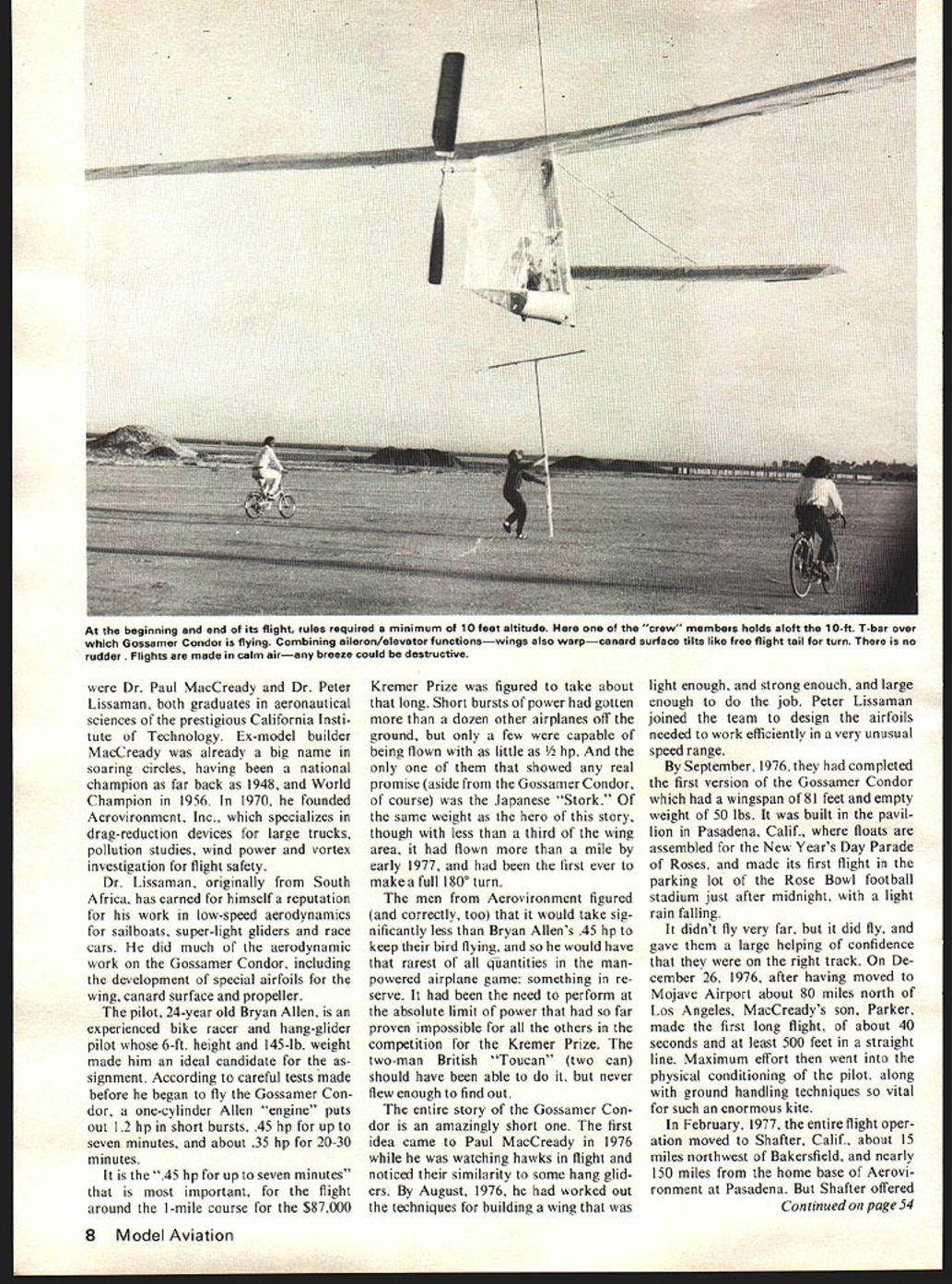
It took a pair of aeronautical PhD's in the unrestricted atmosphere of free-wheeling southern California to carry the theory to its ridiculous limit, and to succeed where others had repeatedly failed. They went forth with a wing loading less than 1/5 of that for any other man-powered airplane, reasoning that there were enough early mornings with little or no wind in the desert north of Los Angeles to allow them to fly it without fear of it being blown into the next county by an errant breeze.
Leading this assault on the impossible were Dr. Paul MacCready and Dr. Peter Lissaman, both graduates in aeronautical sciences of the prestigious California Institute of Technology. Ex-model builder MacCready was already a big name in soaring circles, having been a national champion as far back as 1948, and World Champion in 1956. In 1970, he founded Acroenvironment, Inc., which specializes in drag-reduction devices for large trucks, pollution studies, wind power and vortex investigation for flight safety.
Dr. Lissaman, originally from South Africa, has earned for himself a reputation for his work in low-speed aerodynamics for sailboats, super-light gliders and race cars. He did much of the aerodynamic work on the Gossamer Condor, including the development of special airfoils for the wing, canard surface and propeller.
The pilot, 24-year-old Bryan Allen, is an experienced bike racer and hang-glider pilot whose 6-ft. height and 145-lb. weight made him an ideal candidate for the assignment. According to careful tests made before he began to fly the Gossamer Condor, a one-cylinder Allen "engine" puts out 1.2 hp in short bursts, .45 hp for up to seven minutes, and about .35 hp for 20-30 minutes.
It is the ".45 hp for up to seven minutes" that is most important, for the flight around the 1-mile course for the $87,000 Kremer Prize was figured to take about that long. Short bursts of power had gotten more than a dozen other airplanes off the ground, but only a few were capable of being flown with as little as 1/2 hp. And the only one of them that showed any real promise (aside from the Gossamer Condor, of course) was the Japanese "Stork." Of the same weight as the hero of this story, though with less than a third of the wing area, it had flown more than a mile by early 1977, and had been the first ever to make a full 180° turn.
The men from Acroenvironment figured (and correctly, too) that it would take significantly less than Bryan Allen's .45 hp to keep their bird flying, and so he would have that rarest of all quantities in the manpowered airplane game: something in reserve. It had been the need to perform at the absolute limit of power that had so far proven impossible for all the others in the competition for the Kremer Prize. The two-man British "Toucan" (two can) should have been able to do it, but never flew enough to find out.
The entire story of the Gossamer Condor is an amazingly short one. The first idea came to Paul MacCready in 1976 while he was watching hawks in flight and noticed their similarity to some hang gliders. By August, 1976, he had worked out the techniques for building a wing that was light enough, and strong enough, and large enough to do the job. Peter Lissaman joined the team to design the airfoils needed to work efficiently in a very unusual speed range.
By September, 1976, they had completed the first version of the Gossamer Condor which had a wingspan of 81 feet and empty weight of 50 lbs. It was built in the pavilion in Pasadena, Calif., where floats are assembled for the New Year's Day Parade of Roses, and made its first flight in the parking lot of the Rose Bowl football stadium just after midnight, with a light rain falling.
It didn't fly very far, but it did fly, and gave them a large helping of confidence that they were on the right track. On December 26, 1976, after having moved to Mojave Airport about 80 miles north of Los Angeles, MacCready's son, Parker, made the first long flight, of about 40 seconds and at least 500 feet in a straight line. Maximum effort then went into the physical conditioning of the pilot, along with ground handling techniques so vital for such an enormous kite.
In February, 1977, the entire flight operation moved to Shafter, Calif., about 15 miles northwest of Bakersfield, and nearly 150 miles from the home base of Acroenvironment at Pasadena. But Shafter offered
Gossamer Condor
more hangar and working space and, most important, more mornings with little or no wind.
By March, 1977, it had flown 1½ miles in a straight line for an unofficial distance record (neither NAA nor the FAI has yet recognized other than closed-circuit marks). And by July, Bryan Allen had demonstrated on one flight, a take off in 20 feet, a ¼-mile flight, a 180° turn and a ½- mile flight back. Soon, he had more flying time in man-powered airplanes than anyone else in the world, and was able to fly it in mild turbulence despite the slow reacting controls. In late July, he got 5/6 of the way around the Kremer Prize course, and it looked like the great goal was truly in sight.
Then, in the wee hours of August 23, 1977, with a dead calm blowing across Shafter Airport in the San Joaquin Valley, final preparations began. Men were sent out to the two turning points, just over a half mile apart. Another went out to the start/finish line to hold up a 10-ft. T-bar over which Bryan would have to fly at the beginning and end of the journey to meet the requirements of the Royal Aeronautical Society. A truck carrying the official observer, a movie cameraman and others sat poised along the runway, just behind the Gossamer Condor.
At 7:30 a.m., PDT, everything was ready and Bryan Allen began pedalling for all he was worth. The fragile craft quickly lifted off and headed away so slowly that a man could easily run beside it. Over the 10-ft. marker at the starting line, then down the field to the first turning point which was rounded with maybe 50 feet to spare. Back to the second turning point which was negotiated with just as much room and as little effort. And finally over the T-bar at the finish to an easy landing.
In 7 minutes and 22½ seconds, man had reached a goal toward which he had been striving intensely for over 15 years. More than that, he had flown under complete control and for an extended period of time with nothing but his own power for the very first time in recorded history. It was a dream come true not only for the small group of totally dedicated people who imagined, created and perfected the Gossamer Condor, but for others as well.
For those who still see the skies as a frontier to be conquered. For those who still see opportunities for clever individuals to tackle a big challenge on their own. And for those who refuse to believe that anything is impossible.
Transcribed from original scans by AI. Minor OCR errors may remain.

