
The Great Frontier Jet Shootout
Dan Bott
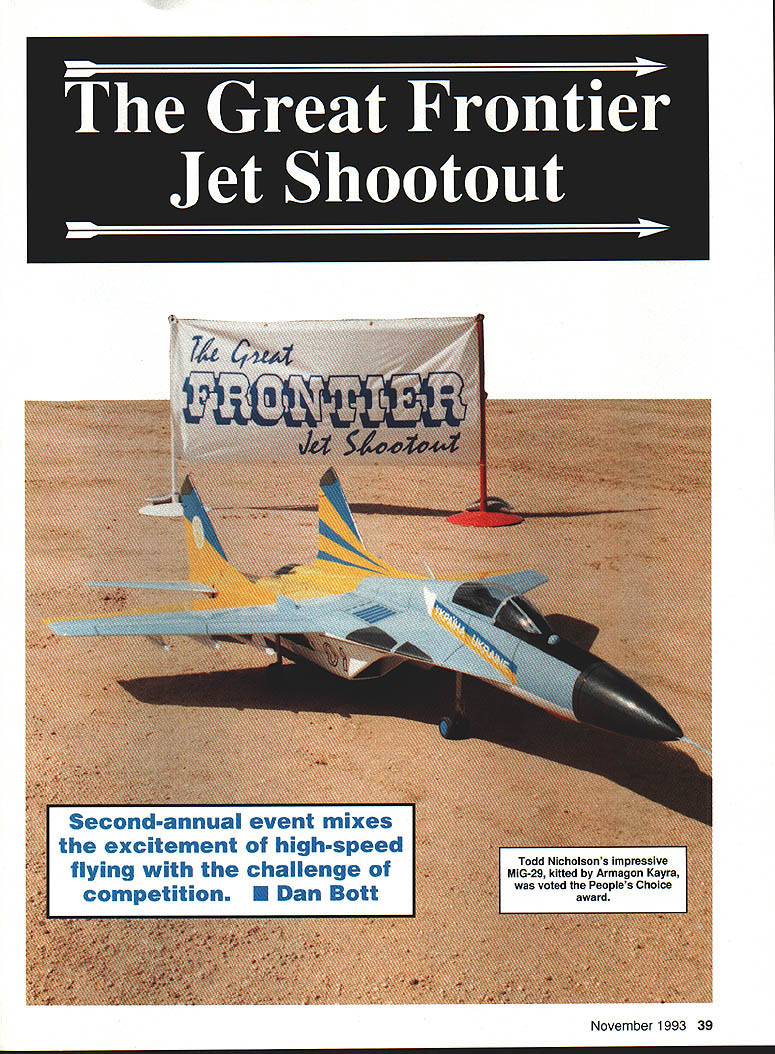
Second-annual event mixes the excitement of high-speed flying with the challenge of competition.
For those who have the need for speed, RC jets have become a logical way to satisfy that need. The Great Frontier Jet Shootout was created for pilots who not only love the excitement of high-speed jet flying, but also find the challenge of competition rewarding.
Until now the element of competition was available only to Scale competitors and select merit awards at fun-flys. Now the Great Frontier Jet Shootout in Phoenix, Arizona, is carving out its place in model aviation as the place to set the performance records.
The Shootout, held in late February, is hosted by the Sun Valley Flyers at its 200-acre flying site that has a 700-foot paved runway. In February, the clear, brisk desert air is perfect. Even southern California's heavy rains couldn't dampen this event. The forecast called for heavy rains, but they went north, as usual.
The Jet Enthusiast Timing Association (JETA) was created by a handful of RC pilots to develop a set of rules that would cover all RC jets—large and small, fast and slow, fuel and electric, ducted fan and turbine, Scale and sport.
In 1992, JETA tried to match plane and pilots by engine, fan, and type of plane. It was close, but no cigar. However, they took a page from the bracket-racing rules of drag racing and created dial-in speed brackets. Success! Without exception, every pilot loved the concept, and it looks like jet competition is here to stay.
Dial-in speed brackets
The objective of dial-in is for a contestant to achieve a speed closer to his dial-in score than his opponents are to theirs. Pilots and their planes are grouped into speed categories. The resulting benefit is that pilots compete against their own dial-in speed; thus they are competing against themselves.
For example, suppose there were two Byron F-16s with the same size engine, but one had more scale equipment and flew 120 mph, while the other flew 130 mph. Not only would those planes not have to compete with each other, they would also run in separate brackets.
One pilot may want to dive his plane for maximum performance, and another may want to fly a racetrack pattern. Since each pilot will dial in his own speed, to dive or not to dive is the pilot's choice.
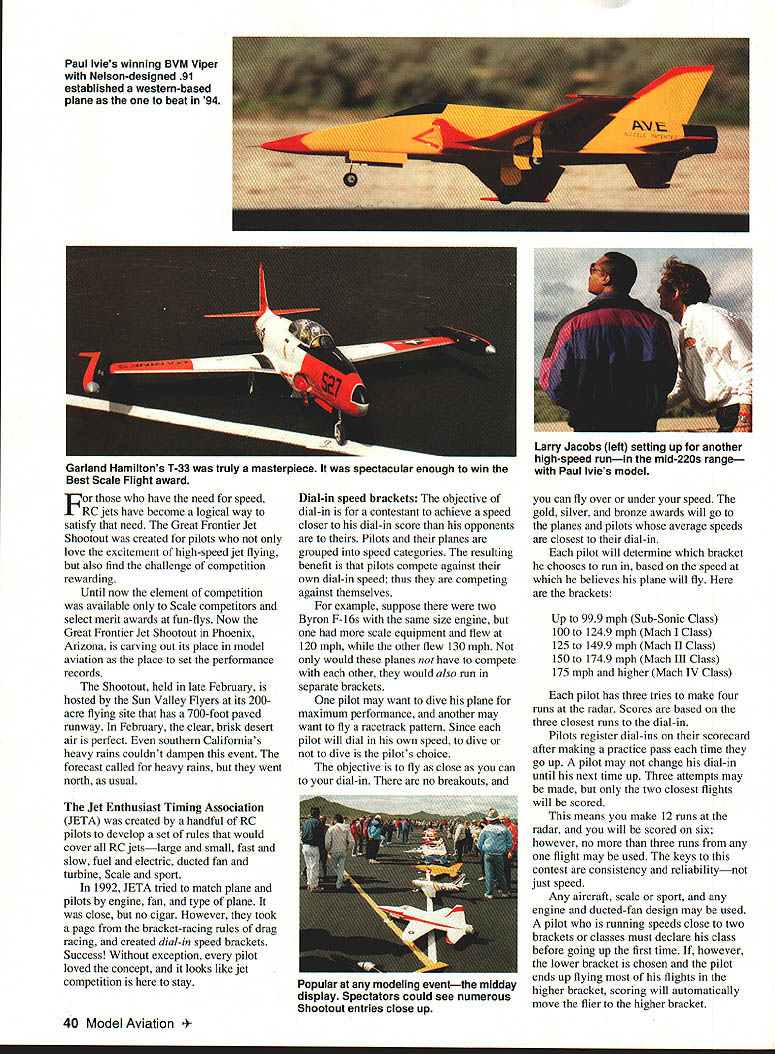
The objective is to fly as close as you can to your dial-in. There are no breakouts, and you can fly over or under your speed. The gold, silver, and bronze awards will go to the planes and pilots whose average speeds are closest to their dial-in.
Each pilot will determine which bracket he chooses to run in, based on the speed at which he believes his plane will fly. Here are the brackets:
- Up to 99.9 mph (Sub-Sonic Class)
- 100 to 124.9 mph (Mach I Class)
- 125 to 149.9 mph (Mach II Class)
- 150 to 174.9 mph (Mach III Class)
- 175 mph and higher (Mach IV Class)
Each pilot has three attempts (times up) and, on each attempt, may make four runs at the radar. For each attempt the slowest of the four runs is discarded and the remaining three runs are used to determine that attempt's average relative to the dial-in. Pilots register dial-ins on their scorecard after making a practice pass each time they go up. A pilot may not change his dial-in until his next time up.
Of the three attempts, the two attempts closest to the dial-in are used for final scoring. In total you may make 12 runs at the radar, and you will be scored on six; however, no more than three runs from any one attempt may be used. The keys to the contest are consistency and reliability—not just speed.
Any aircraft, scale or sport, and any engine and ducted-fan design may be used. A pilot who is running speeds close to two brackets or classes must declare his class before going up the first time. If, however, the lower bracket is chosen and the pilot ends up flying most of his flights in the higher bracket, scoring will automatically move the flier to the higher bracket.
JETA Unlimited Afterburner Class
This class was "run what you brung" — go-for-broke, any engine, any fan, any plane (as long as it met AMA rules), heads-up speed competition. It was not a dial-in; it was for who had the fastest plane, and who could make the necessary radar runs to get the highest average speed.
A contestant took his model up three times over Saturday and Sunday. Each time up he was allowed to make four runs at the radar. Scoring threw out the slowest pass; the remaining three passes were averaged.
Scoring then took the two highest average speeds of the three allowed attempts and averaged them for the best Unlimited Afterburner trophy of gold, silver, or bronze.
JETA Ballistic Award
This award went to a competitor from either the Mach IV or the Unlimited Class who had the best overall top speed, backed up with a second run within 1%.
In 1993, Paul Ivie, with Larry Jacobs at the sticks, took the Ballistic Award at 226.5 mph. See awards listing for other class winners.
Three-Minute Freestyle
This center-stage show was the first and only opportunity for accomplished jet pilots to dazzle the spectators. The event ran on Saturday only, from 1 p.m. to 2 p.m., right after the midday static display. Each pilot had three minutes to perform to the music of his choice.
Gold, silver, and bronze awards were given. Judging was based on originality, choreography, and showmanship. The judging was performed by experienced RC pilots with input from the spectators.
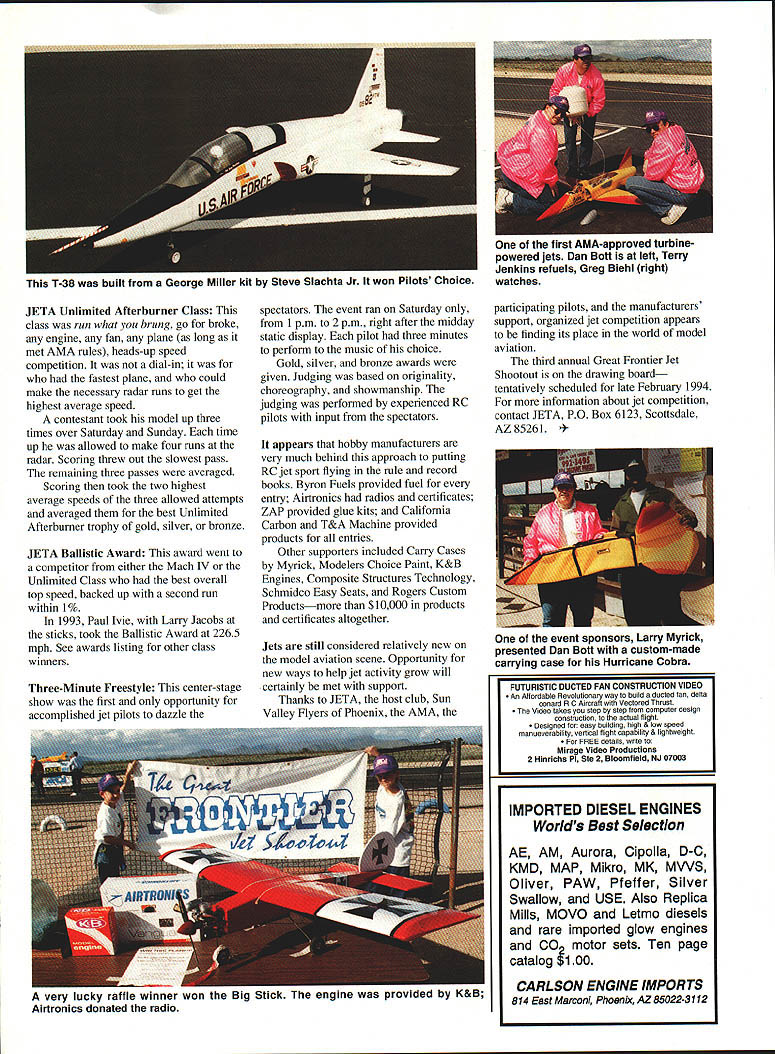
It appears that hobby manufacturers are very much behind this approach to putting RC jet sport flying in the rule and record books. Sponsors and contributors included:
- Byron Fuels (provided fuel for every entry)
- Airtronics (radios and certificates)
- ZAP (glue kits)
- California Carbon
- T & A Machine
- Carry Cases by Myrick
- Modelers Choice Paint
- K&B Engines
- Composite Structures Technology
- Schmidco Easy Seats
- Rogers Custom Products
Together these sponsors provided more than $10,000 in products and certificates.
Jets are still considered relatively new on the model aviation scene. Opportunity for new ways to help jet activity grow will certainly be met with support.
Thanks to JETA, the host club Sun Valley Flyers of Phoenix, the AMA, the participating pilots, and the manufacturers' support, organized jet competition appears to be finding its place in the world of model aviation.
The third annual Great Frontier Jet Shootout is on the drawing board—tentatively scheduled for late February 1994. For more information about jet competition, contact JETA, P.O. Box 6123, Scottsdale, AZ 85261.
Transcribed from original scans by AI. Minor OCR errors may remain.

