
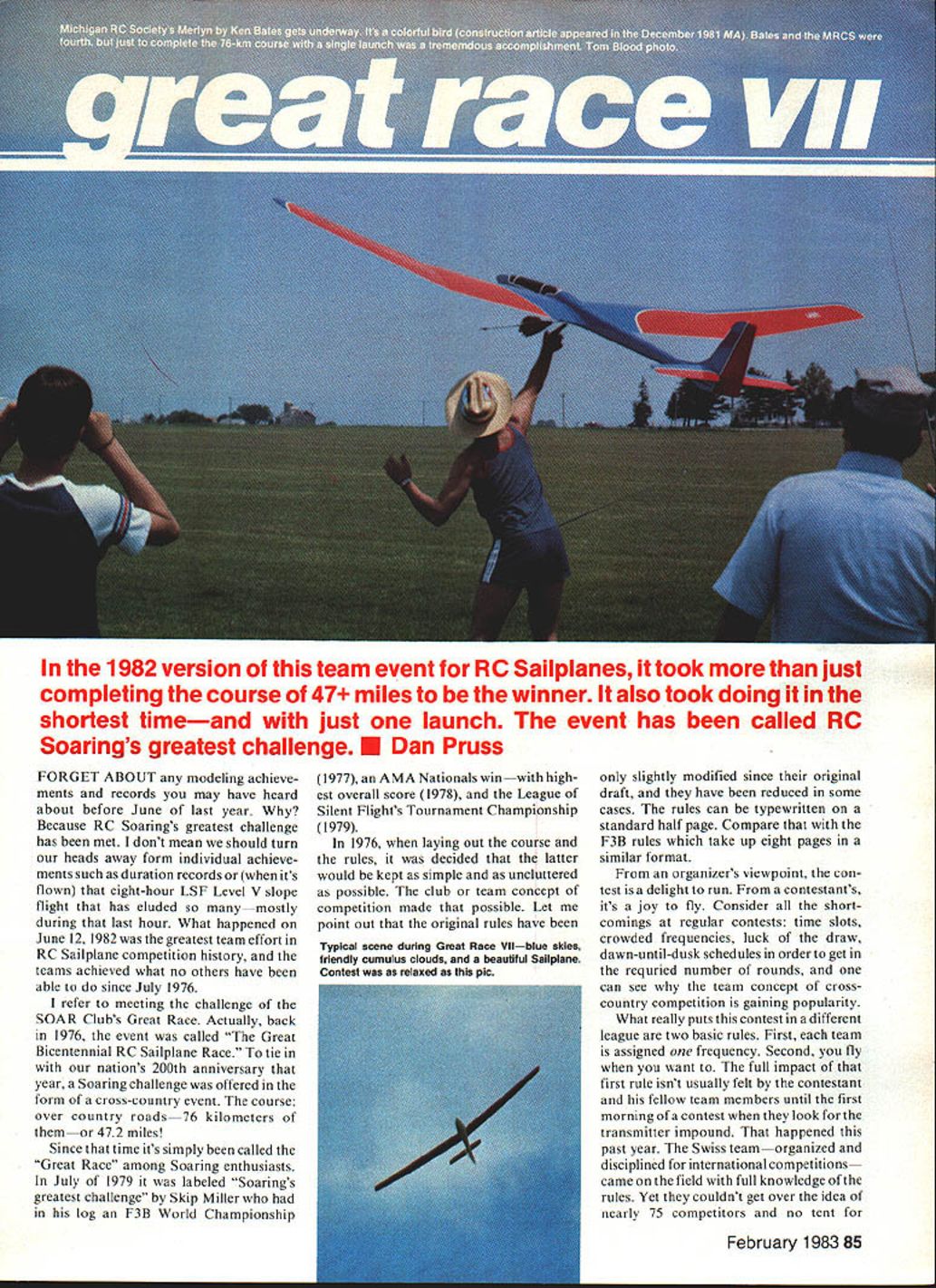
Great Race VII
In the 1982 version of this team event for RC sailplanes, it took more than just completing the course of 47+ miles to be the winner. It also took doing it in the shortest time—and with just one launch. The event has been called RC soaring's greatest challenge. — Dan Pruss
Forget about any modeling achievements and records you may have heard about before June of last year. Why? Because RC soaring's greatest challenge was met. I don't mean we should turn our heads away from individual achievements such as duration records or (when it's flown) that eight-hour LSF Level V slope flight that has eluded so many—mostly during that last hour. What happened on June 12, 1982 was the greatest team effort in RC sailplane competition history, and the teams achieved what no others had been able to do since July 1976.
I refer to meeting the challenge of the SOAR Club's Great Race. Actually, back in 1976 the event was called "The Great Bicentennial RC Sailplane Race." To tie in with our nation's 200th anniversary that year, a soaring challenge was offered in the form of a cross-country event. The course: over country roads—76 kilometers of them—or 47.2 miles!
Since that time it's simply been called the "Great Race" among soaring enthusiasts. In July of 1979 it was labeled "soaring's greatest challenge" by Skip Miller, who had in his log an F3B World Championship (1977), an AMA Nationals win—with highest overall score (1978), and the League of Silent Flight's Tournament Championship (1979).
In 1976, when laying out the course and the rules, it was decided that the latter would be kept as simple and as uncluttered as possible. The club-or-team concept of competition made that possible. The original rules have been only slightly modified since their original draft, and they have been reduced in some cases. The rules can be typewritten on a standard half page. Compare that with the F3B rules which take up eight pages in a similar format.
From an organizer's viewpoint, the contest is a delight to run. From a contestant's, it's a joy to fly. Consider all the shortcomings at regular contests: time slots, crowded frequencies, luck of the draw, dawn-until-dusk schedules in order to get in the required number of rounds, and one can see why the team concept of cross-country competition is gaining popularity.
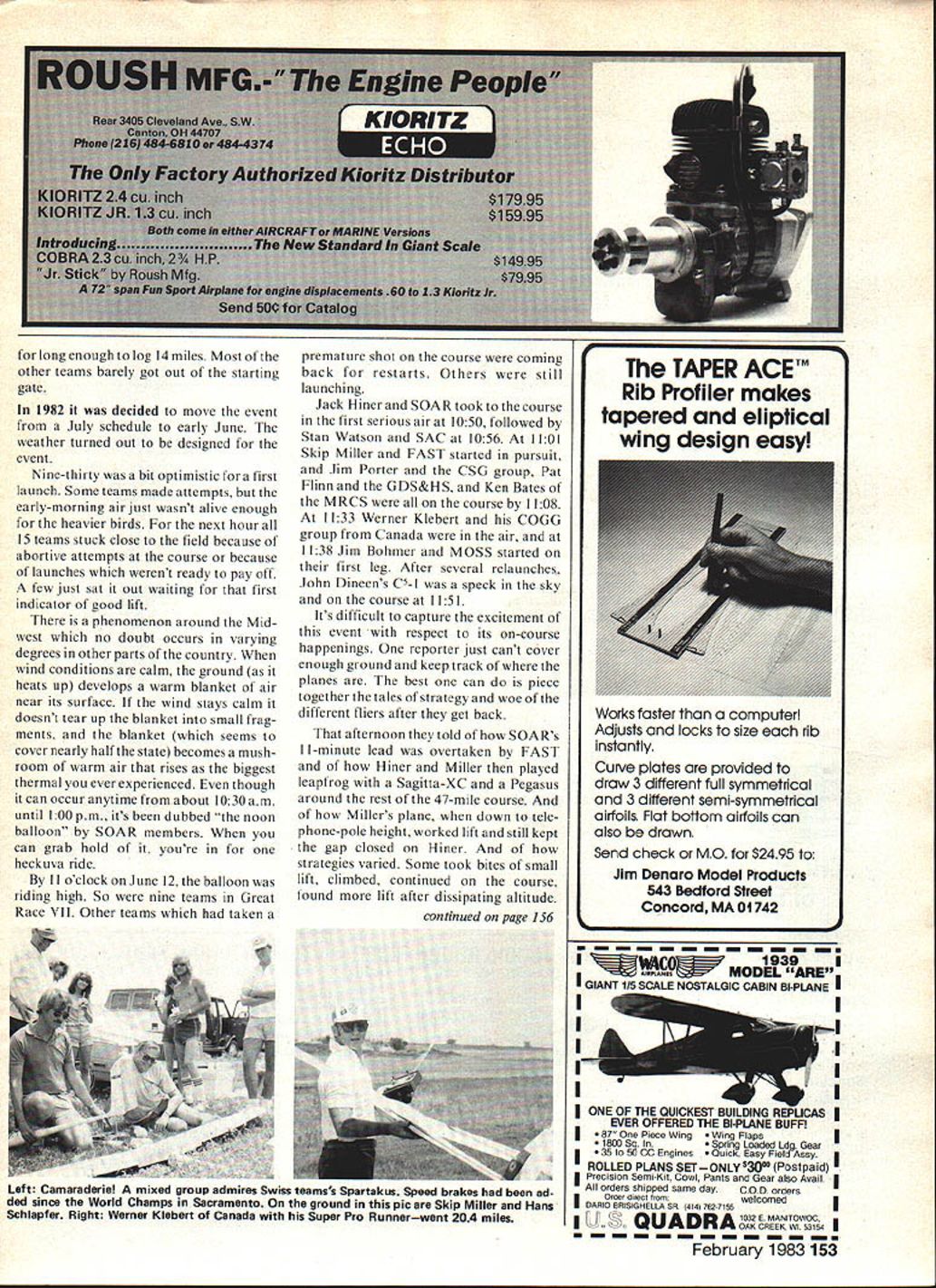
What really puts this contest in a different league are two basic rules. First, each team is assigned one frequency. Second, you fly when you want to. The full impact of that first rule isn't usually felt by the contestant and his fellow team members until the first morning of a contest when they look for the transmitter impound. That happened this past year. The Swiss team—organized and disciplined for international competitions—came on the field with full knowledge of the rules, yet they couldn't get over the idea of nearly 75 competitors and no impound tent for the transmitters. In past years the tent had held the transmitters which were impounded. With no tent this year the club members assigned to each frequency counted on the honor system and kept a record of which transmitters were on their frequency. A listed schedule allowed teams to fly without interfering with other teams' slots. With the transmitters unimpounded, teams could fly several times during the day as desired. The effect was a relaxed, practical schedule; since it's basically a thermal contest there's little reason to begin before coffee brewing. Nine o'clock is too early—spots of lift are likely to be small; sleep, eat a leisurely breakfast, show up at the field just before the hawks break roost.
If you launch into bad air in this event, you don't panic. You just land. And you don't have to slam dunk a landing for an extra five-point bonus. It's your frequency—your slot. There isn't even a frequency pin to lose.
In a 10-minute duration task, waiting for good air is called sandbagging. While some pros can camouflage that unsportsmanlike act with performances worthy of a Hollywood Oscar, in cross-country flying it's considered an open-air art. It was just that on June 12, 1982.
That original race back in 1976 had 13 teams ranging from New York to California entered. Back then the rules included an on-the-course relaunch provision, which allowed for multiple relaunches around the 47+ miles. That first year also was a strong indicator that things were going to be okay for cross-country types of competition. Greater Detroit's Soaring and Hiking Society de-emphasized the hiking part of their title and put two flights back-to-back of 17 and 14 miles. That team, which included Jeff and Jerry Mrlik, Warren Tiahrt, Dave Corven, Erich Kugler, and Dale Martell, covered the course using only 14 launches and won the race in four hours and 13 minutes. RC soaring hasn't been the same since.
By 1978 the art of multiple launching began to overshadow the flying aspect of the event, so the on-course relaunch rule was eliminated. Relaunches were permitted only back at the start line in 1979.
After wins by SOAR in 1977 and 1978, the Greater Detroit gang began their three-year domination of the event with a record run of 21.3 miles in three hours and 32 minutes. They bettered that in 1980 with 30.4 miles in only three hours and 18 minutes.
Bad weather literally put a damper on the two-day event in 1981, but the Greater Detroit group found air good enough and for long enough to log 14 miles. Most of the other teams barely got out of the starting gate.
In 1982 it was decided to move the event from a July schedule to early June. The weather turned out to be designed for the event. Nine-thirty was a bit optimistic for a first launch. Some teams made attempts, but the early-morning air just wasn't alive enough for the heavier birds. For the next hour all 15 teams stuck close to the field because of abortive attempts at the course or because of launches which weren't ready to pay off. A few just sat it out waiting for that first indicator of good lift.
There is a phenomenon around the Midwest which no doubt occurs in varying degrees in other parts of the country. When wind conditions are calm, the ground (as it heats up) develops a warm blanket of air near its surface. If the wind stays calm it doesn't tear up the blanket into small fragments, and the blanket (which seems to cover nearly half the state) becomes a mushroom of warm air that rises as the biggest thermal you ever experienced. Even though it can occur anytime from about 10:30 a.m. until 1:00 p.m., it's been dubbed "the noon balloon" by SOAR members. When you can grab hold of it, you're in for one heckuva ride.
By 11 o'clock on June 12, the balloon was riding high. So were nine teams in Great Race VII. Other teams which had taken a premature shot on the course were coming back for restarts. Others were still launching.
Jack Hiner and SOAR took to the course in the first serious air at 10:50, followed by Stan Watson and SAC at 10:56. At 11:01 Skip Miller and FAST started in pursuit, and Jim Porter and the CSG group, Pat Flinn and the GDS&HS, and Ken Bates of the MRCS were all on the course by 11:08. At 11:33 Werner Klebert and his COGG group from Canada were in the air, and at 11:38 Jim Bohmer and MOSS started on their first go. After several relaunches, John Dineen's C-1 was a speck in the sky and on the course at 11:51.
It's difficult to capture the excitement of this event with respect to its on-course happenings. One reporter just can't cover enough ground and keep track of where the planes are. The best one can do is piece together the tales of strategy and woe of the different fliers after they get back.
That afternoon they told of how SOAR's 11-minute lead was overtaken by FAST and of how Hiner and Miller then played leapfrog with a Sagitta-XC and a Pegasus around the rest of the 47-mile course. How Miller's plane, when down to telephone-pole height, worked lift and still kept the gap closed on Hiner. And of how strategies varied. Some took bites of small lift, climbed, continued on the course, and found more lift after dissipating altitude but kept covering ground at a conservative pace. Others chose to ride out the boomer, then streak the course as fast as posted speed limits would allow. Dineen lived up to the C-1's name and cruised the course seldom circling in lift (but still taking advantage of it—and the noon balloon) as they sped along—passing other teams in their way.
Because this is a race against the clock, and starting times begin when a flier starts on the course, each flier has little knowledge of how his performance compares with the others. In leapfrogging around the course—which has 14 90-degree directional changes—one can easily lose track of who he went by last, and when.
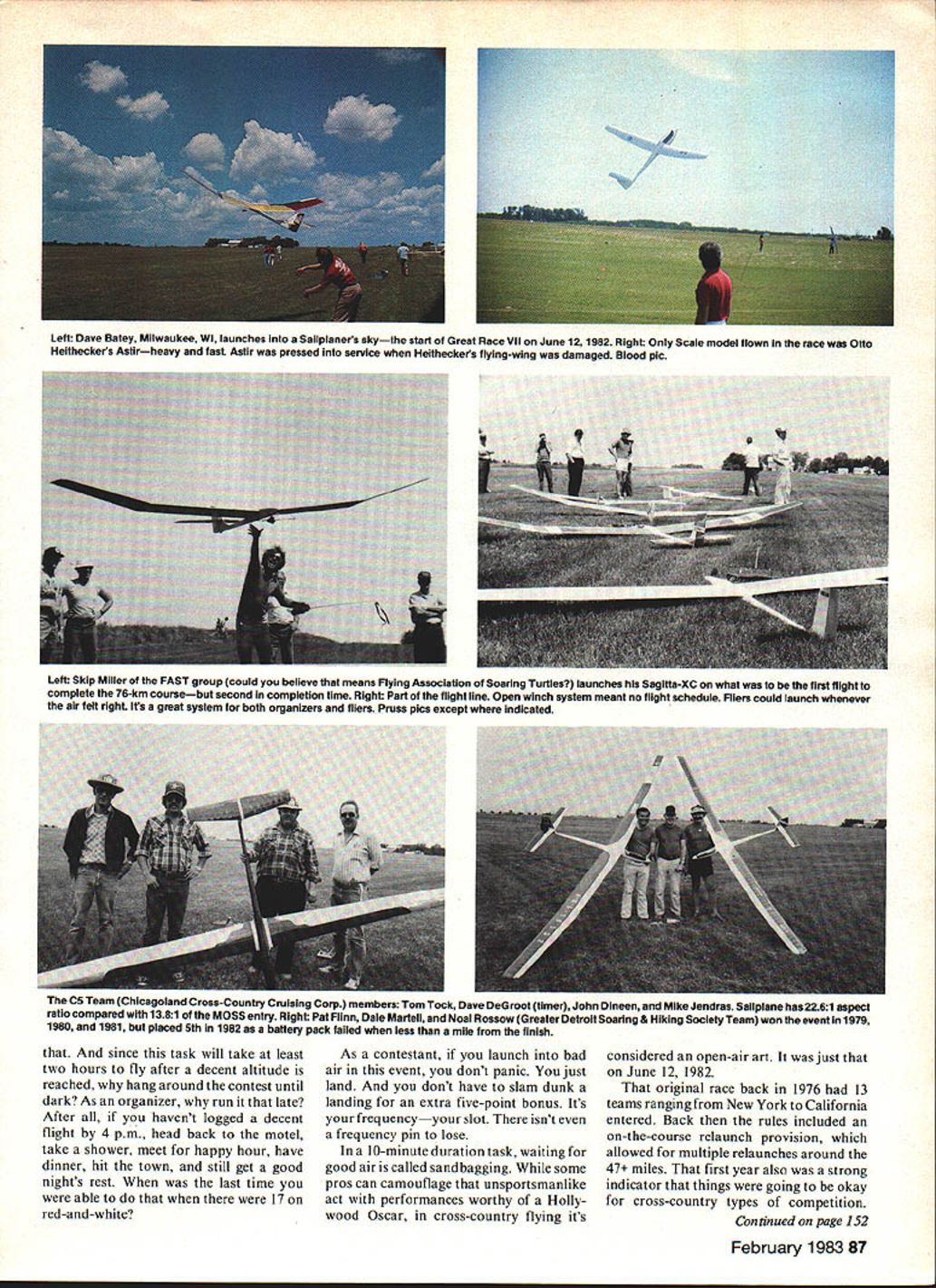
In the afternoon they also talked about chase vehicles and which was best. No winners here. Seems as though each team has its own favorite mode to transport team and planes. For comfort the old six-passenger convertible is tough to beat if you can still find one. The pick-up truck is popular; the back end can accommodate fliers, team support personnel and planes. A van, but with a sunroof or two, carries planes, people, and support equipment all inside—which is a consideration for planning purposes when taking into account what might happen if those friendly cumulus types overdevelop. A standard sedan with a sunroof works well, too, if you have a small crew and a quick-to-knock-down sailplane. Still others have used Jeeps and other four-wheel open-top vehicles, and, in a pinch, some have removed the hatch from a hatchback sedan.
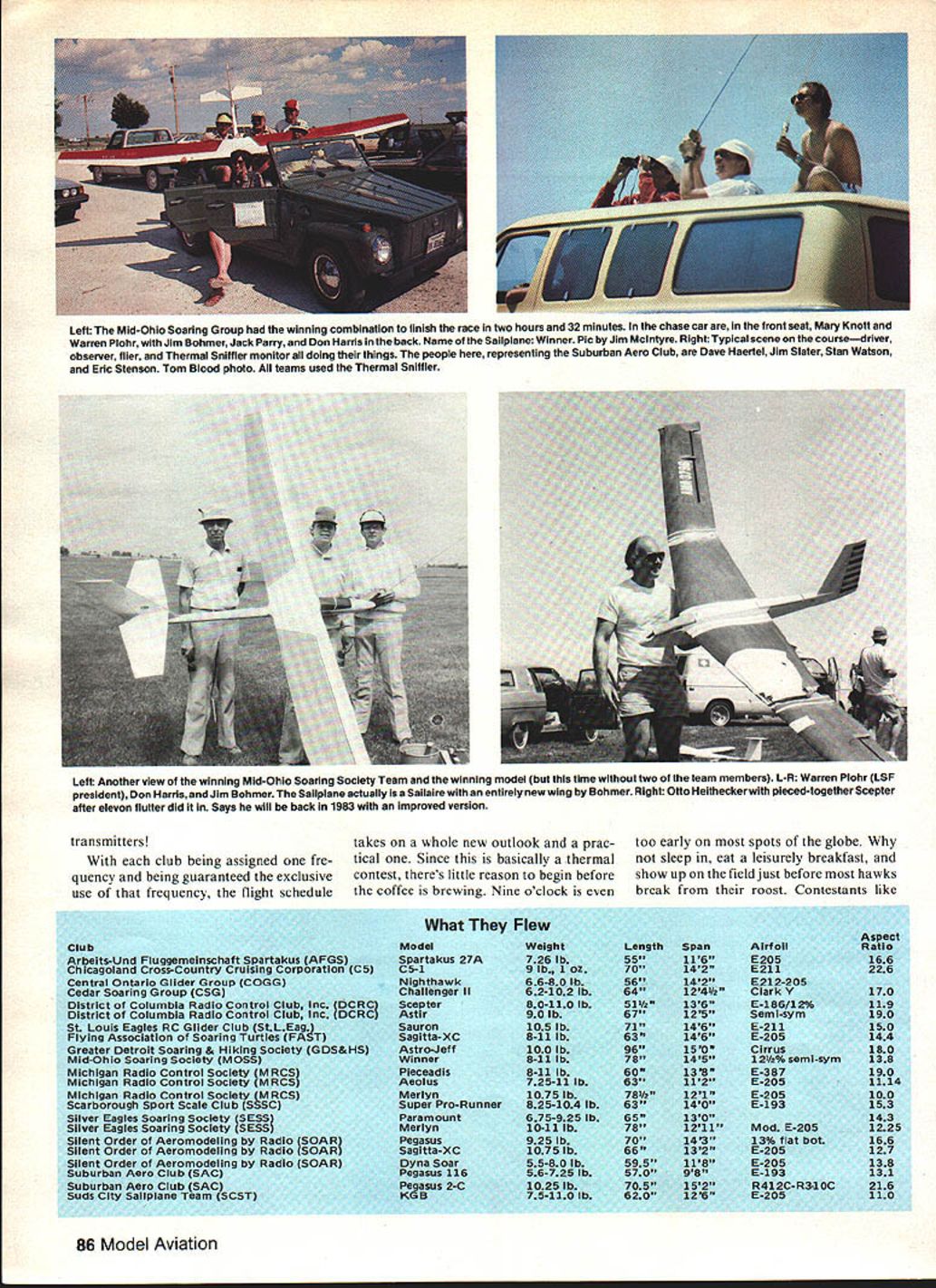
Sailplanes? That's another reason this event is so great. Everybody has a favorite. Whose is the best? The lists below show the entries; you choose. Remember, if other contests are 80% flier and 20% sailplane, those numbers probably spread further apart in cross-country events.
If you were cheering your favorite team onward to the finish line last June 12, you would have had a lot to yell about. If box seats were available there wouldn't have been an empty one. At 1:49 p.m., a most excited FAST team was the first ever to cross the finish line in a single launch. They did it in two hours and 48 minutes. SOAR was a minute behind in landing but 11 minutes behind on the elapsed time. Then at 2:10 came Jim Bohmer and the Ohio team of Mary Knott, Warren Plohr, Jack Parry, and Don Harris with the winning time of two hours and 32 minutes. Eleven minutes later Ken Bates' MRCS crew also crossed the line thinking they were the first to do so. Imagine how their expressions changed when they were congratulated but also told they were merely in fourth place!
From the flight line: Miller and Hiner went back on the course that same afternoon—an hour apart—and each covered another 23 miles before time ran out in hopes of bettering their second and third places. Dineen was setting a record pace when his bird went in at the 41-mile mark. Porter missed a turn towards the end of the course and landed at the 39-mile mark; he came back on Sunday and flew 44.9 miles. On Sunday Pat Flinn's airborne pack gave out, and he landed at the 75 km mark, 0.6 mile from the finish line. Watson (SAC) and Stoll (Switzerland) flew their regular F3B models. Heithecker's flying wing was destroyed in practice after some impressive flights; elevator flutter did it in. He then went on to fly the only scale ship in the meet, an Astir by WIK. Nine teams beat the old mark set in 1980.
For a Great Race VII souvenir program, which includes photos, names, three-views and a complete list of the model details, send $2.00 to SOAR, 23546 West Fern, Plainfield, IL 60544.
For information and entry blanks for Great Race VIII, send a SASE to Dan Pruss, 131 E. Pennington Lane, Plainfield, IL 60544.
What Flew
- Arbeits-Und Fluggemeinschaft Spartakus (AFGS)
- Chicagoland Cross-Country Cruising Corporation (CS)
- Central Ontario Glider Group (COGG)
- Cedar Soaring Group (CSG)
- District of Columbia Radio Control Club, Inc. (DCRC)
- St. Louis Eagles RC Glider Club (SLEag)
- Flying Association of Soaring Turtles (FAST)
- Greater Detroit Soaring & Hiking Society (GDS&HS)
- Mid-Ohio Soaring Society (MOSS)
- Michigan Radio Control Society (MRCS)
- Scarborough Sport Scale Club (SSSC)
- Silver Eagles Soaring Society (SESS)
- Silent Order of Aeromodelling by Radio (SOAR)
- Suburban Aero Club (SAC)
- Suds City Sailplane Team (SCST)
- Model Spartakus
Models reported:
- 27A
- CS-1
- Nighthawk
- Challenger II
- Scepter
- Astir
- Sauron
- Sagitta-XC
- Astro-Jeff
- Pieceadis
- Aeolus
- Merlyn
- Super Pro-Runner
- Paramount
- Merlyn Pegasus
- Sagitta
What They Flew
- Arbeits-Und Fluggemeinschaft Spartakus (AFGS) — Spartakus 27/A — 7.26 lb. — 55" — 11'6" — E205 — 16.6
- Chicagoland Cross-Country Cruising Corporation (CS) — CS-1 — 9 lb., 1 oz. — 70" — 14'2" — E211 — 22.6
- Central Ontario Glider Group (COGG) — Nighthawk — 6.6–8.0 lb. — 56" — 14'2" — E212–205 — 17.0
- Cedar Soaring Group (CSG) — Challenger II — 6.2–10.2 lb. — 64" — 12'4" — Clark Y — 17.0
- District of Columbia Radio Control Club, Inc. (DCRC) — Scepter — 8.0–11.0 lb. — 51.5" — 12'3" — E-? — 11.9
- District of Columbia Radio Control Club, Inc. (DCRC) — Astir — 9.0 lb. — 67" — 12'5" — Seml-? — 19.0
- St. Louis Eagles RC Glider Club (SLEag) — Sauron — 10.5 lb. — 71" — 14'6" — E-211 — 15.0
- Flying Association of Soaring Turtles (FAST) — Sagitta-XC — 8–11 lb. — 63" — 12'6" — E-205 — 14.4
- Greater Detroit Soaring & Hiking Society (GDS&HS) — Astro-Jeff — 10.0 lb. — 96" — 15'0" — Cirrus — 18.0
- Mid-Ohio Soaring Society (MOSS) — Winner — 8–11 lb. — 78" — 15'0" — 12% or semi-sym — 13.8
- Michigan Radio Control Society (MRCS) — Pieceadis — 8–11 lb. — 60" — 13'8" — E-387? — 10.0
- Michigan Radio Control Society (MRCS) — Aeolus — 7.25–11.0 lb. — 60" — 13'8" — E-37 — 19.0
- Michigan Radio Control Society (MRCS) — Merlyn — 10.75 lb. — 78" — 12'11" — E-205 — 10.0
- Scarborough Sport Scale Club (SSSC) — Super Pro-Runner — 8.25–10.4 lb. — 63" — 14'0" — E-193 — 15.3
- Silver Eagles Soaring Society (SESS) — Paramount — 6.75–9.25 lb. — 65" — 13'0" — E-193? — 14.3
- Silver Eagles Soaring Society (SESS) — Merlyn — 10–11 lb. — 78" — 12'11" — Modified E-205 — 12.25
- Silent Order of Aeromodelling by Radio (SOAR) — Pegasus — 9.25 lb. — 70" — 14'3" — 13% flat bottom — 16.6
- Silent Order of Aeromodelling by Radio (SOAR) — Sagitta-XC — 10.75 lb. — 66" — 12'6" — E-205 — 12.7
- Silent Order of Aeromodelling by Radio (SOAR) — Dyna Soar — 5.5–8.0 lb. — 59.5" — 11'8" — E-205 — 13.8
- Suburban Aero Club (SAC) — Pegasus 116 — 5.6–7.25 lb. — 57.0" — 9'8" — E-193 — 13.1
- Suburban Aero Club (SAC) — Pegasus 2-C — 10.25 lb. — 70.5" — 15'2" — R412C–R310C — 21.6
- Suds City Sailplane Team (SCST) — KGB — 7.5–11.0 lb. — 62.0" — 12'6" — E-205 — 11.0
February 1983
Transcribed from original scans by AI. Minor OCR errors may remain.

