
The Greatest Show Off Earth
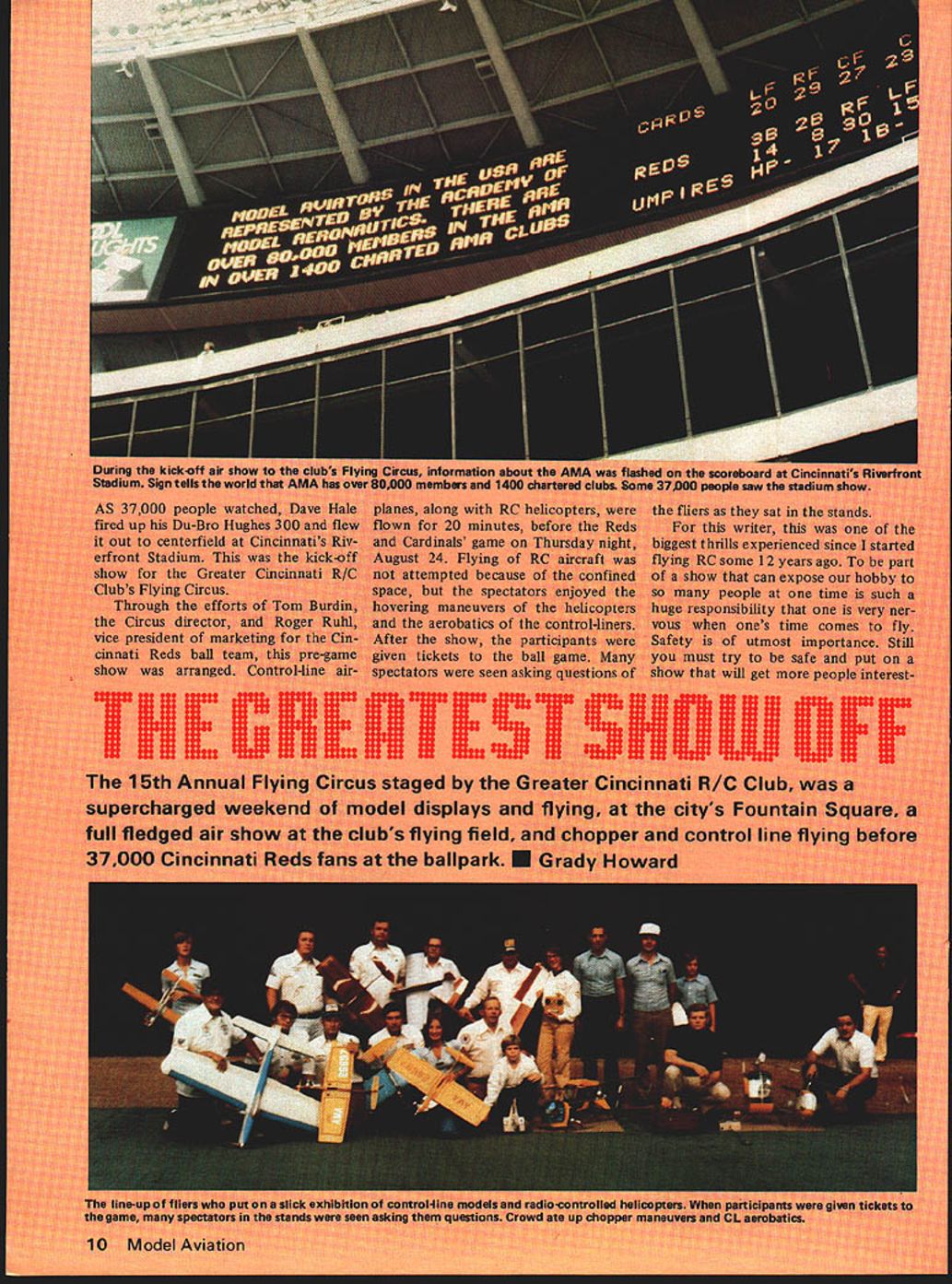
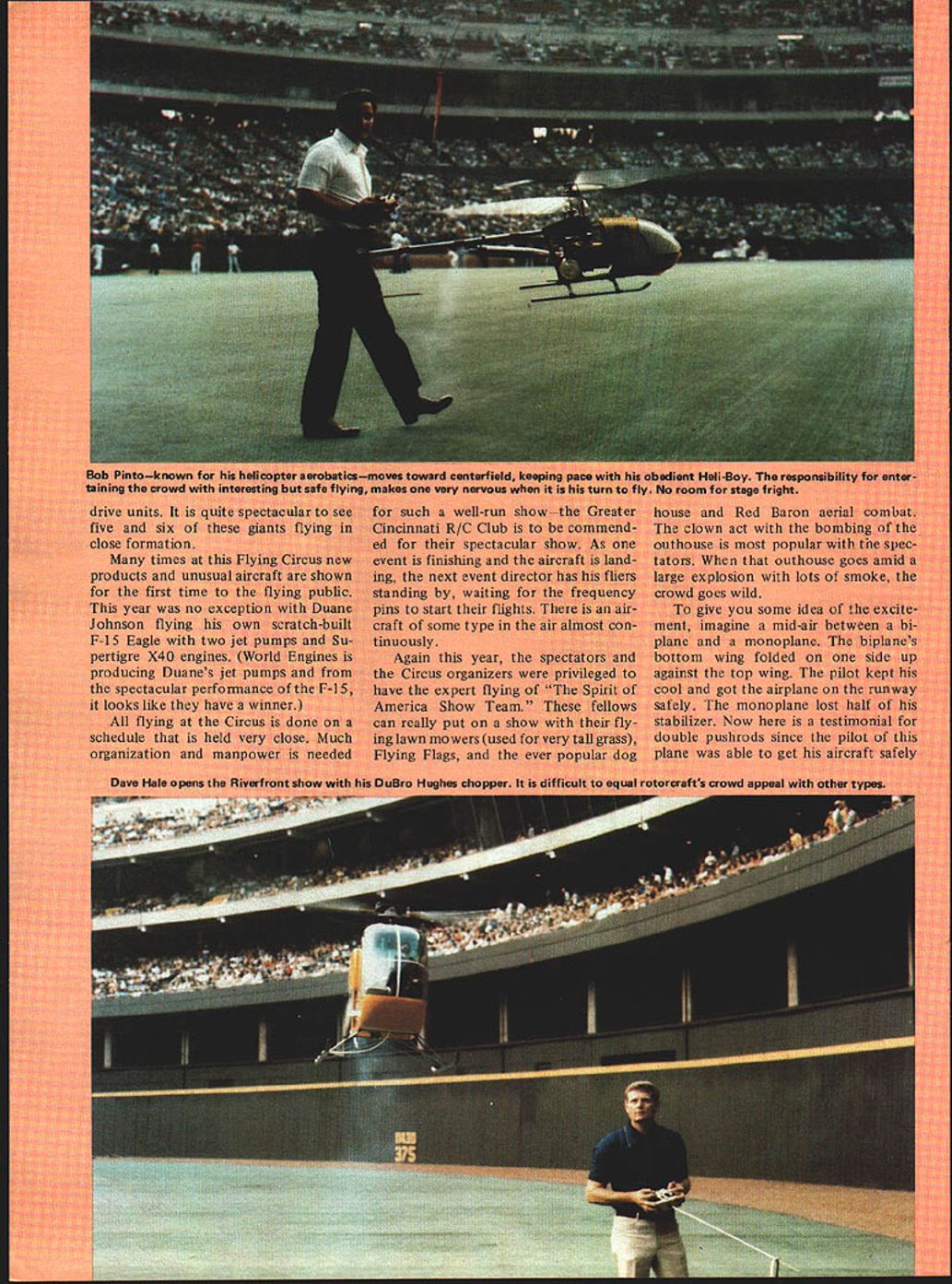
As 37,000 people watched, Dave Hale fired up his Du-Bro Hughes 300 and flew it out to centerfield at Cincinnati's Riverfront Stadium. This was the kick-off show for the Greater Cincinnati R/C Club's Flying Circus.
Through the efforts of Tom Burdin, the Circus director, and Roger Ruhl, vice president of marketing for the Cincinnati Reds, this pre-game show was arranged. Control-line airplanes, along with R/C helicopters, were flown for 20 minutes before the Reds and Cardinals game on Thursday night, August 24. The flying of full-size R/C aircraft was not attempted because of the confined space, but the spectators enjoyed the hovering maneuvers of the helicopters and the aerobatics of the control-liners. After the show, the participants were given tickets to the ballgame. Many spectators were seen asking questions of the fliers as they sat in the stands.
For this writer, this was one of the biggest thrills experienced since I started flying R/C some 12 years ago. To be part of a show that can expose our hobby to so many people at one time is such a huge responsibility that one is very nervous when one's time comes to fly. Safety is of utmost importance. Still, you must try to be safe and put on a show that will get more people interested in our hobby.
15th Annual Flying Circus — Weekend Overview
The 15th Annual Flying Circus staged by the Greater Cincinnati R/C Club was a supercharged weekend of model displays and flying: a public static and helicopter display at the city's Fountain Square, a full-fledged air show at the club's flying field, and chopper and control-line flying before 37,000 Cincinnati Reds fans at the ballpark. — Grady Howard
Fountain Square (Friday)
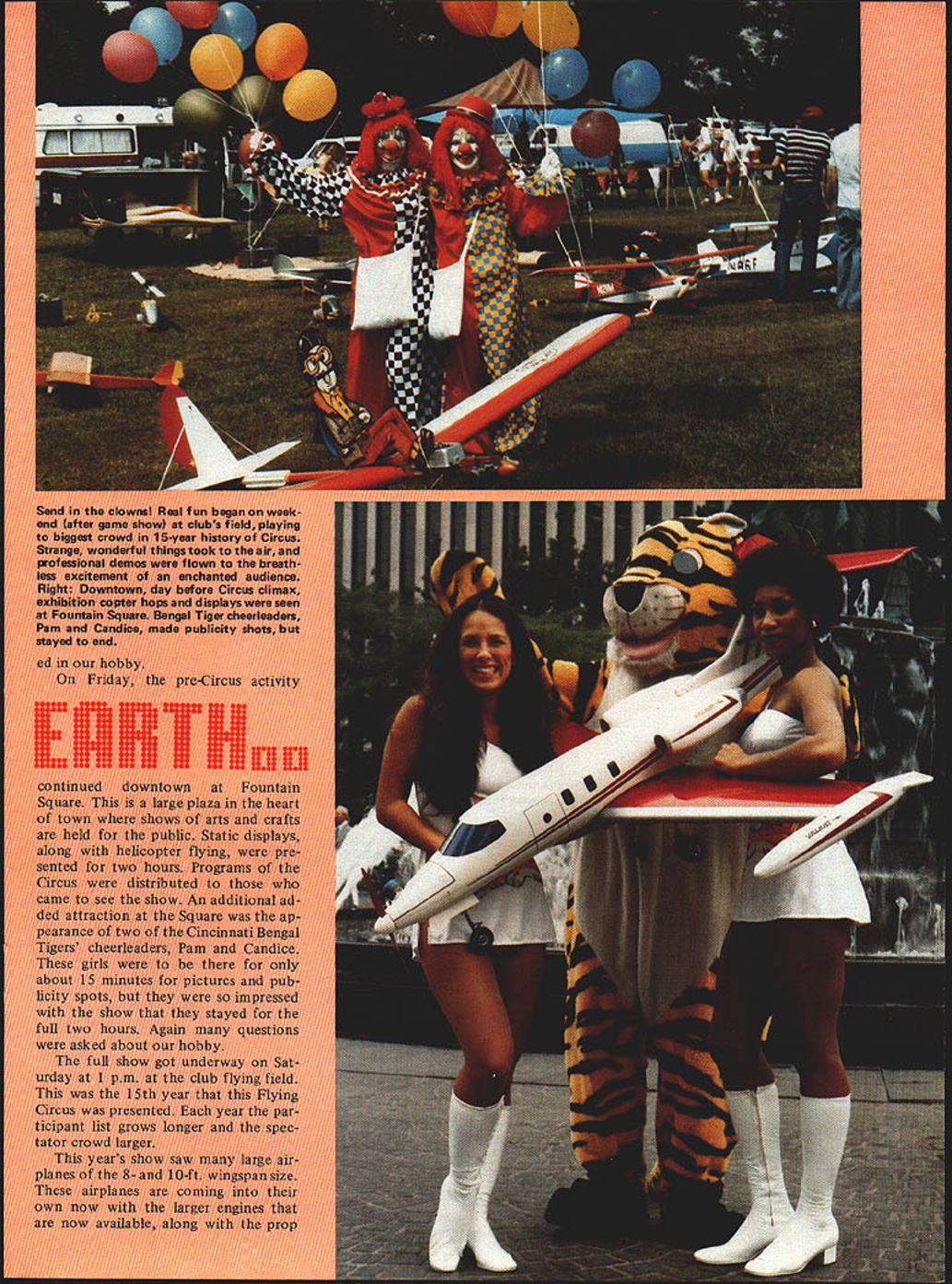
On Friday, the pre-Circus activity continued downtown at Fountain Square, a large plaza in the heart of town where arts-and-crafts shows are held for the public. Static displays, along with helicopter flying, were presented for two hours. Programs of the Circus were distributed to those who came to see the show. An additional attraction at the Square was the appearance of two of the Cincinnati Bengal Tigers' cheerleaders, Pam and Candice. These girls were to be there for only about 15 minutes for pictures and publicity spots, but they were so impressed with the show that they stayed for the full two hours. Again, many questions were asked about the hobby.
Main Show (Saturday)
The full show got underway on Saturday at 1 p.m. at the club flying field. This was the 15th year that the Flying Circus was presented. Each year the participant list grows longer and the spectator crowd larger.
This year's show featured many large airplanes of the 8- and 10-foot wingspan size. These airplanes are coming into their own now with the larger engines that are available, along with the prop-drive units. It is quite spectacular to see five or six of these giants flying in close formation.
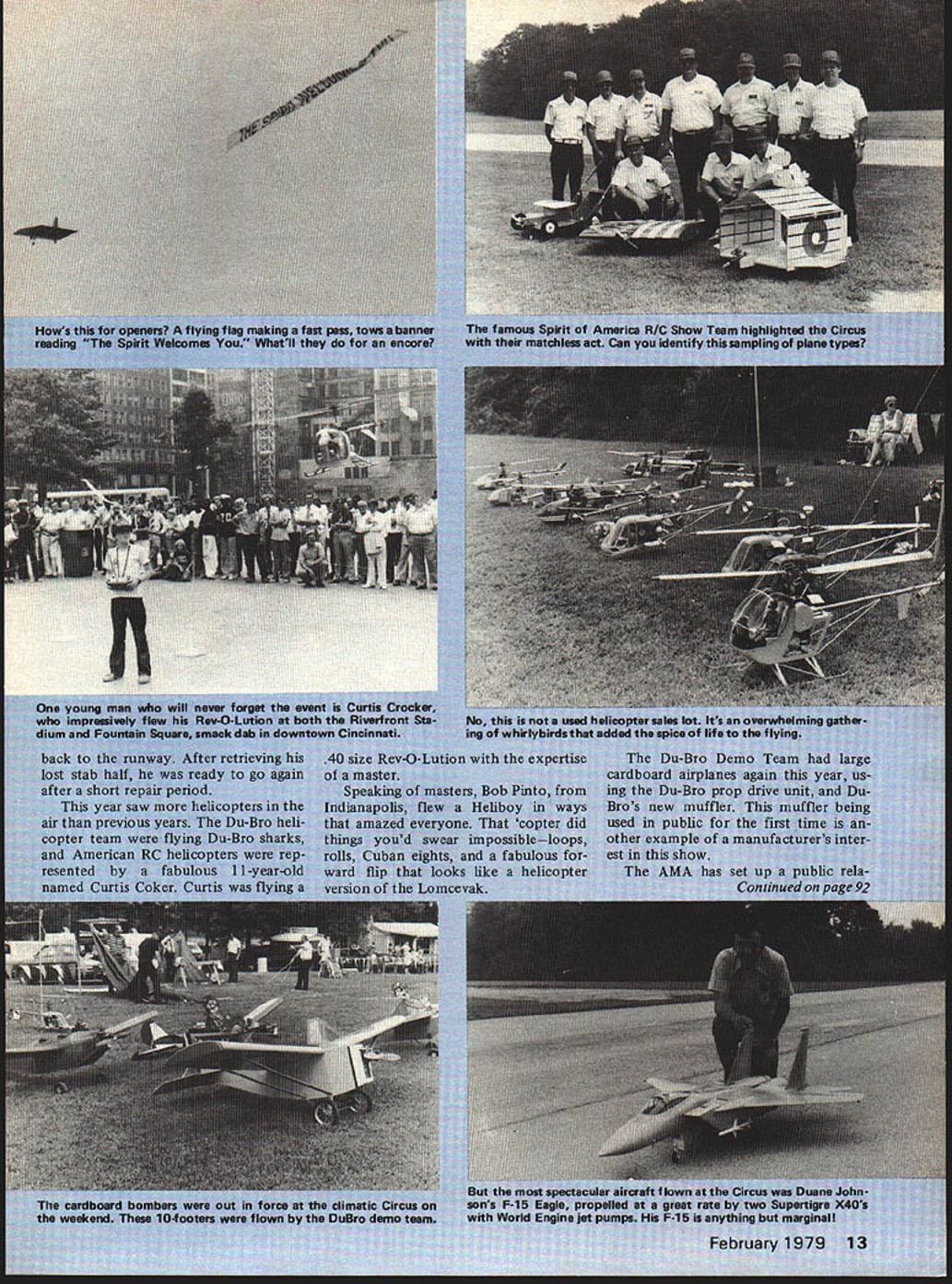
Many times at this Flying Circus, new products and unusual aircraft are shown for the first time to the flying public. This year was no exception, with Duane Johnson flying his own scratch-built F-15 Eagle with two jet pumps and Super Tigre X-40 engines. World Engines is producing Duane's jet pumps, and from the spectacular performance of the F-15, it looks like they have a winner.
Organization and Scheduling
All flying at the Circus is done on a schedule that is held very close. Much organization and manpower are needed for such a well-run show—the Greater Cincinnati R/C Club is to be commended for their spectacular presentation. As one event is finishing and the aircraft is landing, the next event director has his fliers standing by, waiting for the frequency pins to start their flights. There is an aircraft of some type in the air almost continuously.
Spirit of America Show Team
Again this year, the spectators and the Circus organizers were privileged to have the expert flying of the "Spirit of America Show Team." These fellows can really put on a show with their flying lawn mowers (used for very tall grass), Flying Flags, and the ever-popular dog house and Red Baron aerial combat. The clown act with the bombing of the outhouse is most popular with the spectators. When that outhouse goes and a large explosion with lots of smoke occurs, the crowd goes wild.
Incidents and Recoveries
To give you some idea of the excitement, imagine a mid-air between a biplane and a monoplane. The biplane's bottom wing folded on one side up against the top wing. The pilot kept his cool and got the airplane on the runway safely. The monoplane lost half of his stabilizer. Now here is a testimonial for double pushrods: the pilot of this plane was able to get his aircraft safely down. Back to the runway. After retrieving his lost stab half, he was ready to go again after a short repair period.
Helicopters
This year saw more helicopters in the air than previous years. The Du-Bro helicopter team was flying Du-Bro Sharks, and American RC helicopters were represented by a fabulous 11-year-old named Curtis Coker. Curtis was flying a .40-size Rev-O-Lution with the expertise of a master.
Speaking of masters, Bob Pinto, from Indianapolis, flew a Heliboy in ways that amazed everyone. That 'copter did things you'd swear impossible—loops, rolls, Cuban eights, and a fabulous forward flip that looked like a helicopter version of the Lomcevak.
Du-Bro Demo Team and AMA
The Du-Bro Demo Team had large cardboard airplanes again this year, using the Du-Bro prop-drive unit and Du-Bro's new muffler. This muffler, being used in public for the first time, is another example of a manufacturer's interest in this show.
The AMA has set up a public relations booth there for several years and it draws lots of interest from the spectators. The AMA was represented by president Johnny Clemens; Larry Bolich, special events director; and Earl Witt, secretary-treasurer. The AMA is always very responsive to this type of public exposure.
One could go on and on about the fun and fellowship the fliers enjoy at this show, but the photos show much more than words can tell. If you can see a Flying Circus in your future, make plans to participate. Enjoy your hobby even more.
Model Modifications and Cowl Construction
The author's decisions were largely a compromise based on a desire to fun-fly even in moderately windy weather, and possibly to enter a contest not requiring exact scale. Although the model deviates from scale in the selection of airfoil and the slightly larger engine scale, the plans show the true outline except as previously noted.
For a realistic appearance, a slightly oversize 2 in = 1 ft Williams Wright Whirlwind J5 was installed in a way to largely conceal the inverted .60 engine. Further streamlining and camouflaging of the engine were accomplished by a fiberglass cowling to provide as much space around the engine as possible for the muffler, and to permit the installation of the battery pack under the cowling, if desired, to help establish the correct center of gravity (C.G.) location without resorting to excess dead weight for balance.
It is common practice to remove scale-like engines on routine test flights, and if necessary to substitute an equivalent weight to prevent a shift of C.G. For this reason, the fiberglass cowl and engine crankcase were formed as separate molded parts.
The crankcase form was made of hard balsa previously used for packing or crating because of its weight. This balsa was cut into discs and laminated before shaping to size. During machining, it was observed that the form tended to turn out round even in a lathe. This was due to the end grain not cutting the same as the other grain directions. Care had to be taken to bring the form back to round by hand work. Finally, the form was fitted with a 1/2-inch diameter wood-holding dowel centrally located to extend axially out of the back. This dowel can be supported easily by a vise while applying the fiberglass. No attempt was made to provide draft or taper on the form diameters since it was believed that the fiberglass crankcase would have to be cut from the form anyway.
Then there was a pleasant surprise. When the easy-does-it method was completed, the fiberglass crankcase was removed in one piece without damage to either the crankcase or the form. The method of removal is as follows:
- Remove the thumb tacks which held the Saran Wrap and glass cloth in place while being coated with Hobbyoxy II, and during the placement of a balloon to cover the lay-up.
- Trim fiberglass at the rear outer diameter to assure that no fiberglass locks around the back corner of the form. Then, rough out the front opening hole of the fiberglass cowl, removing any excess that was not cut away to extract thumb tacks. These operations are easier when the fiberglass has cured two or three hours, but has not completely hardened.
- Insert an artist's flexible palette knife from the rear of the cowl under the fiberglass and Saran Wrap and work the lay-up free from the form.
Transcribed from original scans by AI. Minor OCR errors may remain.

