
Introduction to Aeromodeling
Bob Aberle
This is the start of a new series whose sole purpose is to attract people to the hobby and sport of model aviation. Notice that I wrote "hobby" and "sport": the hobby aspect involves building and assembling model aircraft, and the sport part involves the flying. As you will quickly learn, you don't have to be a builder to be a flier! But as time goes along, I hope you will want to learn to do both.
Throughout this series we intend to explain all facets of model aviation. Monthly articles geared toward beginners and intermediates will become a regular feature. Sometimes a single subject will be presented; at other times you may see several subjects in a single month.
Magazine issues tend to get lost or misplaced. Unless you faithfully make your own scrapbook of information, data retrieval becomes a problem. The Academy of Model Aeronautics (AMA) intends to make this series available on CD-ROM and on a dedicated website. In both cases the idea is to make all the information accessible and easy to locate for as long as you need it.
In addition to monthly articles, we hope to publish key questions readers ask. These FAQs (Frequently Asked Questions) will be cataloged by subject and placed on CD-ROM and the website to aid beginners.
Where to Start?
You might be out driving on a summer day and pass by a model-aircraft flying field. You see a model in the sky maneuvering much like a full-scale airplane. At first you might think it is a full-scale airplane. You stop and watch, then think, "I'd like to try that." But how do you take that first step?
The purpose of this series is to tell you how to get started, how to learn about model aviation, and how to learn to build/assemble and fly these airplanes. Even if you are already into model aviation, this series might open the door to areas you were not previously familiar with.
The best place to start is to attend a few flying sessions at a local flying field and initially just watch what is going on. Most local flying fields are operated by clubs chartered by AMA—the organization that publishes Model Aviation. Besides observing, you will have modelers to talk to and you can ask some basic questions. Being referred to this magazine and this beginner series is a good first step.
There are other resources: other magazines specializing in different types of model aircraft, books for beginners, Internet groups, hobby trade shows, and instructional videotapes. AMA can provide lists of this supporting material.
After a visit or two to the flying field, ask where the local club meets and if it accepts new members. If so, attend a meeting to see what it is like. Learning to build and fly model aircraft is best done with the help of experienced modelers. You could learn on your own, especially if you live in a remote location, but it will take much more time.
You may have been introduced to model aviation by reading magazines or catalog advertisements. Catalogs placed in airline seat pockets often advertise Ready-to-Fly (RTF) models. Your children may have even seen these ads or heard others talk about the hobby, and now you want to know more.
Another excellent way to get started is to visit a local hobby shop. The AMA website has a "Hobby Shop Locator" to help you find one. Hobby shops are owned and staffed by modelers and can inform you of local flying fields and clubs.
The local hobby dealer can also outline what it will take to get started. There will be an initial outlay of money to buy the necessary equipment. Certain decisions must be made at the start to guide you in the right direction. That is the purpose of this series.
What is Available?
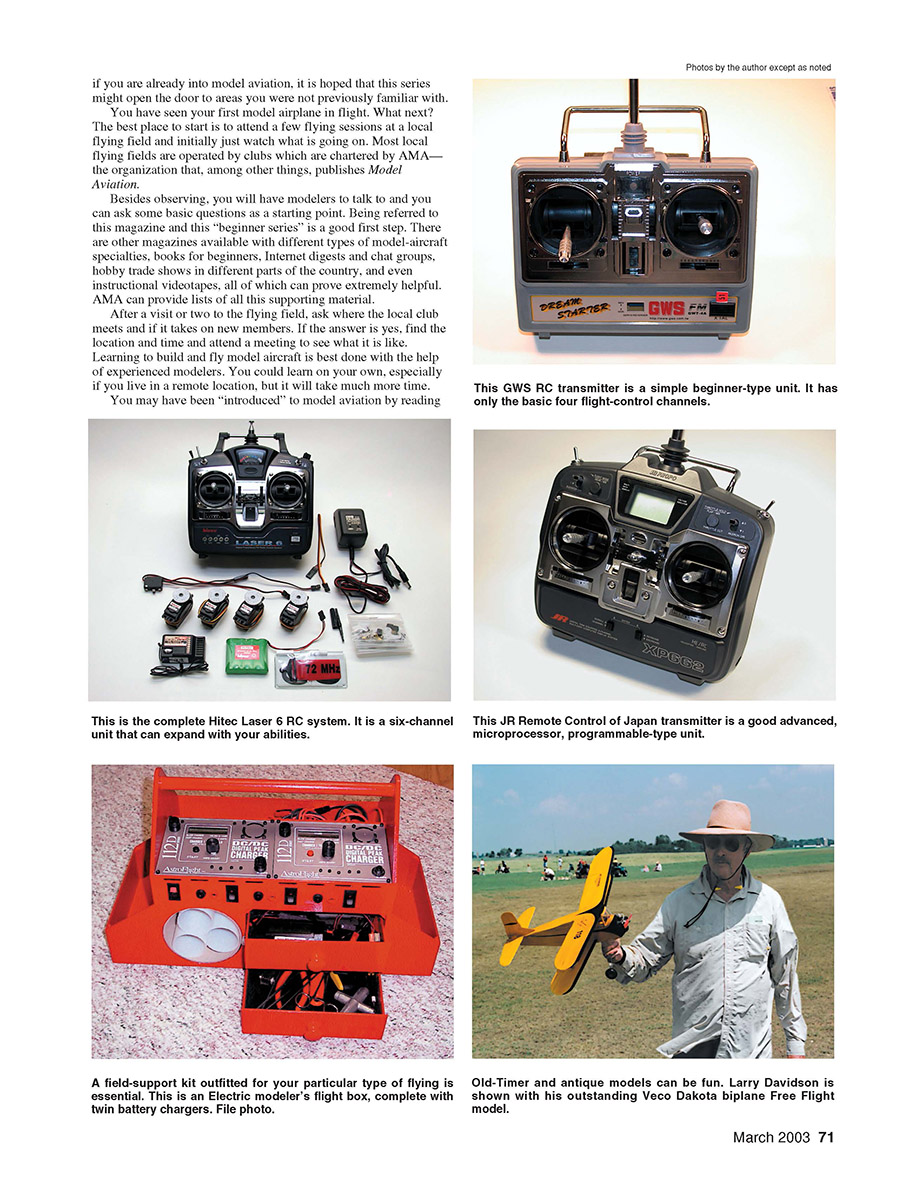
Model aviation today is largely radio-controlled (RC). The idea is that a pilot holds a transmitter. Coded radio signals are broadcast to the model airplane, where they are decoded and result in discrete flying commands that control the model in flight.
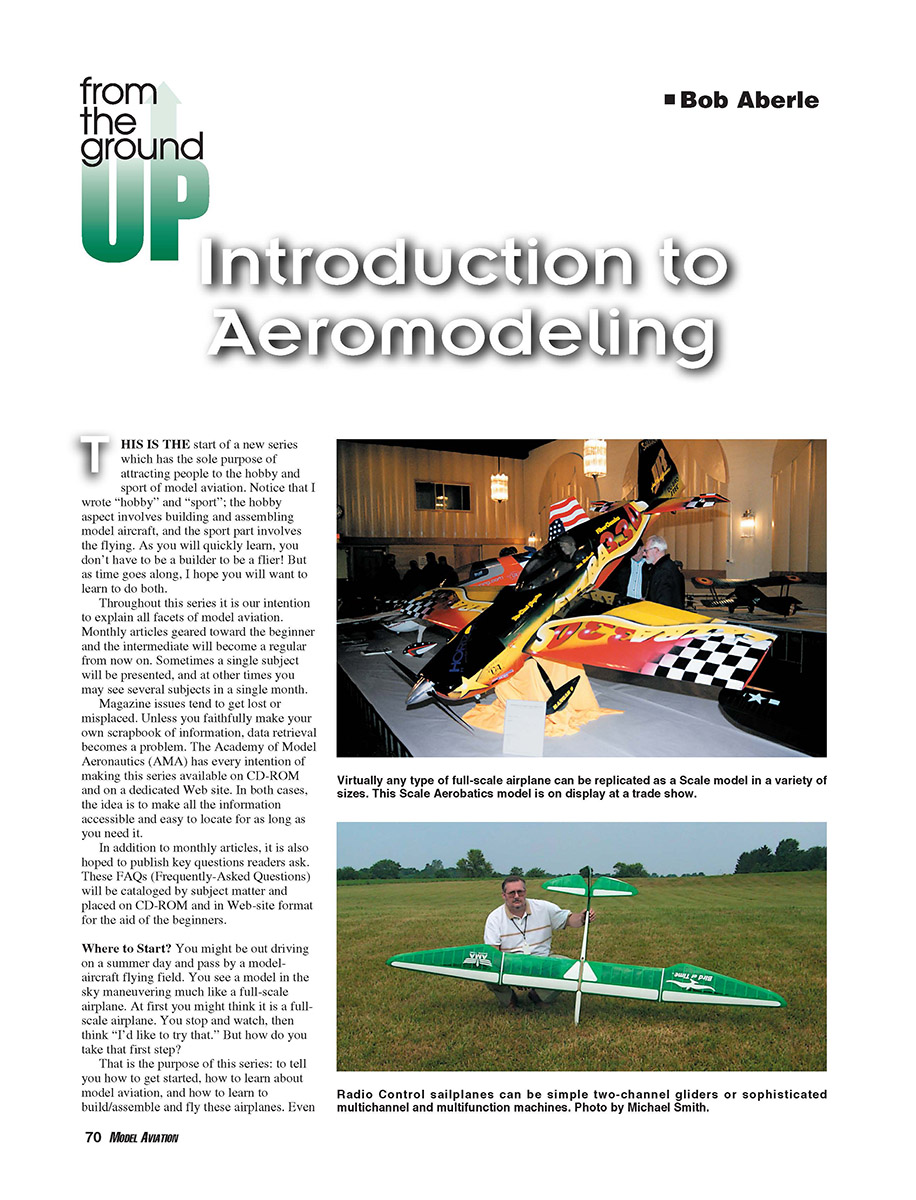
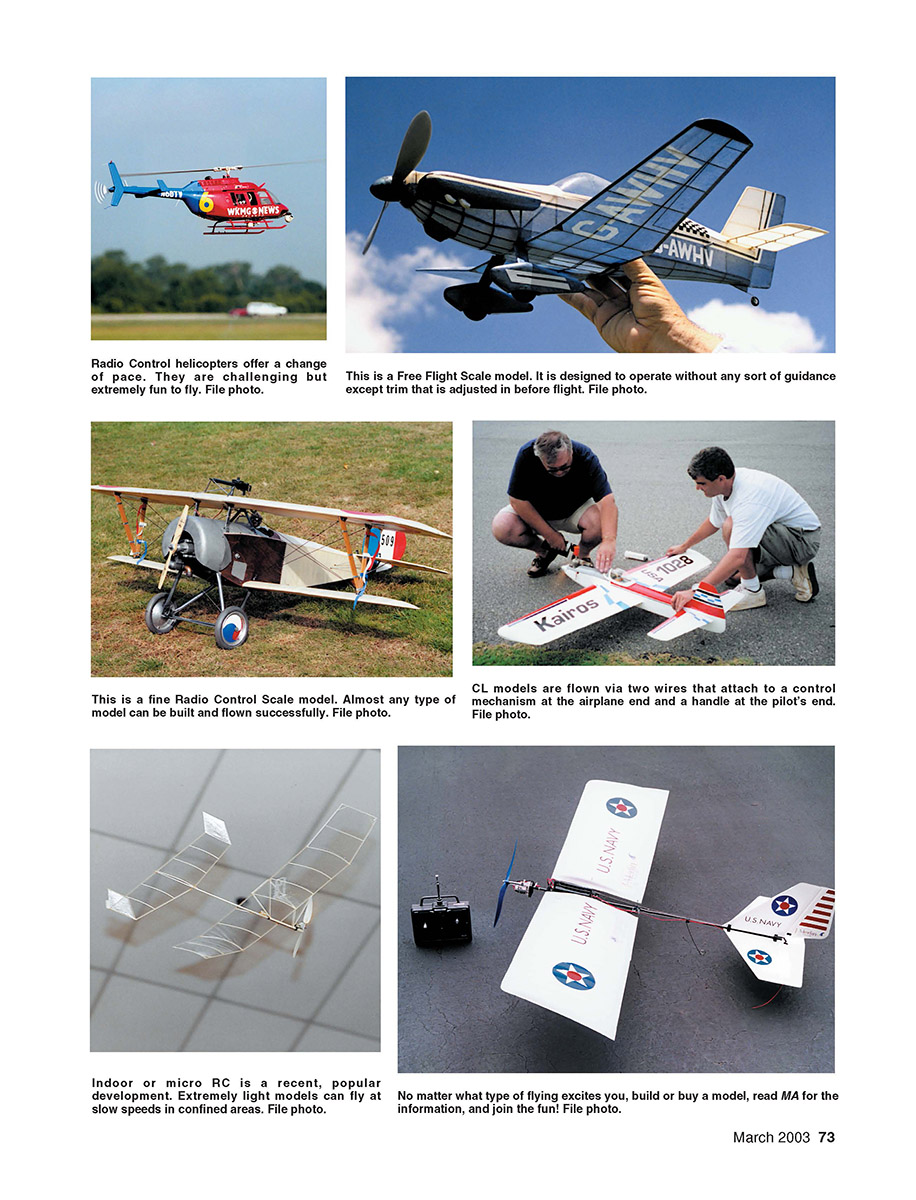
Although RC is the primary interest in our hobby, it is not the only interest. There are free-flying (Free Flight, FF) models that operate without radio control; models that fly in circles attached by steel wires to a control handle (Control Line, CL); sailplanes (models without engines); and a long list of specialty aircraft that make this hobby interesting and entertaining for every family member.
What Do You Really Need?
RC is one of the easier ways to enter the hobby, allowing you to make that first solo flight relatively quickly.
At minimum you will need a basic RC system, which will cost approximately $200. The details will be explained as the series progresses. The purchase of that first RC system is essentially a nonrecurring cost: the same radio can be transferred from model to model, year after year.
The next important choice is the model aircraft. There are several options:
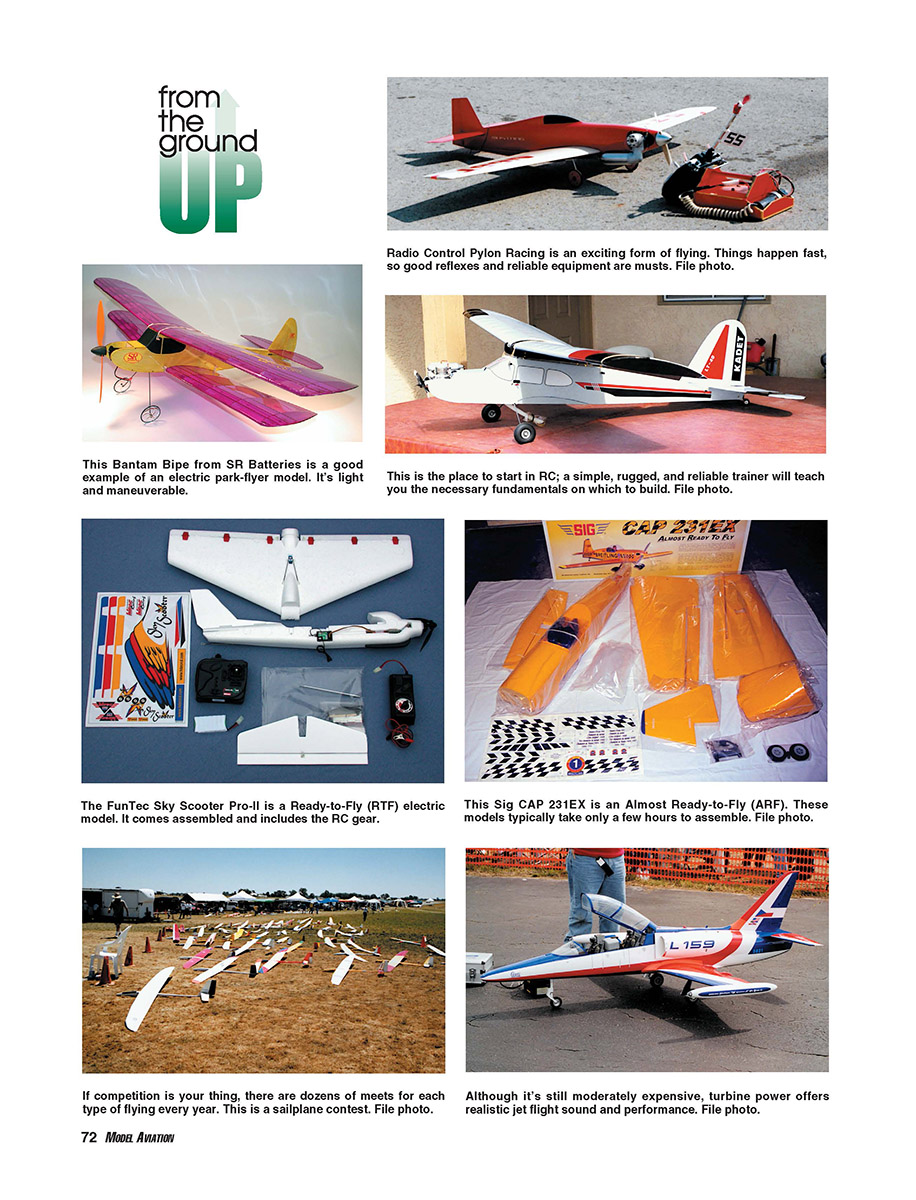
- Ready-to-Fly (RTF)
- These models come essentially complete with an RC system and motor already installed. After final adjustments and charging batteries, you can head to the field. RTFs can be purchased at modest prices and replacement parts are often available.
- Almost-Ready-to-Fly (ARF)
- ARFs are largely constructed and covered but require final assembly, installation of your RC system, and installation of the motor or engine. There are hundreds of ARFs available in many sizes and types, from basic trainers to advanced aerobatic models. Final assembly usually takes a few days.
- Kit or Scratch Building
- Building from a kit or from raw materials (scratch building) takes the most time and requires developing construction skills—using cements, covering, painting, and proper building techniques. Improper construction can make flying more difficult. Many modelers enjoy designing and scratch-building their own models, but ARFs are a practical option for those with time constraints.
I suggest everyone eventually try constructing a model or two from kits, even if you regularly fly ARFs. The lessons learned will help when assembling and repairing ARFs. As you gain building experience, you might expand to other areas such as FF, CL, rubber-powered models, and hand-launched gliders. Specialized construction articles are planned for future installments.
After choosing the RC system and the model, the next consideration is the power source. The primary choices today are glow-fueled engines or electric motors/batteries. Each has advantages and disadvantages.
The size of your engine or motor must match the size and estimated weight of your model. The ARF or kit you buy will usually provide proper recommendations. An experienced modeler can also help.
Depending on your choice of engine or motor, you will need field-support equipment.
- For glow (fuel) engines:
- Fuel and fuel container
- Fuel pump to transfer fuel to the aircraft tank
- Starter motor to flip the propeller
- Propellers of the correct size
- Wrenches and basic tools
- Glow-plug igniter
- For electric power:
- Extra battery packs
- A suitable field-type rapid charger
Today the choice between glow and electric power is roughly equal. Fueled engines are reliable and easy to operate but leave fuel residue and make significant noise, even with mufflers. Electric power is clean and quiet but requires careful power management.
Either way, get a field kit or box—preferably one with brackets on top to hold your model. This box should include a variety of tools necessary to support flight. If you travel a long distance to a flying field and forget an essential item, you'll quickly learn to take inventory and prepare a good checklist.
Now that you have the RC system, the model airplane, the engine or motor, and supporting equipment, you are ready for that first flight.
Flying
Remember this suggestion: get help! Don't try to do it on your own because you may never make that first flight. I don't want you to walk away from this wonderful hobby/sport without having at least accomplished the basic goal of solo flight. Anyone can do it, although it can take time and patience.
As we progress in this series, you will learn tricks necessary to enjoy radio-controlled flight. We will introduce you to RC simulators, which are quite effective; to self-stabilizing devices that maintain a level model attitude; and to trainer cables (dual-control setups) that allow you and your instructor to have access to the same transmitter controls.
Flight Safety
Before concluding this first installment, beginners must understand several important safety rules. All of these rules can be found in the AMA Membership Manual, which you receive when you join the organization.
- Frequency/channel interference:
- Two RC systems on the same channel (or frequency) will interfere with one another. The FCC has made 50 channels available between 72 and 73 MHz expressly for control of model aircraft. There are 30 additional channels on the 75 MHz band for control of surface vehicles (RC cars, boats, robots, etc.).
- Field frequency control procedures:
- At any flying field you will see a form of frequency or channel control, often using frequency pins or clothespins displayed on a board. When you want to fly, you take the pin designating your channel off the board and clip it to your transmitter antenna. If the clip is gone, others must wait until you return it. This is basic but necessary.
- Separation of flying sites:
- AMA has determined that it is unsafe to have two adjacent model flying fields closer than three miles apart. Do not attempt to fly on your own too close to an existing flying field. If you do and you are on the same channel as another modeler, one or both of you could crash. Always be aware of where others are flying.
That concludes part one. Any comments, questions, and suggestions as this series develops are welcome. The whole idea is to allow our hobby to maintain itself and hopefully grow. Each item mentioned in this article will be greatly expanded upon in the next few months so that you gain the proper experience to fully enjoy the hobby and sport of model aviation. Please help make it a success.
Bob Aberle
Transcribed from original scans by AI. Minor OCR errors may remain.

