

Grumman G-164D Turbine Ag-Cat
Warren D. Shipp
Introduction
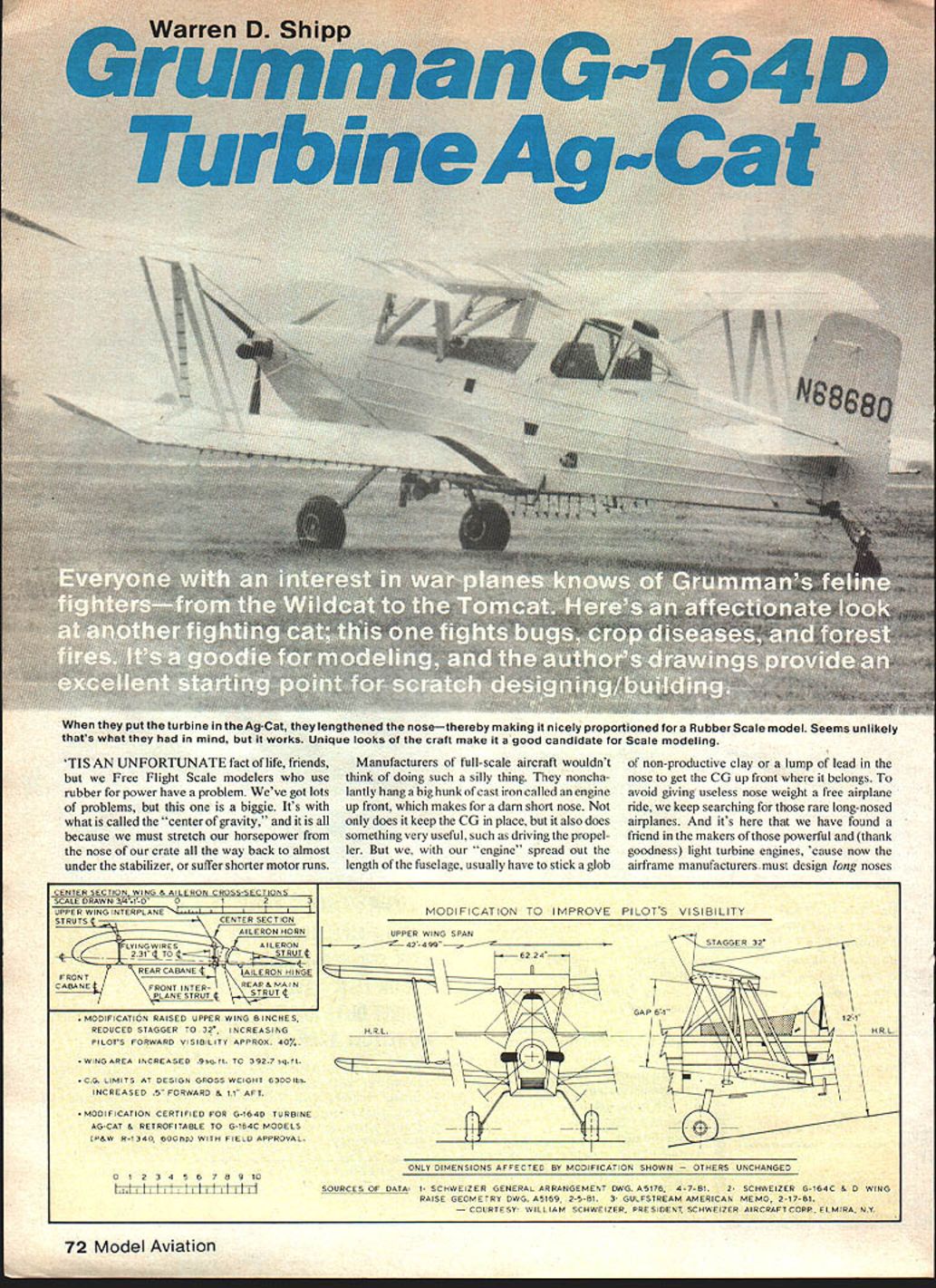
Everyone with an interest in war planes knows of Grumman's feline fighters — from the Wildcat to the Tomcat. Here's an affectionate look at another fighting cat; this one fights bugs, crop diseases, and forest fires. It's a goodie for modeling, and the author's drawings provide an excellent starting point for scratch designing and building.
When Grumman installed a turbine in the Ag‑Cat, they lengthened the nose — thereby making it nicely proportioned for a Rubber Scale model. Seems unlikely that's what they had in mind, but it works. The unique looks of the craft make it a good candidate for scale modeling.
'Tis an unfortunate fact of life, friends, but we Free Flight Scale modelers who use rubber for power have a problem. We've got lots of problems, but this one is a biggie. It's what is called the "center of gravity," and it is all because we must stretch our horsepower from the nose of our crate all the way back to almost under the stabilizer, or suffer shorter motor runs.
Manufacturers of full‑scale aircraft wouldn't think of doing such a silly thing. They nonchalantly hang a big hunk of cast iron called an engine up front, which makes for a darn short nose. Not only does it keep the CG in place, but it also does something very useful, such as driving the propeller.
But we, with our "engine" spread out the length of the fuselage, usually have to stick a glob of non‑productive clay or a lump of lead in the nose to get the CG up front where it belongs. To avoid giving useless nose weight a free airplane ride, we keep searching for those rare long‑nosed airplanes. And it's here that we have found a friend in the makers of powerful — and (thank goodness) light — turbine engines, because now airframe manufacturers must design long noses.
Notes
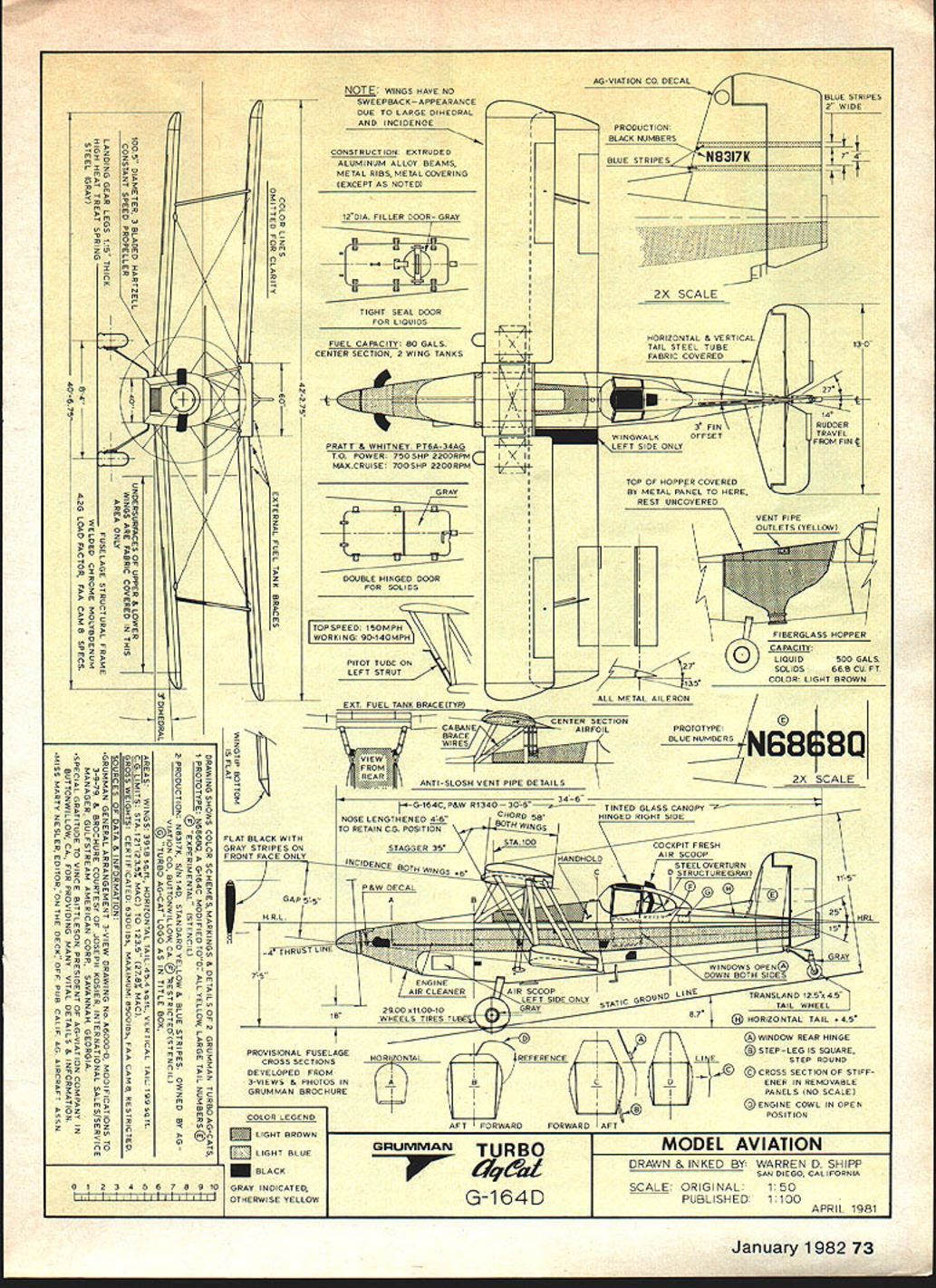
- NOTE: Wings have no sweepback — appearance due to large dihedral and incidence.
Construction
- Extruded aluminum alloy beams.
- Metal ribs.
- Metal covering (except as noted).
Access and Tanks
- 12" diameter filler door — gray.
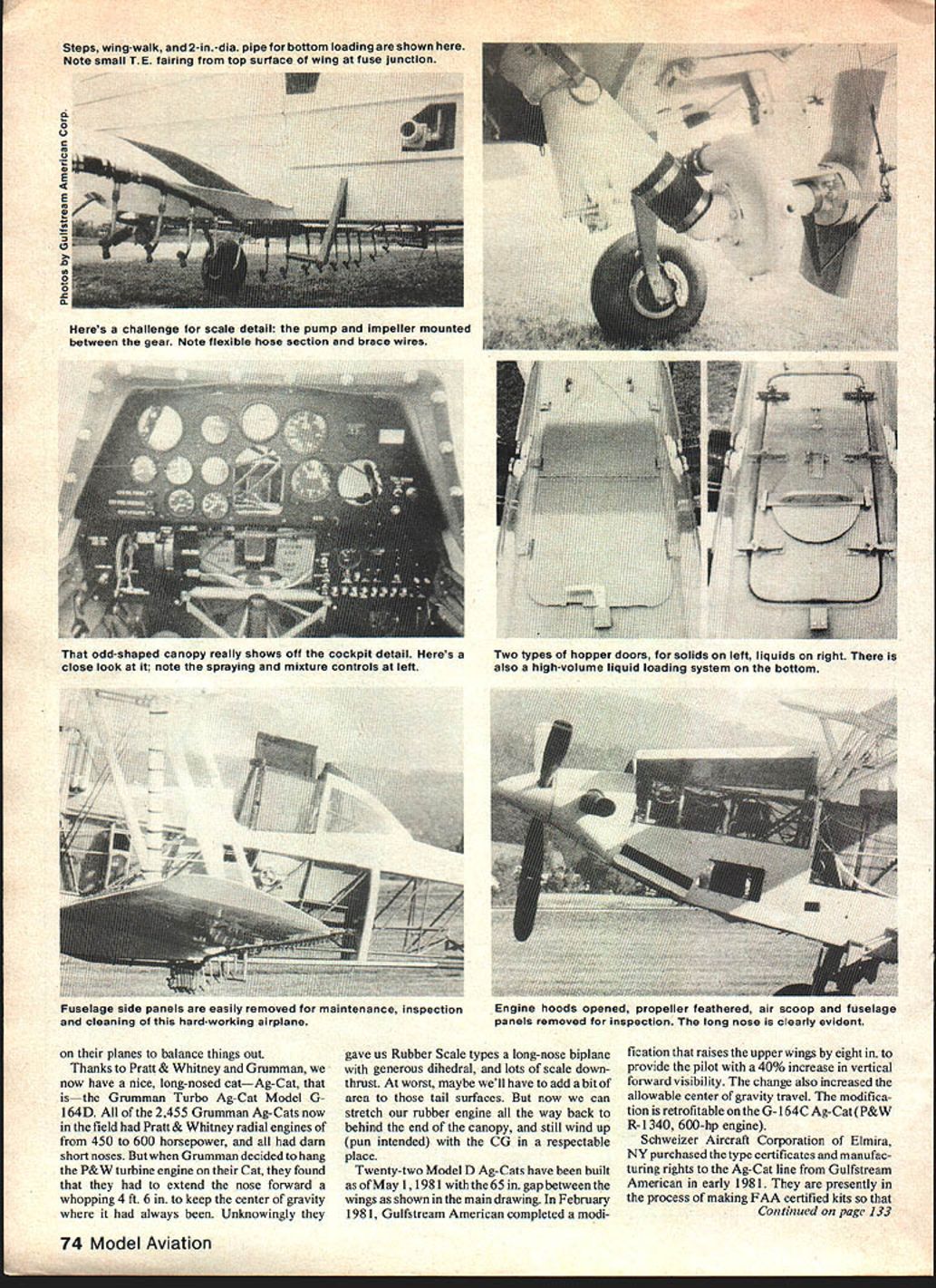
- Tight seal door for liquids.
- Double‑hinged door for solids.
- Fuel capacity: 80 gallons — center section + 2 wing tanks.
- External fuel tank brace (typical).
- Anti‑slosh vent pipe details.
Engine and Performance
- Pratt & Whitney PT6A‑34AG.
- Takeoff power: 750 shp @ 2200 rpm.
- Max cruise: 700 shp @ 2200 rpm.
- Top speed: 150 mph.
- Working speed: 90–140 mph.
- Pitot tube on left strut.
- Engine air cleaner.
- Thrust line indicated.
- P&W decal.
Airframe Geometry and Controls
- Nose lengthened 46" to retain CG position.
- Stagger: 25°.
- Chord: 58" both wings.
- Incidence: both wings +6°.
- Horizontal tail: +4.5°.
- Transland 12.5 x 4.5 tail wheel.
- Cabane brace wires.
- Center section airfoil.
- View from rear (drawing reference).
- Static ground line.
- Windows open both sides.
- Air scoop left side only — gray.
- Provisional fuselage cross sections developed from 3‑views and photos in Grumman brochure.
Color Legend
- Light brown
- Light blue
- Black
- Gray indicated, otherwise yellow
Modification to Improve Pilot's Visibility
Modification: Raised upper wing 8 inches; reduced stagger to 32 inches, increasing pilot's forward visibility approximately 40%. The change also increased wing area by about 9% to 392.7 sq. ft. CG limits at design gross weight (6,300 lbs) increase 5% forward and 11% aft. Modification certifies for G‑164D Turbine Ag‑Cat and is retrofit‑able to G‑164C models.
History and Remarks
Thanks to Pratt & Whitney and Grumman, we now have a nice, long‑nosed cat — the Grumman Turbo Ag‑Cat Model G‑164D. All of the 2,455 Grumman Ag‑Cats now in the field had Pratt & Whitney radial engines of from 450 to 600 horsepower, and all had darn short noses. But when Grumman decided to hang the P&W turbine engine on their Cat, they found that they had to extend the nose forward a whopping 4 ft. 6 in. to keep the center of gravity where it had always been. Unknowingly they gave rubber‑scale types a long‑nose biplane with generous dihedral, and lots of scale downthrust. At worst, modelers may have to add a bit of area to the tail surfaces. Now we can stretch our rubber engine all the way back to behind the end of the canopy and still wind up with the CG in a respectable place.
Twenty‑two Model D Ag‑Cats had been built as of May 1, 1981 with the 65‑in. gap between the wings as shown in the main drawing. In February 1981, Gulfstream American completed a modification that raises the upper wing by eight inches to provide the pilot with a 40% increase in vertical forward visibility. The change also increased the allowable center‑of‑gravity travel. The modification is retrofit‑able on the G‑164C Ag‑Cat (P&W R‑1340, 600‑hp engine).
Schweizer Aircraft Corporation of Elmira, NY purchased the type certificates and manufacturing rights to the Ag‑Cat line from Gulfstream American in early 1981. They were in the process of making FAA‑certified kits so that airplanes in the field could be modified. For the past 24 years, Schweizer — a leading manufacturer of sailplanes — has been building Ag‑Cats under contract to Grumman and Gulfstream American. Certification of the Ag‑Cat was made in June 1957, and the line includes the Model 450B with the 450‑hp P&W R‑985, Model 600B with the 600‑hp P&W R‑1340, Model G‑164C also with the R‑1340, and the new G‑164D Turbine Ag‑Cat.
While well‑suited to rubber power, the Turbo Ag‑Cat can be powered by any of the other forms of model engines. The wing modification opens up many possibilities. Gas‑powered Model Cs with the radial engines could be made with the 73‑in. gap, and all types could possibly benefit from the increased gap and increased CG travel. Put a Cat into your life!
Grumman's Flock of Ferocious Fighting Felines
- Wildcat F4F‑3
- Hellcat F6F‑3
- Tiger F11F‑1
- Bearcat F8F‑2
- Tigercat F7F‑1N
- Tomcat F‑14A
- Panther F9F‑4
- Cougar F9F‑6
- Ag‑Cat
These are all great fighters. Even, coincidentally, the Navy designation for Grummans was "F" (for fighters). They're all military, but the civic Ag‑Cat not only looks like an older air fighter, it's a great fighter in its assigned job. Some 2,455 of them are out in the fields dusting and spraying, fighting the bugs that destroy the farmers' crops. They even can carry water or other chemical mixtures to fight forest fires. Of all Grumman's cats, only the Ag‑Cat can also be a pussy cat — in its huge hopper it can (and often does) carry loads of seed for planting of crops, thereby helping to perpetuate life as well as to perform other conservation duties.
Sources of Data
- Schweizer — General Arrangement SWO A5176, 4‑7‑91.
- Schweizer — G‑164C & S wing‑raise geometry SWO A51ES.
- Gulfstream American memo, 2‑17‑91.
Courtesy William Schweizer, President, Schweizer Aircraft Corp., Elmira, NY.
Credits
Grumman Turbo Ag‑Cat G‑164D Model Aviation Drawn & inked by: Warren D. Shipp, San Diego, California Scale: original 1:50 — published 1:100 — April 1981
On their planes to balance things out.
Transcribed from original scans by AI. Minor OCR errors may remain.

