
Gustave Whitehead: WAS HE FIRST?
Who really was first to make a controlled, powered flight with an airplane? There may never be conclusive proof to answer that question, but there is growing evidence that Gustave Whitehead may have beaten the Wright brothers to the punch by several years. — Don Berliner
"...we... wish to recall to the aeronautical world the fact that to America belongs the credit of producing the first successful motor-driven aeroplane, and that to such men as the Wright brothers, A. M. Herring, and Gustave Whitehead belongs the real credit of having produced the first successful heavier-than-air flying machines." — Scientific American, January 25, 1908
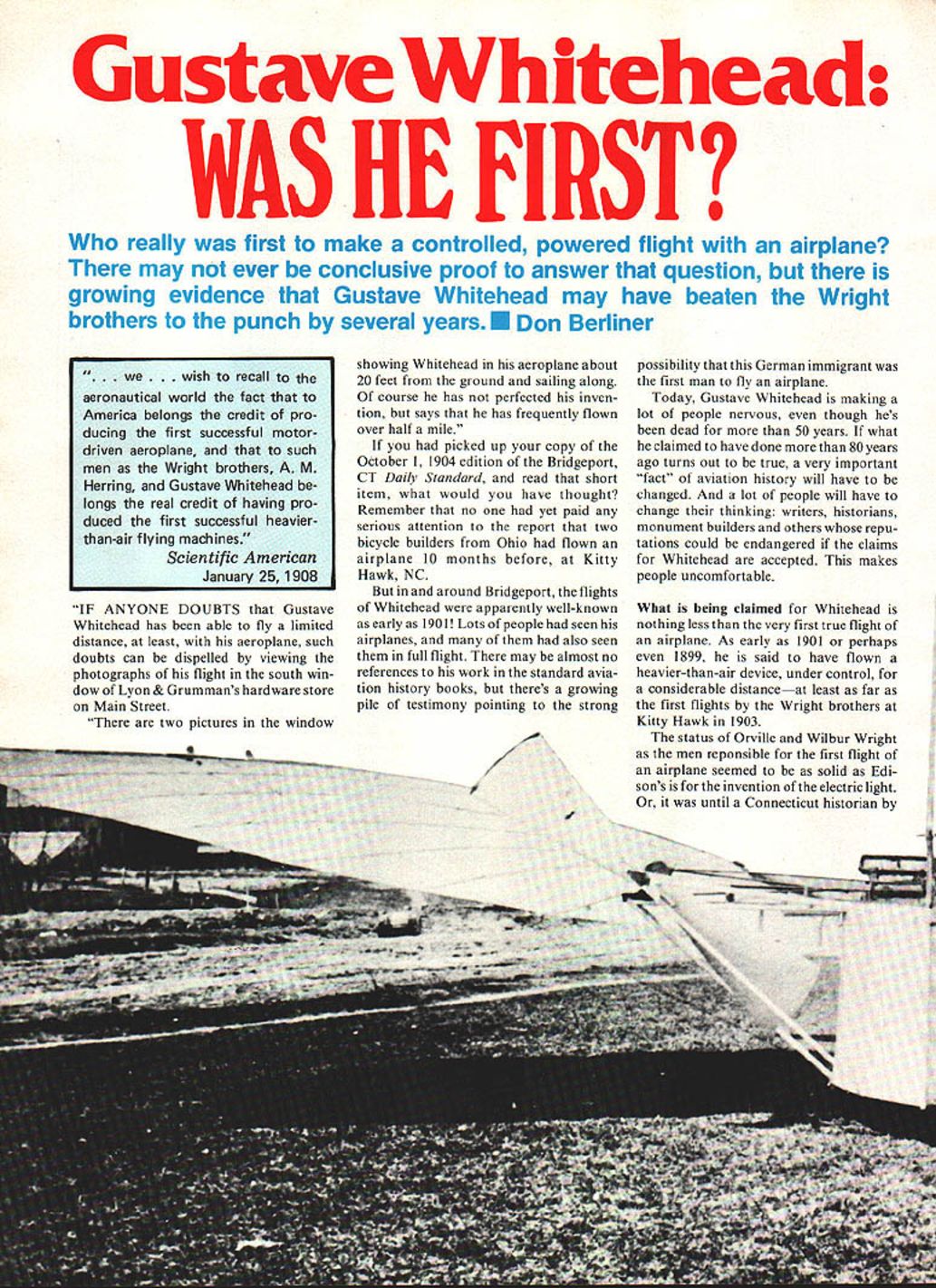
"If anyone doubts that Gustave Whitehead has been able to fly a limited distance, at least, with his aeroplane, such doubts can be dispelled by viewing the photographs of his flight in the south window of Lyon & Grumman's hardware store on Main Street.
There are two pictures in the window showing Whitehead in his aeroplane about 20 feet from the ground and sailing along. Of course he has not perfected his invention, but says that he has frequently flown over half a mile."
If you had picked up your copy of the October 1, 1904 edition of the Bridgeport Daily Standard and read that short item, what would you have thought? Remember that no one had yet paid any serious attention to the report that two bicycle builders from Ohio had flown an airplane 10 months earlier at Kitty Hawk, NC.
But in and around Bridgeport, the flights of Whitehead were apparently well known as early as 1901. Lots of people had seen his airplanes, and many of them had also seen them in full flight. There may be almost no references to his work in the standard aviation history books, but there is a growing pile of testimony pointing to the strong possibility that this German immigrant was the first man to fly an airplane.
Today, Gustave Whitehead makes a lot of people nervous, even though he has been dead for more than 50 years. If what he claimed to have done more than 80 years ago turns out to be true, a very important "fact" of aviation history will have to be changed. Writers, historians, monument builders and others whose reputations could be affected by the claims for Whitehead may be uncomfortable with that prospect.
What is being claimed for Whitehead is nothing less than the very first true flight of an airplane. As early as 1899, and certainly by 1901, he is said to have flown a heavier-than-air device, under control, for a considerable distance — at least as far as the first flights by the Wright brothers at Kitty Hawk in 1903.
Christopher Columbus and the Wright brothers are widely credited for their historic roles. But just as evidence suggests others may have reached the Americas before Columbus, there is growing evidence that someone flew a powered airplane several years before Kitty Hawk. The question is not who made later, world-changing developments, but who deserves credit for being first.
It will probably never be proven definitively that Whitehead flew before the Wrights — or that he did not. It is too late to do the definitive research the question demands. There is nothing in existence that all parties would consider absolute proof: videotape and movie film were rare at the turn of the century, and community leaders who may have witnessed his flying are no longer among us.
About the best anyone can hope for is to collect old testimony and accounts published in reputable journals of the day, and assemble them into a reasonable story of what may have happened. After all, the Kitty Hawk flights of Orville and Wilbur were reconstructed from testimony and photographs, and the classic photo of the 1903 Flyer reportedly was not seen by the public for five years.
The search for evidence
Bill O'Dwyer, a Connecticut historian living near where Whitehead experimented, has made the accumulation of testimony, photographs and other evidence his passion. He picked up where Stella Randolph left off after writing two obscure books (Lost Flights of Gustave Whitehead, 1937; and Before the Wrights Flew, G. P. Putnam's Sons, 1966). O'Dwyer added many eye-witness statements, newspaper and magazine clippings, and other documentary material.
In 1978, O'Dwyer and Randolph jointly compiled History By Contract (published in Germany by Fritz Majer & Son), which expanded the initial work and added documentary support to the premise that Whitehead made many successful flights while the Wrights were still learning to fly kites and gliders.
All through the long grind of trying to convince the world his research mattered, O'Dwyer had to confront a puzzling reaction from the Smithsonian Institution and its National Air & Space Museum. Widely considered the leading authority on aeronautical history, the museum showed a suspicious lack of enthusiasm for the Whitehead matter; some of its people called Whitehead a "hoax."
In the mid-1970s, O'Dwyer enlisted the support of Connecticut Senator Lowell Weicker to force the Smithsonian to release a copy of a long-denied contract between it and the estate of Orville Wright. That contract sheds light on the museum's behavior: it prohibits the Smithsonian from supporting or publishing any claim that any airplane capable of true flight existed before the Wrights flew in late 1903. If the agreement is violated, the Wright 1903 Flyer could revert to the Wright heirs and be removed from the National Air & Space Museum.
Such a contract seems at odds with the basic purpose of a museum — to present as accurate a picture of history as possible. The origin of the contract helps explain its existence. In 1928 the Wright Flyer was sent to the Science Museum in London, displayed as the first successful airplane. At that time the Smithsonian preferred to credit Samuel Langley, its own former secretary, rather than the Wrights. Langley's Aerodrome had failed in 1903. It was not until 1948 that the Smithsonian recognized the Wrights as the "fathers of flight." To get the Flyer back from London, the Smithsonian accepted the restrictive conditions in the contract.
With the Smithsonian constrained, O'Dwyer continued to seek more evidence and witnesses to support the Whitehead story.
Reported flights and witness statements
Where other claimants to pre-Wright flights have been shown to have achieved only brief, non-sustaining "hops," the claims for Whitehead are of sustained, controlled flights over significant distances. O'Dwyer collected signed and notarized statements, tape and videotape recordings, and other testimony from neighbors, co-workers and passersby who described seeing Whitehead fly.
Notable items of testimony include:
- Louis Darvarich (1934, signed and notarized): said he flew with Whitehead in Pittsburgh, PA, at a height of 20–25 feet for about a half mile — in the spring of 1899.
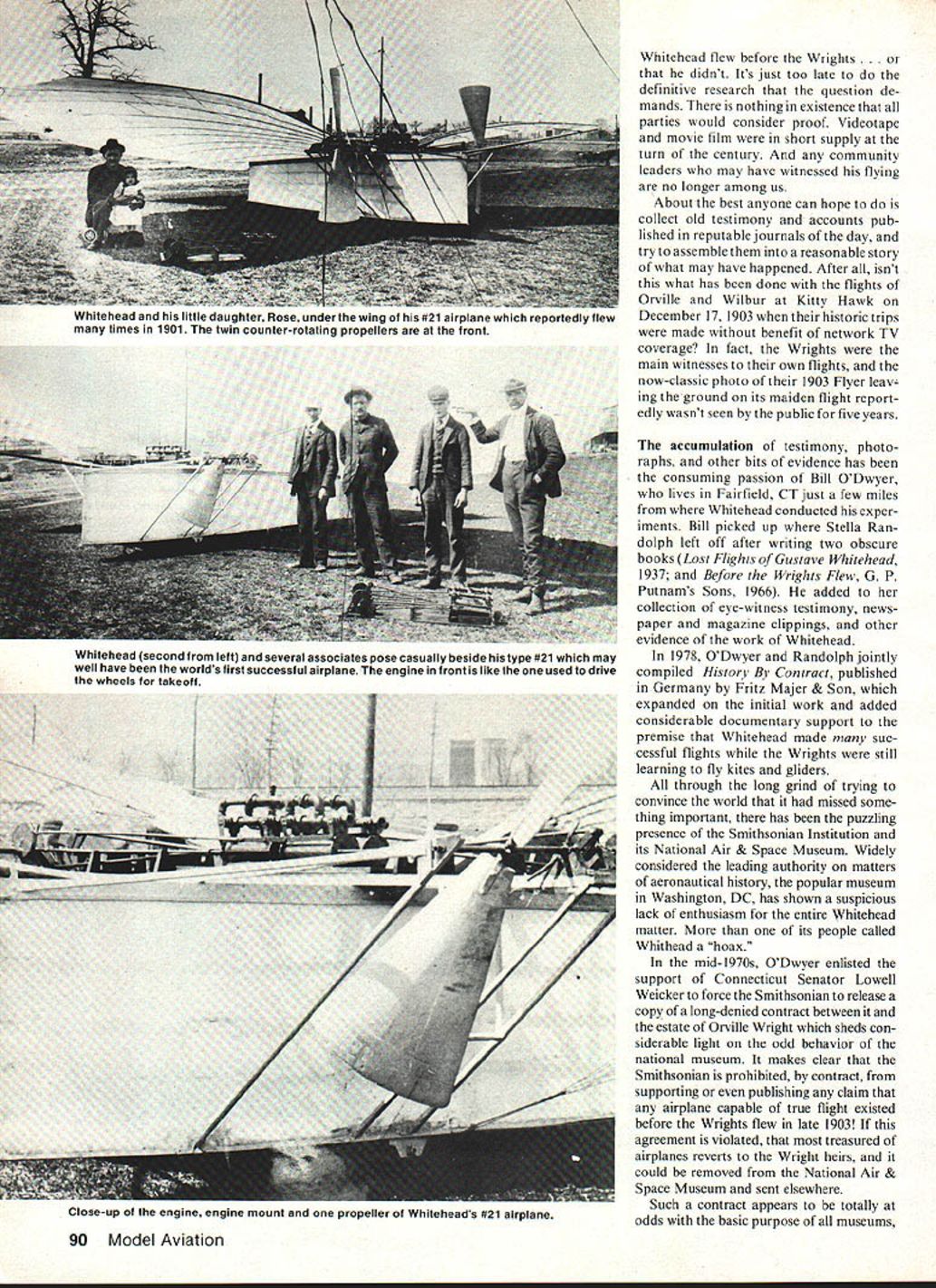
- Thomas Schweikert (sworn 1936): reported seeing a 1901 flight of about 300 feet at 15 feet altitude.
- John Fekete (stated 1948): said that in May or June 1901 he watched Whitehead fly at 30 feet for about 200 feet.
- Bridgeport Herald and other newspapers (August 1901): reported a flight on August 14, 1901, of approximately a half mile and as high as 40 feet, described in colorful detail in the Sunday Herald of August 18 and in the Boston Transcript and New York Herald the following day.
- Junius Harworth (signed and notarized, 1934): said he assisted Whitehead on 8/14/01 when the machine flew to a height of about 200 feet over Lordship Manor, Connecticut, for approximately one and a half miles and about four minutes (roughly 20+ mph). Harworth described the engine and construction, estimating the airplane's weight at about 800 pounds.
- Cecil Steeves (sworn statement, youth observation): described a flight of about 700 feet clearing telephone wires of at least 20 feet; said the #21 machine used steam power (burning gas or acetylene for heat).
- Anton Pruckner (Whitehead's assistant): wrote that he heard reports of flights of two and seven miles over Long Island Sound on January 17, 1901 (no first-hand account known to exist).
By 1900 Whitehead had moved to Bridgeport, CT, where he continued to build and, reportedly, fly his airplanes. In June 1901 the New York Herald and Scientific American ran major articles about him; the latter was widely read by serious experimenters such as Octave Chanute and the Wright brothers, and may have motivated visits or inquiries.
The Whitehead #21 and earlier design antecedents
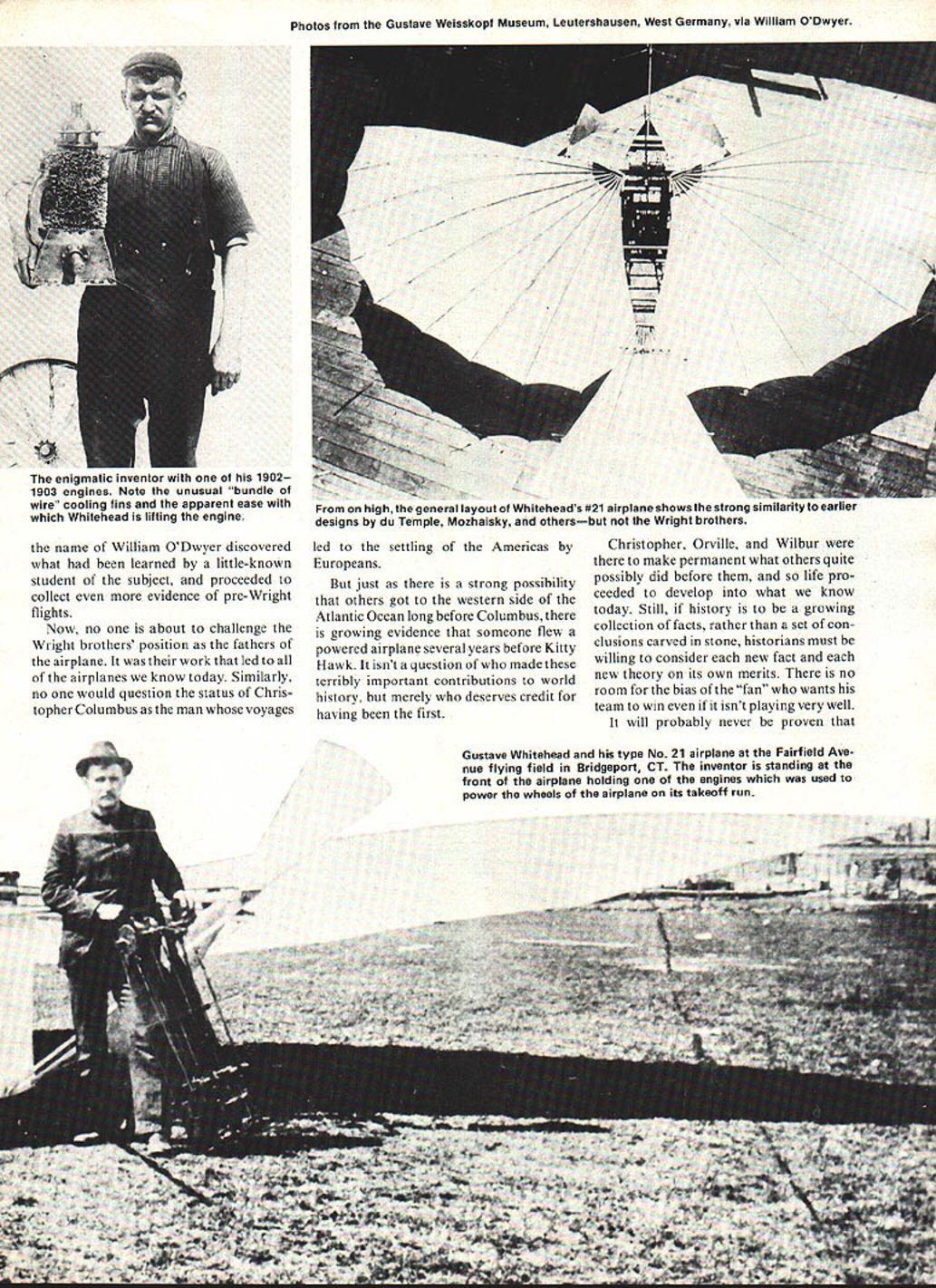
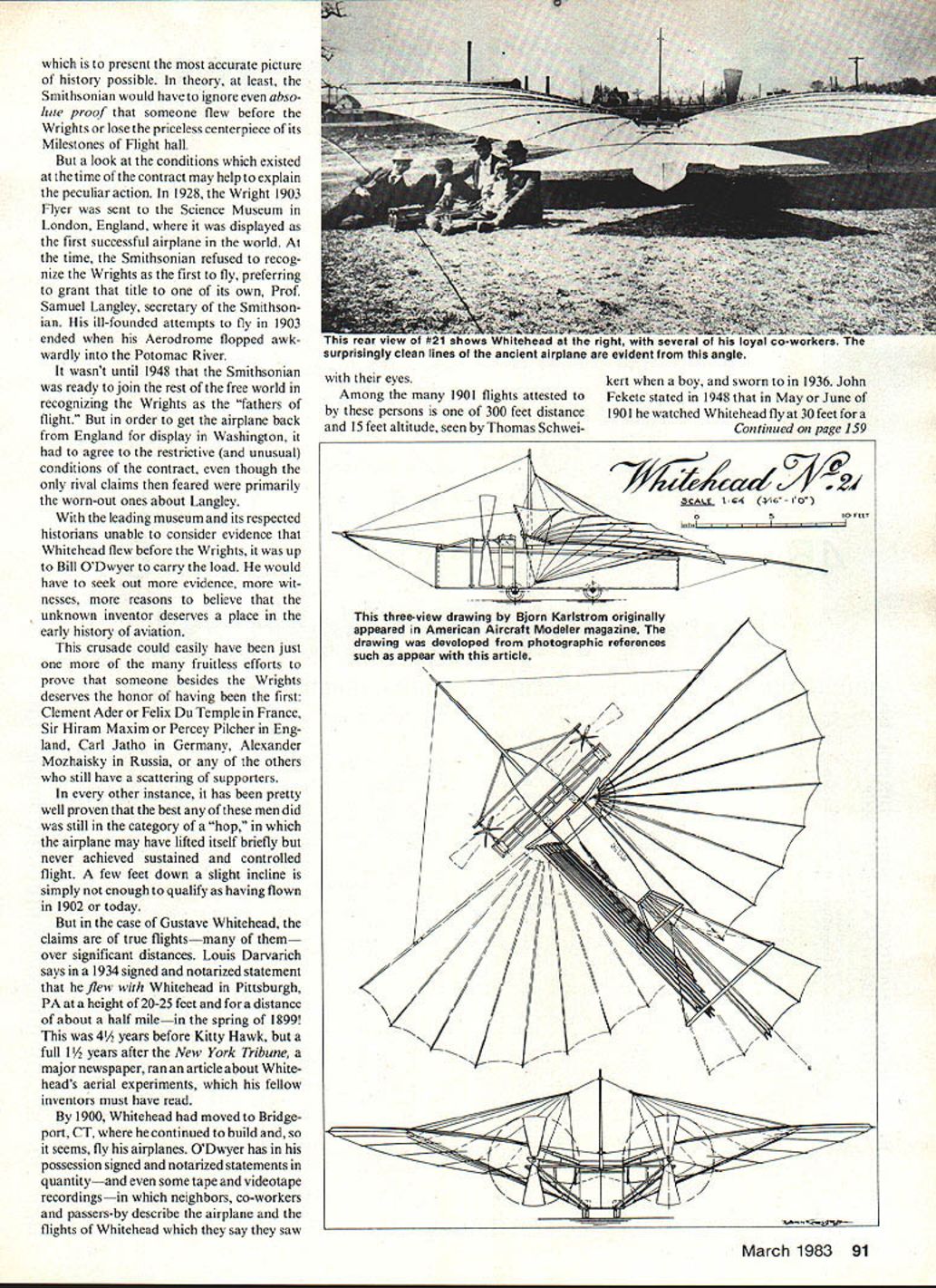
Whitehead's type #21 is the airplane most frequently associated with the reported 1901 flights. Unlike many competitor designs that lack aeronautical logic, #21 appears to be a coherent, flyable monoplane. Many scale models of it have been flown successfully.
The #21 did not spring from nowhere; it was a logical descendant of earlier monoplane ideas and experiments:
- Sir George Cayley (1809/10): published the first known description of the monoplane.
- William Henson (1842): patented an Aerial Steam Carriage — a wire-braced monoplane with a fan-shaped tail and two pusher propellers.
- John Stringfellow (1848): built and flew a 10-foot steam-powered model (reported ~120 feet).
- Count D'Esterno (1864): published a monoplane design with a tapered front wing and fan-shaped tail.
- Felix Du Temple (1874): reportedly lifted a sailor for a short flight down a ramp in a swept-forward monoplane.
- Alexander Mozhaisky (1884): built a large monoplane in Russia that may have made a non-sustaining steam-powered flight.
These earlier designs all featured a wing in front and a tail in the back — a layout later common to many aircraft and also used by Whitehead in #21 (unlike the Wright Flyer).
Whitehead's experiments date back to at least 1897, when he worked on an ornithopter in conjunction with the Boston Aeronautical Society. By 1899–1901 his efforts had moved to fixed-wing aircraft powered by internal combustion or steam engines of his own design. Like other early aviators, he struggled to obtain a lightweight, dependable engine and often built his own.
Later designs and declining fortunes
Whitehead continued to design and exhibit various types after his reported monoplane flights:
- Type #22: a modified version of #21. Whitehead claimed flights of two and seven miles over Long Island Sound on January 17, 1901 (testimony is secondhand). He published a detailed letter in American Inventor describing #22 and included clear ground photographs of #21, inviting the editor to photograph it in flight.
- Type #23 (described 1902–1903): reported to have a single horizontal surface in front, triplane wings in back, and what sounded like a helicopter rotor for vertical takeoff — there is no evidence it ever flew.
- Small powered tractor hang-glider (published dimensions): reported empty weight with engine of 80 pounds; foot-launched and not a major step forward from large monoplanes.
- Bird-like hang-glider (patented 1908): Whitehead built engines on order for other experimenters and exhibited aircraft at Morris Park, NY in November 1908.
- V-tailed biplane (1909/1910): many ground photos exist but no evidence of flight.
- Large helicopter (1911/1912): with 60 two-bladed rotors; failed to lift.
Not much is known about his activities after these experiments. Whitehead died in 1927 at age 53.
Photographs and continuing clues
One intriguing clue is a photograph showing Whitehead's display at the first exhibition of the Aero Club of America in December 1905 (reported in Scientific American, January 27, 1906). On the exhibit wall is what may be a photographic print of one of his 1901 flights, with the airplane airborne. The image is faint and may require computer enhancement to reveal useful detail.
Leads, rumors and fragments of evidence continue to surface, keeping O'Dwyer and others engaged. Some items add important information; others remain inconclusive. Little by little the puzzle is being pieced together, and O'Dwyer believes he is getting closer to knowing what happened in Connecticut shortly after the turn of the 20th century.
Debate, legacy and recognition
Conservative historians often dismiss the Whitehead claims as a "hoax." They possess institutional prestige and established narratives; O'Dwyer has been chipping away at that reluctance with documentary evidence and the help of independent researchers, including Bill Winter, who published a modern article about Whitehead in 1968 in American Aircraft Modeler.
It is hard to imagine a reproduction of Whitehead's #21 supplanting the 1903 Wright Flyer in the National Air & Space Museum. O'Dwyer does not necessarily seek that. He would like to see national credit given to this pioneer who, at the very least, built airplanes as far back as 1901 and who may very possibly have been the first man in history to fly one.
Transcribed from original scans by AI. Minor OCR errors may remain.

