
Hal deBolt's Classic CL Stunters
By Dick Sarpolus
A look at innovator Hal deBolt's tremendous impact on the early days of Control Line flying and the great contribution his designs have made to the sport.
Introduction
CONTROL LINE modelers have been returning to Old-Timer Stunt (OTS) flying in greater numbers. OTS event rules call for aircraft designs dating prior to December 31, 1952, and the aerobatic pattern flown is the one outlined in the 1951–52 AMA rule book.
The popularity of nostalgia and vintage events cuts across modeling categories. Control Line OTS is paralleled by the SAM (Society of Antique Modelers) Old-Timer events in Free Flight and Radio Control. Interest in early RC models prompted the formation of the Vintage Radio Control Society.
Probably one thing that draws modelers to Old-Timer events is the lower level of competitive pressure; contests tend to be more fun-oriented, with emphasis on social gatherings and camaraderie rather than win-at-all-costs competition.
Vintage event cutoffs and categories
- SAM Old-Timer Free Flight and Radio Control: designs originally built no later than December 1942.
- Antique SAM designs: cutoff date December 1938.
- Control Line Old-Timer Stunt: designs must be December 31, 1952, or earlier.
- Vintage R/C Society categories under consideration:
- Early Antique: designs prior to December 31, 1950.
- Early Bird: designs from 1951 through December 1955.
- Vintage: designs from January 1956 through December 1965.
A CL Nostalgia category under discussion would be limited to 25-year-old designs to continually open the door to different aircraft.
Why modelers build old designs
Old-Timer events attract participants of all ages. Modelers often recreate aircraft introduced before they were born or rebuild designs they flew years ago. Modern materials—stronger glues, better coverings and paints, smoother and more powerful engines—mean latter-day versions often fly and perform better than the prototypes. For full authenticity, builders can still use silkspan and dope or reproduce original ignition engines.
Finding plans for vintage models is generally not a problem today; plan reproductions are available from many sources. Everyone involved in nostalgia flight has favorites among the old designs. Among OTS circles, one designer often mentioned is Hal deBolt.
Hal deBolt — overview
Hal deBolt was a long-time competitor, designer, and kit manufacturer and is a deserved member of the AMA Hall of Fame. Though widely known for his RC achievements, he was also active in Control Line and Free Flight and consistently helped other modelers.
deBolt’s CL aircraft designs encapsulate much of the history of CL competition development. Always at the leading edge of technology, his aircraft and their performance helped set the format of competitive events. He favored Speed and Racing events in both CL and RC and became a top Aerobatics competitor with many excellent aircraft.
Early CL days and deBolt's beginnings
deBolt began flying Control Line seriously while serving at the Patuxent River Naval Air Station in Maryland during the 1940s. The Navy Patuxent River Model Engineers club was organized as a recreational activity. Control Line was new then, and designers were still working out lead-out rake, outboard wing tip weight, engine thrust offset, rudder trim, and other underpinnings of successful CL flight.
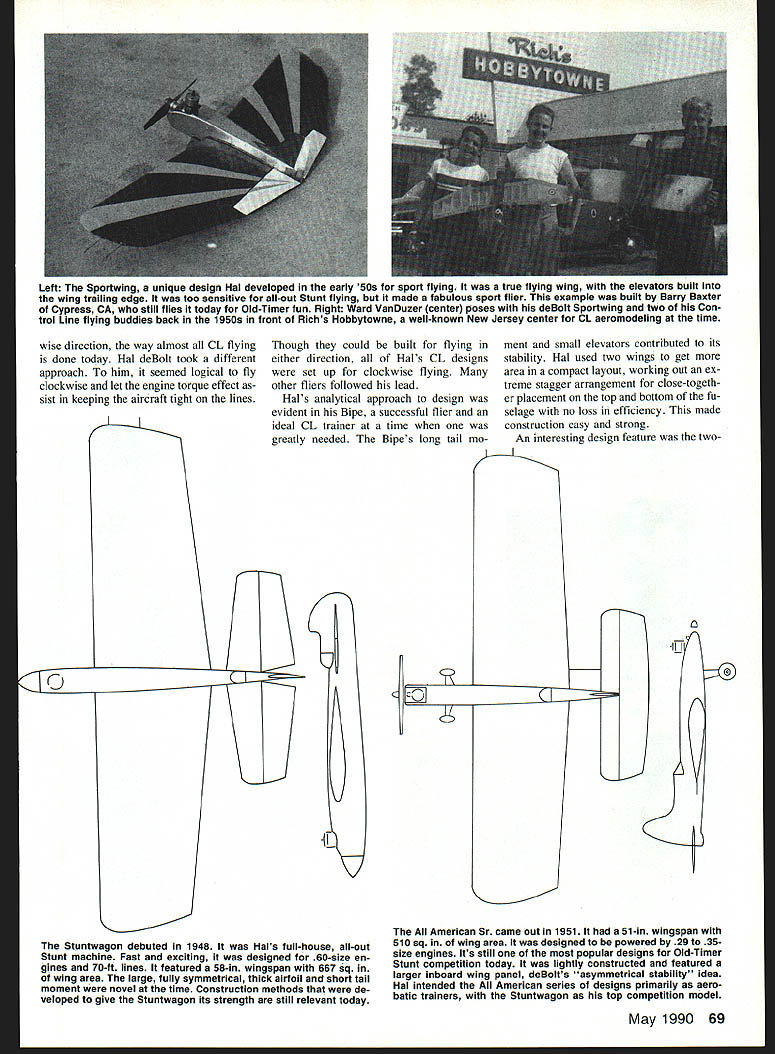
Jim Walker popularized CL flight with demonstrations of his Fireball, flying counterclockwise. deBolt took a different approach and set up his CL designs for clockwise flying, believing engine torque would assist in keeping the aircraft tight on the lines. Many other fliers later followed his lead.
The Bipe and the start of Dmeco
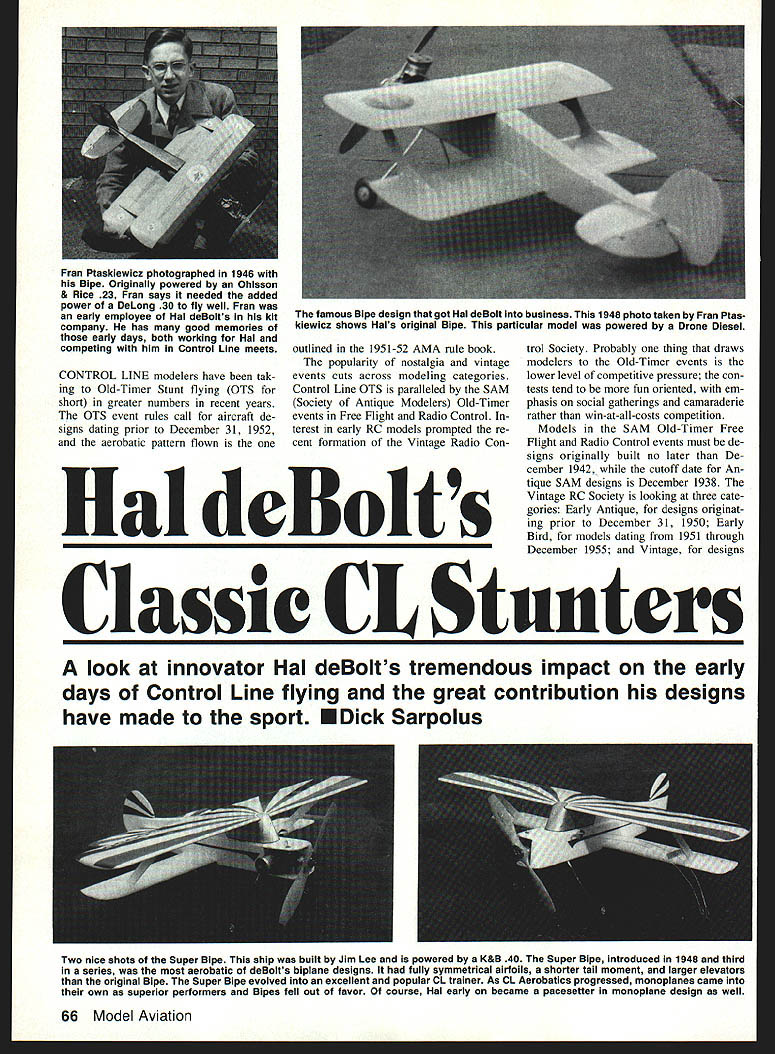
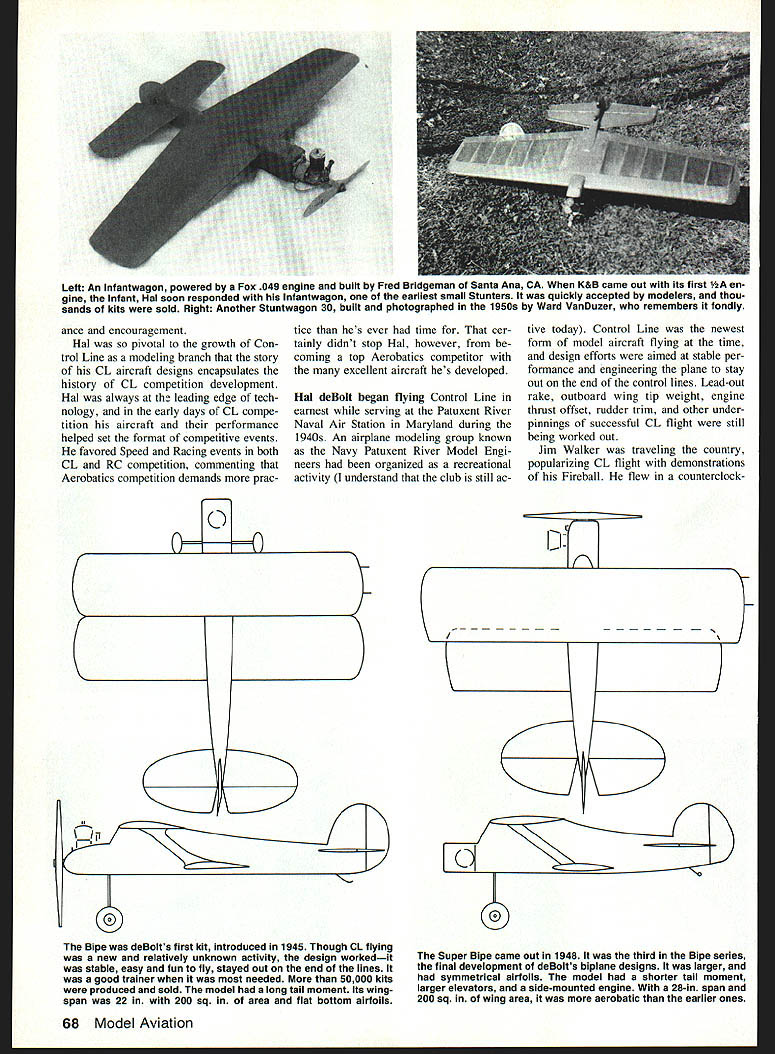
deBolt’s analytical approach showed in his Bipe—an ideal CL trainer when trainers were greatly needed. The Bipe’s long tail moment and small elevators contributed to stability. Using two wings allowed more area in a compact layout; deBolt worked out an extreme stagger for close top-and-bottom wing placement with no loss in efficiency. A notable feature was a two-degree negative incidence setting of the rear wing so the top wing would stall first at slow speeds.
As deBolt approached the end of his military service, a Navy draftsman friend offered to draft the Bipe plans if deBolt would produce the aircraft commercially. deBolt founded Dmeco (deBolt Model Engineering Company) in Buffalo, NY, using his savings of $2,000. Dmeco began producing and advertising Bipe kits in 1945. Orders poured in; with help from his father and others, Dmeco produced only Bipe kits for the next two years and eventually shipped more than 50,000 kits.
Successive Bipe developments:
- New Bipe: increased wing area and symmetrical airfoils.
- Super Bipe (1948): more wing area, thicker symmetrical airfoils, side-mounted engine, and large elevators—more acrobatic than predecessors.
As competitive Aerobatics took hold, modelers shifted toward monoplanes, and deBolt turned to conventional monowing aircraft.
Speed designs and Dmeco Specials
deBolt devoted much CL work toward Speed events. Dmeco produced a line of Dmeco Specials and Speedwagons in different sizes, each incorporating the latest Speed design ideas. Dmeco advertising highlighted wins and promoted the company as "Home of Design-Engineered Models."
Inverted flight and profile construction
Inverted flight was a big breakthrough. When deBolt heard it had been done on the West Coast, he designed a model capable of inverted flight—the Grumman Wildcat scale kit. The Wildcat used a full symmetrical airfoil and a fully built-up, sheeted fuselage for scale appearance.
After a crash during an early attempt at inverted flight, deBolt created a solid wood slab-type fuselage as an interim measure. This profile construction technique—quick to build and fly—became widely adopted. deBolt’s profile Wildcat helped establish profiles in CL design and construction.
The Stuntwagon series
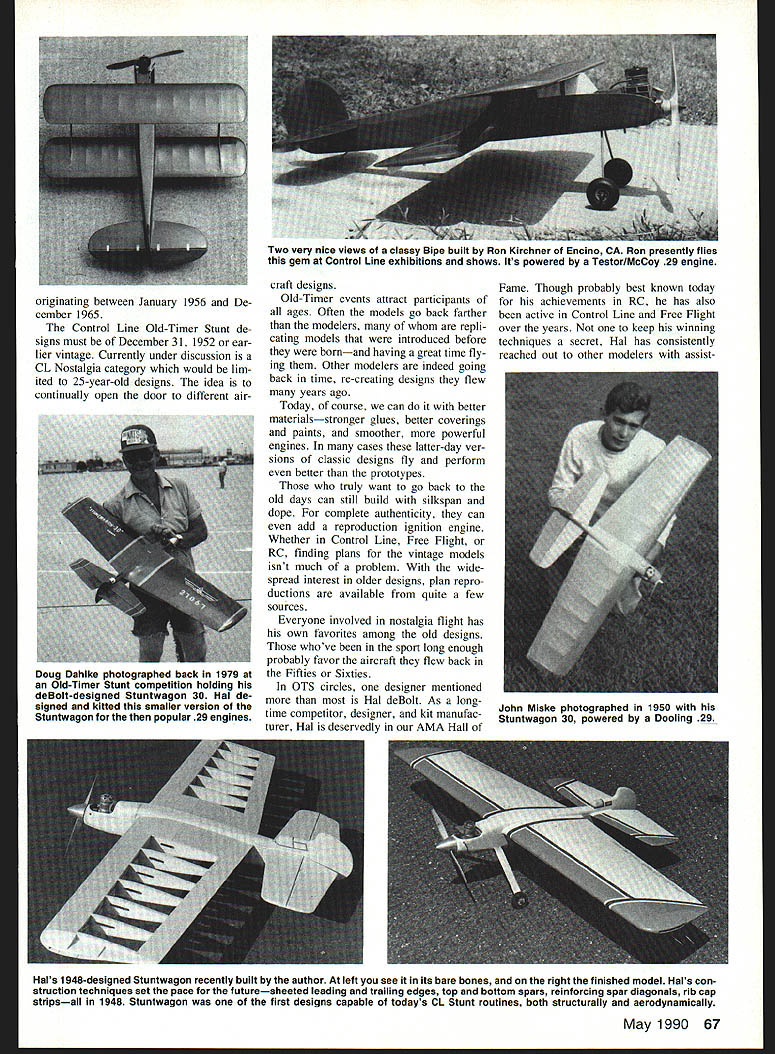
By 1948 deBolt developed the Stuntwagon, one of his most famous designs. Early Aerobatics was fast, furious, and often freestyle. deBolt designed the Stuntwagon to be aerodynamically clean and capable of windy-weather flying. Key features:
- Generous 67 sq. in. wing area.
- Thickened symmetrical airfoil after initial wing failure.
- Drop-off landing gear on early versions for less drag and higher speeds (later versions used fixed sheet-aluminum gear similar to deBolt's All American designs, required for OTS rules).
- Very short tail moment arm with large elevator area for maneuverability.
- Tapered wing planform: straight leading edge, swept-forward trailing edge.
- Construction techniques anticipating modern standards: upper and lower main spars, sheared leading and trailing edges, rib cap strips, and diagonal spar bracing.
- Lightweight engines such as Atwood to achieve high speed on 70-ft lines.
deBolt’s Stuntwagon could be very fast—he recorded 105 mph on his plane versus 85 mph for a rival at one meet.
Subsequent Stuntwagon variants:
- Stuntwagon 30: smaller version for .29 engines.
- Infantwagon: one of the earliest small stunters for the .19 K&B Infant engine—very popular.
- A lighter .35-size version was developed (flew well on 60-ft lines) but was not kitted.
deBolt experimented with wing flaps on a Stuntwagon after news of Palmer’s use of flaps, but they brought no added benefit in his tests—likely due to the short tail moment.
All American series
The All American series was conceived as an introduction to Aerobatics and included four sizes for various engine ratings:
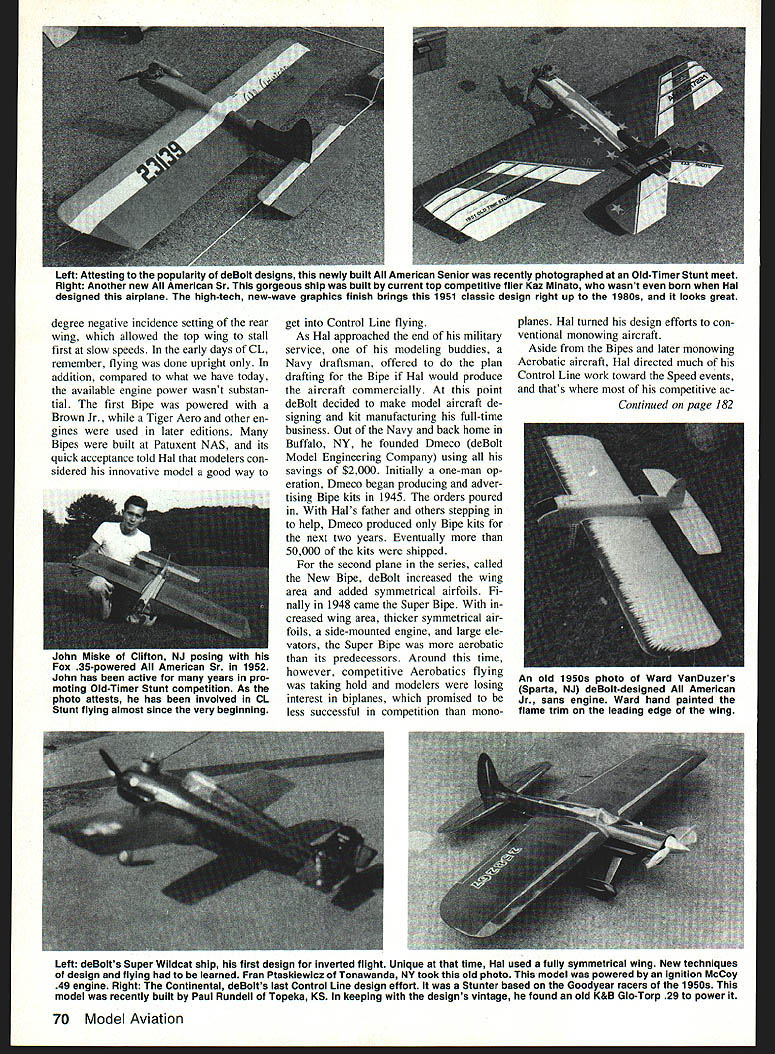
- All American Senior (best known): large wing area, thick airfoil, usually .35 power; easy-to-handle and capable.
- All American Junior: .19-powered version noted as especially pleasant to fly.
- Smaller versions used a profile fuselage and no landing gear; larger versions used full built-up fuselages and sheet-aluminum landing gear.
deBolt considered the All American Senior one of his ultimate Aerobatics competition designs. He noted that his Senior flew better with a Fox .29 than with a Fox .35; the extra power of the .35 made maneuvering more difficult.
A controversial feature of the All Americans was longer inboard wing panels. deBolt theorized moving the fuselage outward on the wing would counterbalance the weight and drag of the control lines and result in lighter, more efficient aircraft. Many builders today adjust lead-out ratios and tip weights to trim All Americans; like many of deBolt’s designs, they were set up for clockwise flying, though most were probably built for the more common counterclockwise direction.
Other notable Dmeco CL designs
- Sportwing: a flying-wing design inspired by 1930s racers with a blended fuselage and wing, stubby nose, tapered swept-forward wing, elevons, and a small fin. Lively for Stunt despite being uncommon.
- A/T Twin: a twin-engine Stunter for .049 engines, styled after the Skyrocket—exciting and easy to build.
- Continental: a medium-sized Stunter for .29–.35 engines, clean in appearance and reminiscent of contemporary Goodyear Pylon Racers. Now seen occasionally in OTS circles.
Dmeco kits and craftsmanship
Dmeco kits were regarded as top quality. Wood and included materials were chosen for the application; parts were well machined and accurate, and plans were clear. deBolt personally tested extensively before incorporating ideas into kits, using only what worked well. He instructed employees to work on each kit as if they would buy it for themselves—no bad wood was used. Design goals emphasized light weight, strength, simplicity of construction, and a minimum of parts. While modern kits include more prefabrication and specialized hardware, for the day Dmeco kits were among the best.
Availability of plans
Though most of deBolt’s CL Aerobatic designs were not published as magazine construction articles, plans for many designs are available today. deBolt arranged for a copyright release of his CL designs to Fran Ptaszkiewicz, an early Dmeco employee, and authorized Fran to sell plan copies.
Contact for plans:
- Fran Ptaszkiewicz, 23 Marlee Drive, Tonawanda, NY 14150.
Personal build and memories
The author recently built deBolt’s 1948 Stuntwagon, powering it with a SuperTiger 46. Modifications and updates included:
- Wing-tip weight compartment.
- Adjustable lead-out guide for trimming.
- Sheet-aluminum landing gear (OTS rules prohibit drop-off gear).
- Muffler for the engine.
- Butyrate dope finish.
Modern glues and hardware improved the build compared to the original. The finished model recaptures the enjoyment of the early days.
deBolt, now living in Florida, and Fran Ptaszkiewicz provided historical details and memories that enriched this article. With help from Mike Keville (PAMPA newsletter editor and OTS enthusiast), photos of deBolt CL aircraft were gathered from modelers across the country.
deBolt's influence and legacy
After shifting from Control Line to Radio Control, deBolt became equally renowned as a top designer and competitor in RC. Though better remembered today for his RC achievements, he remains one of the more influential designers and competitors from the halcyon days of Control Line modeling. His classic CL designs continue to fly.
deBolt deservedly belongs in the AMA Hall of Fame. He kept some winning techniques to himself but consistently reached out to help other modelers. Asked to pick his favorite CL Aerobatic design, he chose the Bipe for starting everything off; for sheer aerobatic performance his loyalty goes to the Big Stuntwagon—its speed, the excitement of 100-mph maneuvering on 70-ft lines, the smoke, and the feel of the airplane make it his favorite.
Anecdotes from Fran Ptaszkiewicz
Fran remembers that most of deBolt’s employees were modelers encouraged to compete. No model building was done during working hours at Dmeco, even by the boss. deBolt often took local youngsters to contests, covering travel and encouraging participation; many camped overnight in tents at meet sites. Fran recalls trips from Buffalo to meets in Cleveland, the Mirror meets in New York, and Nationals in Olathe and Dallas—great years and great times.
At one meet, organizers objected to deBolt’s “professional team.” deBolt agreed not to enter but requested the boys be permitted to fly. Later he served as a Stunt event judge and offered constructive criticism to each flier.
Conclusion
Hal deBolt’s CL designs and kit-building set construction and design standards that anticipated many contemporary techniques: sheeted fuselages, sheeted leading and trailing edges top and bottom, main spars, reinforcing diagonal bracing, and rib cap strips. The 1948 Stuntwagon was one of the first designs structurally and aerodynamically capable of today’s CL Stunt routines. His influence on Control Line modeling endures, and his classic designs will continue to fly for a long time to come.
Transcribed from original scans by AI. Minor OCR errors may remain.

