
Handicap Air Racing
Don Berliner
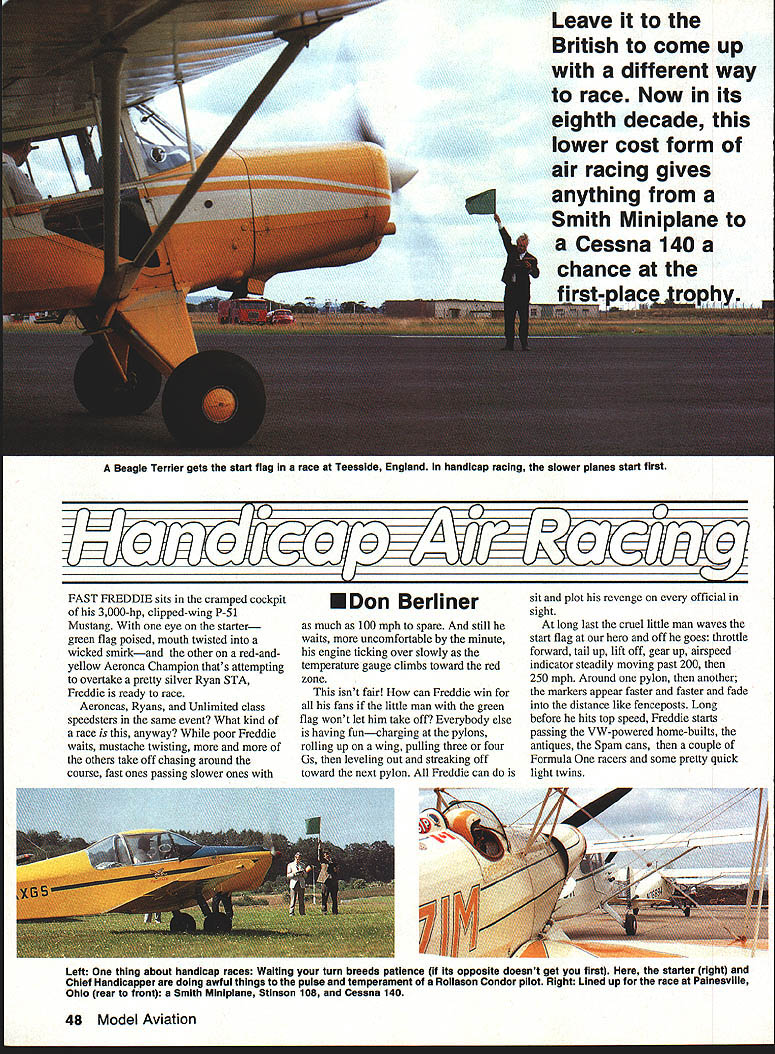
FAST FREDDIE sits in the cramped cockpit of his 3,000-hp, clipped-wing P-51 Mustang, one eye on the starter—green flag poised, mouth twisted into a wicked smirk—and the other on a red-and-yellow Aeronca Champion that's attempting to overtake a pretty silver Ryan STA. Freddie is ready to race.
Aeroncas, Ryans, and Unlimited-class speedsters in the same event? What kind of a race is this, anyway? While poor Freddie waits, mustache twisting, more and more of the others take off, chasing around the course, fast ones passing slower ones with as much as 100 mph to spare. And still he waits, more uncomfortable by the minute, his engine ticking over slowly as the temperature gauge climbs toward the red zone.
This isn't fair! How can Freddie win for all his fans if the little man with the green flag won't let him take off? Everybody else is having fun—charging at the pylons, rolling up on a wing, pulling three or four Gs, then leveling out and streaking off toward the next pylon. All Freddie can do is sit and plot his revenge on every official in sight.
At long last the cruel little man waves the start flag at our hero and off he goes: throttle forward, tail up, lift off, gear up, airspeed indicator steadily moving past 200, then 250 mph. Around one pylon, then another; the markers appear faster and faster and fade into the distance like fenceposts. Long before he hits top speed, Freddie starts passing the VW-powered home-builts, the antiques, the Spam cans, then a couple of Formula One racers and some pretty quick light twins.
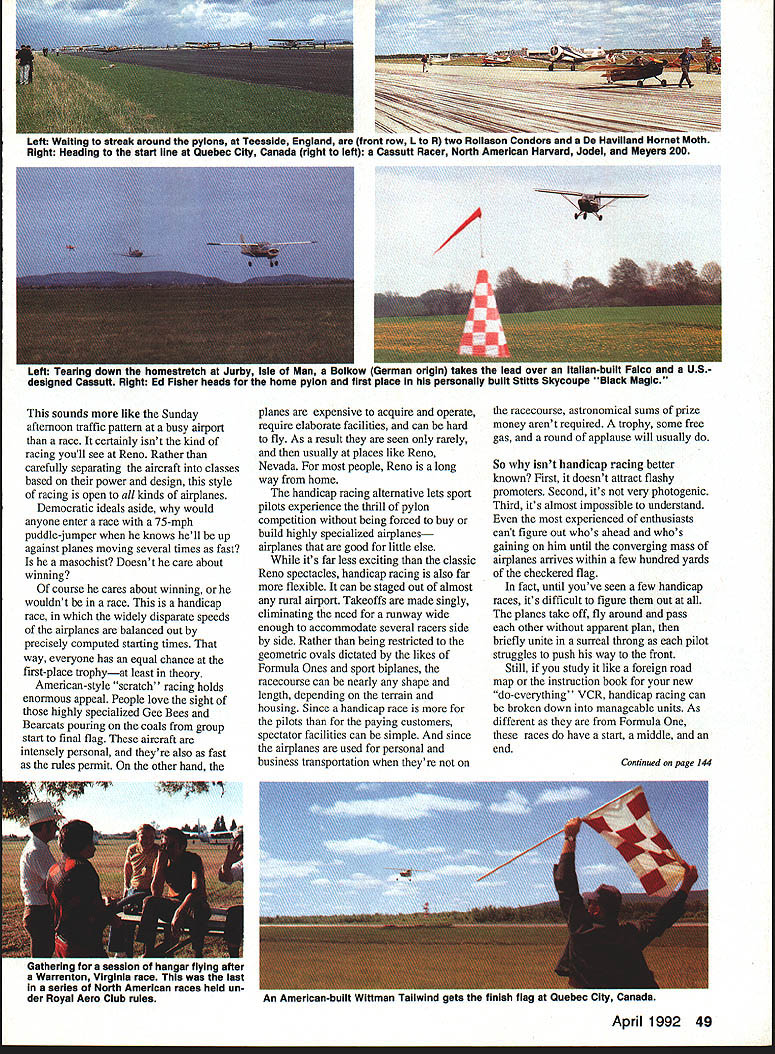
One thing about handicap races: waiting your turn breeds patience; its opposite doesn't get you first. Rather than carefully separating aircraft classes based on power, design and style, handicap racing opens all kinds of airplanes to competition. Democratic ideals aside, would anyone enter a 75-mph puddle-jumper who knows he'll be up against planes moving several times faster? A masochist who doesn't care about winning? Of course not. If the course cares about winning, it wouldn't race that way. In a handicap race, widely disparate-speed airplanes are balanced out by precisely computed starting times so that everyone has an equal chance at the first-place trophy—at least in theory.
American-style scratch racing holds enormous appeal. People love the sight of highly specialized Gee Bees and Bearcats pouring coal in a group start at the final flag. The aircraft are intensely personal; they're also fast, and the rules permit it. On the other hand, those planes are expensive to acquire and operate, require elaborate facilities and can be hard to fly. As a result they are seen rarely, usually in places like Reno, Nevada, and many people live a long way from them. Handicap racing is an alternative that lets sport pilots experience the thrill of pylon competition without being forced to buy and build highly specialized airplanes that are good for little else.
Handicap racing is far less spectacular than the classic Reno spectacles, but it is far more flexible: it can be staged at almost any rural airport. Takeoffs are made singly, eliminating the need for a runway wide enough to accommodate several racers side by side. Rather than being restricted to geometric ovals dictated by the likes of Formula One, the sport-biplane racecourse can be nearly any shape or length depending on terrain and housing. Since handicap race pilots are often paying customers, spectator facilities can be simple; since the airplanes used are personal or business transportation, the racecourse doesn't require astronomical sums of prize money. A trophy, some free gas and a round of applause will usually do.
So isn't handicap racing better known? First, it doesn't attract flashy promoters. Second, it's very photogenic. Third, it's almost impossible to understand. Experienced enthusiasts can't figure out who's ahead or who's gaining on whom until the converging mass of airplanes arrives within a few hundred yards of the checkered flag. In fact, until you've seen a few handicap races it's difficult to figure out how the planes take off, fly around, pass others and then, briefly, unite into a surreal throng as pilots struggle to push their way to the front.
Still, studied like a foreign road map with the instruction book for a new do-everything VCR, handicap racing can be broken down into manageable units. As different as they are from Formula One, these races do have a start, a middle, and an end.
Handicap Racing
The handicap system
Over the years the handicapping system has been refined into a surprisingly accurate instrument. The Chief Handicapper (an official at least as important as a president or prime minister, and just as controversial) knows everything about each airplane in his race—especially its true top speed.
Determining top speed is the basis for the handicapping, and hence it is critical to the fairness of a race. Private notebooks recording years of experience with similar airplanes make the job easier.
The first time a new type of airplane is entered in a race, its top speed is estimated from factory claims, the accuracy of which is adjusted on the basis of earlier claims for other models built by the same firm. Miscalculating this figure by even a few miles per hour, over or under, can make a huge difference in performance, so the plane stands a good chance of either winning big or losing big the first time it is raced.
These estimates can't be made in a locked room filled with incense and computers. Each airplane must be checked on the field to detect any deviations from stock—new fairings, a different propeller or wheel pants, tape-covered gaps between panels. Each small variation adds from 1/2 to 10 or more mph to the estimated top speed, and any failure on the part of the pilot to acknowledge modifications can lead to disqualification. In some respects the race is less between pilots and airplanes than between pilots and the Chief Handicapper.
Once the top speeds of all the entries have been estimated, they are listed in order from slowest to fastest. After that, adjustments are made for the length of the course and the number of turns per lap, since these conditions will affect slow airplanes differently than fast ones. The same holds for the wind: slow aircraft lose a greater percentage of their speed to a high wind than do faster planes. Finally, a correction is applied for the time it takes each plane to accelerate to top speed.
The officials use these figures to calculate the time it should take each plane to fly the entire race, then base the handicaps on that calculation. If the slowest racer—say, a Volksplane—should require 28 minutes 41 seconds to complete the race, and the next slowest, an EAA biplane, has an estimated time of 27 minutes 9 seconds, the Volksplane is assigned a handicap equal to the difference between the two—1 minute 32 seconds. This system continues on down the line.
If the Chief Handicapper has done his job perfectly, if the pilots possess equal skill and determination, if the wind doesn't change, if all the engines produce full power for the entire race, and if nobody gets lost, then all the airplanes should cross the finish line at the same time. Fortunately, that never happens; the planes always manage to get strung out along the final dash to the flag. Nonetheless, there have been some wonderfully close finishes, with a half-dozen airplanes crossing the line in three or four seconds' time.
Race dynamics
Now you know why Fast Freddie sits twitching and fiddling in the cockpit of his parked Mustang. The Cubs and Luscombes have long since gotten the starter's flag and are on their way around the course, while faster planes catch up with them one by one. Since the race is for six laps around a 15-mile, five-pylon course, poor old Freddie is forced to sit there and watch the slowest planes start their fourth lap before his chance to show the world how great he is.
Once on the course and up to speed, Freddie has about a lap and a half during which to pass all the other pilots at least once and many of them several times. This means flying wide so he can go by slower airplanes without having to maneuver in and out of traffic. Flying a wide course adds distance to his race and thus provides an additional handicap of sorts. But any pilot as superior as Freddie should be able to cope with a little extra challenge.
Since the slow airplanes jump into what appears to be a big lead, the race quickly becomes confusing. Will the slowpokes flying their 90-mph assemblies of wood and cloth be able to hold off the high-tech types in their powerful, streamlined beasts? And how can you tell if the fast planes are gaining on the slow ones at a rate that will enable them to become victorious? Apparently, you can't. That's part of the fun of watching a handicap race: nobody knows until the very last moment if good ol' Harvey in his ratty Tri-Pacer can keep Dr. Hyphenated-Last-Name in the Bonanza from slipping by him.
Origins and history
Although handicap air races have been run in America with limited success, the form originated in England in 1912 as a way around a shortage of legitimate racers that at that time made class racing impossible. (Formula One wasn't imported by Great Britain until 1970.) Pilots could indulge in a bit of Sunday afternoon sport in their personal Austers, Tiger Moths and Cherokees without the bother of a lot of fancy advance preparations. A fresh coat of wax and some duct tape, and they were ready to race.
The King's Cup, the British counterpart of America's Thompson and Bendix air racing trophies, was first presented in 1922 by King George V to a pilot who had flown a World War I surplus D.H.4 at a dizzying 124 mph around the 80-mile course. Subsequent recipients included airplanes built by such hallowed names as Miles, Percival, Blackburn, and Gloster. Whether the winning airplane was the fastest or the slowest, the pilot in the cockpit was nearly always one of the best.
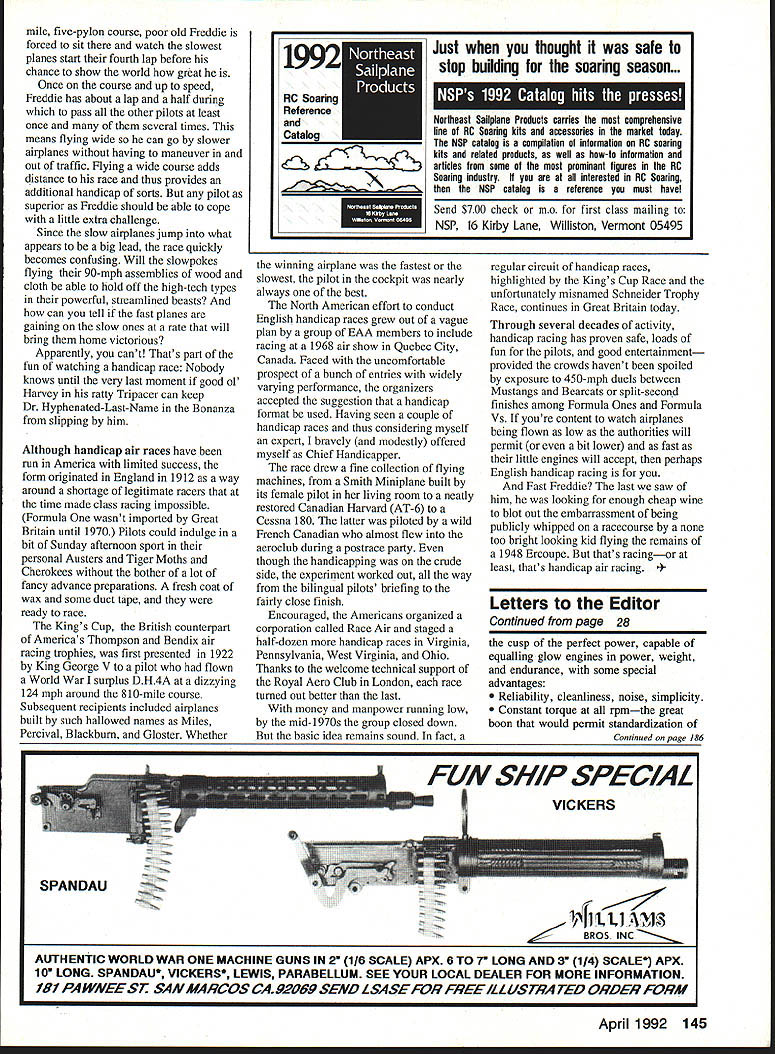
The North American effort to conduct English handicap races grew out of a vague plan by a group of EAA members to include racing at a 1968 air show in Quebec City, Canada. Faced with the uncomfortable prospect of a bunch of entries with widely varying performance, the organizers accepted the suggestion that a handicap format be used. Having seen a couple of handicap races and thus considering myself an expert, I bravely (and modestly) offered myself as Chief Handicapper.
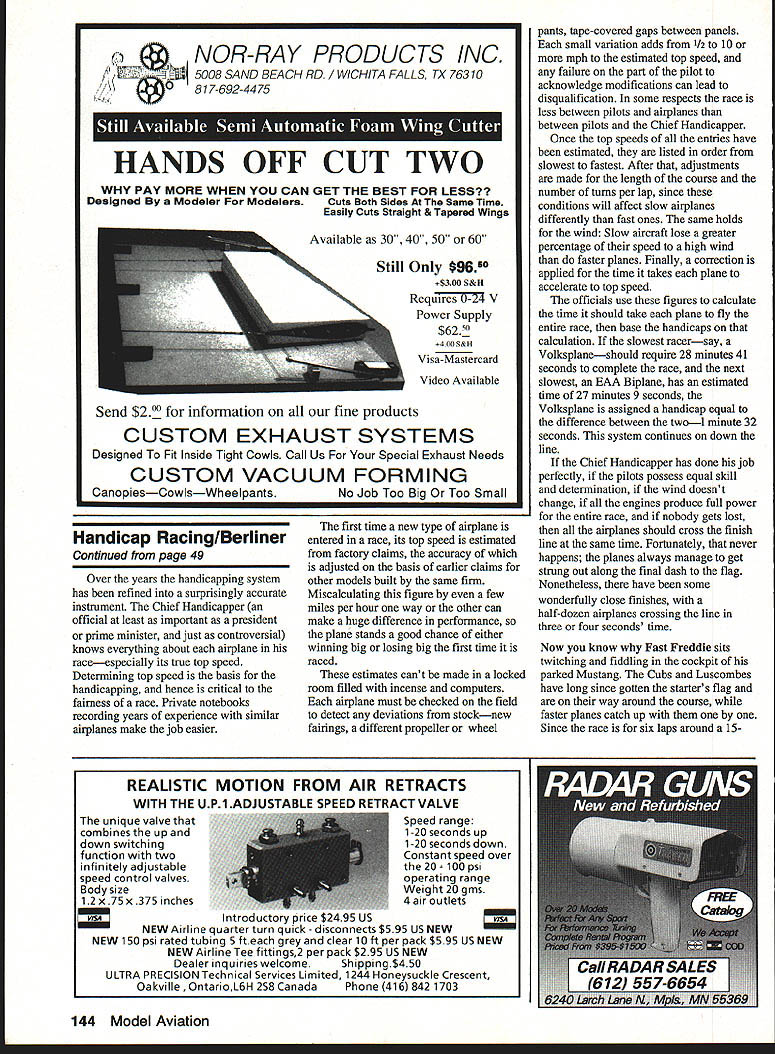
The race drew a fine collection of flying machines, from a Smith Miniplane built by its female pilot in her living room to a neatly restored Canadian Harvard (AT-6) to a Cessna 180. The latter was piloted by a wild French Canadian who almost flew into the aerobatic box during a postrace party. Even though the handicapping was on the crude side, the experiment worked out, all the way from the bilingual pilots' briefing to the fairly close finish.
Encouraged, the Americans organized a corporation called Race Air and staged a half-dozen more handicap races in Virginia, Pennsylvania, West Virginia, and Ohio. Thanks to the welcome technical support of the Royal Aero Club in London, each race turned out better than the last. With money and manpower running low, by the mid-1970s the group closed down. But the basic idea remains sound. In fact, a regular circuit of handicap races, highlighted by the King's Cup Race and the unfortunately misnamed Schneider Trophy Race, continues in Great Britain today.
Conclusion
Through several decades of activity, handicap racing has proven safe, loads of fun for the pilots, and good entertainment—provided the crowds haven't been spoiled by exposure to 450-mph duels between Mustangs and Bearcats or split-second finishes among Formula Ones and Formula Vs. If you're content to watch airplanes being flown as low as the authorities will permit (or even a bit lower) and as fast as their little engines will accept, then perhaps English handicap racing is for you.
And Fast Freddie? The last we saw of him, he was looking for enough cheap wine to blot out the embarrassment of being publicly whipped on a racecourse by a none-too-bright-looking kid flying the remains of a 1948 Ercoupe. But that's racing—or at least, that's handicap air racing.
Transcribed from original scans by AI. Minor OCR errors may remain.

