
Hanno Prettner: Ambassador For Aeromodeling
Conclusion of a two-part article. David Boddington
Long a bellwether in RC aerobatics, multitime World Champion Hanno Prettner is as warm and personable face-to-face as he is hard-driving in the pattern arena. He's an ideal spokesman for modelers everywhere.
PART ONE of this two-part article (April 1991 Model Aviation) traced Hanno Prettner's rise from a seven-year-old who fell instantly in love with modeling to the professional RC aerobatics flier and virtually invincible World Champion he is today. Hanno's bold experiments in model design and his hugely successful kits and engines are discussed in this concluding segment, which focuses on Hanno Prettner as an ambassador for the sport of aeromodeling.
Background and family
As one of the few—and possibly the only—professional RC aerobatics modelers in the world, Hanno divides his efforts between European and international competition and demonstration flying. When he's not crisscrossing the globe to take part in these activities, Hanno spends much of his time introducing modeling to youth in his native Austria.
Highlights and achievements:
- Eight-time winner of the Las Vegas Tournament of Champions.
- Six-time F3A World Champion.
Hanno is a rare combination of virtuosity and modesty. Always open to questions, he's approachable, level-headed and friendly — everything that a good ambassador should be.
Hanno has been extremely lucky in having a loving, supportive family throughout his 39 years. His father, Hans, encouraged him to build his first free-flight plane—and shared his excitement in seeing it fly. Father and son have been modeling together ever since, with Hans serving as helper at competitions. It's impossible to imagine Hanno on the flight line without Hans.
Hanno's mother, Adi, and his wife, Christel, have been equally generous with their support. The Prettner household in Klagenfurt, Austria, is organized around Hanno's rigorous schedule and frequent travels. Four-year-old Hanno Jr., by the way, already shows precocious skills in driving RC cars.
Youth outreach programs
Hanno is totally committed to bringing more young people into the hobby. With the support of Austria's largest newspaper, he organized a competition in building and flying a simple "chuck" glider. The newspaper donated double-page spreads for promotion; the children were told how to enter the competition and how to build, trim and fly the model. Age-group categories ranged from six to eight years through thirteen to fifteen years. In one town alone, over a thousand glider kits were given away, and 250 were built for the contest.
Major model companies cosponsored the competition. Fabulous prizes for the top three entries in each age group included Graupner and JR radios, engines, kits and accessories. No one went away empty-handed: those not awarded a prize received a certificate of participation indicating that they had flown successfully in the contest.
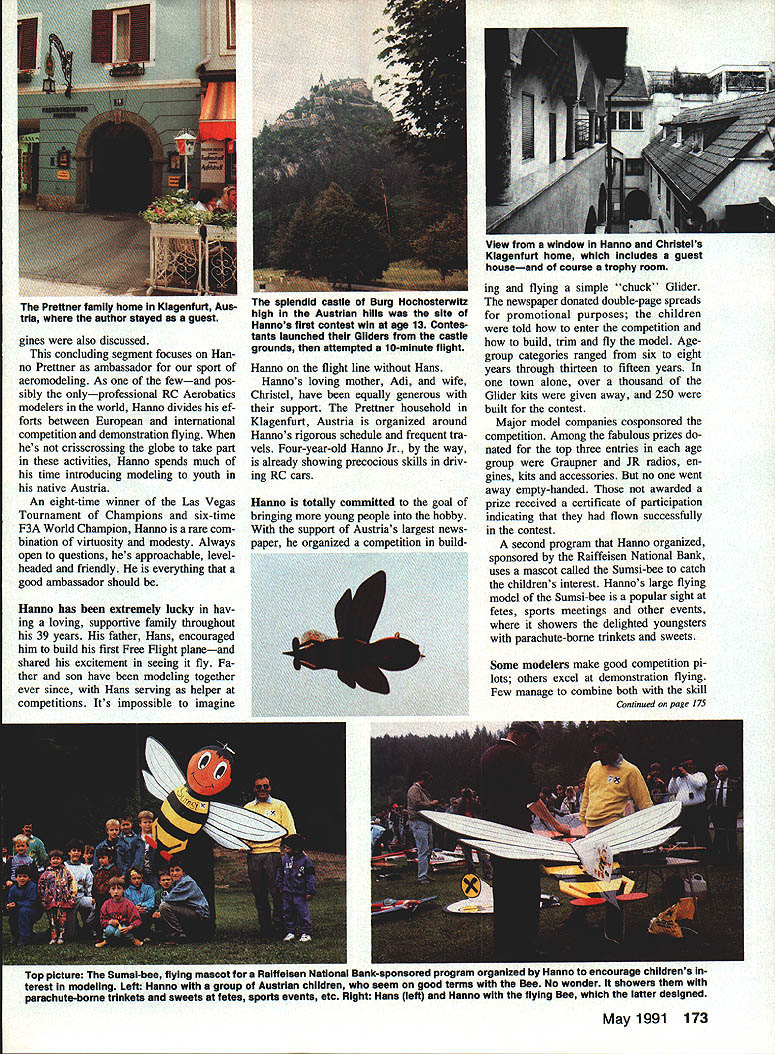
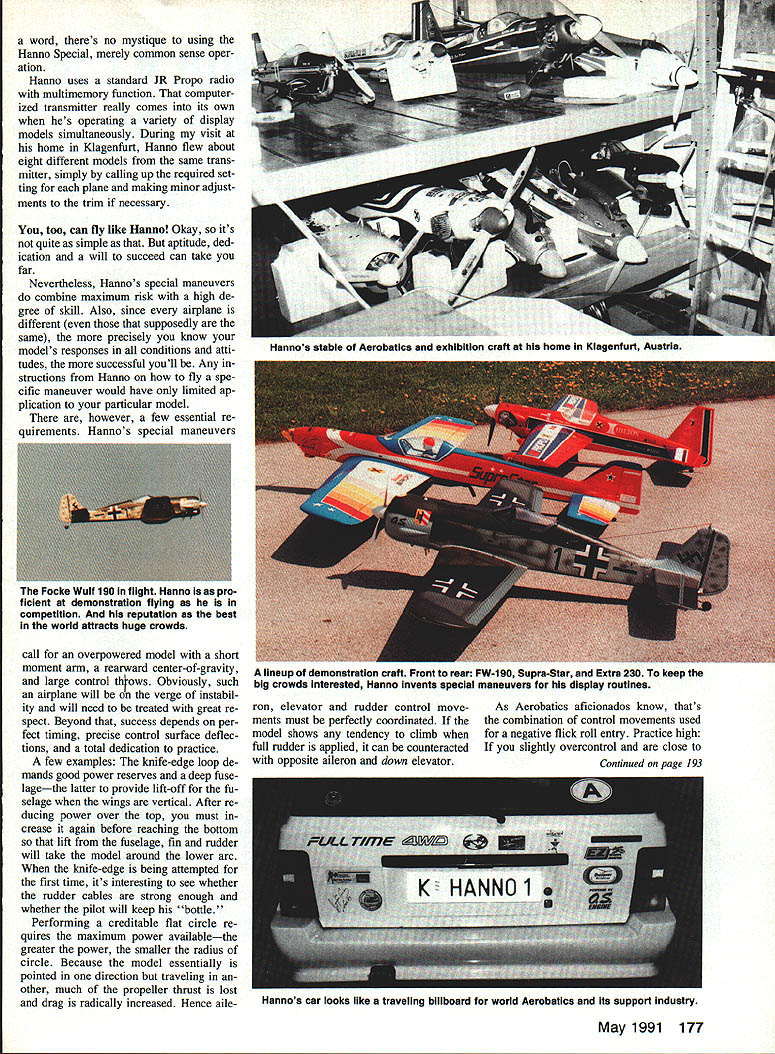
A second program, sponsored by the Raiffeisen National Bank, uses a mascot called the Sumsi-bee to catch the children's interest. Hanno's large flying model of the Sumsi-bee is a popular sight at fetes, sports meetings and other events, where it showers delighted youngsters with parachute-borne trinkets and sweets.
Competition and exhibition flying
Some modelers make good competition pilots; others excel at demonstration flying. Few manage to combine both with the skill and panache Hanno demonstrates. The pressures are intense, though of a different nature from competition. When you're advertised as the best in the world, an audience has high expectations — and Hanno's sponsors expect him to show their products in the best possible light.
Hanno's exhibition flying draws huge crowds, often many thousands strong. His challenge is to please both knowledgeable modelers and casual spectators—to demonstrate precision aerobatics at its best while still being entertaining. It's a delicate balancing act.
One way Hanno keeps his audience interested is by adding unique maneuvers to his aerobatics menu, among them:
- Hanno Screw
- Helicopter Spin
- Horizontal Lomcevak
- Knife-edge Loop
While not appropriate for full-size airplanes, which lack the power-to-weight ratio necessary to perform them, these maneuvers are beginning to gain acceptance in specialized competitions such as the Tournament of Champions.
Whether his fellow competitors can successfully execute Hanno's advanced maneuvers is another matter. If they fail, it won't be for want of information or hardware: Hanno is always ready to share his knowledge and experience.
Designs, equipment and sharing knowledge
Faithful copies of his designs are commercially available in the EZ series (Pilot kits). It should be noted, however, that Hanno usually increases engine size for maximum display performance. Hanno's specially modified O.S. engine is also available to the modeler: the Hanno Prettner Special long-stroke, two-stroke .60 will perform like the one he uses.
There is no mystique to using the Hanno Special — merely common-sense operation. There are no special selection rituals, no magic fuel ingredient, no stripping and reworking of the engine.
Hanno uses a standard JR Propo radio with multimemory function. That computerized transmitter really comes into its own when he's operating a variety of display models simultaneously. During a visit to his home in Klagenfurt, Hanno flew about eight different models from the same transmitter, simply by calling up the required setting for each plane and making minor trim adjustments if necessary.
Requirements and cautions for special maneuvers
You, too, can learn these maneuvers — but they demand aptitude, dedication and will. Hanno's special maneuvers combine maximum risk with a high degree of skill. Because every airplane is different, instructions for one model will have only limited application to another. Still, a few essential requirements apply:
- An overpowered model.
- A short moment arm.
- A rearward center of gravity.
- Large control throws.
Such an airplane will be on the verge of instability and must be treated with great respect. Beyond setup, success depends on perfect timing, precise control-surface deflections and total dedication to practice.
Examples and notes:
- Knife-edge loop: Requires good power reserves and a deep fuselage to provide lift when the wings are vertical. Reduce power over the top and increase it again before the bottom so fuselage, fin and rudder lift will carry the model around the lower arc. When attempting this for the first time, check rudder cable strength and whether the pilot can maintain composure.
- Flat circle: Demands maximum available power — the greater the power, the smaller the radius. Because the model is pointed in one direction but traveling in another, much thrust is lost and drag increases dramatically. Aileron, elevator and rudder must be perfectly coordinated. If the model tends to climb with full rudder, counteract with opposite aileron and down elevator.
As aerobatics aficionados know, that combination of control movements is also used for a negative flick roll entry. Practice to a high standard: if you slightly overcontrol and are close to the ground, you have only about a tenth of a second to avoid disaster. Never attempt exhibition flying of these special maneuvers until you have perfected them beyond any chance of mishap.
Experiments, collection and outlook
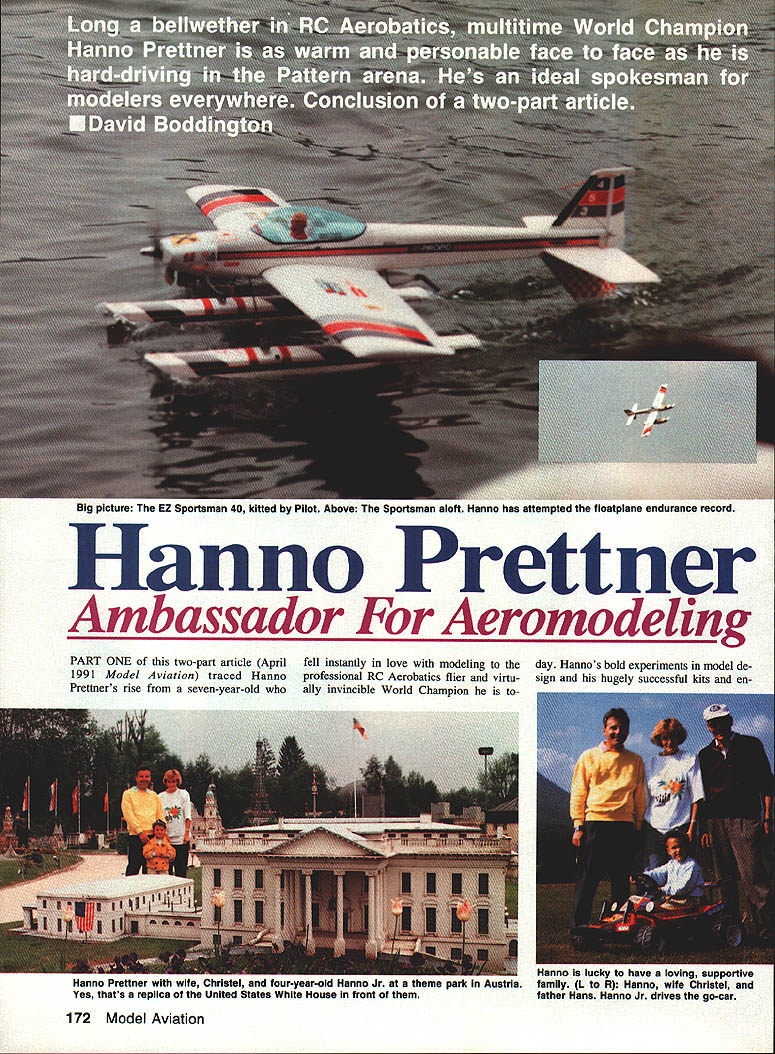
Hanno obviously enjoys modeling, and the pride he takes in doing it spurs his accomplishments. An experimental sort, he has built the world's smallest RC-powered delta-wing model, attempted the floatplane endurance record, and flown a Toffee Bomber at village fetes.
His collection of RC models is eclectic: beyond his mainstay aerobatics planes he has gliders and nearly every type of fun model imaginable — seaplanes, scale models, monoplanes, biplanes, delta-wings, minimodels and maximodels. If critics were as catholic in their tastes as Hanno, they'd have less time to complain.
Hanno has no immediate plans to retire from competition. When that day comes, it's safe to predict he will use the extra time for designing, building and flying. Even today, Hanno never loses sight of the personal satisfactions that modeling brings.
The complete aeromodeler, Hanno Prettner is secure in his position as our hobby's most influential ambassador.
Transcribed from original scans by AI. Minor OCR errors may remain.

