
Hanno Prettner: World Aerobatics Champion
By David Boddington
Overview
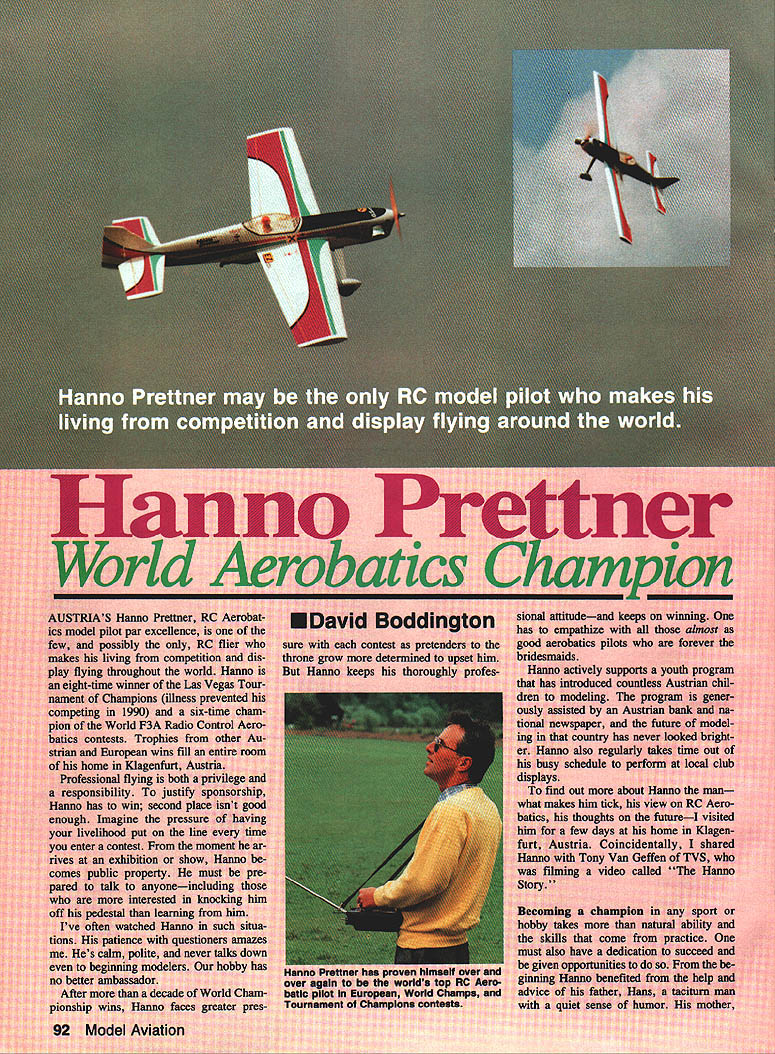
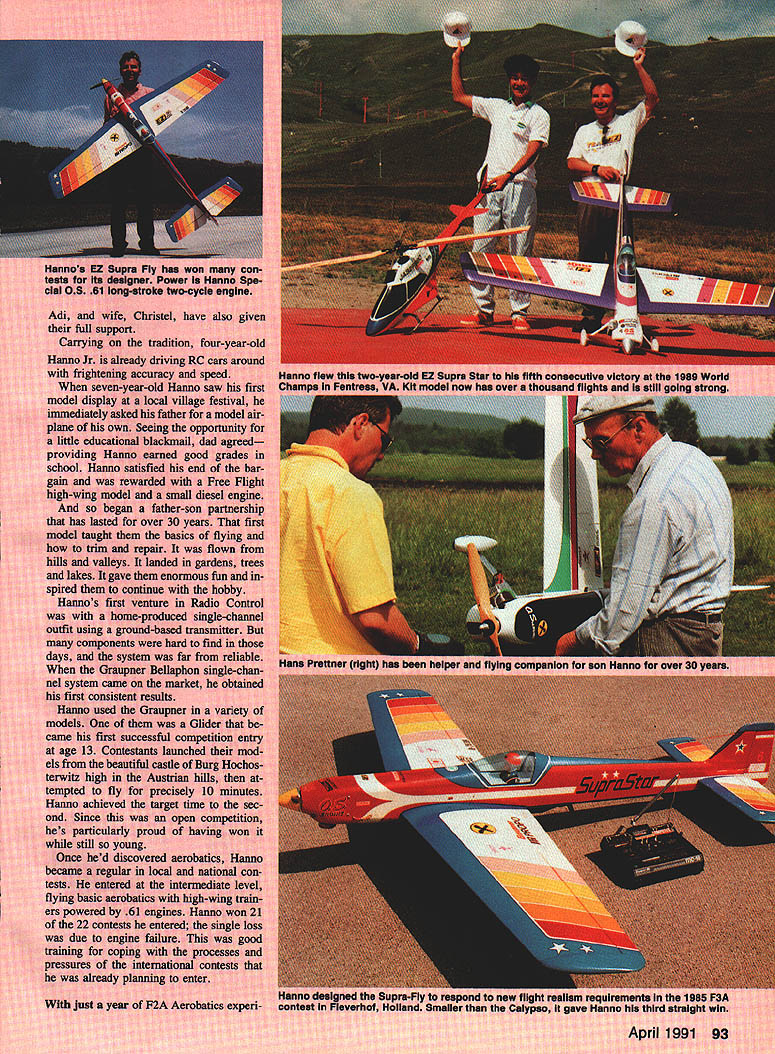
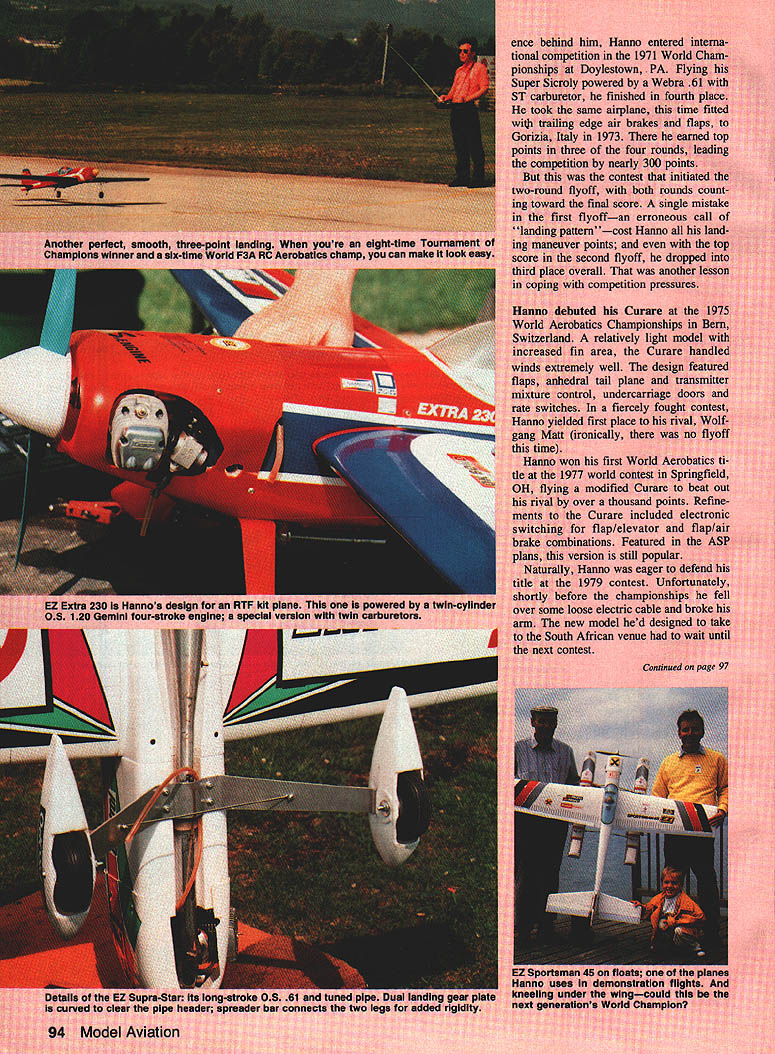
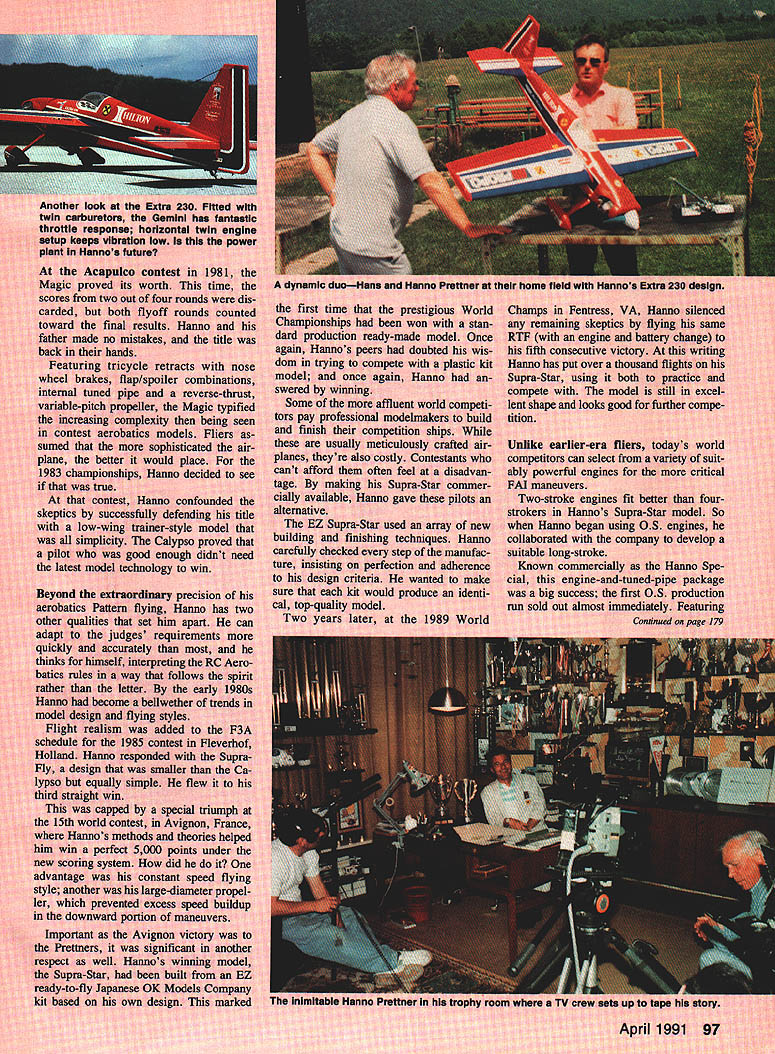
Austria's Hanno Prettner, RC aerobatics model pilot par excellence, is one of the few — and possibly the only — RC fliers who makes his living from competition and display flying around the world. Hanno is an eight-time winner of the Las Vegas Tournament of Champions (illness prevented his competing in 1990) and a six-time champion of the World F3A Radio Control Aerobatics contests. Trophies from other Austrian and European wins fill an entire room of his home in Klagenfurt, Austria.
Professional flying is both a privilege and a responsibility. To justify sponsorship, Hanno has to win; second place isn't good enough. Imagine the pressure of having your livelihood on the line every time you enter a contest. From the moment he arrives at an exhibition or show, Hanno becomes public property. He must be prepared to talk to anyone — including those who are more interested in knocking him off his pedestal than learning from him.
I've often watched Hanno in such situations. His patience with questioners amazes me. He's calm, polite, and never talks down even to beginning modelers. Our hobby has no better ambassador.
After more than a decade of World Championship wins, Hanno faces greater pressure with each contest as pretenders to the throne grow more determined to upset him. But Hanno keeps his thoroughly professional attitude — and keeps on winning. One has to empathize with all those almost-as-good aerobatics pilots who are forever the bridesmaids.
Hanno actively supports a youth program that has introduced countless Austrian children to modeling. The program is generously assisted by an Austrian bank and many newspapers, and the future of modeling in that country has never looked brighter. Hanno also regularly takes time out of his busy schedule to perform at local club displays.
To find out more about Hanno the man — what makes him tick, his view on RC aerobatics, his thoughts on the future — I visited him for a few days at his home in Klagenfurt, Austria. Coincidentally, I shared Hanno with Tony Van Geffen of TVS, who was filming a video called "The Hanno Story."
Early life and beginnings
Becoming a champion in any sport or hobby takes more than natural ability and the skills that come from practice. One must also have dedication and be given opportunities to succeed. From the beginning Hanno benefited from the help and advice of his father, Hans, a taciturn man with a quiet sense of humor. His mother and his wife, Christel, have also given their full support.
Carrying on the tradition, four-year-old Hanno Jr. is already driving RC cars around with frightening accuracy and speed.
When seven-year-old Hanno saw his first model display at a local village festival, he immediately asked his father for a model airplane of his own. Seeing the opportunity for a little educational blackmail, Dad agreed — providing Hanno earned good grades in school. Hanno satisfied his end of the bargain and was rewarded with a free-flight high-wing model and a small diesel engine.
That first model taught him the basics of flying and how to trim and repair. It was flown from hills and valleys, landing in gardens, trees and lakes. It gave them enormous fun and inspired them to continue with the hobby.
Hanno’s first venture in radio control was with a home-produced single-channel outfit using a ground-based transmitter. Many components were hard to find in those days, and the system was far from reliable. When the Graupner Bellaphon single-channel system came on the market, he obtained his first consistent results.
Hanno used the Graupner in a variety of models. One was a glider that became his first successful competition entry at age 13. Contestants launched their models from the beautiful castle of Burg Hochosterwitz high in the Austrian hills, then attempted to fly for precisely 10 minutes. Hanno achieved the target time to the second. Since this was an open competition, he’s particularly proud of having won it while still so young.
Once he discovered aerobatics, Hanno became a regular in local and national contests. He entered at the intermediate level, flying basic aerobatics with high-wing trainers powered by .61 engines. Hanno won 21 of the 22 contests he entered; the single loss was due to engine failure. This was good training for coping with the processes and pressures of the international contests he was already planning to enter.
With just a year of F2A aerobatics experience behind him, Hanno entered international competition in the 1971 World Championships at Doylestown, PA. Flying his Super Sicroly powered by a Webra .61 with ST carburetor, he finished in fourth place.
Rise to world champion
He took the same airplane, this time fitted with trailing-edge air brakes and flaps, to Gorizia, Italy in 1973. There he earned top points in three of the four rounds, leading the competition by nearly 300 points. But this was the contest that initiated the two-round flyoff, with both rounds counting toward the final score. A single mistake in the first flyoff — an erroneous call of "landing pattern" — cost Hanno all his landing maneuver points; and even with the top score in the second flyoff, he dropped into third place overall. That was another lesson in coping with competition pressures.
Hanno debuted his Curare at the 1975 World Aerobatics Championships in Bern, Switzerland. A relatively light model with increased fin area, the Curare handled winds extremely well. The design featured flaps, anhedral tail plane and transmitter mixture control, undercarriage doors and rake switches. In a fiercely fought contest, Hanno yielded first place to his rival Wolfgang Matt (ironically, there was no flyoff that time).
Hanno won his first World Aerobatics title at the 1977 world contest in Springfield, OH, flying a modified Curare to beat out his rival by over a thousand points. Refinements to the Curare included electronic switching for flap/elevator and flap/air-brake combinations. Featured in the ASP plans, this version remains popular.
Naturally, Hanno was eager to defend his title at the 1979 contest. Unfortunately, shortly before the championships he fell over some loose electric cable and broke his arm. The new model he'd designed to take to the South African venue had to wait until the next contest.
At the Acapulco contest in 1981, the Magic proved its worth. This time, the scores from two out of four rounds were discarded, but both flyoff rounds counted toward the final results. Hanno and his father made no mistakes, and the title was back in their hands.
Featuring tricycle retracts with nosewheel brakes, flap/spoiler combinations, internal tuned pipe and a reverse-thrust, variable-pitch propeller, the Magic typified the increasing complexity then being seen in contest aerobatics models. Fliers assumed that the more sophisticated the airplane, the better it would place.
For the 1983 championships, Hanno confounded the skeptics by successfully defending his title with a low-wing trainer-style model that was all simplicity. The Calypso proved that a pilot who was good enough didn't need the latest model technology to win.
Beyond the extraordinary precision of his aerobatics pattern flying, Hanno has two other qualities that set him apart. He can adapt to the judges' requirements more quickly and accurately than most, and he thinks for himself, interpreting the RC aerobatics rules in a way that follows the spirit rather than the letter. By the early 1980s Hanno had become a bellwether of trends in model design and flying styles.
Flight realism was added to the F3A schedule for the 1985 contest in Flevohof, Holland. Hanno responded with the Supra-Fly, a design that was smaller than the Calypso but equally simple. He flew it to his third straight win.
This was capped by a special triumph at the 15th world contest in Avignon, France, where Hanno's methods and theories helped him win a perfect 5,000 points under the new scoring system. One advantage was his constant-speed flying style; another was his large-diameter propeller, which prevented excess speed buildup in the downward portion of maneuvers.
Important as the Avignon victory was to the Prettners, it was significant in another respect as well. Hanno's winning model, the Supra-Star, had been built from an EZ ready-to-fly Japanese OK Models Company kit based on his own design. This marked the first time that the prestigious World Championships had been won with a standard production ready-made model. Once again, Hanno's peers had doubted his wisdom in trying to compete with a plastic kit model; and once again, Hanno answered by winning.
Some of the more affluent world competitors pay professional modelmakers to build and finish their competition ships. While these are usually meticulously crafted airplanes, they're also costly. Contestants who can't afford them often feel at a disadvantage. By making his Supra-Star commercially available, Hanno gave these pilots an alternative.
The EZ Supra-Star used an array of new building and finishing techniques. Hanno carefully checked every step of the manufacture, insisting on perfection and adherence to his design criteria. He wanted to make sure that each kit would produce an identical, top-quality model.
Two years later, at the 1989 World Champs in Fentress, VA, Hanno silenced any remaining skeptics by flying his same Supra (with an engine and battery change) to his fifth consecutive victory. At this writing Hanno has put over a thousand flights on his Supra-Star, using it both to practice and compete with. The model is still in excellent shape and looks good for further competition.
Models, engines and technical innovations
Unlike earlier-era fliers, today's world competitors can select from a variety of suitably powerful engines for the more critical FAI maneuvers. Two-stroke engines fit better than four-strokers in Hanno's Supra-Star model. So when Hanno began using O.S. engines, he collaborated with the company to develop a suitable long-stroke.
Known commercially as the Hanno Special, this engine-and-tuned-pipe package was a big success; the first O.S. production run sold out almost immediately. With revised porting and timing, stainless steel ball bearings, carburetion modifications and other refinements, the Special combines good power output — it's among the more powerful of the .61 engines — with a low noise level. In fact it proved the quietest of the two-strokers at the Fentress contest.
Four-stroke engines continue to be improved. The O.S. offerings have progressed from the standard engines to the Surpass, Surpass 2 and now the supercharged version. But the 1.20 four-strokers allowed in the FAI contests tend to be noisier than less powerful engines. While using lighter, higher-pitch propellers would help keep noise to acceptable levels, the supercharged engines would still put out more power than those currently in use and would require larger models. Hanno isn't sure that's the right way to go at the moment.
Of course, Hanno uses a variety of models in his demonstration and display flying. His EZ Extra 230 is fitted with a special O.S. Gemini 1.20 horizontal twin four-stroke engine. Twin carburetors give the Gemini fantastic throttle response. The horizontal twin engine setup keeps vibration levels low. Noise levels are modest, and the engine sounds delightful. This could well be the power plant in the reigning World Champion's future.
It would be a mistake for FAI authorities to introduce new maneuvers solely to exploit today's more powerful engines. Their efforts are much better spent on reducing noise levels and improving flying realism.
Radio equipment and maintenance
One invisible link in Hanno Prettner's world competition success is his top-line, well-maintained radio equipment. It's a mistake to assume that Hanno would win regardless of the type of radio he used.
First-class radio systems share two important characteristics: resolution and reliability. Top-quality electromechanical components and well-engineered, well-installed linkages are necessary for resolution, or accuracy of control surface response to transmitter input. Reliability comes from thorough research and testing, followed by preventive maintenance and servicing. To Hanno's credit, he has never had a radio failure.
Hanno's JR Propo radio equipment has multimodel programming. The computerized PCM memory stores the settings for each of his display and competition models. Hanno simply calls up the programmed memory for whatever airplane he's flying.
Views on F3A and the future
When asked about future directions in F3A flying, Hanno offered some interesting suggestions.
Constant-speed maneuvers have gradually been added to FAI programs, but they still aren't flown enough to suit Hanno. He pioneered this style of flying with his twin-engined, rear-drive Zlin at the 1978 Tournament of Champions.
For some time now, World F3A Championships have become so closely contested at the top that the judges have a hard time picking a clear winner. Hanno suggests increasing the difficulty of maneuvers in the flyoffs. The top 10 or so from the qualifying rounds would move on to snaps (flicks), rolling circuits and other demanding maneuvers where mistakes are more likely. As in the Tournament of Champions, the winner would be the pilot who made the fewest mistakes.
Hanno added that perhaps an Unknown Schedule could be introduced, a sequence used at the Tournament of Champions that requires the pilot to think quickly and have full command of his skills.
Personal outlook and legacy
How do the Hanno/Hans pair see their future? Will their enthusiasm for international competition remain strong? Will they continue to withstand the pressure?
Hans turns contest pressure into a challenge — a gauntlet thrown down. That way it's no longer destructive. He stays motivated by constantly striving to improve models, invent new flying styles and generally improve the breed. Taking an active and positive interest in development keeps him satisfied and eager for competition. As long as that satisfaction continues, he'll go on defending his world contest prominence.
Hanno enjoys modeling as much as he ever did. He still delights in watching a wing fly. He still likes to have fun with a glider, a flying saucer, a scale model — or an aerobatic model. But for all his years as a competitor, he has an unflagging sense of humor. His feet are planted firmly on the ground.
May Hanno long continue as our number one ambassador for the hobby. He'd be difficult to replace.
Selected achievements
- Eight-time Las Vegas Tournament of Champions winner
- Six-time World F3A Radio Control Aerobatics champion
- First World Championship won with a standard production ready-to-fly kit (Supra-Star)
Transcribed from original scans by AI. Minor OCR errors may remain.

