
Bernie Oldenburgh
Hansen Trophy Race
Origins and concept
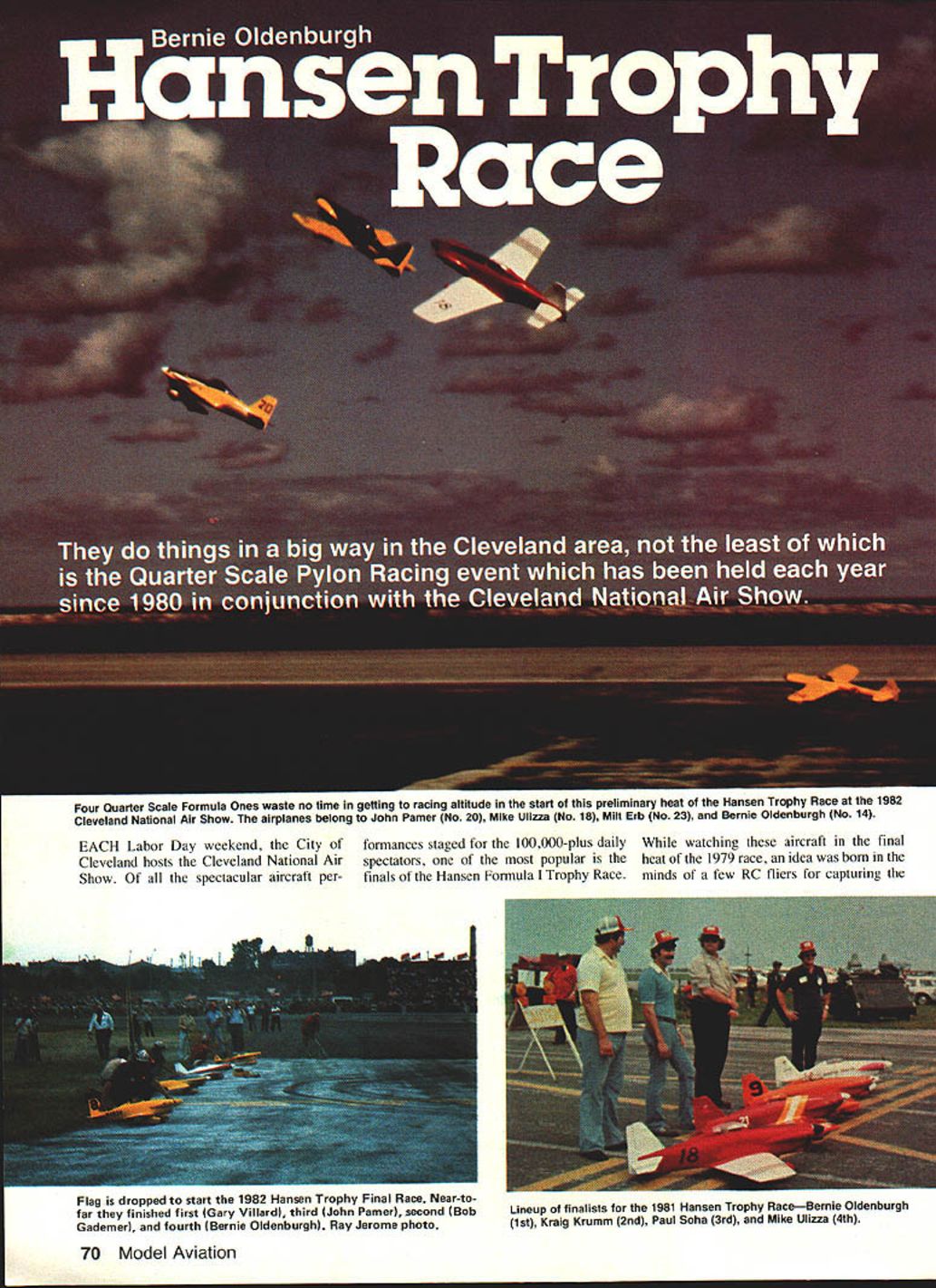
They do things in a big way in the Cleveland area, not the least of which is the Quarter Scale Pylon Racing event, held each year since 1980 in conjunction with the Cleveland National Air Show.
Each Labor Day weekend the City of Cleveland hosts the Cleveland National Air Show. Of all the spectacular aircraft performances staged for the 100,000-plus daily spectators, one of the most popular is the finals of the Hansen Formula I Trophy Race. While watching these aircraft in the final heat of the 1979 race, a few RC fliers conceived the idea of capturing that excitement and spectator appeal in miniature.
The idea grew with the introduction of the Bridi Quarter Scale Cosmic Wind. We saw the potential to organize a pylon racing event at much closer-to-scale speeds using an extremely stable 1/4-size model powered by a .60 cu. in. engine, with restrictions imposed on maximum noise levels. Upsizing the model to 1/4-scale and slowing flight speeds to about 85–90 mph resulted in a highly visible and exciting spectator event.
First races and organization
The first race became a reality thanks to several individuals. Bud Crane (one of the organizers of the original AMA Formula I races in Ohio) arranged with Bridi Enterprises to support the new event by supplying a large quantity of Cosmic Wind kits to northeast Ohio RC modelers. The Cosmic Wind became the focal point of the new event.
Liaison with Hansen Mfg. Co. (sponsor of the full-size Formula I Race) and the Cleveland National Air Show was handled by Lynn Engdahl under the direction of Bernie Oldenburgh. Bernie, president of the Mentor Area Radio Control Society (MARCS) and vice-president of the Cleveland Aeromodel Society (a local amalgamation of clubs), presented the miniature Formula I Race concept to Hansen and the Air Show Committee. Hansen enthusiastically offered $500 in prize money and a half-size duplicate of the coveted Hansen trophy for the finalists.
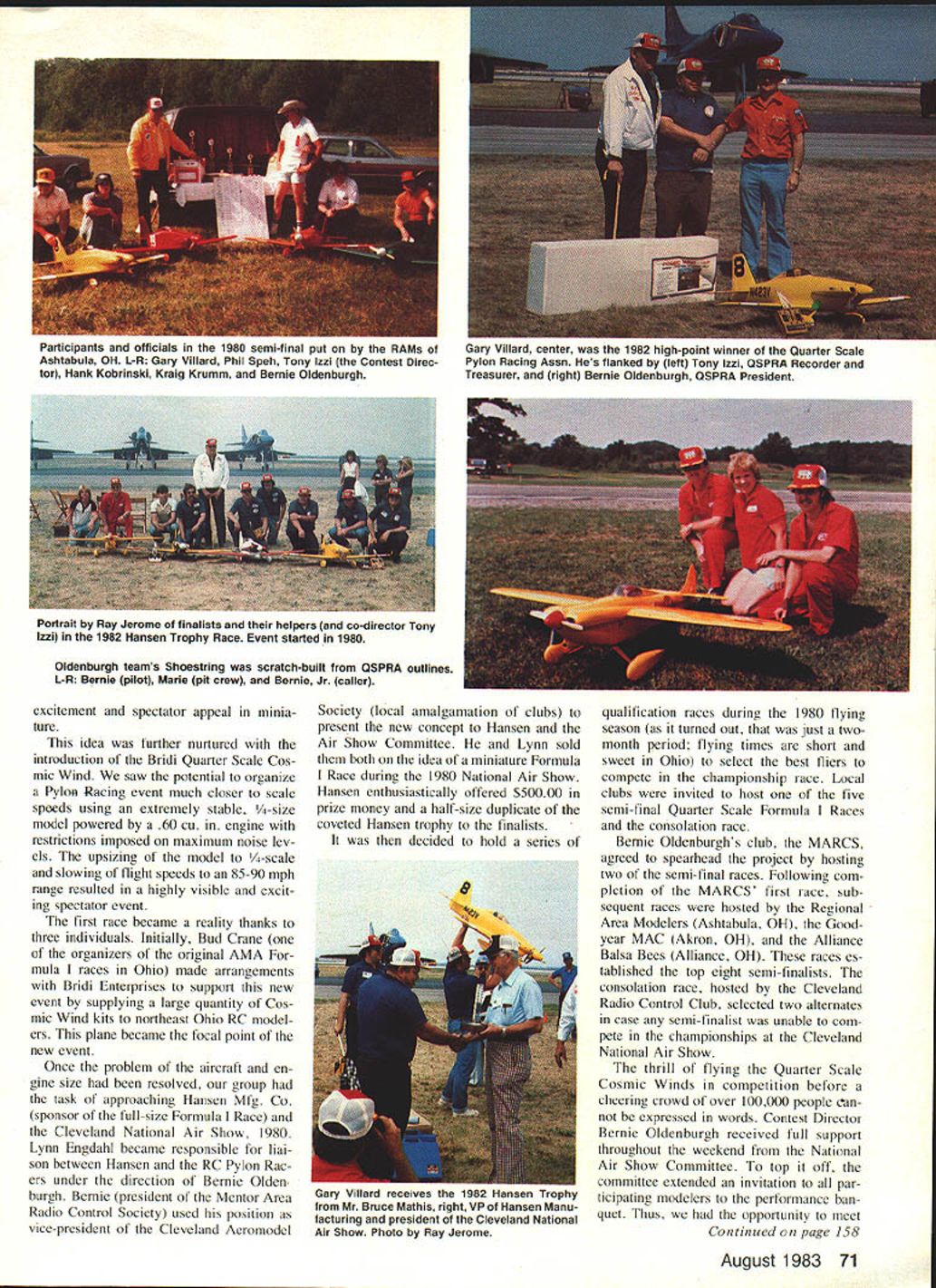
It was decided to hold a series of qualification races during the 1980 flying season (a short two-month period in Ohio) to select the best fliers for the championship race. Local clubs were invited to host the semi-finals and the consolation race. MARCS agreed to spearhead the project by hosting two semi-final races. Subsequent semi-finals were hosted by:
- Regional Area Modelers (Ashtabula, OH)
- Goodyear MAC (Akron, OH)
- Alliance Balsa Bees (Alliance, OH)
These races established the top eight semi-finalists. The consolation race, hosted by the Cleveland Radio Control Club, selected two alternates in case any semi-finalist could not compete in the championships at the Cleveland National Air Show.
Championship and spectator reaction
Flying the Quarter Scale Cosmic Winds in competition before a cheering crowd of over 100,000 people was a thrilling experience for the competitors. Contest Director Bernie Oldenburgh received full support throughout the weekend from the National Air Show Committee. Participating modelers were invited to the performance banquet and had the opportunity to meet and discuss aviation with premier fliers such as the Navy Blue Angels, Corky Fornoff, and the U.S. World Championship Aerobatics Team.
The Quarter Scale Formula I Race was held for three consecutive days before a total audience exceeding 400,000 people. Spectator safety was never compromised during the event.
Rules, aircraft eligibility, and scale requirements
At the end of the 1980 season the organizing group met to discuss the future of Quarter Scale Formula I Pylon Racing. To expand the event while preserving the competitive role of the Cosmic Wind, they required that outline drawings used be at least the scale of the Cosmic Wind kit. This was set at 1/4-scale plus 10% (3.3 in. to the foot).
It was also decided to limit eligible aircraft to those that had competed against the Cosmic Wind from 1947 through 1951. Six outline drawings were approved and made available for use in the event:
- Shoestring
- Bonzo
- Rivets (standard stabilizer)
- Sweet Pea
- Midget Mustang
- Loving Special
Models may be larger than the approved plans but not smaller.
Noise control — the muffler solution
By the end of the 1981 season it became clear a method was needed to limit engine noise without increasing speed or detracting from appearance. A local machinist-modeler, Bill Kucharcik (WPK Enterprises), donated his time and equipment to develop a suitable muffler. The mufflers were made available to Quarter Scale Pylon Racing Association members at a cost comparable to a standard muffler. By season’s end, everyone agreed that this muffler solved the noise problem, allowing quieter flying at club fields without sacrificing performance.
Growth, sponsorship, and organization
The 1982 season brought added sponsorship from Kraft Systems, the Loctite Company, and Great Planes Models. The Quarter Scale Pylon Racing Association (QSPRA) became an official organization with an executive committee that reviewed and refined rules and regulations. Racing model designs became easier to fly, and, thanks to the muffler, could be operated without disturbing neighbors.
The success of this approach to Formula I Pylon Racing in the Cleveland area should lay groundwork for similar races nationwide.
Contact and acknowledgments
For details, contact: Bernie Oldenburgh 27191 Shirley Avenue Euclid, OH 44132
Special thanks to:
- Tony Izzi and the RAMS Club for support at each semi-final race and the championship event
- Bill Kucharcik (WPK Enterprises) for developing the muffler
- Circus-Circus for support during the 1980 season
Any organization looking for an exciting and safe event to promote model aviation should consider Quarter Scale Formula I Pylon Racing.
Transcribed from original scans by AI. Minor OCR errors may remain.

