
Happiness Is An Old Engine!
Collecting engines is a thriving hobby in itself. The Model Engine Collectors Association has 1,100 members. Collectogethers are held, climaxed yearly by the Annual Grand National Collectogether. And that's just the tip of the iceberg.
Keith Gebers
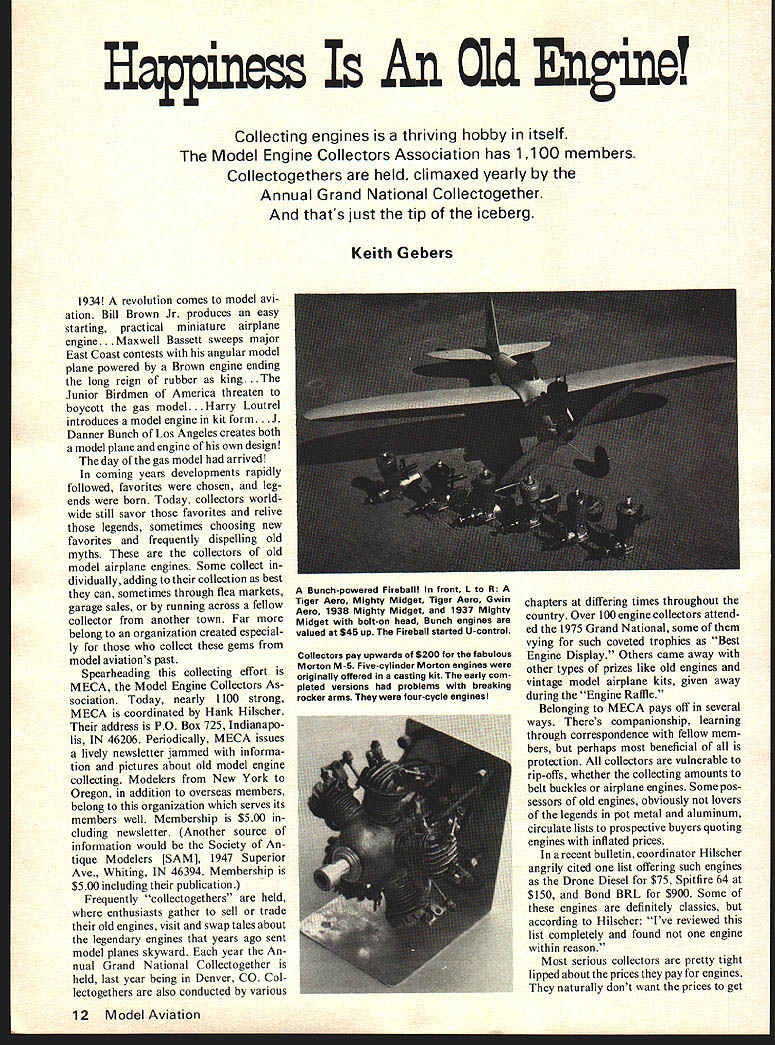
1934! A revolution comes to model aviation. Bill Brown Jr. produces an easy starting, practical miniature airplane engine...Maxwell Bassett sweeps major East Coast contests with his angular model plane powered by a Brown engine ending the long reign of rubber as king...The Junior Birdmen of America threaten to boycott the gas model...Harry Loutrel introduces a model engine in kit form...J. Danner Bunch of Los Angeles creates both a model plane and engine of his own design!
The day of the gas model had arrived! In coming years developments rapidly followed, favorites were chosen, and legends were born. Today, collectors world-wide still savor those favorites and relive those legends, sometimes choosing new favorites and frequently dispelling old myths. These are the collectors of old model airplane engines. Some collect individually, adding to their collection as best they can, sometimes through flea markets, garage sales, or by running across a fellow collector from another town. Far more belong to an organization created especially for those who collect these gems from model aviation's past.
Spearheading this collecting effort is MECA, the Model Engine Collectors Association. Today, nearly 1,100 strong, MECA is coordinated by Hank Hilscher. Their address is P.O. Box 725, Indianapolis, IN 46206. Periodically, MECA issues a lively newsletter jammed with information and pictures about old model engine collecting. Modelers from New York to Oregon, in addition to overseas members, belong to this organization which serves its members well. Membership is $5.00 including newsletter. (Another source of information would be the Society of Antique Modelers [SAM], 1947 Superior Ave., Whiting, IN 46394. Membership is $5.00 including their publication.)
Frequently "collectogethers" are held, where enthusiasts gather to sell or trade their old engines, visit and swap tales about the legendary engines that years ago sent model planes skyward. Each year the Annual Grand National Collectogether is held, last year being in Denver, CO. Collectogethers are also conducted by various chapters at differing times throughout the country. Over 100 engine collectors attended the 1975 Grand National, some vying for such coveted trophies as "Best Engine Display." Others came away with other types of prizes like old engines and vintage model airplane kits, given away during the "Engine Raffle."
Belonging to MECA pays off in several ways. There's companionship, learning through correspondence with fellow members, but perhaps most beneficial of all is protection. All collectors are vulnerable to rip-offs, whether the collecting amounts to belt buckles or airplane engines. Some possessors of old engines, obviously not lovers of the legends, in pot metal and aluminum, circulate lists to prospective buyers quoting engines with inflated prices.
In a recent bulletin, coordinator Hilscher angrily cited one list offering such engines as the Drone Diesel for $75, Spitfire 64 at $150, and Bond BRL for $900. Some of these engines are definitely classics, but according to Hilscher "I've reviewed the list completely and found not one engine within reason."
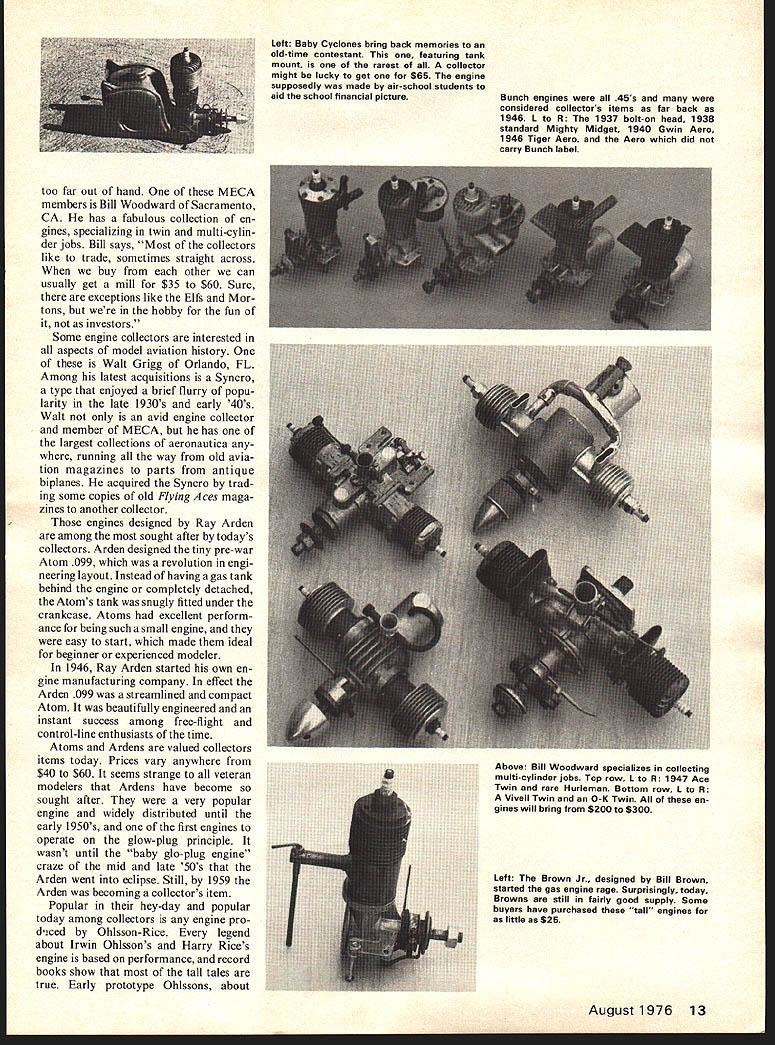
Most serious collectors are pretty tight-lipped about the prices they pay for engines. They naturally don't want the prices to get too far out of hand. One of these MECA members is Bill Woodward of Sacramento, CA. He has a fabulous collection of engines, specializing in twin and multi-cylinder jobs. Bill says, "Most of the collectors like to trade, sometimes straight across. When we buy from each other we can usually get a mill for $35 to $60. Sure, there are exceptions like the Elfs and Mortons, but we're in the hobby for the fun of it, not as investors."
Some engine collectors are interested in all aspects of model aviation history. One of these is Walt Grigg of Orlando, FL. Among his latest acquisitions is a Syncro, a type that enjoyed a brief flurry of popularity in the late 1930's and early '40's. Walt not only is an avid engine collector and member of MECA, but he has one of the largest collections of aeronautica anywhere, running all the way from old aviation magazines to parts from antique biplanes. He acquired the Syncro by trading some copies of old Flying Aces magazines to another collector.
Those engines designed by Ray Arden are among the most sought after by today's collectors. Arden designed the tiny pre-war Atom .099, which was a revolution in engineering layout. Instead of having a gas tank behind the engine or completely detached, the Atom's tank was snugly fitted under the crankcase. Atoms had excellent performance for being such a small engine, and they were easy to start, which made them ideal for beginner or experienced modeler.
In 1946, Ray Arden started his own engine manufacturing company. In effect the Arden .099 was a streamlined and compact Atom. It was beautifully engineered and an instant success among free-flight and control-line enthusiasts of the time.
Atoms and Ardens are valued collectors items today. Prices vary anywhere from $40 to $60. It seems strange to all veteran modelers that Ardens have become so sought after. They were a very popular engine and widely distributed until the early 1950's, and one of the first engines to operate on the glow-plug principle. It wasn't until the 'baby glo-plug engine' craze of the mid and late '50's that the Arden went into eclipse. Still, by 1959 the Arden was becoming a collector's item.
Popular in their hey-day and popular today among collectors is any engine produced by Ohlsson-Rice. Every legend about Irwin Ohlsson's and Harry Rice's engine is based on performance, and record books show that most of the tall tales are true. Early prototype Ohlssons, about Bunch, having been a frequent contributor to such publications as Popular Science magazine. The Mighty Midget appeared on the market in 1935 and was every bit as desirable as a new engine then as it is a collector's item today. Back in those days when the big "sixty" was the norm, this Los Angeles producer was offering a trim "forty-five." But Dan Bunch was never one to stand on laurels. He kept improving his product. The original Mighty Midget had rear exhaust ports that sprayed oil over firewall and plane. That was soon changed to a side exhaust port, and additional refinements were made. Bunch soon offered a companion engine, the Gwinn Aero, and several marine adaptations. Then in 1940 came one of the hottest "forty-fives" of the time, the famous Tiger Aero. In those days budding control-line enthusiasts flocked to the Tiger Aeros as their own, as contest after contest fell to the new Bunch engine. Following the war the Tiger Aeros were offered by the Bunch company for a couple of years. Then Dan Bunch scaled-up his designs to the "sixty" class. They were unmistakably Bunch creations; they were attractive, they were powerful, but were marketed under the Contestor label.
Today, Bunch engines are sought after by collectors. They don't bring the highest prices, since many were originally sold and they are in fairly good supply. One thing to remember about Bunch designs is that an early Mighty Midget was considered a desirable collector's item back in 1947 when only a handful of such people existed and old engines could be obtained for a couple of Wheaties.
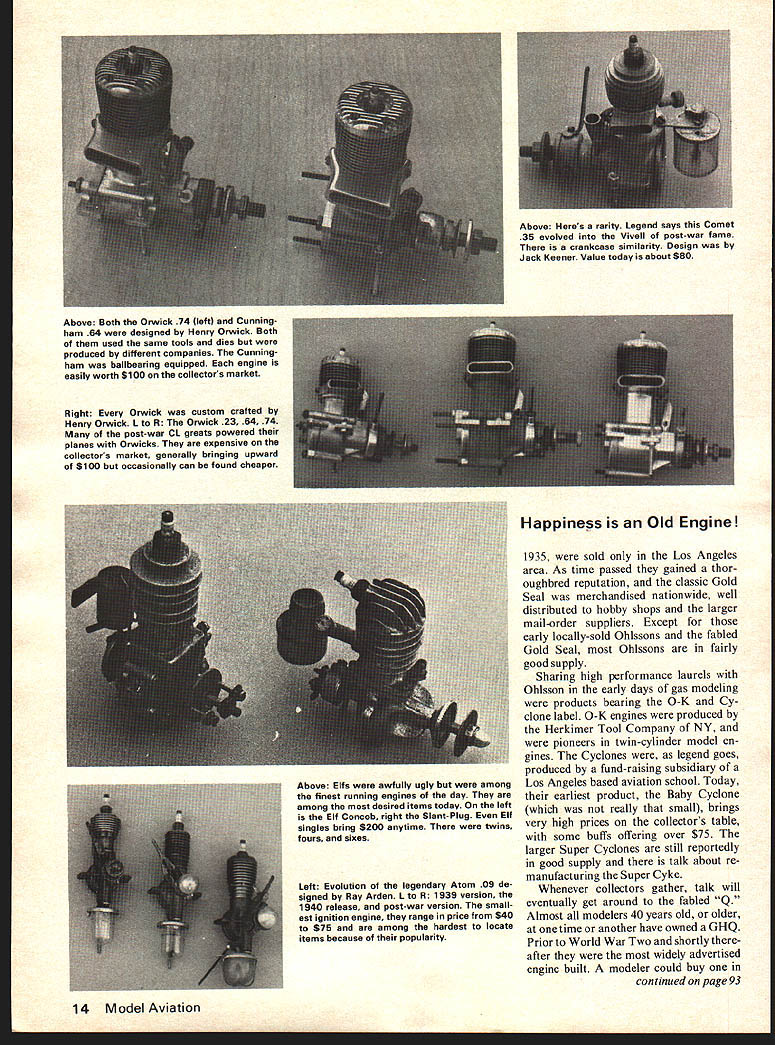
One rare and expensive find in the engine-collecting field is an Elf. Even in the 1940s a modeler who had a plane powered by an Elf knew he had a rare, unique, and desirable engine. Elfs were literally manufactured in the basement of Dan Calkins's Portland, OR, home. These tiny engines were a gem of engineering and workmanship. Even before Calkins's short war years, if you ordered an Elf you frequently had to wait months before its delivery. Elfs were never widely advertised and manufacturing was limited. Producer Dan Calkins was just as tacit and wivey as his engines, right down to his pencil-line mustache. Shortly before America's involvement in World War Two, Calkins introduced a twin as a companion to the Elf single. Today, it is even more sought-after than the single, if that is possible. Collectors have been known to pay over $250 for an Elf single or twin.
Engine collecting falls into several categories. Some collect individually, adding to a collection until they feel they have the best; sometimes a collector will luck into engines through flea markets or garage sales, or running across a fellow collector in another town. For those who belong to organizations created especially to collect gems of model aviation's past, the camaraderie and resources are even greater.
Spearheading the collecting effort is MECA (Model Engine Collectors Association). Today nearly 1,100 strong, MECA is coordinated by Hank Hilscher, PO Box 725, Indianapolis, IN 46206. Periodically MECA issues a lively newsletter jammed with information and pictures about old model engine collecting. Members from New York to Oregon, in addition to several overseas members, belong; the organization serves its members well. Membership is $5.00, including the newsletter.
Another source of information would be SAM (Society of Antique Modelers), 1947 Superior Ave., Whiting, IN 46394. Membership $5.00, including publication.
Frequently collectogethers are held where enthusiasts gather to sell and trade old engines, visit and swap tales about legendary engines that years ago sent model planes skyward. The Annual Grand National Collectogether was held last year in Denver, CO. Collectogethers are also conducted by various chapters at differing times throughout the country. Over 100 engine collectors attended the 1975 Grand National, some vying for such coveted trophies as Best Engine Display. Others came away with other types of prizes, like old engines or vintage model airplane kits given away during the engine raffle.
Belonging to MECA pays off several ways. There's companionship and learning through correspondence with fellow members, perhaps beneficial protection for collectors vulnerable to rip-offs—whether collecting amounts to belt buckles or airplane engines. Some possessors of old engines, obviously lovers of legends and pot metal aluminum, circulate lists to prospective buyers quoting engines at inflated prices. In a recent bulletin, coordinator Hilscher angrily cited a list offering such engines as Drone Diesel $75, Spitfire .64 $150, Bond BRL $900. Some engines are definitely classics according to Hilscher. "I've reviewed the list completely and found some engines within reason," he said. Most serious collectors are pretty tight-lipped about prices they pay; collectors naturally don't want prices to get out of hand.
Among MECA members Bill Woodward of Sacramento, CA, has a fabulous collection of engines specializing in twin and multi-cylinder jobs. Bill says most collectors like to trade—sometimes straight across, sometimes buy one to get another—but you can usually get mills for $35–$60, sure exceptions like Elfs or Mortons aside. Some treat engine collecting as a hobby; others view it as an investment.
Some engine collectors are interested in the historical aspects of model aviation. Walt Grigg of Orlando, FL, among his latest acquisitions obtained a Syncro type that enjoyed a brief flurry of popularity in the late 1930s and early '40s. Walt, an avid engine collector and member of MECA, has one of the largest collections of aeronautica, running way back: old aviation magazines, parts and even antique biplane pieces. He acquired the Syncro by trading some copies of old Flying Aces magazines to another collector. Engines designed by Ray Arden are among those sought after by today's collectors. Categories. Some of these classifications can be broad. One general classification is the "era" category. For instance, there is the Ignition Era, which lasted from 1934 through the late 1940s; and the Glo-Plug Era, which started about 1949. Many collectors prefer breaking this down further into three distinct categories: Pre-War Era lasting from 1934 to 1945; Post-War Era from 1946 until the demise of the ignition engine; and the Glo-Plug Era.
The three-era category would probably be the best since it covers a broader aspect of model aviation history. Following the end of World War Two the market was deluged with new products for engine-hungry modelers. Even after war's end there were long delays before the demand was satisfied. New engines like the Mercury 29 appeared, featuring a combination gas-intake supercharger on the front of the cylinder; the Super Scraper, which was ordered by thousands of modelers but only a few were produced; and the Bond, which featured an absence of all die-cast bearing surfaces.
Also during the immediate post-war period American modelers discovered the compression-ignition (or diesel) engine, already popular in Europe. Such products as the C.I.E., Kencraft, Drone, and Deezi quickly saturated the market. Then in 1947 modelers were re-introduced to the modern version of the expansion engine, namely CO2, with such brands as O-K, Campus, and Genie. All of these and scores of other engine makes appearing briefly during the immediate post-war years have found their spot with collectors. Few of these engines are considered classics, most being classified as "special interest" engines at best. Although most don't bring big prices they do have their enthusiasts.
Collection categories can be broken down even further. Some collections feature only compression-ignition engines from the immediate post-war period. Others collect expansion-engines such as the compressed-air engines produced prior to the gasoline-powered product, the Imp-type motor, which was produced in Japan in the mid-1930s and powered by a combination of dry-ice and carbide, and the CO2 engine.
A growing number of buffs collect engines manufactured in one particular region or city. From Philadelphia came such engines as the Browns. Also from the City of Brotherly Love came the Aristocrat, produced by pioneer Walter Hurdman, which was never a big seller but remained constantly on the market for over 15 years. Immediately after World War Two, Los Angeles became the virtual capital of model engine activity with Cameron joining Ohlsson, Atwood and Bunch. The Lemnity, produced by the late film star Reginald Denny, was headquartered there. According to legend this engine shared many castings with the less sophisticated and budget-priced pre-war Sky Chief, which was manufactured on the East Coast.
San Francisco buffs tell an interesting and still argued story about an engine marketed by the Comet Model Airplane Company. Called the Comet 35 in pre-war years, this engine was designed and actually produced by Jack Keener. It is said that during the war years Keener designed a series of twin-cylinder engines used for target drone aircraft and looked to businessman Earl Vivell for financing. As the story goes, toward the end of World War Two, when engines again became available in limited supply, the engine was slightly re-designed and emerged as the Vivell 35. Then immediately after the war the Vivell was "hotted-up" and became one of the most desirable engines available. Later it was joined by a twin and even a small diesel. An old Comet 35 is easily worth $75 because of its rarity.
One name can merely skim the surface—during the Thirties, and to some extent the early Forties, numerous makes of engines saw the light of day: the Merlin, Perky, Hurricane, Husky, Barker, Circle 60, Rocket, and so on. Modelers in general have regarded the Brown as the first gas engine. It was the first practical, good-performance engine that caught on—and it deserved to be. The modern era seems to date from the 2.5 to 3.5 cc Brown. The pre-WW II dollar value was high-priced, but many individuals had succeeded in making an engine or two for their own use. For example, in 1904—that's correct, 1904—Ray Arden flew a gas-powered model across Van Cortlandt Park in New York City.
The legends, the myths, the actual history of the model airplane engine could fill a book. The lore of the men who designed and manufactured engines; their high hopes, shattered dreams, and financial disasters could keep a model builder smiling. In just over 40 years we have seen names like Brown, Ohlsson, and Bunch endure. But there were legends like the low-cost Rodgers, the short-lived blaze-of-glory of the Pacemaker, and the gutsy Forster that powered some of the earliest RC jobs.
These and scores of other engines are little more than the remote past to some collectors. But not all: there are those who keep those legends and myths alive. They are the collectors of these engines of the past. These are the people who polish up the old mills, display them in their dens or shops, trade them at collectogethers, and re-create the lore of days long gone. To them, happiness is an old engine.
Transcribed from original scans by AI. Minor OCR errors may remain.

