
Hard Times Handle
Michael Jennings
Times are much harder than they used to be in the Control Line fraternity if you need a new control handle. The demise of the E‑Z Just Company eliminated, in my opinion, the best all‑around handle. Hobby shops that still have a supply of E‑Z Justs are hard to find.
The April 1983 issue of Model Aviation, in the CL Aerobatics column then authored by Wynn Paul, had excellent information on super‑improved state‑of‑the‑art handles. The only problem with those designs was that you needed to own a machine shop or pay for several hours of machine‑shop work at about $18 an hour. The cost — about $75 — is acceptable if you can swing it, but many fliers need a lower‑cost solution.
What I think everyone needs is a low‑cost replacement that performs well. Fox Mfg. Co. and Sullivan Products/Pylon Brand both make handles. (Editor: Since this article was written, a new handle has come on the market from Sagan Industries — the Pro‑Grip. CL fliers should certainly take a look at this one.) The Fox handle is well built but too heavy for precision aerobatics flying and has a long overhang.
The Sullivan/Pylon Brand handle generally sells for about $1.75. It is very lightweight and has a desirable short overhang, but it has a basic problem: it is not infinitely adjustable and is only adjustable in discrete steps. In other words, the E‑Z Just handle is analog, and the Sullivan/Pylon Brand handle is digital. This discrete adjustment forces your hand and wrist into uncomfortable positions while flying. That may not be a big bother for one or two flights, but anyone serious about precision aerobatics makes many practice flights, and any awkwardness will take its toll.
Another problem with the Sullivan handle is that the tang can fall out when the handle is laid down. In addition, the two halves of the handle are often poorly aligned when glued together.
The good points of the Sullivan handle, besides the low cost, are that it is very lightweight and includes a trigger‑finger notch that helps you pick up the handle correctly every time. The fact that the bright yellow color is easy to see is also an advantage.
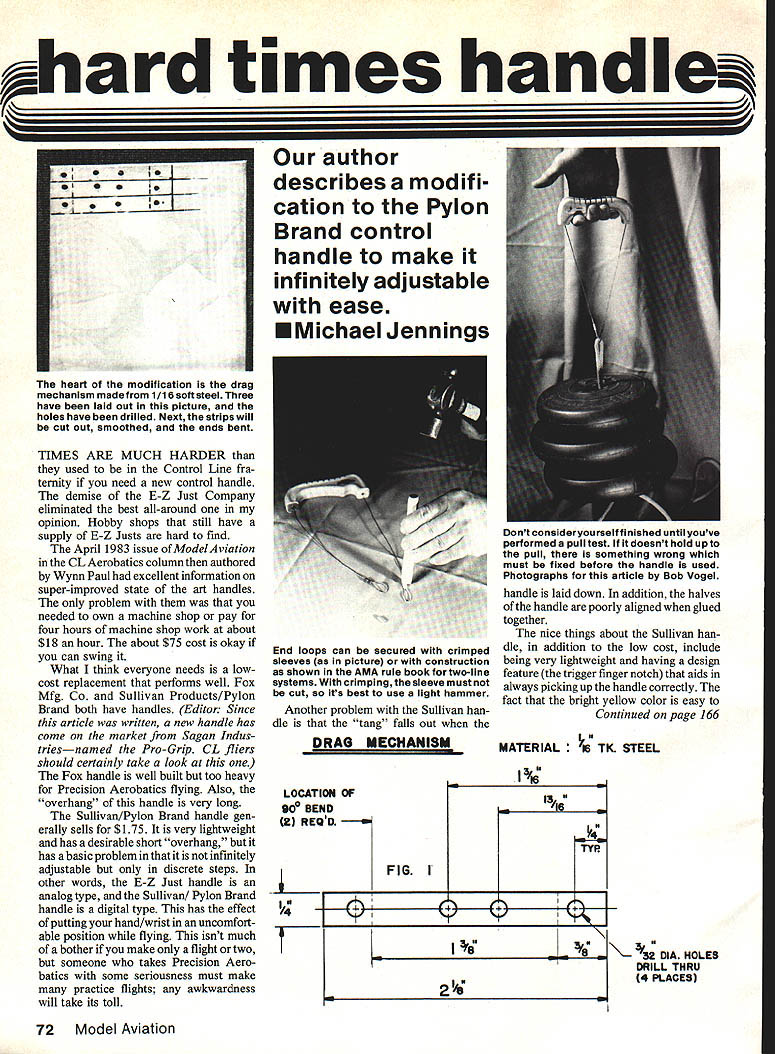
Drag mechanism (modified Pylon handle)
Figure 1: Location of 90° bends (2 required). Material: 1/16" thick steel.
- Material required:
- 1/16" thick steel wire or strip for the drag mechanism
- Two 90° bends as shown in Figure 1
- End loops for the line attachment
- Crimping sleeves for securing end loops
- Construction notes:
- Form the drag mechanism with the two 90° bends at the locations indicated.
- Secure end loops with crimping sleeves (see picture of construction).
- Per the AMA rule book for two‑line systems, the crimping sleeve must be cut after crimping; it’s best to use a light hammer to do this.
- Don’t consider the job finished until you have performed a pull test. If the assembly does not hold up under the pull test, something is wrong and must be fixed before the handle is used.
Photographs in this article by Bob Vogel.
Transcribed from original scans by AI. Minor OCR errors may remain.

