
Hatching the '92 NATS
One last look at this year's competition, through the eyes of those who help make it happen.
"Why bother?"
"WHY BOTHER?" some of you might say. "Out of roughly 160,000 members, only about 1,000 register to compete at the Nats. And that is less than three‑fourths of one percent!" As a sort of devil's advocate, a reporter posed that very question to members of the top echelon of our Academy. Here is the gist of what they replied.
Don Lowe, AMA President: "Competition is the very spice of every human activity. In some manner, all of us are competing—maybe even against ourselves. Competition is also the test bed of hobby products and is the major source of innovation, development, and improvement. Engines, airfoils, airframes, and certainly radio‑control technology get a boost from that striving for excellence by the must‑win champions. It's like the end result of research.
"Take the astronauts. Millions benefit from the efforts of those few up there in the Space Shuttle! There are so many reasons why we must perpetuate the Nats. We could compare it to a reactor core of the entire hobby sport. The Olympics—the World Series—the Super Bowl—Wimbledon. For the huge benefit to all of us, let there always be a Nats! We could even describe it as the epitome of the love of flying!"
Dean Koger, champion RC Pattern contestant: "That percentage figure is at least somewhat misleading. Take a look at the membership roster of any club. Only about a third of the dues payers are active fliers."
Voices from the volunteers
Bob Landry, manager and magician of properties and supplies: "Don't try to talk down the Nats. I'm proud to have helped out at the last several Nats. I even own equipment, arrange vacation time, and can set up, maintain, and tear down Nats paraphernalia. Assistants and helpers couldn't be hired—they work hard here for free. Nats are a perennial tradition—just like the Indy 500. We never want to see them terminated."
Betty Stream, longtime administrator and hand‑lender (with Bev Wisniewski and Darlene Frederick): "Without the Nats something would be cut out of life. True, my husband is no longer active in the hobby, but once friendships and camaraderie—AMA people from the whole spectrum of model aviation—come together in one place to see the state of the art, it is a fulfilling activity. Like a reunion. Oh, sometimes I still fly gliders."
Vince Mankowski, AMA Executive Director: "As you may not suspect, I'm a triple grandfather; one son is a Marine and another is a CPA. I am also an avid CL Combat flier and have placed sixth in a national contest.
"What's it take to put on a Nats? Glad you asked.
"First we have to find a site—a big one, with lots of paved surface. We ask for bids from local clubs who have an 'in' with a large aerodrome or its equivalent. Then we inspect and evaluate the site for Nats suitability. The preliminaries must be in place in order to publish the announcement of date and location in the January issue of Model Aviation. That means planning must be started three months earlier and completed by October of the prior year.
"Now for the people part. We typically recruit roughly 540 volunteers to help run the Nats. At least half of them are experienced people—like Betty, Darlene, and Bev. And we must synchronize the judges' points of view so their verdicts are fair and not regionally oriented.
"Money matters? Most of the sites, such as Westover, are offered free of charge. Other expenses (mostly services, rentals, and transportation) add up to about $140,000. A large portion of this is defrayed by competitors' entry fees, while at least a third is taken care of by concessions and industry support. So AMA covers roughly $25,000—and we have broken even in some years!
"One more look at attendance numbers: a thousand contestants, 600 volunteer workers, 3,000 family members, 3,000 visiting nonparticipating AMA members, and 10,000 non‑AMA spectators, including military base personnel. Okay, these last numbers are guesstimates—good ones, to the best of my knowledge. What a grand show for 16,000 noncompeting, nonworking fans at a cost of a buck and a half each!"
Logistics and site highlights
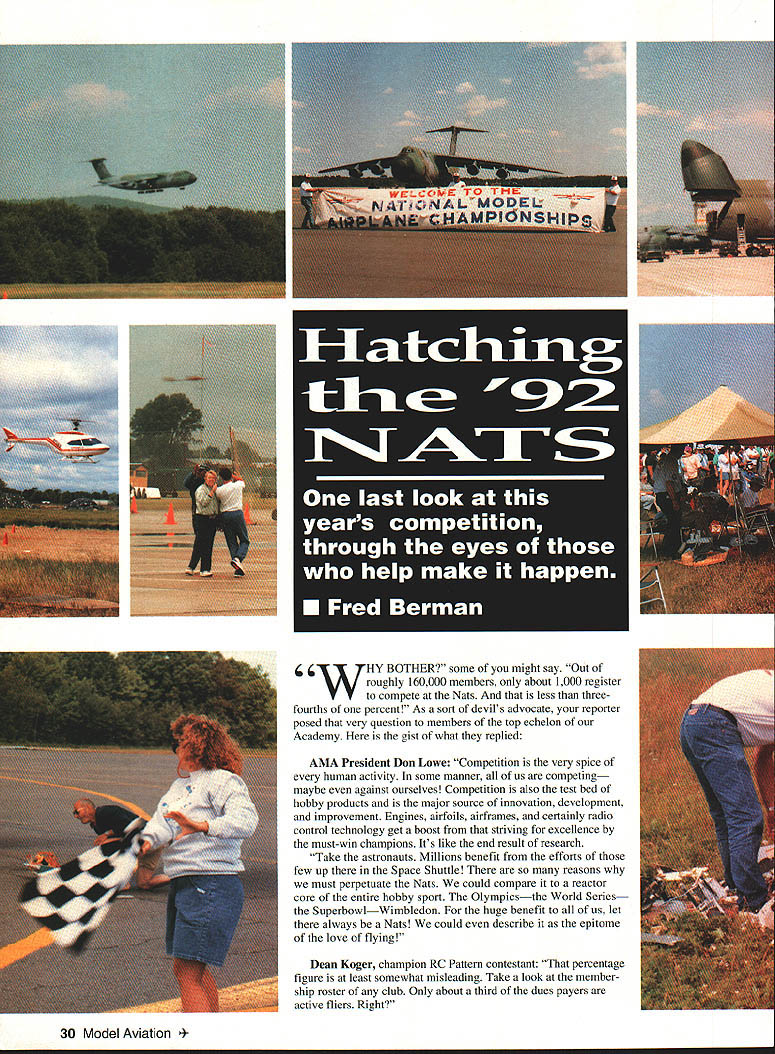
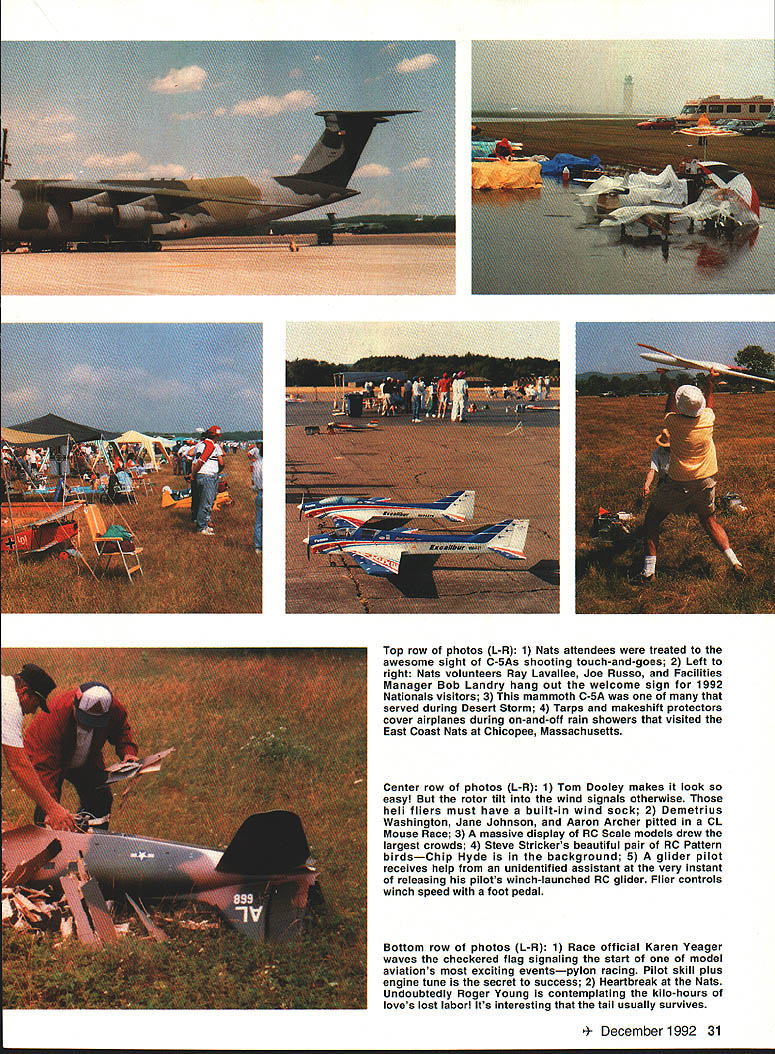
- Site: Westover Air Force Base, whose cooperation was instrumental. The base hosted full‑scale military hardware—among them numerous C‑5A transports—which performed touch‑and‑goes and added a spectacular backdrop.
- Hangars: One cavernous hangar was emptied for use as a transmitter check station, indoor free flight competition, and static judging. C‑5A tails even stick out through oversized hangar doors.
- Supplies: Typical requirements include hundreds of walkie‑talkies and dozens of porta‑johns, plus fencing and safety gear around high‑speed circles.
- Volunteers: About 540 recruited, with many experienced workers donating long hours.
Events and competitions
Pylon Racing (Wayne Yeager): "Pylon racing is my thing. Karen and I would love to compete, but there's also megasatisfaction in seeing that the Nats pylon competition is the best organized and most disciplined event there is. When Karen drops that checkered flag, those screaming horns let loose—and so does each competitor's and spectator's adrenaline!"
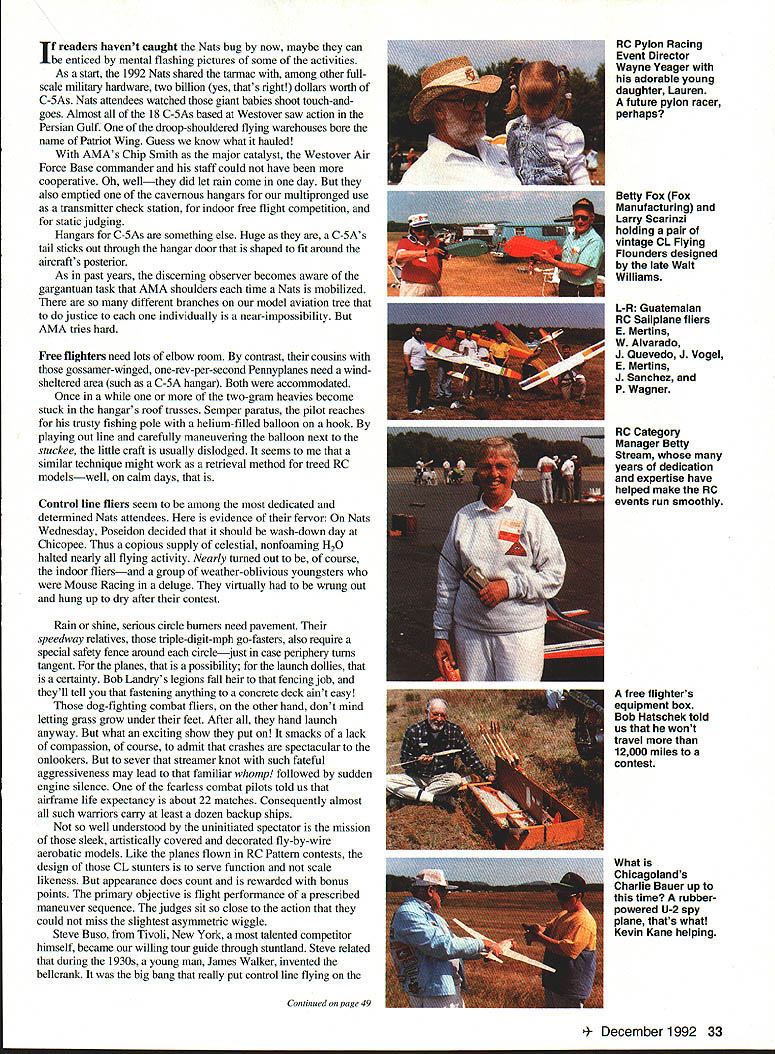
Free flight: Free‑flighters need lots of elbow room; some of the tiny, lightweight designs (two‑gram models, Pennyplanes) need wind‑sheltered areas—hence the use of a hangar for indoor events. Retrievals can be inventive: pilots have used fishing poles and helium balloons to retrieve models stuck in trusses.
Control line: Control line fliers are among the most dedicated. Even when rain shut down most flying one Wednesday, indoor fliers and a group of youngsters continued Mouse Racing in the deluge. Combat fliers put on spectacular shows; one pilot estimated airframe life at about 22 matches, so most carry many backups.
RC Pattern: "RC pattern is the test for the best," with big names in attendance. David Von Linsowe took top honors. Equipment discussions rage between two‑strokes and four‑strokes, and airframes share many visual similarities—slender fuselages and tapered midwings with retracts.
Scale: RC Scale drew the largest spectator crowd. Viewers admire models that closely resemble full‑size counterparts; a thousand‑plus building hours is common. Scale flyers pay a price: shrinking an airplane doesn't shrink the air, so many scale ships have less forgiving flight envelopes. Dead‑stick glide is a valuable trait; multi‑engine models with engine flameouts often ended in heartbreak, as with Roger Young's DC‑3.
Helicopters: Model helicopters amazed spectators with precise, hummingbird‑like maneuvers—pinpoint landings, hover, and even inverted flight—especially when piloted by skilled fliers such as Georgia's Tom Dooley.
Free flight "cloud scrapers": These often use timed dethermalizers and clever trimming to achieve long flights and controlled returns. Trimming and launch timing are both art and science.
Combat, dog‑fighting and speed: Combat is dramatic and brutal to watch; speed events require pavement and special safety fencing. Fast launch dollies and high‑G turns make safety fencing a demanding job on concrete surfaces.
History, lore, and notable moments
- Walker Cup: The control‑line stunt legacy includes James Walker, who invented the bellcrank in the 1930s and helped popularize CL flying. The Walker Cup, a coveted traveling stunt trophy established in his honor, has been awarded for decades.
- Anecdotes: Two billion (yes, that's right!) worth of C‑5As shared the tarmac with model aviation at Westover; one aircraft bore the name "Patriot Wing."
- International flavor: Contingents arrived from Guatemala (whose seven‑decade club owns a paved field and whose trip was sponsored by TACA) and teams from Canada and Mexico. A control line team reportedly traveled from Singapore.
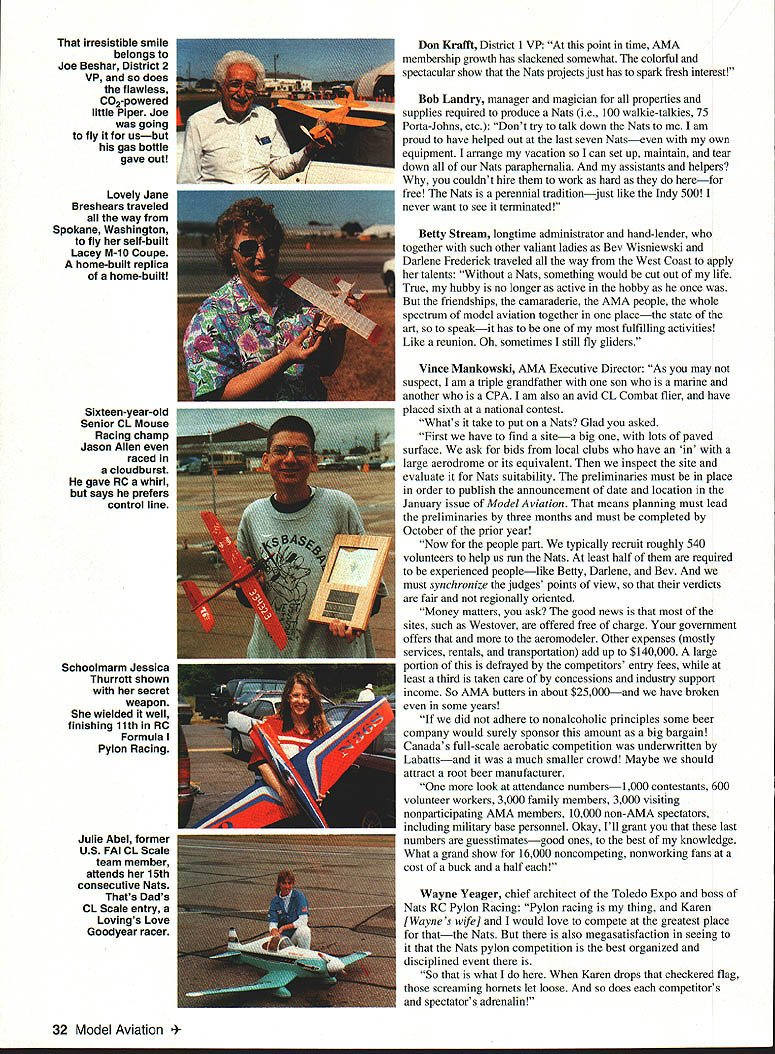
- Jessica Thurrott: A Connecticut schoolteacher and Formula 1 pylon racer, she finished 11th overall and brought her Japanese language students to cheer her on. She was accepted into the Samurai Pylon Racing Team, an elite invitational squad led by Jim Shinohara.
- Betty Fox: Sprightly Betty Fox, president of Fox Manufacturing and the Duke's widow, provided moral support throughout the Nats, frequently near the circle‑burners even if she didn't bring tools.
- Parking theft: A cautionary episode—Matt Klein's truck was stolen from a motel parking lot the first night. Fortunately the truck was recovered in a nearby town empty of valuables. Lesson: never leave anything valuable in a vehicle overnight.
Participation and the future
AMA's problem is participation density. Some event categories now have low entry levels—certain glider and rubber free flight contests, for instance. Youth priorities may have shifted toward prefabricated electronics and away from the do‑it‑yourself bench—with its balsa, CyA, and hobby knives. Electric propulsion, rocket‑launched gliders, Vertols, solar craft, and scaled ornithopters hint at future directions.
Despite challenges, the fascination with things airborne remains. With a bit of PR from the older generation and as full‑scale flying becomes more expensive and restricted, amateur aeromodeling may regain momentum.
Attendance and costs (high‑level)
- Volunteers recruited: ~540
- Competitors: ~1,000
- Family members: ~3,000
- Visiting nonparticipating AMA members: ~3,000
- Non‑AMA spectators (estimate): ~10,000
- Typical Nats expenses: ~$140,000 (mostly services, rentals, transport)
- AMA share: roughly $25,000 after entry fees, concessions, and industry support
Viva los Nats! See you there next year for sure!
Transcribed from original scans by AI. Minor OCR errors may remain.

