
The Haught Corner
The long-awaited youth/beginner issue is here, and it's loaded with useful information. Our columnists and other authors have gone beyond the call to produce a variety of interesting material.
The "youth/beginner problem" has been attacked from a number of angles, and it's clear that a great deal of time and effort has been spent by all those who have expressed opinions or offered solutions. I believe this issue contains more thoughtful, cogent writing than any in recent memory.
With so many people concerned about the future of our hobby, it's a wonder we have a "problem" at all.
No Room at the Inn:
A few items had to be omitted from this issue because of time and space considerations. Thus our Junior World Champs report by Bill Fee will appear in a future issue, as will Van Twelves' "American Eagles Earn Their Wings," and a piece where I solicited opinions from some modeling leaders about proper direction for youth/beginner programs.
Moreover, we will run a youth-oriented feature at least six times per year. Now we can feature youth programs, modeling classes, training sessions, and similar activities. Let's hear from you on a regular basis concerning these activities.
Da Two Voots:
Three generations of Haughts have flown models in competition; all have been successful.
Generation one, my father, featured the classic modeling scenario: He was eleven years old when Lindbergh crossed the Atlantic. His interest paralleled thousands of other youths of his time.
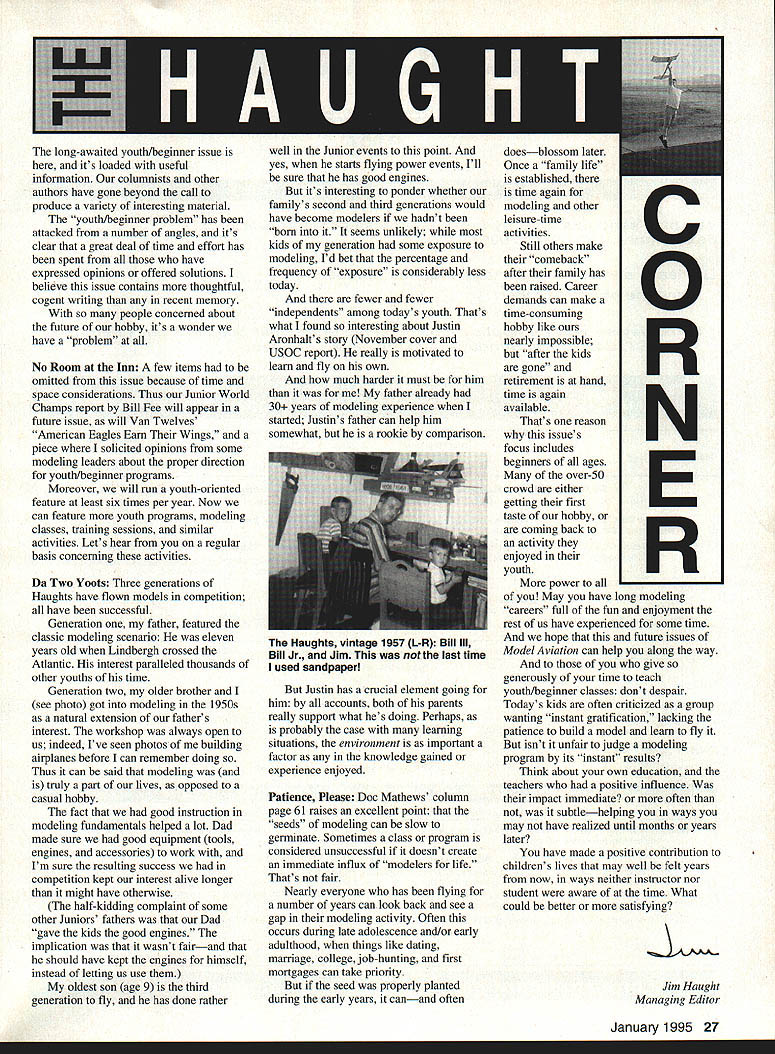
Generation two, my older brother and I (see photo), got into modeling in the 1950s as a natural extension of our father's interest. The workshop was always open to us; indeed, I've seen photos of me building airplanes before I can remember doing so. Thus it can be said that modeling was (and is) truly a part of our lives, as opposed to a casual hobby.
The fact that we had good instruction in modeling fundamentals helped a lot. Dad made sure we had good equipment—tools, engines, and accessories—to work with, and I'm sure the resulting success we had in competition kept our interest alive longer than it might have otherwise.
(The half-kidding complaint of some other juniors' fathers was that our dad "gave the kids the good engines." The implication was that it wasn't fair—and that he should have kept the engines for himself, instead of letting us use them.)
My oldest son (age 9) is the third generation to fly, and he has done rather well in the junior events to this point. And yes, when he starts flying power events, I'll be sure that he has good engines.
But it's interesting to ponder whether our family's second and third generations would have become modelers if we hadn't been "born into it." It seems unlikely; while most kids of my generation had some exposure to modeling, I'd bet that the percentage and frequency of "exposure" is considerably less today.
And there are fewer and fewer "independents" among today's youth. That's what I found so interesting about Justin Aronhalt's story (November cover and USOC report). He really is motivated to learn and fly on his own.
And how much harder it must be for him than it was for me! My father already had 30+ years of modeling experience when I started; Justin's father can help him somewhat, but he is a rookie by comparison.
But Justin has a crucial element going for him: by all accounts, both of his parents really support what he's doing. Perhaps, as is probably the case with many learning situations, the environment is as important a factor as any in the knowledge gained or experience enjoyed.
Patience, Please:
Doc Mathews' column (page 61) raises an excellent point: the "seeds" of modeling can be slow to germinate. Sometimes a class or program is considered unsuccessful if it doesn't create an immediate influx of "modelers for life." That's not fair.
Nearly everyone who has been flying for a number of years can look back and see a gap in their modeling activity. Often this occurs during late adolescence and/or early adulthood, when things like dating, marriage, college, job-hunting, and first mortgages can take priority.
But if the seed was properly planted during the early years, it can—and often does—blossom later. Once a "family life" is established, there's again time for modeling and other leisure-time activities.
Still others make their "comeback" after their family has been raised. Career demands can make a time-consuming hobby like ours nearly impossible; but after the kids are gone and retirement is at hand, time is again available.
That's one reason why this issue's focus includes beginners of all ages. Many of the over-50 crowd are either getting their first taste of our hobby, or are coming back to an activity they enjoyed in their youth.
More power to all of you! May you have long modeling "careers" full of the fun and enjoyment the rest of us have experienced for some time. And we hope that this and future issues of Model Aviation can help you along the way.
And to those of you who give so generously of your time to teach youth/beginner classes: don't despair. Today's kids are often criticized as a group wanting "instant gratification," lacking the patience to build a model and learn to fly it. But isn't it unfair to judge a modeling program by its "instant" results?
Think about your own education, and the teachers who had a positive influence. Were their impacts immediate? Or more often than not, was it subtle—helping you in ways you may not have realized until months or years later?
You may have made a positive contribution to somebody's life that will be felt years from now, in ways neither instructor nor student were aware of at the time. What could be better or more satisfying?
Jim Haught Managing Editor
Transcribed from original scans by AI. Minor OCR errors may remain.

