
The Haught Corner
William R. Haught, Jr.
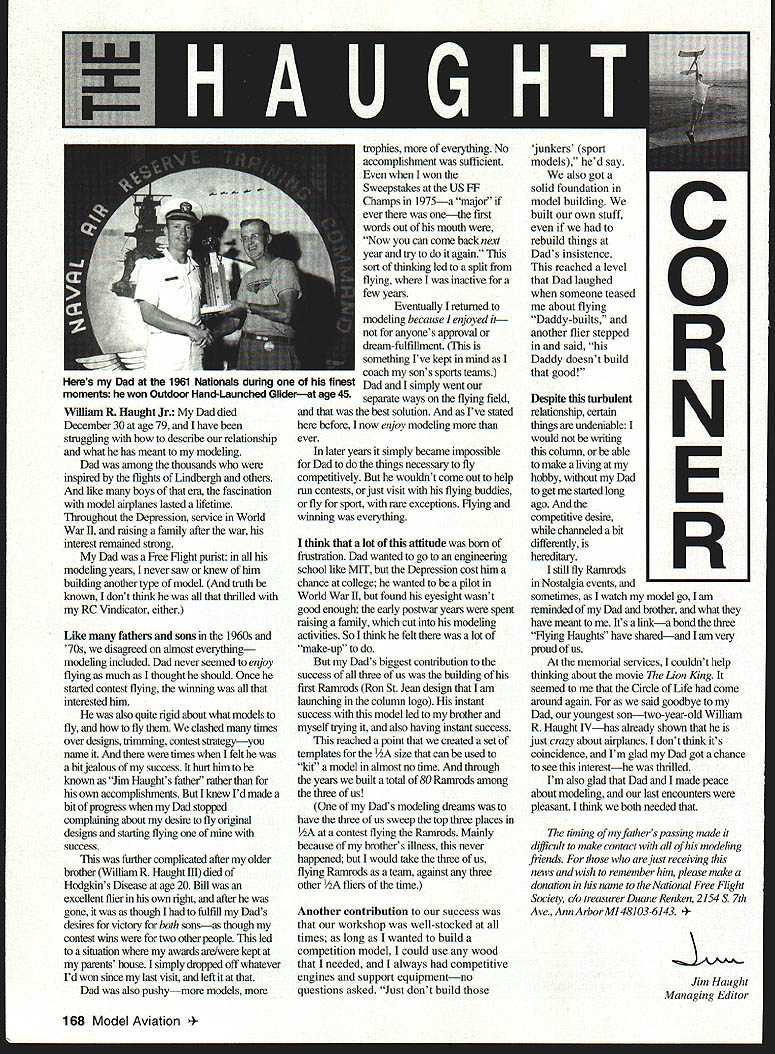
My Dad died December 30 at age 79, and I have been struggling with how to describe our relationship and what he has meant to my modeling.
Dad was among the thousands who were inspired by the flights of Lindbergh and others. Like many boys of that era, the fascination with model airplanes lasted a lifetime. Throughout the Depression, service in World War II, and raising a family after the war, his interest remained strong.
My Dad was a Free Flight purist; in all his modeling years, I never saw or knew of him building another type of model. (Truth be known, I don't think he was all that thrilled with my RC Vindicator, either.)
Like many fathers and sons in the 1960s and '70s, we disagreed on almost everything modeling included. Dad never seemed to enjoy flying as much as I thought he should. Once he started contest flying, winning was all that interested him.
He was also quite rigid about what models to fly and how to fly them. We clashed many times over designs, trimming, contest strategy — you name it. There were times when I felt he was a bit jealous of my success. It hurt him to be known as Jim Haught's father rather than for his own accomplishments. I knew I'd made a bit of progress when my Dad stopped complaining about my desire to fly original designs and started flying one of mine with success.
This was further complicated after my older brother, William R. Haught III, died of Hodgkin's disease at age 20. Bill was an excellent flier in his own right. After he was gone, it was as though I had to fulfill my Dad's desires for victory both as his son and as a flier. The awards are kept at my parents' house; I dropped off whatever I'd won since my last visit and left them there.
Dad was also pushy — more models, more trophies, more of everything. No accomplishment was sufficient. Even when I won the Sweepstakes at the US FF Champs in 1975 — a "major" if ever there was one — the first words out of his mouth were, "Now you can come back next year and try to do it again." This sort of thinking led to a split from flying, where I was inactive for a few years.
Eventually I returned to modeling because I enjoyed it — not for anyone's approval or dream-fulfillment. This is something I've kept in mind as I coach my son's sports teams. Dad and I simply went our separate ways on the flying field, and that was the best solution. As I've stated here before, I now enjoy modeling more than ever.
In later years it simply became impossible for Dad to do the things necessary to fly competitively. But he wouldn't come out to help run contests, just visit with his flying buddies, or fly for sport, with rare exceptions. Flying and winning was everything.
I think a lot of this attitude was born of frustration. Dad wanted to go to an engineering school like MIT, but the Depression cost him a chance at college; he wanted to be a pilot in World War II, but his eyesight wasn't good enough; the early postwar years were spent raising a family, which cut into his modeling activities. So I think he felt there was a lot of "make-up" to do.
My Dad's biggest contribution to the success of all three of us was the building of his first Ramrods — a Ron St. Jean design that I am using as the column logo. His instant success with this model led my brother and me to try it, and we had instant success as well.
We created a set of templates for the 1/2A size that can be used to "kit" a model in almost no time. Through the years we built a total of 80 Ramrods among the three of us.
One of my Dad's modeling dreams was to have the three of us sweep the top three places in 1/2A at a contest flying the Ramrods. Mainly because of my brother's illness, this never happened; but I would take the three of us, flying Ramrods as a team, against any other three 1/2A fliers of the time.
Another contribution to our success was that our workshop was well-stocked at all times. As long as I wanted to build a competition model, I could use any wood I needed, and I always had competitive engines and support equipment — no questions asked. "Just don't build those 'junkers' (sport models)," he'd say.
We also got a solid foundation in model building. We built our own stuff, even if we had to rebuild things at Dad's insistence. This reached a level that Dad laughed when someone teased me about flying "Daddy-builts," and another flier stepped in and said, "Daddy doesn't build that good!"
Despite this turbulent relationship, certain things are undeniable: I would not be writing this column, or be able to make a living at my hobby, without my Dad to get me started long ago. The competitive desire, while channeled a bit differently, is hereditary.
I still fly Ramrods in Nostalgia events, and sometimes, as I watch my model go, I am reminded of my Dad and brother and what they have meant to me. It's a link — a bond the three "Flying Haughts" have shared — and I am very proud of us.
At the memorial services, I couldn't help thinking about the movie The Lion King. It seemed the "Circle of Life" come around again as we said goodbye. Dad's youngest son — two-year-old William R. Haught IV — has already shown he's just crazy about airplanes. I don't think it's a coincidence, and I'm glad Dad got a chance to see the interest; he was thrilled. I'm also glad Dad made peace about modeling; our last encounters were pleasant. I think we both needed that.
The timing of my father's passing made it difficult to make contact with all of his modeling friends. For those who are just receiving this news and wish to remember him, please make a donation in his name to the National Free Flight Society, c/o treasurer Duane Renken, 2154 S. 7th Ave., Ann Arbor, MI 48103-6143.
Jim Haught Managing Editor
Transcribed from original scans by AI. Minor OCR errors may remain.

