
The Haught Corner
Tech...tech...tech: In this issue we present the first of a two-part article by Andy Lennon on model aircraft structural design. An editor's note at the beginning of Part I touches on problems encountered in preparation of the piece, and refers readers to this column for details. So:
After the problems we encountered with the last technical article we ran, I decided that all future tech pieces would be subject to peer review prior to publication. My hope was that this would eliminate the intramural squabbling we've had in the past over who's right/wrong/smarter.
The structural design piece had been in inventory for some time, and I felt an update might be in order, so I sent a copy of the text to the author. I also advised that all tech articles would be reviewed, and that I had enlisted Gil Morris to handle that task for this piece. Mr. Lennon indicated that the review process was no problem.
About the reviewer
Gil Morris has qualifications and experience that make him well suited to this role:
- Bachelor's and master's degrees from Ohio State.
- Years of service as a professional engineer and/or consultant.
- Author of a number of papers for the National Free Flight Society's Symposium reports.
- Holder of many national records and a multiple-time Nationals winner.
- A top competitor in a wide range of events, respected for both technical knowledge and flying skill.
Everything was fine until I received Gil's review and sent a copy to the author, requesting revisions where they appeared to be necessary.
At this point Mr. Lennon rejected the review entirely, calling it "specious, negative, mildly amusing, and in some areas, dead wrong." He also stated, "I will not change my article...so do what you feel you must...I will not correspond further on this subject."
What I felt I "must do," then, was to include comments from Morris' review, to give a bit of perspective—to show that there may be some room for interpretation or discussion here. There were instances where the original text was modified—very slightly—to clarify terminology or to neutralize points of disagreement between Lennon and Morris.
I believe that these changes are minor enough that the gist of the article is preserved, and it will still be of use to most readers.
Both Morris and Lennon have been widely published, and each has a large number of followers. However, what we see here is that even such advanced thinkers can disagree; each views things a bit differently.
When I asked Gil to review the structural design piece, he stated that he'd be happy to do so, but that he would like "a statement that would relieve me of any liability or responsibility in the event of misjudgment or oversight...."
I think that's fair enough; the admission of potential for error is refreshingly candid.
Indeed, while Gil and I regularly compete against each other, he voluntarily ran my Power Play 1/2A design through a computer analysis to assure its design was sound. Gil's program confirmed my calculations, and he pronounced it a good design. That model and its successors have since won their fair share of contests.
I implicitly trust Gil's knowledge, analytical abilities, and ability to communicate. I have never found his oral or written presentations to contain anything with a hidden agenda, desire for self-aggrandizement, or specious intent.
In theory, we can do anything we like to an article, since we own its rights once it has been paid for—it's Model Aviation property. However, I don't like to make radical changes to a piece without consulting the author first.
Too much editing (rewriting, really) makes the author's manuscript serve as little more than a template for the editor's re-creation. That's especially dangerous for scientific and technical writing.
"The shame of it all is when egos get involved, and are easily bruised. Our hobby has more than its share of geniuses (and probably crackpots too) that focus on technicalities, and they can create some embarrassments if allowed, I'm sure," writes Morris.
It's not my intent to turn every technical article into a forum for debate; the point of the article can be lost in the crossfire. But the author who hasn't made an error has yet to be born, so we will continue with our review policy.
About the logo and the Ramrod replica
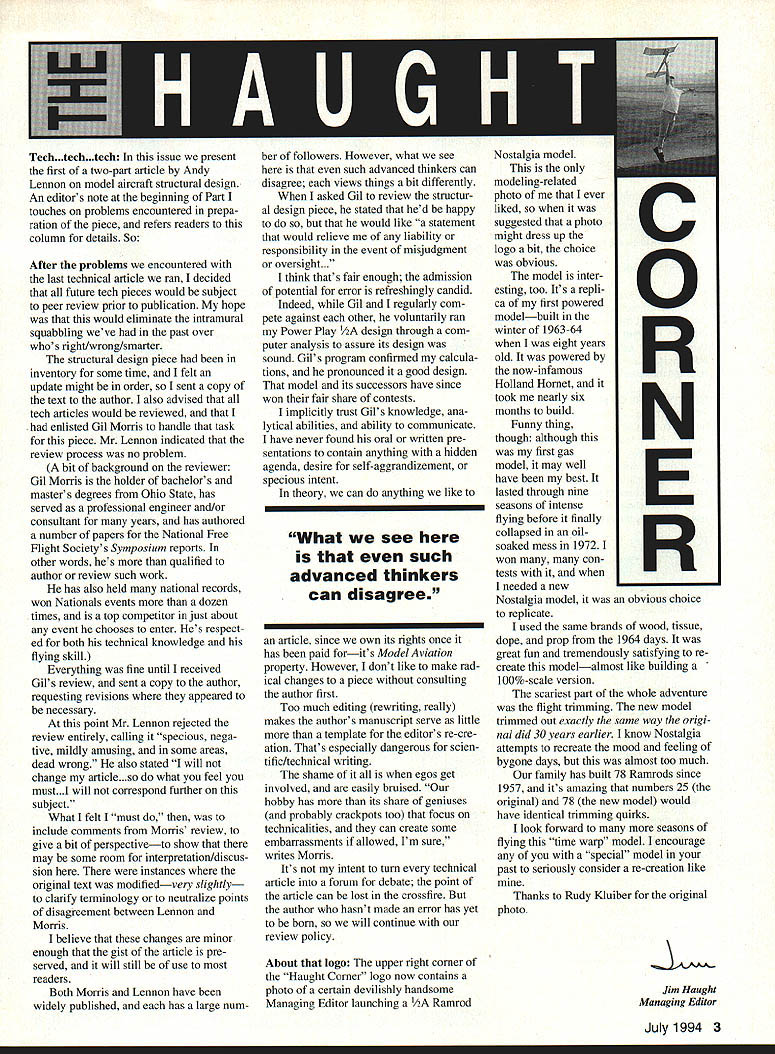
The upper right corner of the "Haught Corner" logo now contains a photo of a certain devilishly handsome Managing Editor launching a 1/2A Ramrod Nostalgia model.
This is the only modeling-related photo of me that I ever liked, so when it was suggested that a photo might dress up the logo a bit, the choice was obvious.
The model is interesting, too. It's a replica of my first powered model—built in the winter of 1963–64 when I was eight years old. It was powered by the now-infamous Holland Hornet, and it took me nearly six months to build.
Funny thing, though: although this was my first gas model, it may well have been the best. It lasted through nine seasons of intense flying before it finally collapsed in an oil-soaked mess in 1972. I won many, many contests with it, and when I needed a new Nostalgia model, it was an obvious choice to replicate.
I used the same brands of wood, tissue, dope, and prop from the 1964 days. It was great fun and tremendously satisfying to recreate this model—almost like building a 100%-scale version.
The scariest part of the whole adventure was the flight trimming. The new model trimmed out exactly the same way the original did 30 years earlier. I know Nostalgia attempts to recreate the mood and feeling of bygone days, but this was almost too much.
Our family has built 78 Ramrods since 1957, and it's amazing that numbers 25 (the original) and 78 (the new model) would have identical trimming quirks.
I look forward to many more seasons of flying this "time warp" model. I encourage any of you with a "special" model in your past to seriously consider a re-creation like mine.
Thanks to Rudy Klubber for the original photo.
Jim Haught Managing Editor
Transcribed from original scans by AI. Minor OCR errors may remain.

