
Hawks: Four-Cycle Rally
Duke Iden
To those of you who love models that sound like real airplanes, who prefer expensive fuel to be burned mostly in the engine, and who like to see models fly like real aircraft—not zip around like houseflies in a jar—welcome again to the 11th Annual HAWKS Four-Cycle Rally.
The Hamilton Area Wireless Kontrol Society holds the three-day event at Joyce Park in hilly Hamilton, Ohio, during the third weekend in September. The 1993 rally had more than 110 pilots and more than 200 four-stroke airplanes—that's a record. Thanks go to Tower Hobbies, O.S. Engines, Sig Manufacturing, and other sponsors; there were thousands of dollars in prizes.
Most events require a qualifying flight in mini pattern, bomb drop, or spot landing; when you qualify for an event, your name is entered in a hopper, and if drawn, you win. Simple, huh? You don't have to be a master builder or expert pilot to go home with an engine or airplane, although Stand-Off Scale and the Old-Timer events are getting tougher. There were also lots of door prizes.
Remember C.R. Price, the guy from Talbot, Tennessee, who flew two airplanes at once? C.R. was not only smart enough to fly two planes at the same time, he flew two that belonged to two other guys (Ken Akers and Tom Fierbaugh). Now, that's really smart. C.R. was back this year, and the Tennessee pilot flew three RC planes at once.
I could hardly believe it last year when there were two planes in the sky, but this year C.R. really outdid himself. When Contest Director Herm Tholen mentioned C.R. had once flown two airplanes, it did not sit well with C.R. So, on Sunday, September 19, 1993, C.R. flew three models.
Perhaps some of you are saying, "Yeah, that's an old show-team trick. There's a couple of guys in the parking lot who are doing the real flying." I watched the transmitter needles, and club members kept an eye out for "ghost fliers." All transmitters were impounded, except for the three C.R. used.
C.R. flew a 1/3-scale Laser, a Pro Trainer, and a Sig Kadet Senior—not exactly a matched set. Afterwards, when C.R. was asked how it went, he said, "It felt alright." C.R. is a man of few words.
Herm Tholen flew two Kadet Seniors. Now that's not a simple feat—flying with your feet. Herm Tholen has graduated into the Real Twin Fliers Group.
C.R. developed the idea of feet-flying because of a friend who could not use his hands. The idea progressed "logically" to trying to fly two planes with hands and feet. Do this in a secluded area with an assistant:
- Link your transmitters with a buddy-box system. Use a very slow, docile trainer or a powered glider. Take off with your hands, then switch to your feet after gaining lots of altitude. After you are proficient, land with your hands, then proceed to step two.
- Practice taking off using your feet, then practice landings.
- Two planes: First, take off using feet only; do not hold the transmitter. Have an assistant take off the second plane and pass the transmitter to you. Practice, practice, practice. Good luck.
Curiosities
As four-stroke power grows in popularity, strange contraptions creep into the rally. A four-stroke fun-flier? Yes—an O.S. .26 Surpass-powered fun-fly plane from Brian Merrel was on hand.
Dennis Kirby of Lebanon, Ohio started with a Senior Telemaster and ended up with a twin. Dennis was flying on the grounds of a high school when the Telemaster had an engine failure and collided with a light pole, shearing a wing. After the Telemaster had spent some time in the attic, Dennis thought, "Since I have to rebuild the wing, why not add two .48 O.S. Surpasses, lengthen the stabilizer two bays, add about 20% rudder, and have a twin? I always wanted one." Dennis' Twin Telemaster flies great and sounds terrific—a new lease on life for a damaged airplane.
The most unusual scale model was the French-designed 1/3-scale Dormoy Bathtub. The plane dates back to 1924 when it took first place in a cross-country race from Dayton to Columbus, Ohio. In 1925 it was rebuilt; the Dormoy Bathtub was really only in use for one year. Builder Elmer Willhitt of Mekado, Michigan handmade most of the hardware and designed the working suspension. Details are topped off with a working compass and pinking tape that is 1/2-inch hospital adhesive tape. The plane required four rolls of tape. Elmer says the .91 Saito-powered plane is a "handful" because of the short coupling. Elmer did not enter it in Scale competition because of incomplete documentation.
Lester Robertson of Hamilton, Ohio had a Sig Kadet Senior covered with clear UltraCote. The see-it-all model is equipped with lights and has flown at night. It is ten years old, has flaps or spoilers, and has an Enya .60 F-C in the nose.
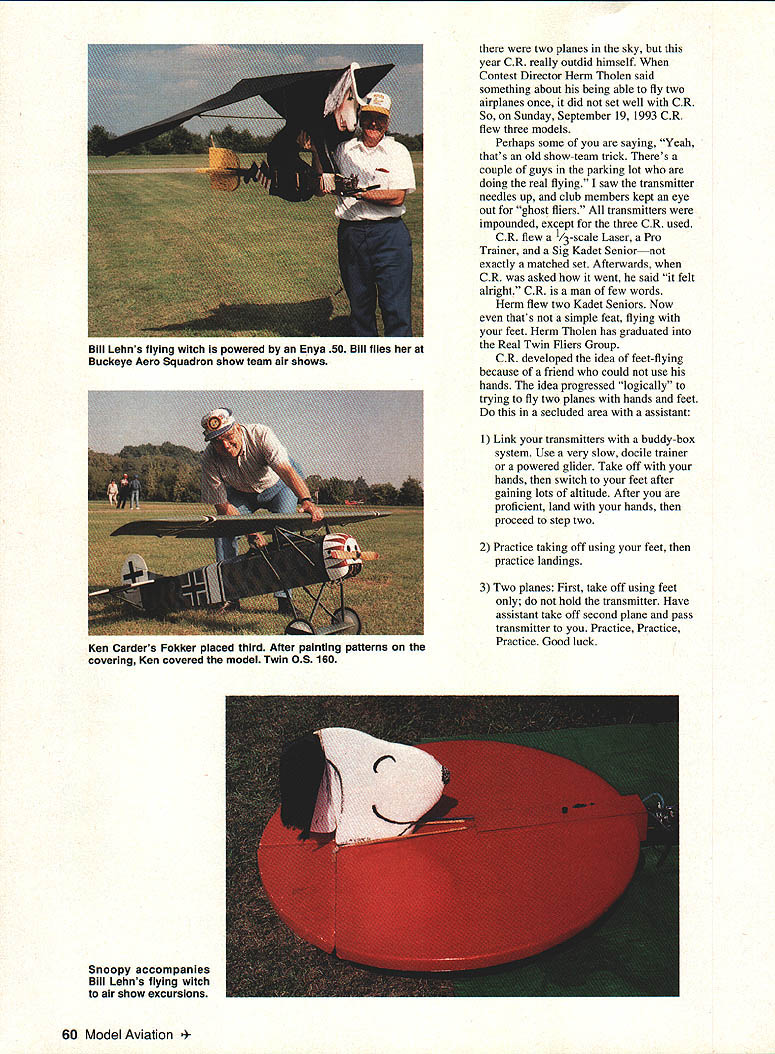
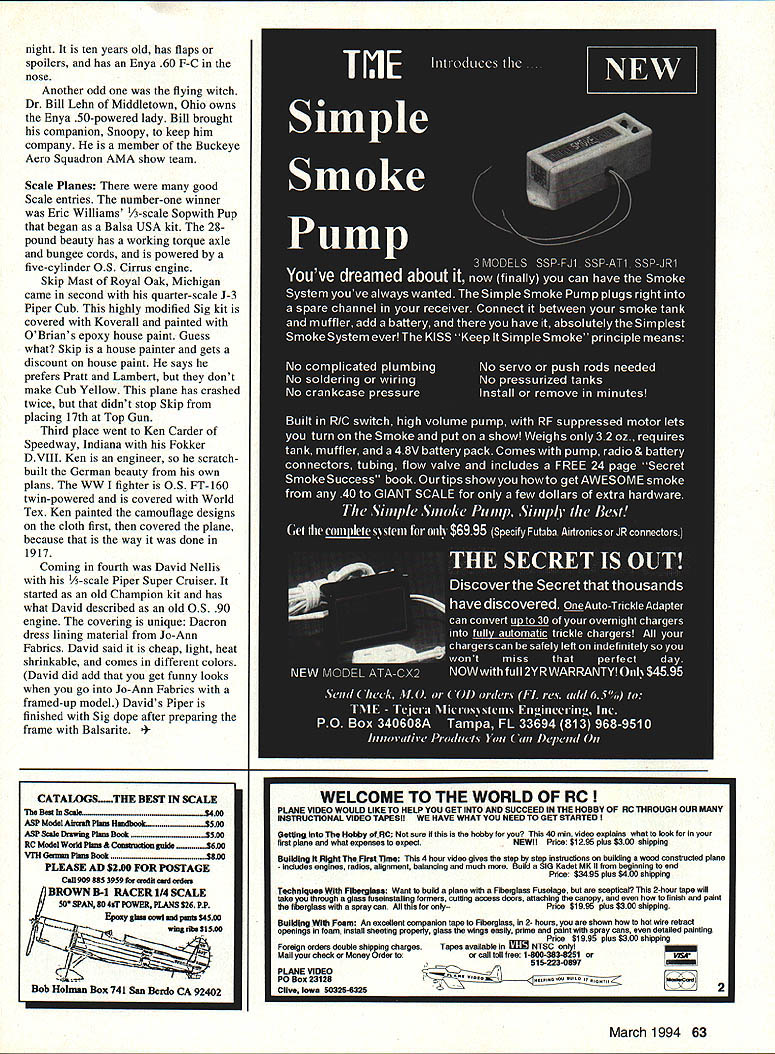
Another odd one was the flying witch. Dr. Bill Lehn of Middletown, Ohio owns the Enya .50-powered lady. Bill brought his companion, Snoopy, to keep him company. He is a member of the Buckeye Aero Squadron AMA show team.
Scale Planes
There were many good Scale entries. The number-one winner was Eric Williams' 1/3-scale Sopwith Pup that began as a Balsa USA kit. The 28-pound beauty has a working torque axle and bungee cords, and is powered by a five-cylinder O.S. Cirrus engine.
Skip Mast of Royal Oak, Michigan came in second with his quarter-scale J-3 Piper Cub. This highly modified Sig kit is covered with Koverall and painted with O'Brian's epoxy house paint. Guess what? Skip is a house painter and gets a discount on house paint. He says he prefers Pratt and Lambert, but they don't make Cub Yellow. This plane has crashed twice, but that didn't stop Skip from placing 17th at Top Gun.
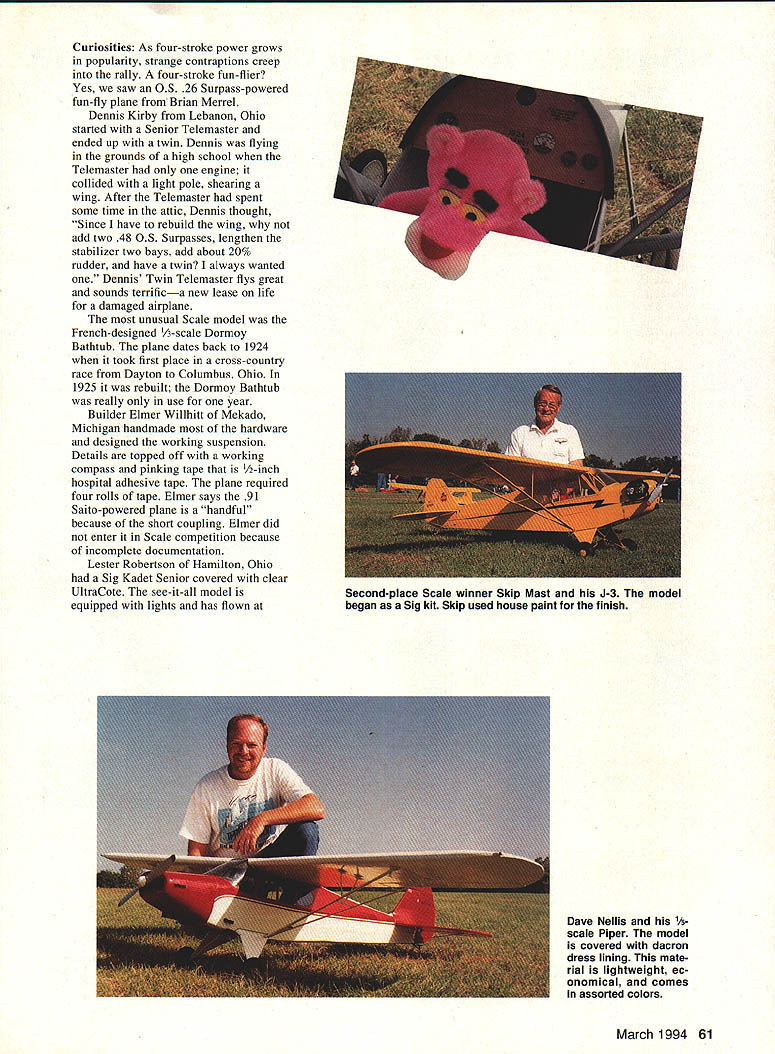
Third place went to Ken Carder of Speedway, Indiana with his Fokker D.VIII. Ken is an engineer, so he scratch-built the German beauty from his own plans. The WW I fighter is O.S. FT-160 twin-powered and is covered with World Tex. Ken painted the camouflage designs on the cloth first, then covered the plane, because that is the way it was done in 1917.
Coming in fourth was David Nellis with his 1/5-scale Piper Super Cruiser. It started as an old Champion kit and has what David described as an old O.S. .90 engine. The covering is unique: Dacron dress-lining material from Jo-Ann Fabrics. David said it is cheap, light, heat-shrinkable, and comes in different colors. (David did add that you get funny looks when you go into Jo-Ann Fabrics with a framed-up model.) David's Piper is finished with Sig dope after preparing the frame with Balsarite.
Transcribed from original scans by AI. Minor OCR errors may remain.

