
He Will Achieve His Goal
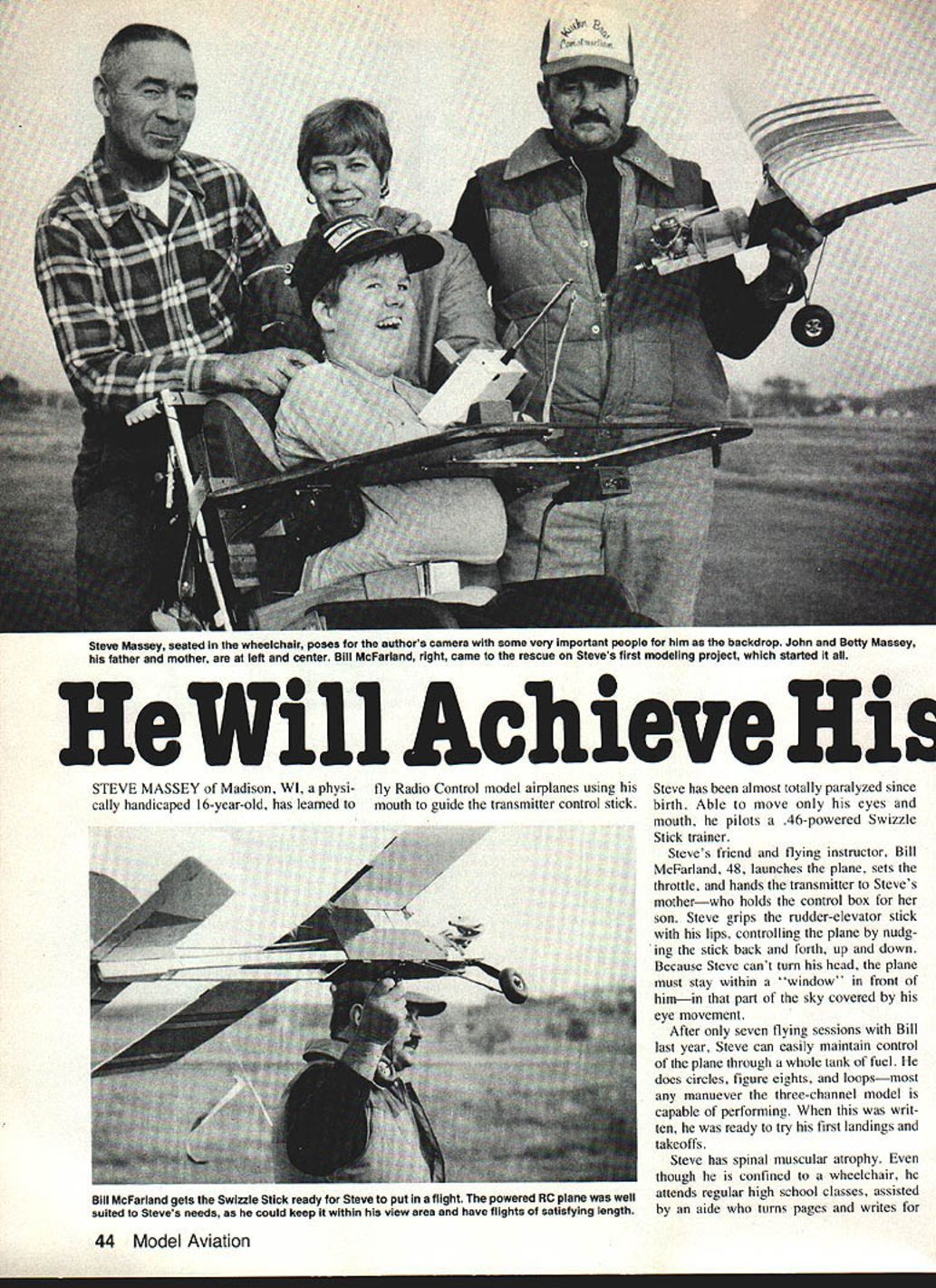
STEVE MASSEY of Madison, WI, a physically handicapped 16-year-old, has learned to fly radio-control model airplanes using his mouth to guide the transmitter control stick.
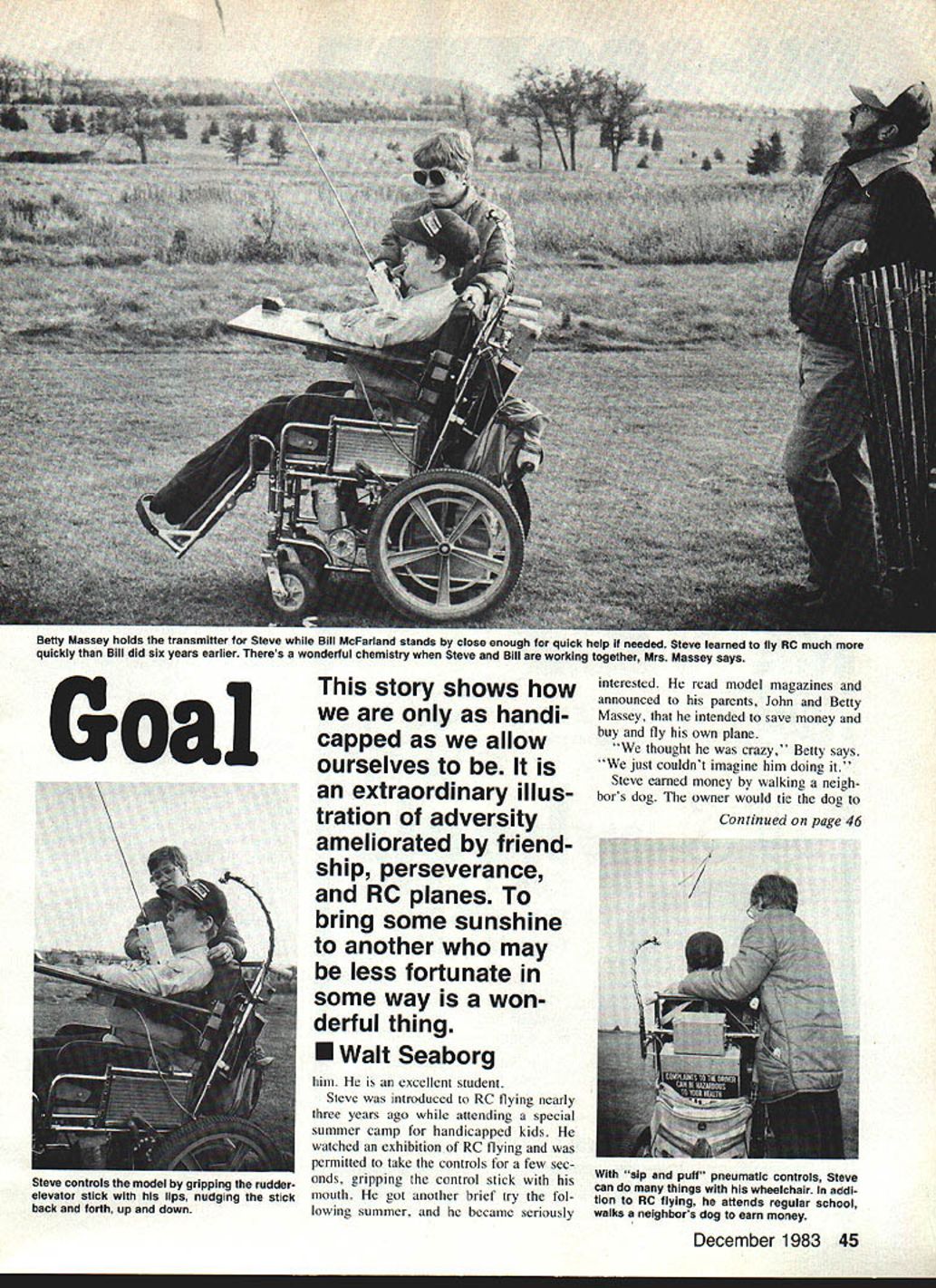
Steve has been almost totally paralyzed since birth. Able to move only his eyes and mouth, he pilots a .46-powered Swizzle Stick trainer.
Early life and condition
Steve has spinal muscular atrophy. Even though he is confined to a wheelchair, he attends regular high school classes, assisted by an aide who turns pages and writes for him. He is an excellent student.
Introduction to RC flying
Steve was introduced to RC flying nearly three years ago while attending a special summer camp for handicapped kids. He watched an exhibition of RC flying and was permitted to take the controls for a few seconds, gripping the control stick with his mouth. He got another brief try the following summer, and he became seriously interested. He read model magazines and announced to his parents, John and Betty Massey, that he intended to save money and buy and fly his own plane.
"We thought he was crazy," Betty says. "We just couldn't imagine him doing it."
Steve earned money by walking a neighbor's dog. The owner would tie the dog to Steve's wheelchair, and Steve would take the pooch for its daily exercise.
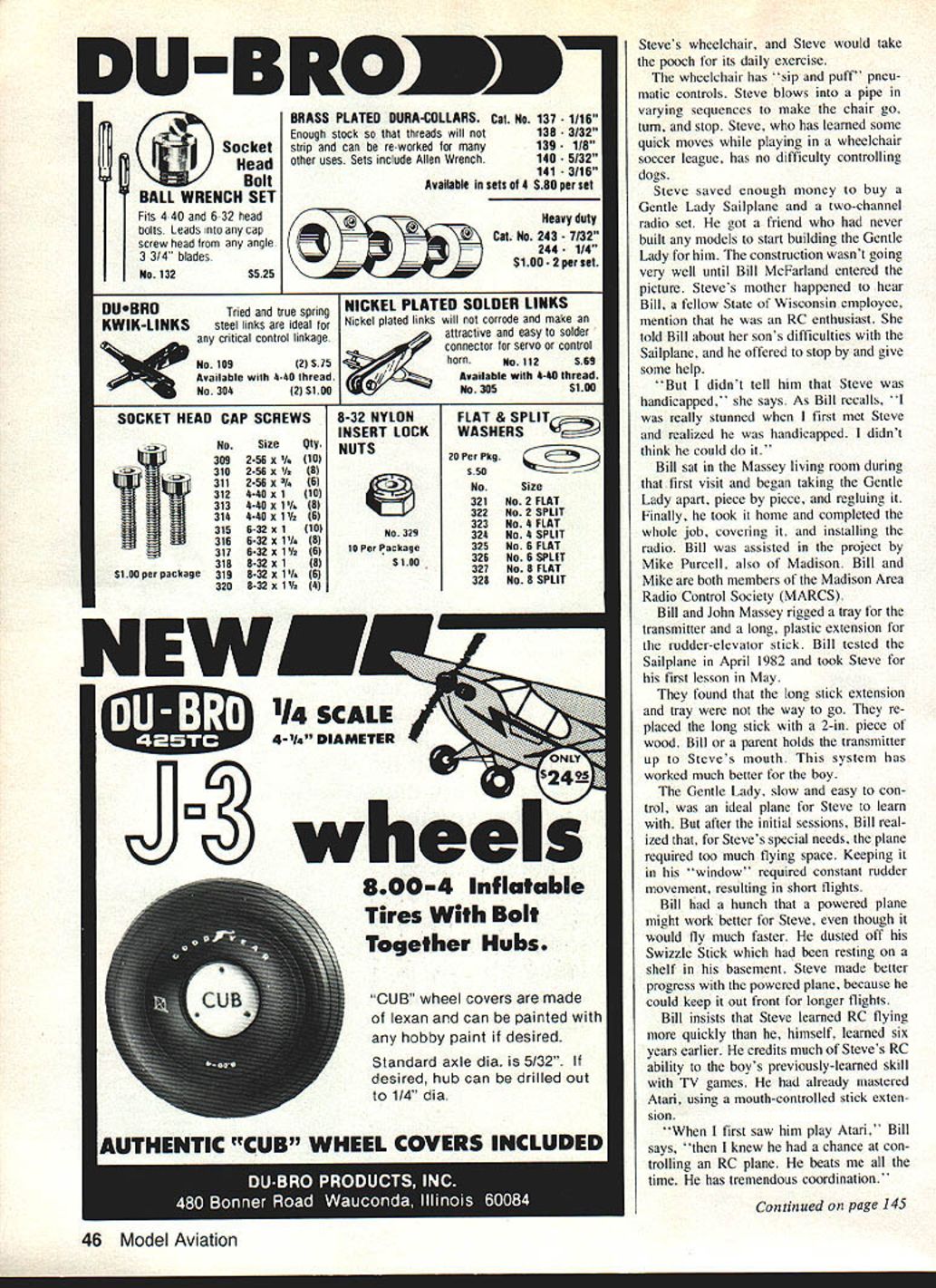
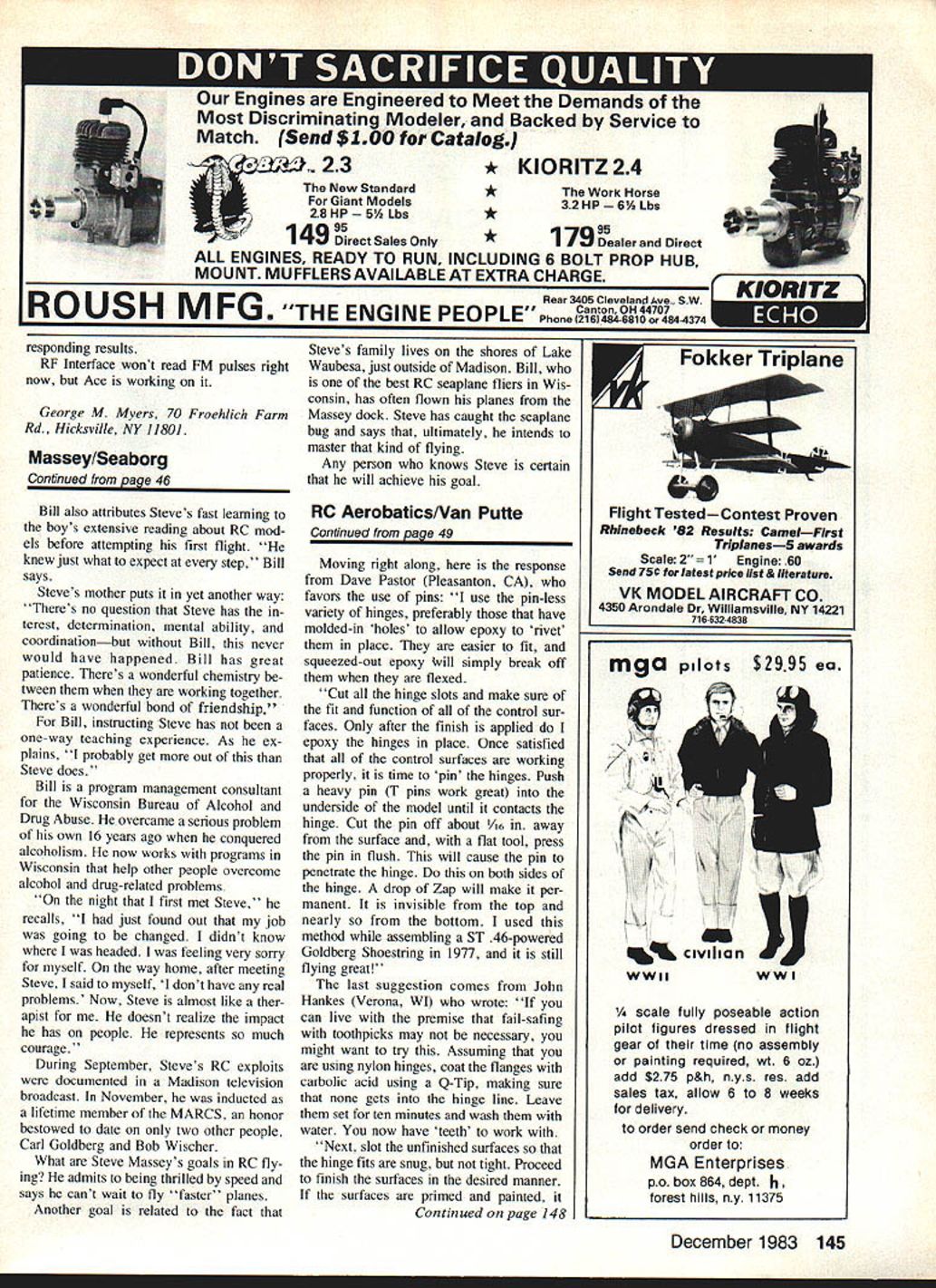
The wheelchair has "sip-and-puff" pneumatic controls. Steve blows into a pipe in varying sequences to make the chair go, turn, and stop. Steve, who has learned some quick moves while playing in a wheelchair soccer league, has no difficulty controlling dogs.
Building and adapting a model
Steve saved enough money to buy a Gentle Lady sailplane and a two-channel radio set. He got a friend who had never built any models to start building the Gentle Lady for him. The construction wasn't going very well until Bill McFarland entered the picture.
Steve's mother happened to hear Bill, a fellow State of Wisconsin employee, mention that he was an RC enthusiast. She told Bill about her son's difficulties with the sailplane, and he offered to stop by and give some help.
"But I didn't tell him that Steve was handicapped," she says. As Bill recalls, "I was really stunned when I first met Steve and realized he was handicapped. I didn't think he could do it."
Bill sat in the Massey living room during that first visit and began taking the Gentle Lady apart, piece by piece, and re-gluing it. Finally, he took it home and completed the whole job, covering it and installing the radio. Bill was assisted in the project by Mike Purcell, also of Madison. Bill and Mike are both members of the Madison Area Radio Control Society (MARCS).
Bill and John Massey rigged a tray for the transmitter and a long plastic extension for the rudder-elevator stick. Bill tested the sailplane in April 1982 and took Steve for his first lesson in May.
They found that the long stick extension and tray were not the way to go. They replaced the long stick with a 2-in. piece of wood. Bill or a parent holds the transmitter up to Steve's mouth. This system has worked much better for the boy.
Learning to fly
The Gentle Lady, slow and easy to control, was an ideal plane for Steve to learn with. But after the initial sessions, Bill realized that, for Steve's special needs, the plane required too much flying space. Keeping it in his "window" required constant rudder movement, resulting in short flights.
Bill had a hunch that a powered plane might work better for Steve, even though it would fly much faster. He dusted off his Swizzle Stick, which had been resting on a shelf in his basement. Steve made better progress with the powered plane, because he could keep it out front for longer flights.
After only seven flying sessions with Bill last year, Steve can easily maintain control of the plane through a whole tank of fuel. He does circles, figure eights, and loops—most any maneuver the three-channel model is capable of performing. When this was written, he was ready to try his first landings and takeoffs.
Bill insists that Steve learned RC flying more quickly than he himself learned six years earlier. He credits much of Steve's RC ability to the boy's previously learned skill with TV games. He had already mastered Atari, using a mouth-controlled stick extension.
"When I first saw him play Atari," Bill says, "then I knew he had a chance at controlling an RC plane. He beats me all the time. He has tremendous coordination."
Bill also attributes Steve's fast learning to the boy's extensive reading about RC models before attempting his first flight. "He knew just what to expect at every step," Bill says.
Steve's mother puts it in yet another way: "There's no question that Steve has the interest, determination, mental ability, and coordination—but without Bill, this never would have happened. Bill has great patience. There's a wonderful chemistry between them when they are working together. There's a wonderful bond of friendship."
Support, recognition, and goals
For Bill, instructing Steve has not been a one-way teaching experience. As he explains, "I probably get more out of this than Steve does."
Bill is a program management consultant for the Wisconsin Bureau of Alcohol and Drug Abuse. He overcame a serious problem of his own 16 years ago when he conquered alcoholism. He now works with programs in Wisconsin that help other people overcome alcohol- and drug-related problems.
"On the night that I first met Steve," he recalls, "I had just found out that my job was going to be changed. I didn't know where I was headed. I was feeling very sorry for myself. On the way home, after meeting Steve, I said to myself, 'I don't have any real problems.' Now, Steve is almost like a therapist for me. He doesn't realize the impact he has on people. He represents so much courage."
During September, Steve's RC exploits were documented in a Madison television broadcast. In November, he was inducted as a lifetime member of MARCS, an honor bestowed to date on only two other people, Carl Goldberg and Bob Wischer.
What are Steve Massey's goals in RC flying? He admits to being thrilled by speed and says he can't wait to fly "faster" planes.
Another goal is related to the fact that Steve's family lives on the shores of Lake Waubesa, just outside of Madison. Bill, who is one of the best RC seaplane fliers in Wisconsin, has often flown his planes from the Massey dock. Steve has caught the seaplane bug and says that, ultimately, he intends to master that kind of flying.
Any person who knows Steve is certain that he will achieve his goal.
People mentioned
- Steve Massey
- John and Betty Massey (parents)
- Bill McFarland (friend and instructor)
- Mike Purcell (assistant)
- Carl Goldberg (MARCS lifetime member)
- Bob Wischer (MARCS lifetime member)
Transcribed from original scans by AI. Minor OCR errors may remain.

