
Heart of Ohio Jet Meet
Del Ellis
Overview
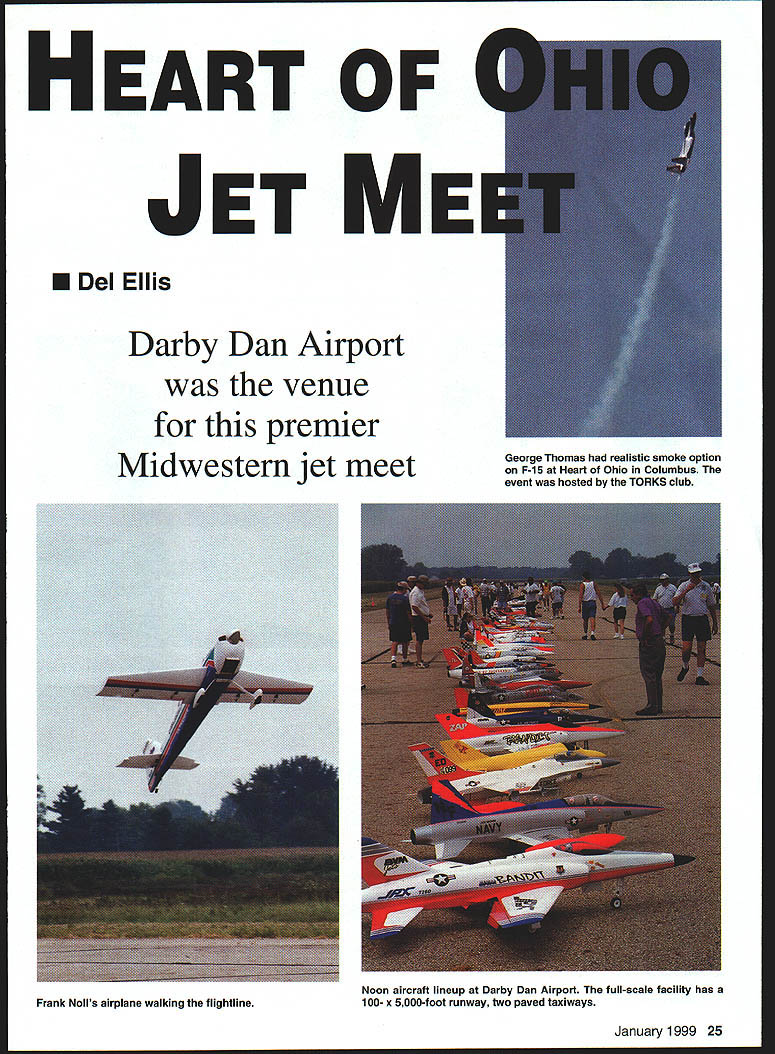
The Heart of Ohio Jet Scramble was held August 21–23, 1998, at Darby Dan Airport in Columbus, Ohio. Unlike some larger events (for example, winter Florida meets), Heart of Ohio’s appeal is its moderate size, emphasis on contest flying, and ample room on the flightline, allowing participants to fly as much as they desire.
The regional meet attracted competitors from New England to Texas and as far south as Florida. This year it became international, with pilots from England and Puerto Rico. Manufacturers and vendors demonstrated and displayed products on the flightline and sold items from the hangar. Exhibitors included BVM, Bob Violett Models, Century Jet Models, Lesher Models, AMT Turbines, RAM, RA Microjets, and ProMark. Suppliers such as Wildcat Fuels, Dave Brown Products, and Electrodynamics sold items over the counter.
Facility and Hosting
A major factor in Heart of Ohio’s success is its top-rated facility, Darby Dan full-scale Airport: a 100- by 5,000-foot smooth concrete runway, a huge ramp used as the pit/startup area, and two paved taxiways that provide separate taxi-out and return paths. The back half of the ramp was roped off for spectators, who turned out by the hundreds. The overfly area is vast, flat, and unobstructed.
Hosting by TORKS (Ohio Radio Kontrol Society—Columbus) was another key factor. Club members provided hardworking, friendly, knowledgeable, and supportive ground crews that enhanced the meet. Contest Director and Flight Line Director Bill Midgley ran a superb operation. Turbine Americas’ Bernie Oldenburgh provided professional flightline commentary for three days. The demonstrations were proficient and as entertaining as many full-scale airshows.
Weather, Entertainment, and Social Events
The meet enjoyed three days of near-perfect weather: clear skies and temperatures generally in the high 80s to low 90s (mid-70s by noon Saturday was noted in some reports). Noon-break entertainment each day included model rocket launches, a model helicopter demo, and a spectacular aerobatic TOC flight routine. Frank Noll’s jet aerobatics preceded the runway lineup of participating jets and was a major draw.
Friday night featured a free pizza/barbecue hangar party. Saturday night was a steak banquet in a canopied plaza near Bolton Field, with videos of the day’s jet flying shown during the meal. The best part of the meet was models, pilots, and top-quality real pilots getting together—fifty-three pilots attended.
Aircraft and Flying
There were more than 150 aircraft at the meet, including more than 20 turbine-powered models. Flying was constant and exciting, with one of the lowest attrition rates of any meet the author has attended. The majority of aircraft were ducted fans, and someone’s model was always in the air.
Turbines were pitted separately for startup safety but mixed well on the flightline. The turbine start area was busy yet orderly. Improvements in aircraft design allow sufficient fuel for long flights, so turbine flight time is no longer an issue—turbine aircraft simply line up for takeoff with everyone else.
Competitions
An informal jet scale competition was conducted without restricting flightline operations. Most attendees came to fly and have fun rather than to compete. A traditional event at Heart of Ohio, likely held for the last time at this meet, was the speed run: a flat run through JPO (Jet Pilots’ Organization) remote speed traps following a high-altitude vertical approach. Qualification runs (coincident with open flying on Friday and Saturday) produced speeds exceeding 200 mph.
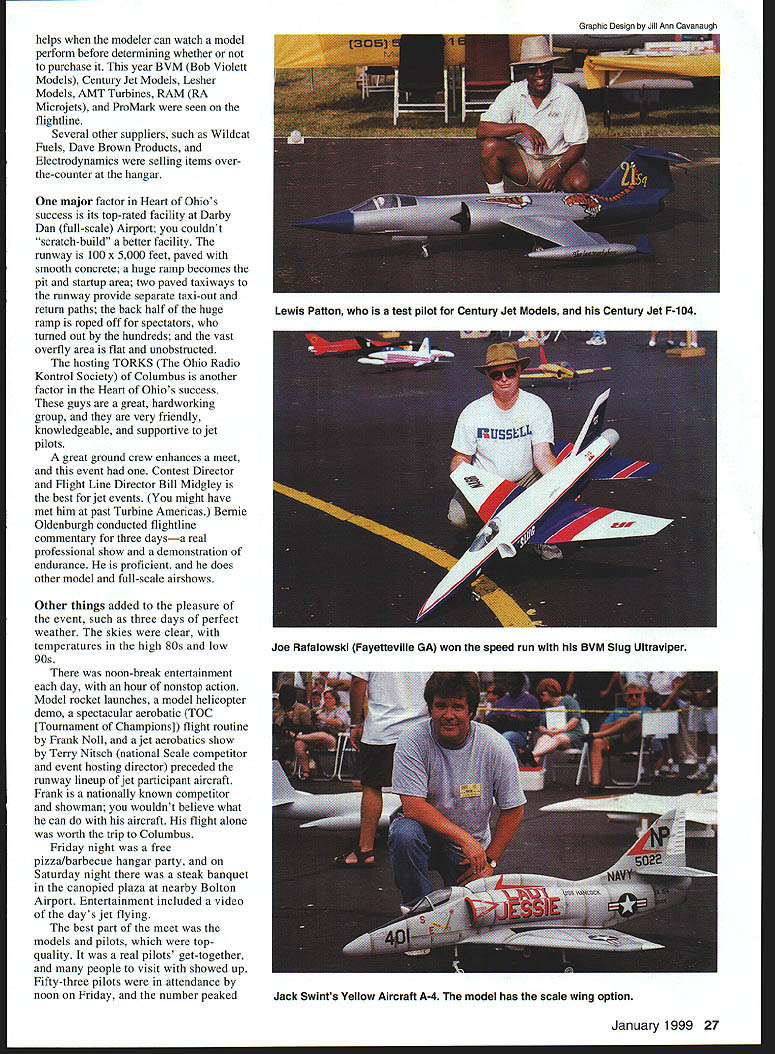
Speed was measured by an infrared, two-plane-of-light meter, computerized to convert time into speed. The Sunday afternoon final was intense, with some flights exceeding a qualifying threshold of 224.2 mph. Joe Rafalowski—winner and longtime competitor—won by a large margin and recorded a final pass at 232.2 mph.
Official speed results were:
- Joe Rafalowski — 216.3 mph (UltraViper)
- Jerry Kerr — 187.5 mph (Terminator)
- Glen Robinson — 186.3 mph (Viper)
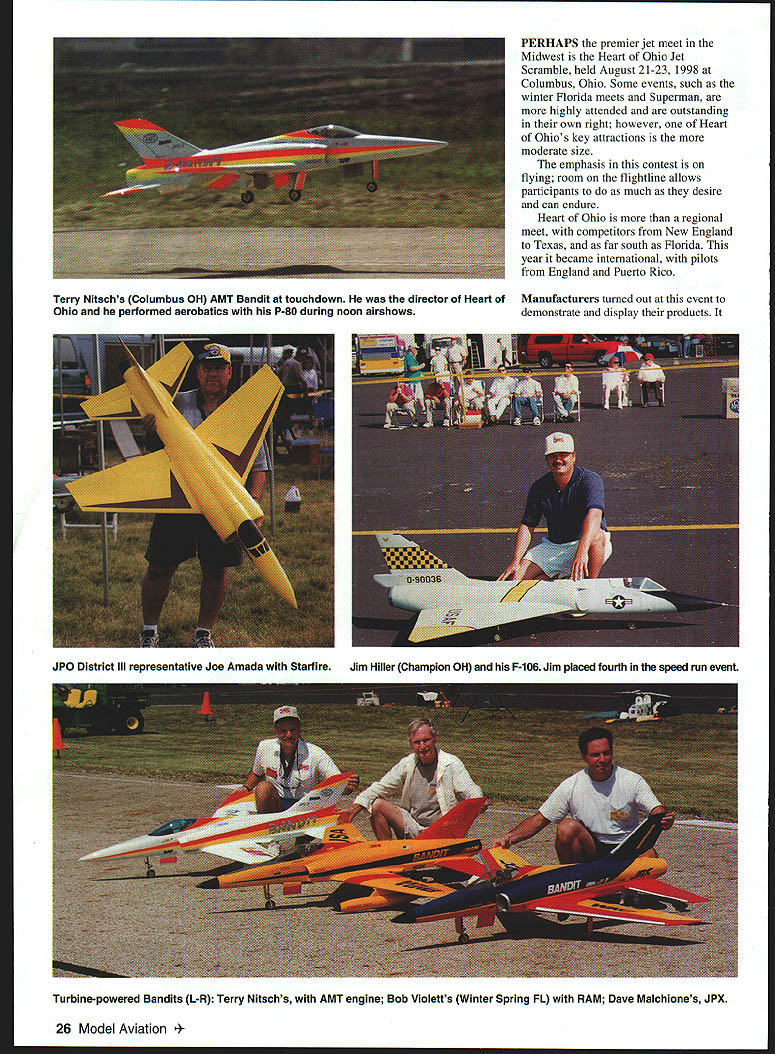
- Jim Hiller — 138.0 mph (F-106)
Although turbines did not officially compete in the event, occasional speed readings were taken for crowd interest:
- Steve Elias’ AMT Pegasus–powered Bandit: 216 mph flat and level (at less than half-throttle)
- Terry Nitsch’s AMT Mercury–powered Bandit: 229.7 mph (during familiarization flights)
- Bob Violett’s MiG-15: 202 mph flat and level
- Rei Gonzalez’s RAM-powered Bandit: 215 mph flat and level; downhill runs measured 253 mph and later 283 mph
Because turbines can achieve very high speeds, they are not raced at events like this for safety reasons; competition jets pushed to extreme speeds would compromise safety and acceptance of turbine modeling.
Safety and Turbine Discipline
Most turbine pilots adhered to the turbine safety program, maintaining 1/2 to 2/3 power settings except at takeoff and during vertical climbs. This discipline supports conservative, safe flying even at well-populated events and may permit cautious increases in thrust for the future.
Bob Brown, District III AMA Vice President, attended the meet and the banquet, offering praise for the event and its participants—an encouraging show of respect and support from AMA.
Notable Pilots and Aircraft
Many great pilots and spectacular aircraft participated. A selection:
- Steve Elias (from England): Flew an AMT Pegasus–powered Bandit with exceptionally smooth Top Gun–level flying. Called Heart of Ohio “absolutely fantastic,” and plans to return.
- Malcolm Kay (England): Flew a stunning Pegasus-powered Bandit; experienced in Florida meets and helpful at the first Jet Turbine Symposium in DeLand in 1994.
- Jim Hiller (northern Ohio): A superior showman, flew a Golden West turbine-powered Terminator and a ducted-fan F-106. The F-106 was extremely maneuverable, capable of nose-high crawls and impossibly tight turns; Jim’s low passes were spectacular and frequent.
- Filipe Vidal (Puerto Rico): Brought a bright yellow-and-black RAM-powered Bandit that flew several 200+ mph passes; he and his pit crew wore matching outfits.
- David Malchione and son Dave Jr.: Brought a fleet including a fan-powered Bandit in a three-color scheme and a twin-fan F-4 Phantom (extremely detailed and bright red). The F-4 won Scale and Pilots’ Choice Twin.
- Lewis Patton (Century Jet Models demo pilot): Flew Century’s powered Bandits and a convincing F-104 Starfighter, demonstrating docile, stable handling and smooth landings. Century announced a forthcoming high-performance sport jet, the Scorpion.
- Bob Violett: Considered by many a founding father of jet modeling; attended with several BVM aircraft, notably a turbine-powered MiG-15 in Soviet show colors and a RAM turbine–powered Bandit. Bob remains one of the best jet pilots to watch.
- Terry Nitsch (Heart of Ohio Director): Had limited flying time but flew a new AMT Mercury–powered Bandit in a striking white scheme with fluorescent trim. He also performed a halftime show with a P-80.
- Rei Gonzalez (RAM demo pilot): Flew two RAM-powered Bandits, demonstrated smoke trails, and logged the fastest speed readings of the meet. He flew more turbine flights than anyone else.
My apologies to the many other friends and pilots not mentioned—their participation was noted and truly appreciated.
Del Ellis 2877 Meadowview Dr. West Chester, OH 45069
Transcribed from original scans by AI. Minor OCR errors may remain.

