
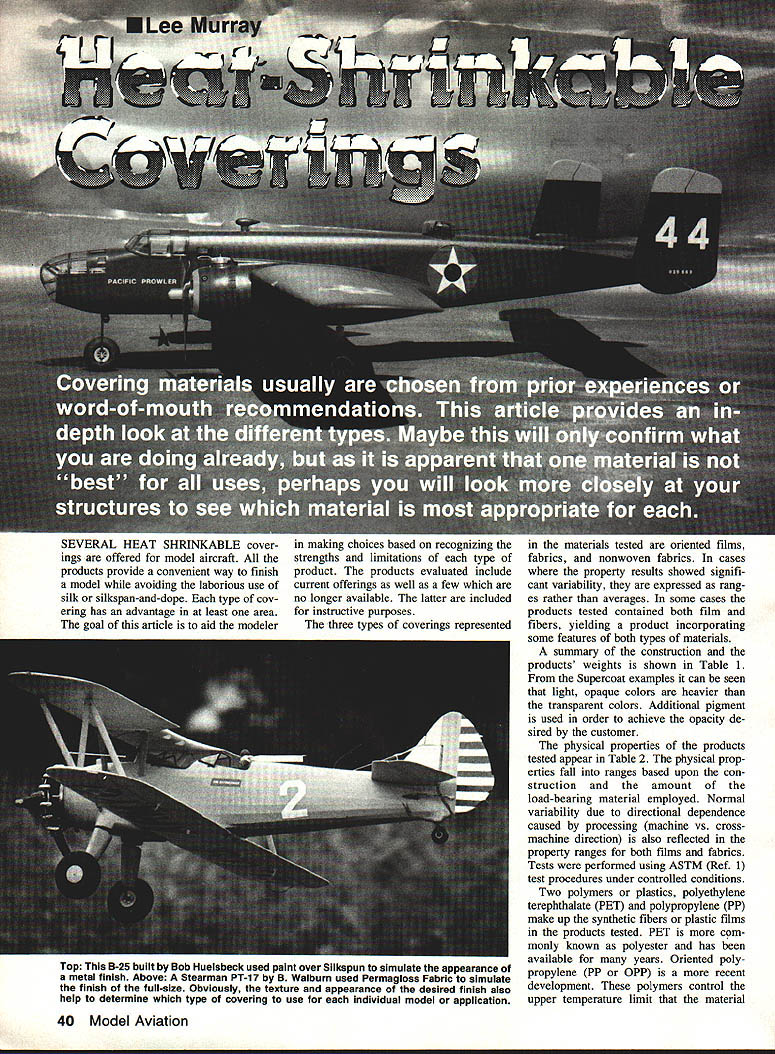
Heat-Shrinkable Coverings
Lee Murray
Covering materials usually are chosen from prior experience or word-of-mouth recommendations. This article provides an in-depth look at the different types. One material is not "best" for all uses, so you may want to examine your structures to see which material is most appropriate for each.
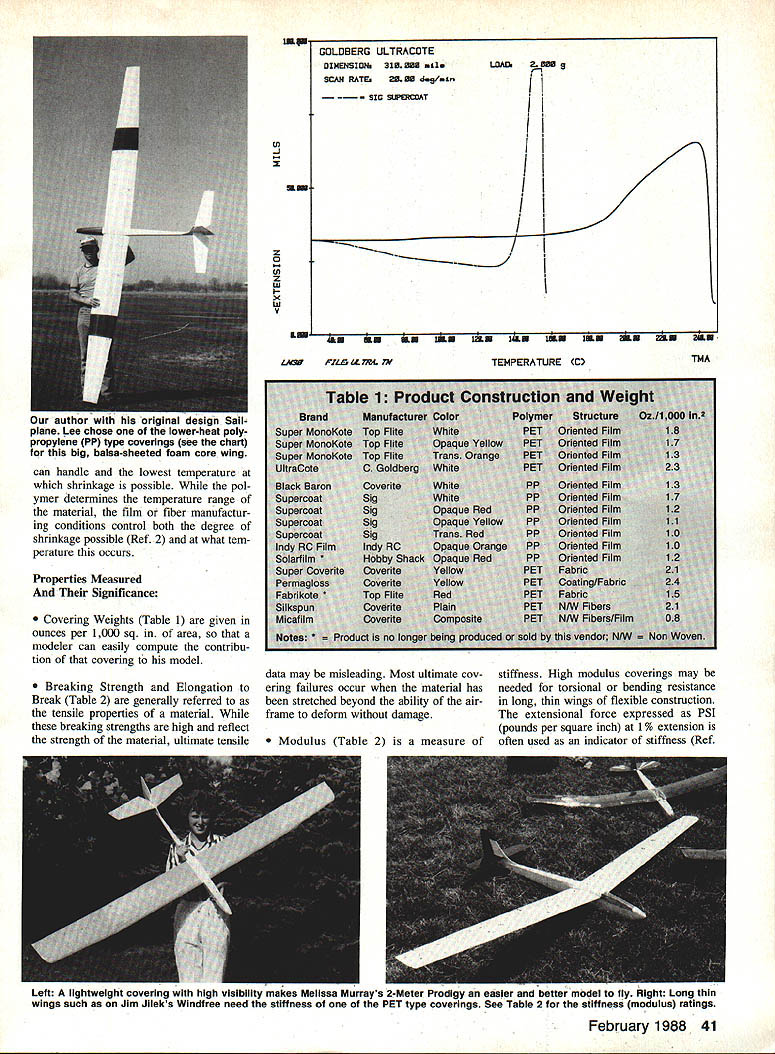
Several heat-shrinkable coverings are offered for model aircraft. All the products provide a convenient way to finish a model while avoiding the laborious use of silk or silkspan-and-dope. Each type of covering has an advantage in at least one area. The goal of this article is to aid the modeler in making choices based on the strengths and limitations of each product. The products evaluated include current offerings as well as a few that are no longer available; the latter are included for instructive purposes.
The three types of coverings represented in the materials tested are oriented films, fabrics, and nonwoven fabrics. In cases where the property results showed significant variability, results are expressed as ranges rather than averages. Some products tested contained both film and fibers, yielding a hybrid product with features of both construction types.
Two polymers make up the synthetic fibers or plastic films in the products tested: polyethylene terephthalate (PET, commonly known as polyester) and polypropylene (PP or OPP). These polymers control the upper temperature limit the material can withstand, the temperature range for shrinkage, and the degree of shrinkage possible. Manufacturing and processing conditions also affect shrinkage behavior.
Properties measured and their significance
- Covering weight
- Given in ounces per 1,000 sq. in. (see Table 1). This lets the modeler compute the covering's contribution to model weight.
- Breaking strength and elongation at break
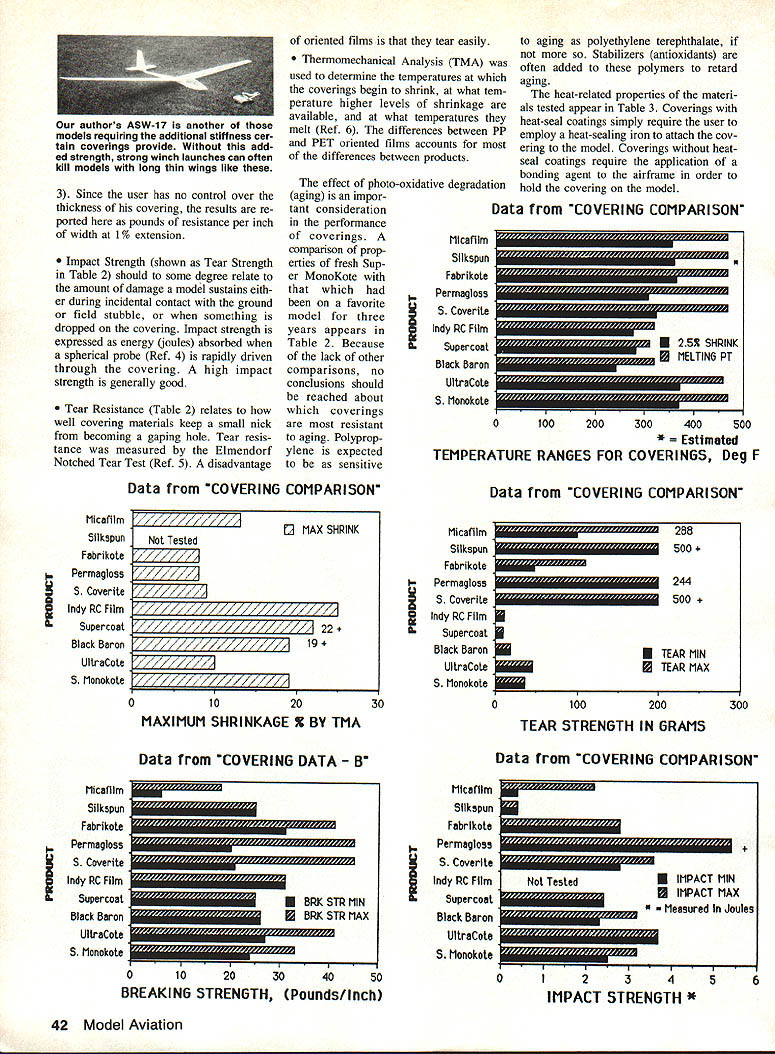
- Generally refer to tensile properties. High breaking strengths reflect ultimate tensile strength, but ultimate tensile data may be misleading: most failures occur when the material has stretched beyond the airframe's ability to tolerate deformation.
- Modulus
- A measure of stiffness (Table 2). High-modulus coverings may be needed for torsional or bending resistance on long, thin wings or flexible construction. Extensional force expressed in psi at 1% extension is often used as an indicator of stiffness (Ref. 3).
- Impact strength
- Expressed as energy (joules) absorbed when a spherical probe is rapidly driven through the covering (Ref. 4). High impact strength is generally desirable and relates to resistance to incidental damage.
- Tear resistance
- Measured by the Elmendorf Notched Tear Test (Ref. 5). Tear resistance indicates how well a covering prevents a small nick from becoming a large tear. Oriented films typically have poor tear resistance.
- Thermomechanical analysis (TMA)
- Used to determine temperatures at which coverings begin to shrink, temperatures for further shrinkage, and melting points (Ref. 6). The polymer type (PET vs. PP) accounts for most differences between products; processing conditions control the degree and onset temperature of shrinkage.
- Aging (photo-oxidative degradation)
- An important consideration. Comparison of fresh Super MonoKote with a sample aged three years shows property changes (Table 2). Stabilizers (antioxidants) are often added to retard aging. Limited data prevent firm conclusions about relative aging resistance of different products.
Application notes — shrinkage and heat effects
- Shrinkage onset temperature
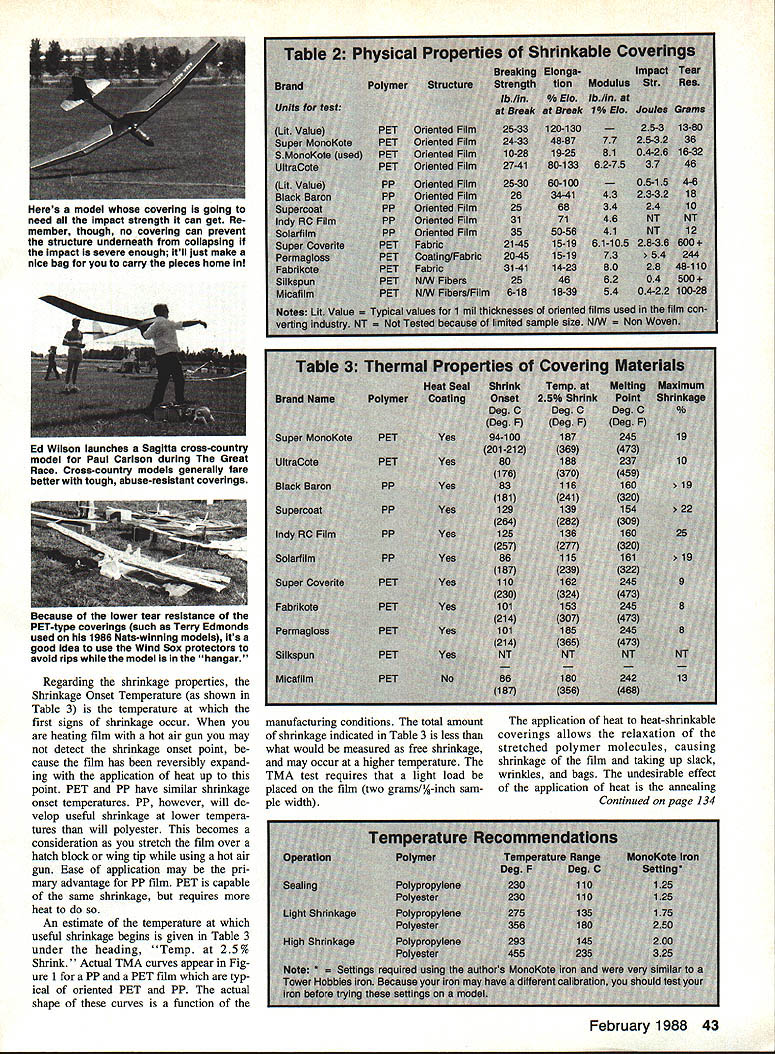
- The temperature at which first signs of shrinkage occur. PET and PP have similar shrinkage onset temperatures, but PP develops useful shrinkage at lower temperatures than PET. This can make PP easier to apply with a hot air gun.
- Temp. at 2.5% shrink
- An estimate of the temperature where useful shrinkage begins (see Table 3). Actual TMA curves vary by product and manufacturing conditions. TMA tests use a light load (two grams per 1/2-inch sample width).
- Annealing
- Applying heat relaxes stretched polymer molecules, producing shrinkage that removes slack and wrinkles. Heat can also anneal the film, permanently reducing residual shrinkage available for later adjustments. When reworking old coverings, spot-heat small areas and check effects; puffing with a little heat and immediately shrinking adjacent areas can sometimes remove slack without annealing the whole cover.
Product construction and weight (Table 1)
Brand | Manufacturer | Color | Polymer | Structure | Oz./1,000 in.^2 --- | ---: | --- | --- | --- | ---: Super MonoKote | Top Flite | White | PET | Oriented Film | 1.8 Super MonoKote | Top Flite | Opaque Yellow | PET | Oriented Film | 1.7 Super MonoKote | Top Flite | Trans. Orange | PET | Oriented Film | 1.3 UltraCote | C. Goldberg | White | PET | Oriented Film | 2.3 Black Baron | Coverite | White | PP | Oriented Film | 1.3 Supercoat | Sig | White | PP | Oriented Film | 1.7 Supercoat | Sig | Opaque Red | PP | Oriented Film | 1.2 Supercoat | Sig | Opaque Yellow | PP | Oriented Film | 1.1 Supercoat | Sig | Trans. Red | PP | Oriented Film | 1.0 Indy RC Film | Indy RC | Opaque Orange | PP | Oriented Film | 1.2 Solarfilm | Hobby Shack | Opaque Red | PP | Oriented Film | 1.2 Super Coverite | Coverite | Yellow | PET | Fabric | 2.1 Permagloss | Coverite | Yellow | PET | Coating/Fabric | 2.4 Fabrikote | Top Flite | Red | PET | Fabric | 1.5 Silkspan | Coverite | Plain | PET | N/W Fibers | 2.1 Micalfilm | Coverite | Composite | PET | N/W Fibers/Film | 0.8
Notes:
- * Product may no longer be produced or sold by this vendor.
- N/W = Nonwoven.
- Because the user has no control over covering thickness, some mechanical results are reported as pounds of resistance per inch of width at 1% extension.
Heat-related properties and attachment
- Coverings with heat-seal coatings can be attached with a heat-sealing iron.
- Coverings without heat-seal coatings require a bonding agent applied to the airframe.
- Table 3 (not reproduced here) summarizes heat-related properties such as shrinkage onset, temp. at 2.5% shrink, and melting behavior.
Conclusions
- Oriented PET films
- Offer good stiffness, impact strength, and breaking strength, but lack tear resistance. Using socks for wings covered with oriented films helps prevent cuts, scratches, and property degradation from light and solar heating.
- Oriented PP films
- Offer useful shrinkage at lower temperatures, light weight, and good impact resistance and breaking strength, but also lack tear resistance to a significant degree.
- Fabrics
- Offer a scalelike appearance, higher tear resistance compared to oriented films, and high impact and breaking strength. A clear stiffness advantage for films over fabrics was not evident in these tests; evaluation methods may need adjustment. Gliders may benefit from fabric coverings because the surface can promote beneficial turbulent airflow at low speeds, reducing sudden stall onset.
- Nonwoven (Micafil) fiber coverings
- Offer low weight, good tear resistance, and good modulus, making them suitable for R/C hand-launched gliders, free-flight models, and other weight-sensitive applications. Impact strength was not a feature of the nonwoven samples tested. Silkspan, with more fibers, was very tear resistant and can produce a "metal-like" scale appearance when painted.
- Heat-seal coating performance
- Not evaluated in this article; this may be the basis for future work.
Selection considerations for modelers:
- Scale-like appearance of fabrics
- Ability to apply paints
- Stiffness (flutter and wing bending resistance)
- Abrasion resistance (tear and impact strength)
- Weight differences based on product type and color (lighter transparent colors often weigh less than opaque colors)
- Ease of application for products that activate at lower temperatures
Acknowledgments
Thanks to Art Kramer and Henry Haffle of Coverite; Lawrence King of Carl Goldberg Models, Inc.; Mike Gretz of Sig Manufacturing, Inc.; and Scott Christensen of Top Flite for samples and assistance reviewing the information. Thanks also to Bob Huelsbeck of the Valley Aero Modelers, who provided many samples from his collection.
About the author: Lee Murray is a Senior Research Associate for a large midwestern film converter. He is active in R/C soaring and in computers.
References
- ASTM — American Society for Testing and Materials; organization devoted to test standardization.
- Packaging's Encyclopedia 1987. (Newton, MA: Cahner's Publishing Co., 1987).
- ASTM D882 (8.01), Tensile Properties of Thin Plastic Sheeting.
- ASTM D256 (35), Impact Resistance of Plastics and Electrical Insulating Materials. Test for Spencer Impact.
- ASTM D1424 (32), Tear Resistance of Woven Fabrics by Falling Pendulum (Elmendorf) Apparatus.
- P. W. Brennan, Thermomechanical Analysis of Polyethylene Film—Thermal Analysis Application Study 23 (Elmer Corp., Instrument Div., Norwalk, CT).
- G. W. Urbanczyk and G. Michalak, "The Influence of Annealing on the Thermal Properties of Poly(ethylene terephthalate) Fibers; 1. The Heat Capacity of Annealed PET Fibers," Journal of Applied Polymer Science.
Transcribed from original scans by AI. Minor OCR errors may remain.

