
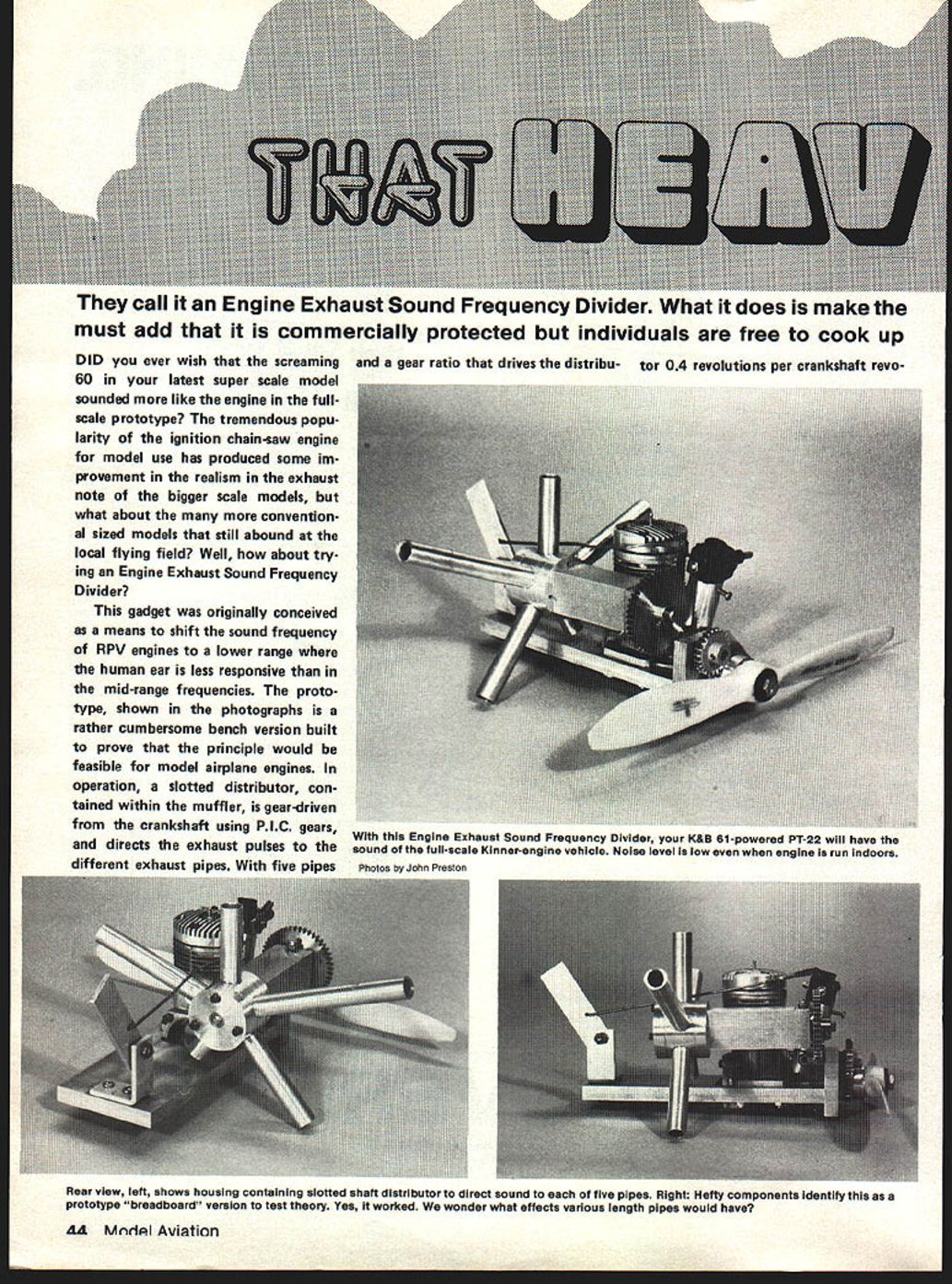
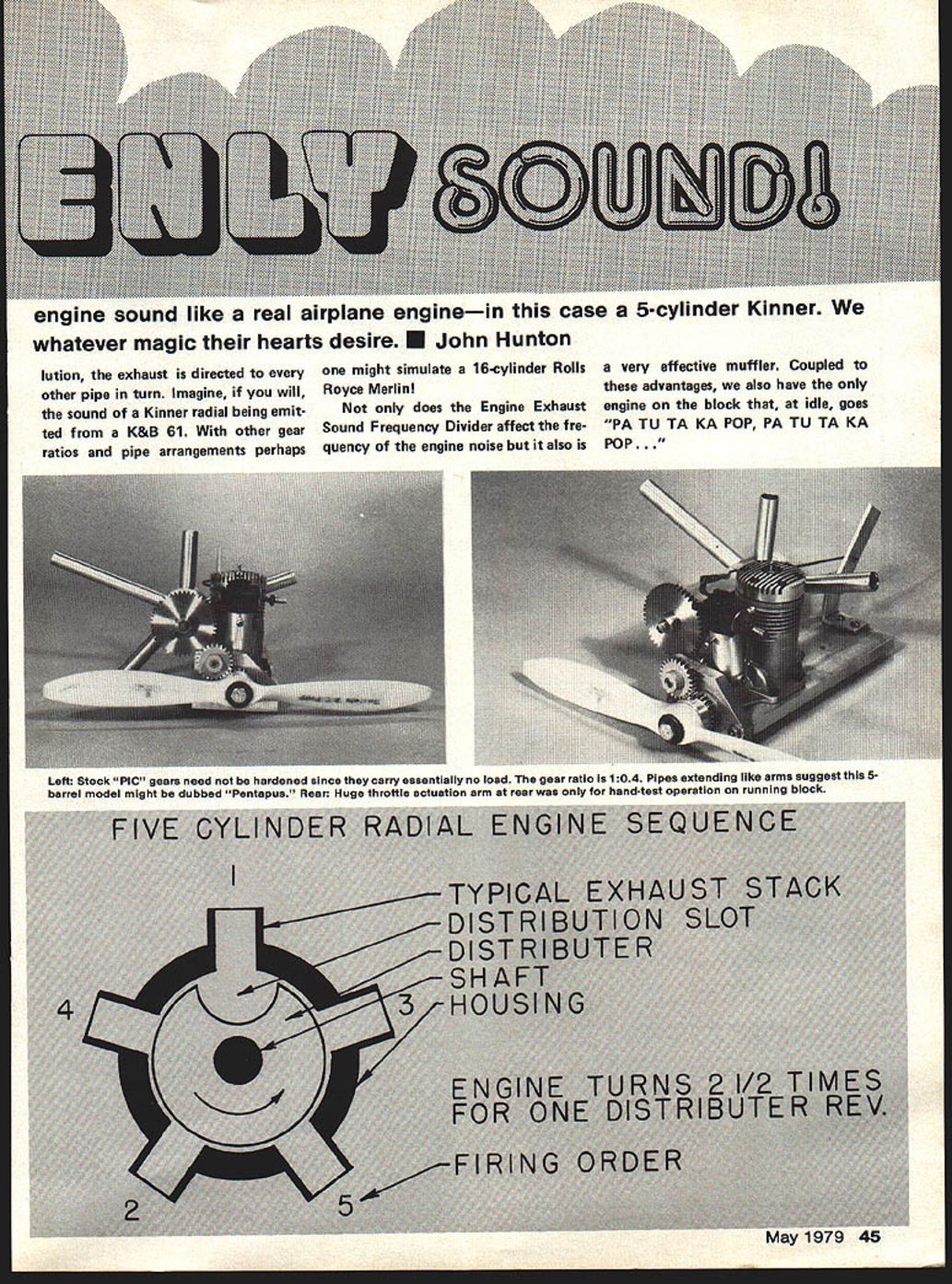
That Heav
They call it an Engine Exhaust Sound Frequency Divider. What it does is make the exhaust note sound lower. We must add that it is commercially protected, but individuals are free to cook up their own versions.
Did you ever wish that the screaming 60 in your latest super-scale model sounded more like the engine in the full-scale prototype? The tremendous popularity of the ignition chainsaw engine for model use has produced some improvement in the realism of the exhaust note in the bigger scale models, but what about the many more conventional-sized models that still abound at the local flying field? Well, how about trying an Engine Exhaust Sound Frequency Divider?
Background
This gadget was originally conceived as a means to shift the sound frequency of model engines to a lower range where the human ear is less responsive than in the mid-range frequencies. The prototype, shown in the photographs, is a rather cumbersome bench version built to prove that the principle would be feasible for model airplane engines.
Prototype and operation
In operation, a slotted distributor, contained within the muffler, is gear-driven from the crankshaft using pin gears and directs the exhaust pulses to the different exhaust pipes. With five pipes and a gear ratio that drives the distributor to 0.4 revolutions per crankshaft revolution, the exhaust is directed to every other pipe in turn. Imagine, if you will, the sound of a Kinner radial being emitted from a K&B 61. With other gear ratios and pipe arrangements, perhaps one might simulate a 16-cylinder Rolls-Royce Merlin!
Advantages
- Shifts engine noise to a lower frequency band where the ear is less sensitive, increasing perceived scale realism.
- Acts as a very effective muffler.
- Produces a distinctive idle rhythm; at idle the engine goes "PA TU TA KA POP, PA TU TA KA POP..."
Transcribed from original scans by AI. Minor OCR errors may remain.

