
The Heinkel 100
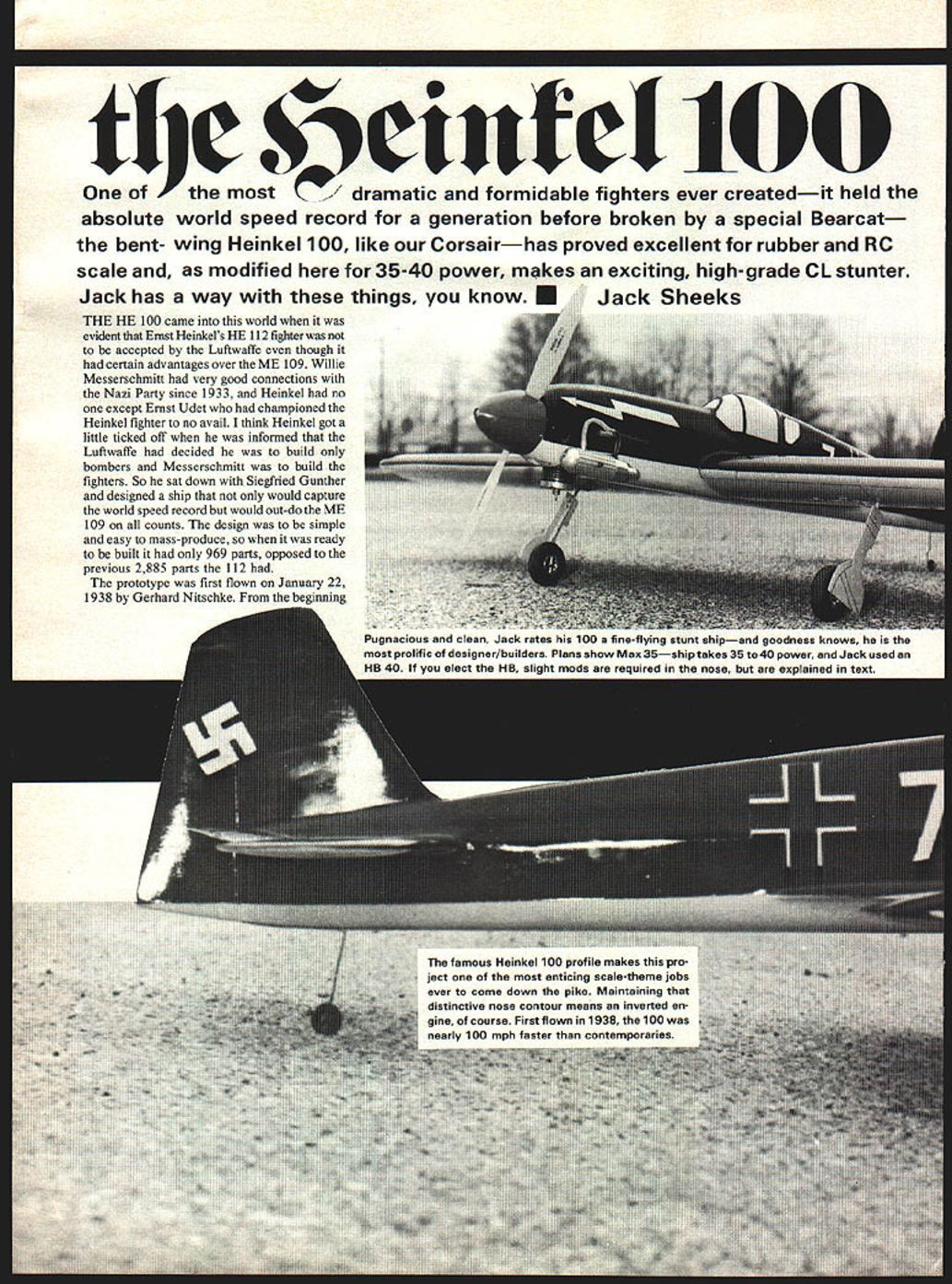
One of the most dramatic and formidable fighters ever created—it held the absolute world speed record for a generation before being broken by a special Bearcat—the bent‑wing Heinkel 100, like our Corsair, has proved excellent for rubber and R/C scale. As modified here for .35–.40 power, it makes an exciting, high‑grade control‑line stunter. Jack has a way with these things, you know. — Jack Sheeks
Background and history
The He 100 came into this world when it was evident that Ernst Heinkel's He 112 fighter was not to be accepted by the Luftwaffe even though it had certain advantages over the Me 109. Willy Messerschmitt had very good connections with the Nazi Party since 1933, and Heinkel had no one except Ernst Udet who had championed the Heinkel fighter to no avail. I think Heinkel got a little ticked off when he was informed that the Luftwaffe had decided he was to build only bombers and Messerschmitt was to build the fighters. So he sat down with Siegfried Günther and designed a ship that not only would capture the world speed record but would out‑do the Me 109 on all counts. The design was to be simple and easy to mass‑produce, so when it was ready to be built it had only 969 parts, compared to the previous 2,885 parts of the He 112.
The prototype was first flown on January 22, 1938 by Gerhard Nitschke. From the beginning it was evident that it had a very marked advantage over Willy's 109.
One by one, the records on aircraft flight speed began to fall to this new aircraft, until it came to the absolute world speed record, which it broke on March 31, 1939. The pilot was Hans Dieterle and the speed attained was 463.92 mph. The aircraft was a modified version of the fighter, but the production version was still faster and better than anything flying at that time.
Even with all the propaganda this aircraft generated, the high command still would not accept it for Luftwaffe use. But the Russians and Japanese were not so shortsighted: they purchased a few each for study and design work. The Russians used it in studies that led to the Yak‑3 and Yak‑9, and the Japanese developed their Kawasaki Ki‑61 "Tony." The final version had a speed of 416 mph at 13,120 feet, cruised at 345 mph, and had a climb rate of 3,288 ft/min. With stats like these, the Allies were pleased that politics killed this aircraft, since they had nothing that would keep up with it at the time.
The full‑scale Heinkel 100 was a remarkable airplane. The model is a fine‑flying stunt ship.
The model: story and acquisition
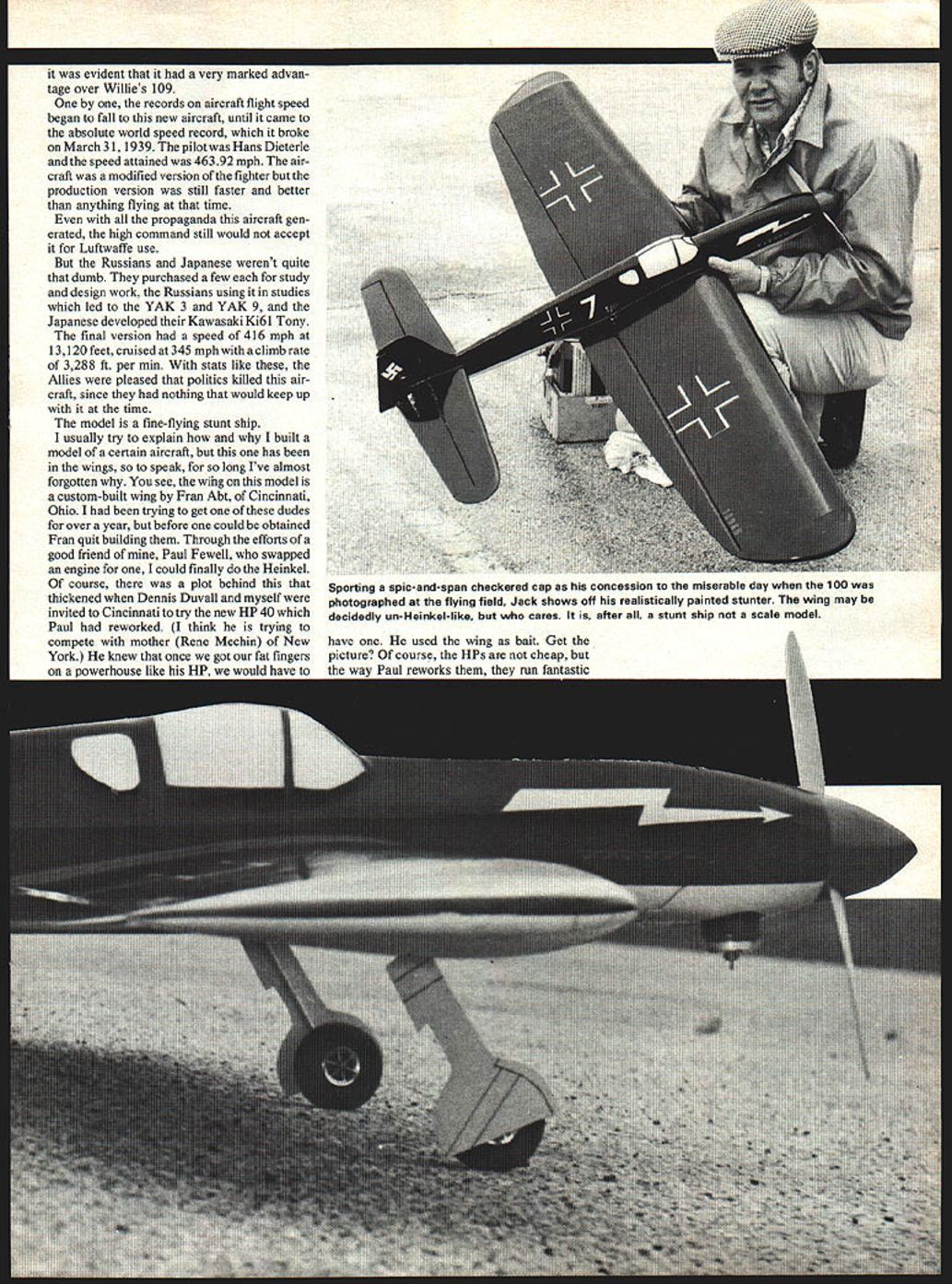
I usually try to explain how and why I built a model of a certain aircraft, but this one has been in the wings, so to speak, for so long I've almost forgotten why. The wing on this model is a custom‑built wing by Fran Abt of Cincinnati, Ohio. I had been trying to get one of these wings for over a year, but before one could be obtained Fran quit building them. Through the efforts of a good friend, Paul Fewell, who swapped an engine for one, I could finally do the Heinkel.
There was a plot behind this that thickened when Dennis Duvall and I were invited to Cincinnati to try the new HP‑40 which Paul had reworked. (I think he is trying to compete with Mother Rene Mechin of New York.) He knew that once we got our fat fingers on a powerhouse like his HP, we would have to have one, so he used the wing as bait. Get the picture? Paul's reworked HP engines are not cheap, but the way he de‑tunes them they run fantastically smooth. They have been called a chain‑horse engine, but Paul tweaks them to run smooth and are worth every dime.
When the wing was finally in hand it turned out to be "petrified‑forest" heavy—Fran had trouble obtaining light wood and had decided to close shop. Sorry about that, because the wing was as close to perfect as I could ask for. Anyhow, as usually happens, the ship was finished during Indiana's nasty winter. As the pictures show, Steve Ashby, vice‑president in charge of airplane bottoms, and his daughter Beth braved icy winds to deliver it; we just couldn't wait for better weather. Steve made me promise not to tell you that he chattered so badly he messed up the in‑flight shots, so I won't tell you. After the session we stopped at Steve's house, drank iced tea, relaxed and discussed performance.
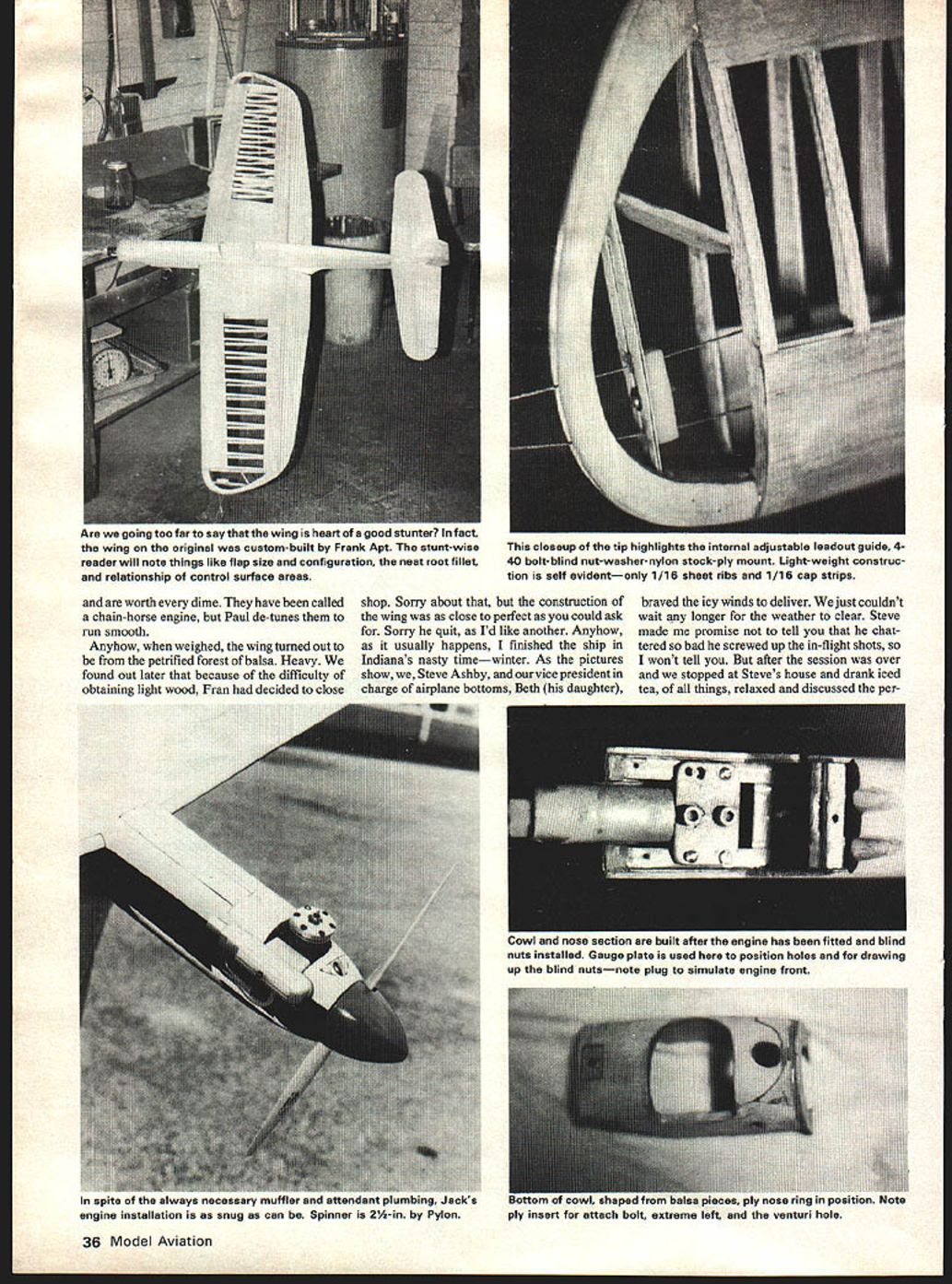
Are we going too far to say the wing is the heart of a good stunter? The fact the wing is an original custom‑built Fran Abt stunt wing is evident. The stuntwise reader will note things like flap size and configuration, neat root‑fillet relationship, control surface areas, etc.
Construction
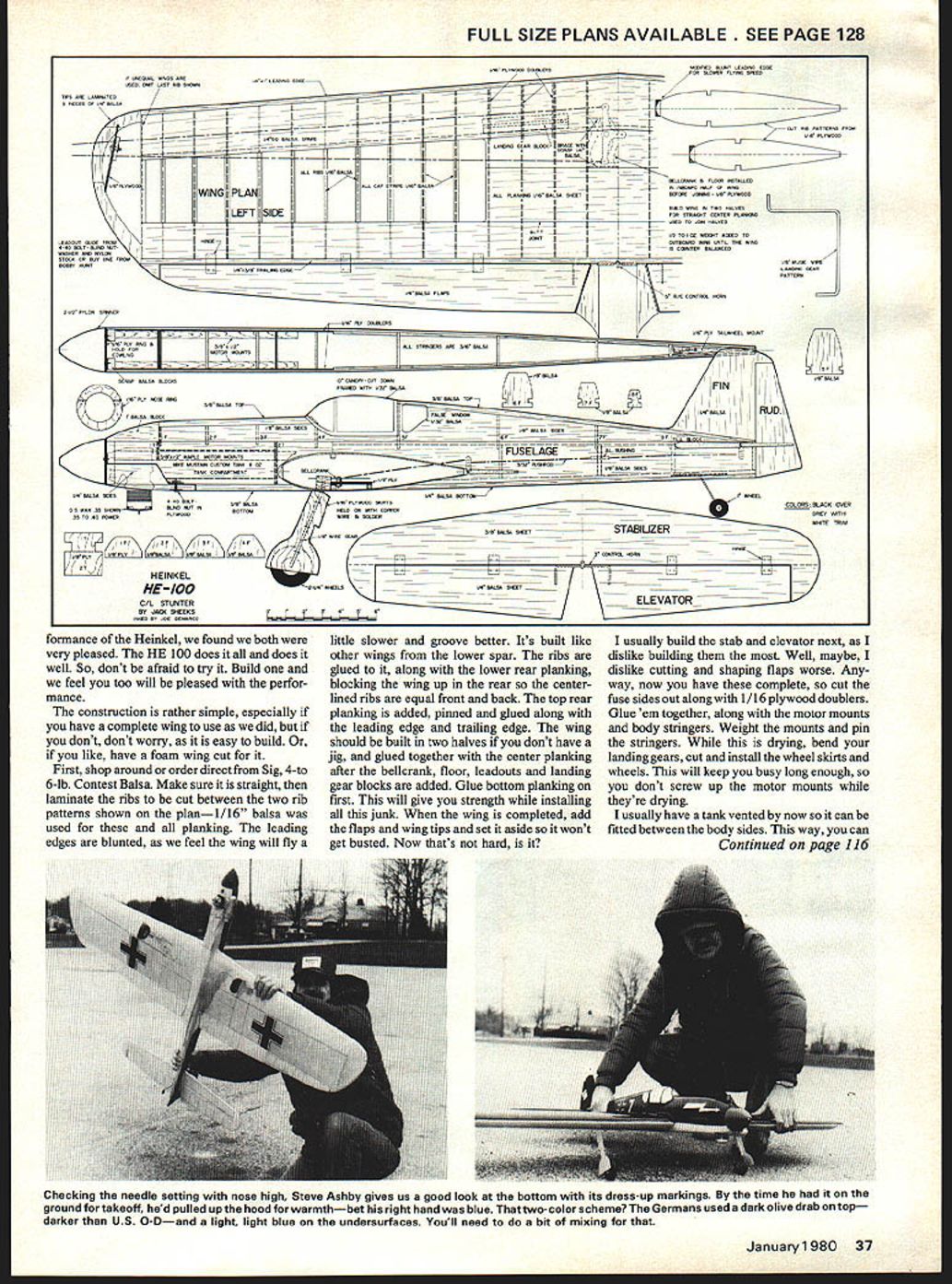
The construction is rather simple, especially if you have a complete wing to use as we did. If you don't, don't worry — it is easy to build, or you can have a foam wing cut for it.
Materials and prep
- Shop around or order direct from Sig: 4‑ to 6‑lb contest balsa. Make sure it is straight.
- Laminate the ribs to be cut between the two rib patterns shown on the plan. I used 1/16" balsa for these and for all planking.
- The leading edges are blunted; this helps the wing fly a little slower and groove better.
Wing construction (overview)
- Build the wing around the lower spar.
- Glue the ribs to the lower spar and add the lower rear planking.
- Block the wing up in the rear so the center‑lined ribs are equal front and back.
- Add top rear planking, pinning and gluing along with the leading and trailing edges.
- Build the wing in two halves if you don't have a jig; glue together with the center planking after the bellcrank, floor, leadouts and landing gear blocks are added.
- Glue the bottom planking on first—this gives you strength while installing the internal components.
- When the wing is completed, add the flaps and wingtips and set it aside.
Notes:
- The wing was built after the engine had been fitted and the blind nuts installed. A gauge plate was used to position the holes when drawing up the blind nuts.
- Include a plug to simulate the engine front opening during fitting if needed.
Tail and fuselage
- Build the stab and elevator next (I usually do these early because I dislike building them later). Cutting and shaping flaps can be worse.
- Cut the fuse sides out and glue on 1/16" plywood doublers.
- Glue the fuse sides together along with the motor mounts and body stringers. Weight the mounts and pin the stringers while they dry.
- While drying, bend the landing gear, cut and install the wheel skirts and wheels so you won't mess up the motor mounts while they're drying.
- Glue the formers around the tank so it will slide in and out snugly. When dry, pull the rear of the fuse together, glue, and install the wing with 5‑minute epoxy.
- Bend the 3/32" pushrod, making sure the 1/4" aluminum bushing tubing is on it before soldering. Solder it to the elevator control horn, then solder it in the wing flap horn. Slide the stab back and forth until both are aligned, then epoxy it in place.
- Install the remaining formers as shown on the plans and begin the planking and blocking of the aircraft to its final shape.
Engine installation and nose
- Build the cowl and nose section after the engine has been fitted and the blind mounting nuts are installed.
- Jack's engine installation is snug and can take a spinner. Use 2‑1/4" pylon‑shaped balsa pieces, a plywood nose ring, position the plywood insert, and attach with the bolt.
- Remember: if you use an HP engine, the engine will have to set on a 1/8" plate or the motor mounts will have to be cut 1/8" so the fuel tank will sit above the motor when the ship is on its wheels. Paul said this makes them run smoother without changing speeds inverted. I went with a metal plate so other engines could also be used.
Finishing
- Install the canopy, rudder and fillets.
- Sand the ship, take care of all the little things you forgot, then paint.
- When you're through enjoying your balsa wonder, paint the jewel and get it ready to fly.
Final notes
This has not been a job, but an adventure. Enjoy it to the fullest, and good luck.
Transcribed from original scans by AI. Minor OCR errors may remain.

