
Heinkel He 45
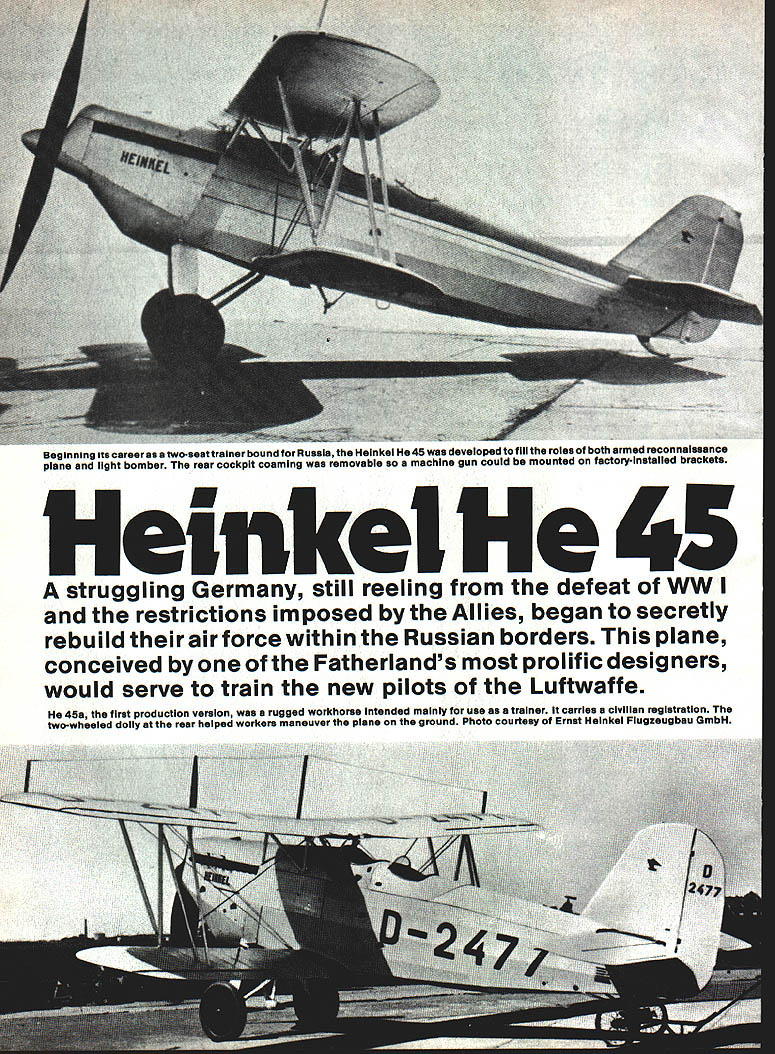
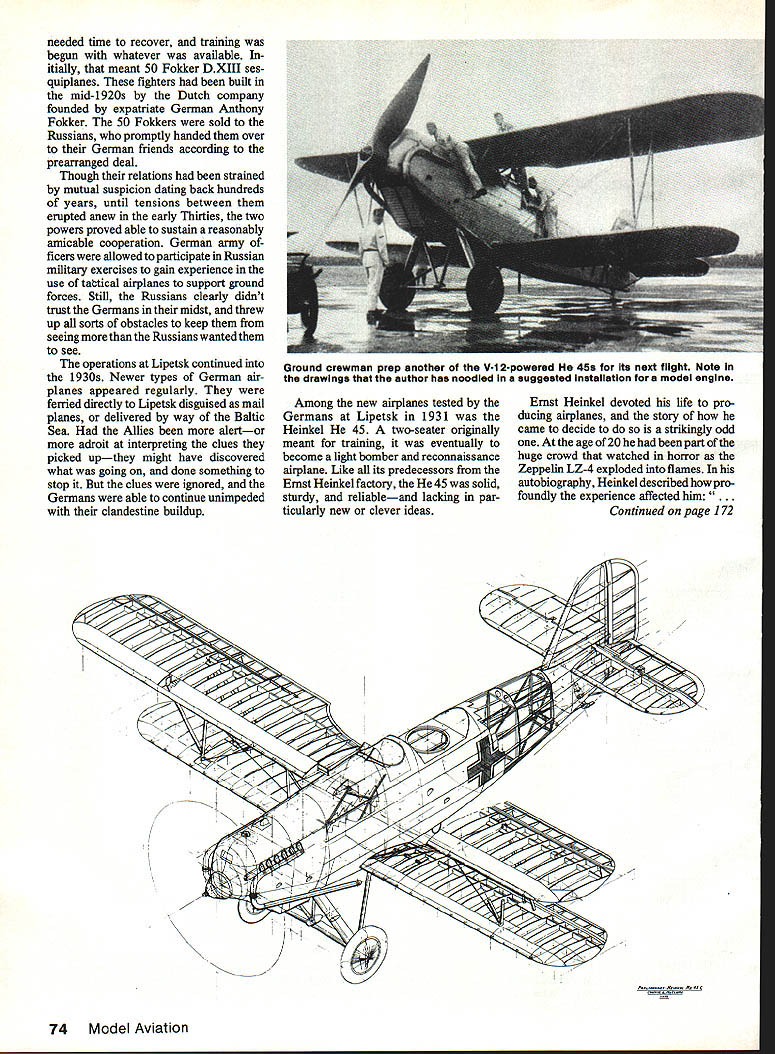
A struggling Germany, still reeling from the defeat of World War I and the restrictions imposed by the Allies, began in the 1920s to rebuild its air force covertly. Much of the early, clandestine work took place on Soviet soil under mutually expedient Russo‑German arrangements. Into this atmosphere of secret cooperation came the Heinkel He 45: a conventional two‑seat biplane developed as a trainer that evolved into light reconnaissance and bomber roles.
Russo‑German cooperation
After World War I the Treaty of Versailles severely limited German military aviation. Germany had to conceal efforts to regain military aviation capability and turned to the Soviet Union for secure territory and testing grounds. In the mid‑1920s the first German test and training center was established at Lipetsk (1924–1925), where German personnel could develop and practice advanced aerial techniques out of sight of the Allied powers.
The Lipetsk center allowed:
- advanced tactical training (formation flying, aerobatics, bombing, gunnery);
- testing of prototype aircraft disguised as civilian mail or sport planes;
- retention of a cadre of skilled personnel while German industry recovered.
Operations at Lipetsk continued into the early 1930s. New German types were regularly ferried there for testing; some were delivered via the Baltic or carried civilian registrations to preserve secrecy. The Russo‑German cooperation was pragmatic rather than friendly and ended as tensions rose in the early 1930s.
Ernst Heinkel (brief biography)
Ernst Heinkel was a prolific German aircraft designer. Early experiences with flight inspired him to pursue aircraft design; by World War I he had been chief designer at several firms. After the armistice he formed the Ernst Heinkel Aircraft company (with Carl Bücker in 1922) and produced a series of designs—single‑ and multi‑engined types, seaplanes, flying boats, and experimental types. Heinkel’s firm survived the postwar inflation in part by producing designs in Sweden and other expedients, and by the time clandestine rearmament began he was well positioned to supply the emerging Luftwaffe.
Development and design
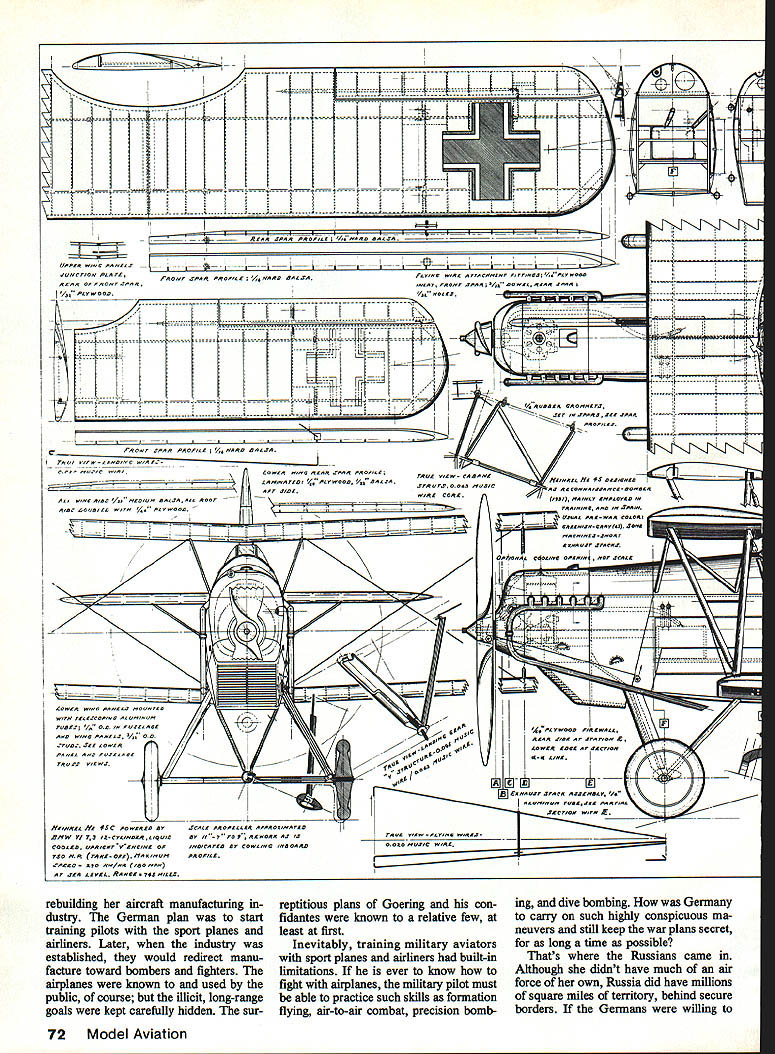
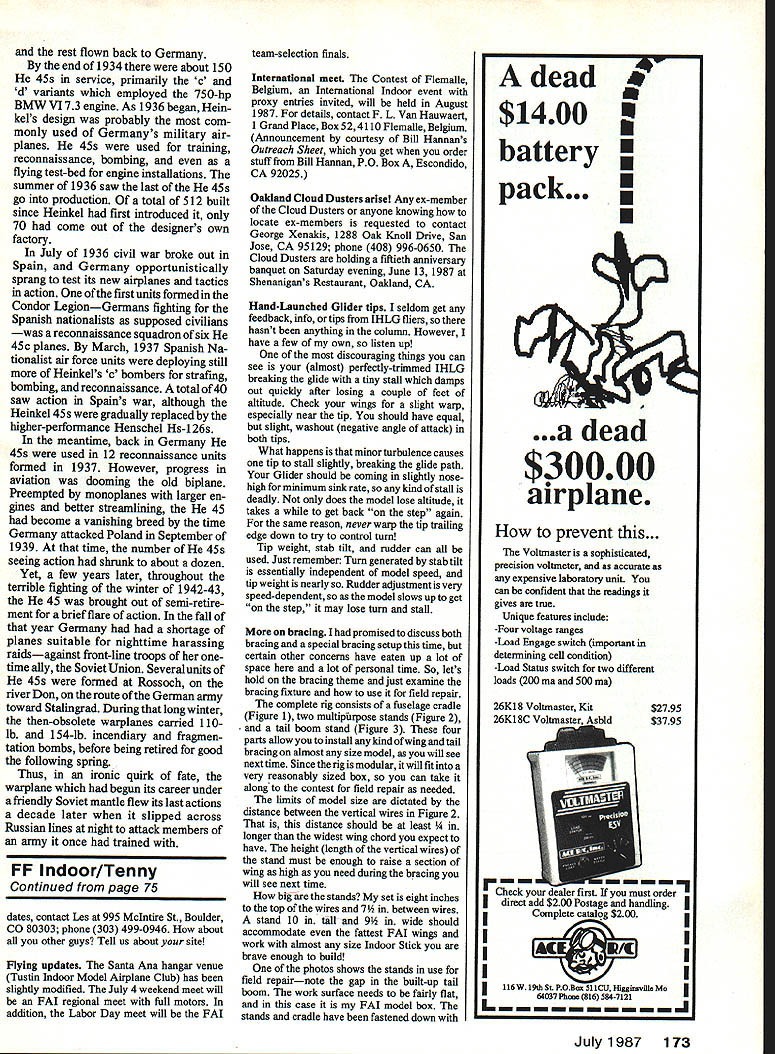
The He 45 was developed to meet a government requirement for an airplane with docile handling, easy maintenance, structural strength, and reasonable load‑carrying ability. Heinkel produced a straightforward, conservative biplane built along proven lines rather than experimental concepts.
Key features:
- conventional two‑place, open‑cockpit biplane layout;
- fuselage of welded rectangular steel tubes with fabric covering;
- wooden wing structure with fabric covering;
- water‑cooled V‑12 engine (prototype sources note a ~600‑hp engine; early production used a 660‑hp BMW engine);
- wooden two‑bladed fixed‑pitch propeller;
- rear cockpit removable coaming that could accept a ring‑mounted machine gun;
- simple, robust undercarriage (early production used a two‑wheeled dolly arrangement for ground handling).
Performance and weights (production examples):
- top speed: about 155 mph (sea level);
- cruising speed: about 137 mph;
- empty weight: ~3,800 lb;
- loaded weight: ~5,750 lb.
Variants
- He 45a: First production version, rugged two‑seat trainer, civil registrations for covert use, used initially at flying schools.
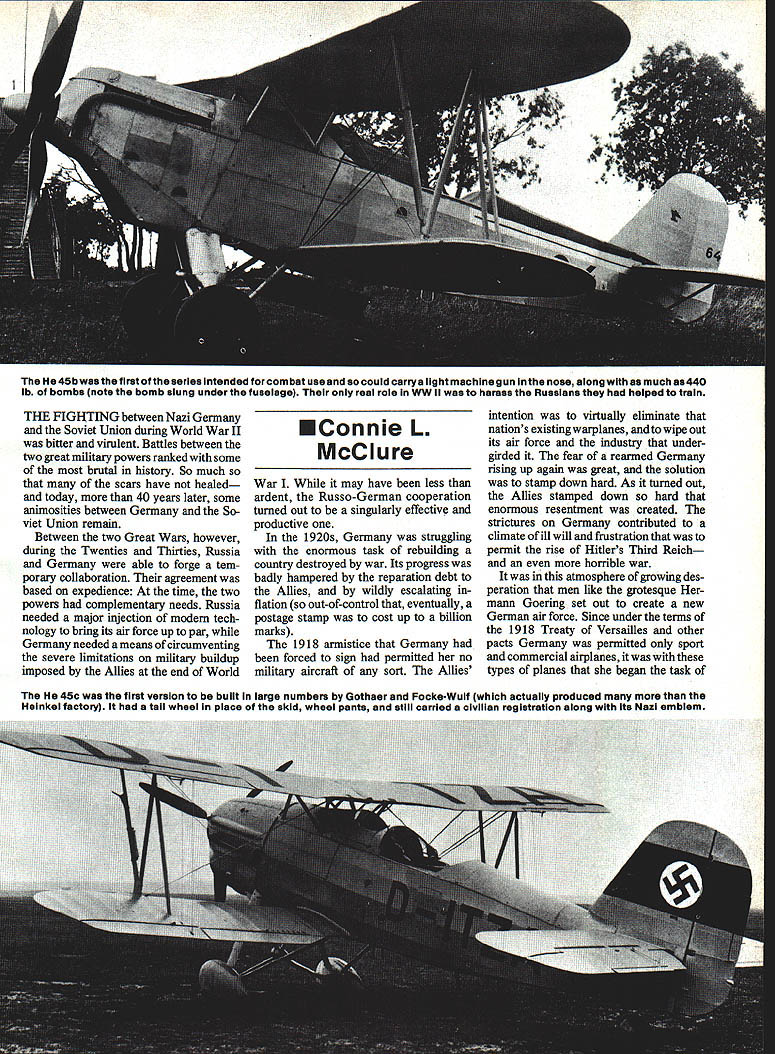
- He 45b: First series intended for combat use; provision for a fixed forward machine gun and internal bomb racks. Bomb load figures vary in sources; examples cite up to 440 lb total, with some installations carrying ten 22‑lb bombs.
- He 45B (reconnaissance/bomber adaptation): Similar to the a-series but fitted with nose changes and bomb racks in the camera bay; first flown 1932 and in production late 1933.
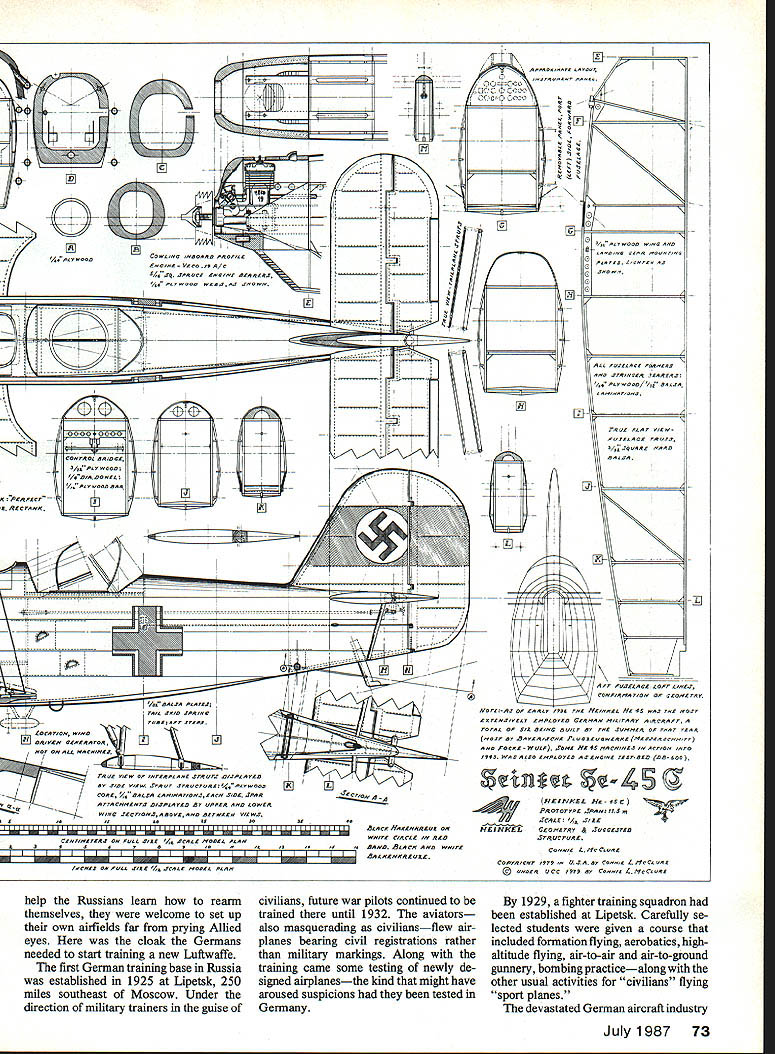
- He 45c / He 45d: Later service variants fitted with more powerful engines (many used the 750‑hp BMW VI 7.3).
- He 61: A small number of Heinkel‑built or modified examples reportedly exported to Nationalist China.
Production and numbers:
- Testing of the prototype completed in 1932; production began by the end of that year.
- First deliveries to Schleissheim flying school in summer 1933.
- Last He 45s went into production in summer 1936.
- Total built: approximately 512, of which only about 70 were built in Heinkel’s own factory.
- By the end of 1934 roughly 150 He 45s were in service (primarily c and d variants).
Operational history
Training and testing:
- The He 45’s primary early role was as a trainer and test aircraft, both in Germany and at covert facilities such as Lipetsk.
- Training curricula at Lipetsk included:
- formation flying;
- aerobatics;
- high‑altitude flying;
- air‑to‑air and air‑to‑ground gunnery;
- bombing practice.
Spanish Civil War:
- In July 1936 the Condor Legion used He 45s in Spain. An initial reconnaissance squadron operated six He 45c aircraft, and by March 1937 more He 45s were deployed for strafing, bombing, and reconnaissance.
- A total of about 40 He 45s saw service in Spain, where they were gradually replaced by higher‑performance types such as the Henschel Hs 126.
Late prewar and World War II service:
- By 1937 twelve reconnaissance units in Germany used He 45s, but rapid aviation progress and the shift to monoplanes reduced the type’s front‑line importance.
- At the outbreak of war against Poland in September 1939 only about a dozen He 45s remained in action.
- In the winter of 1942–43 a few He 45s were briefly returned to service for nighttime harassment raids on the Eastern Front (Rossosh region). They carried incendiary and fragmentation bombs (examples cited: 110‑lb and 154‑lb types) before final retirement in spring 1943.
Legacy:
- The He 45 was a solid, dependable design typical of Heinkel’s conservative approach. It served as a trainer, reconnaissance aircraft, light bomber, and engine testbed. Ironically, an aircraft that had been developed and tested under a Soviet‑German cloak was later used against Soviet forces a decade later.
Transcribed from original scans by AI. Minor OCR errors may remain.

