
Helicopter World Champs
Horace Hagen
Background
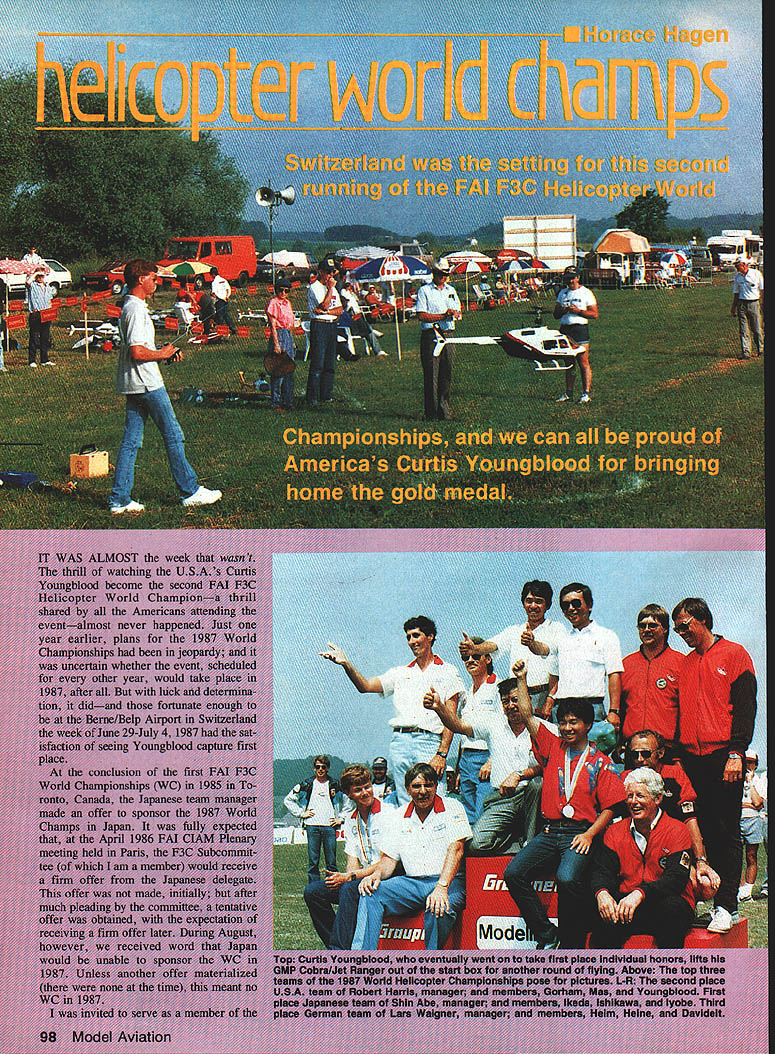
Switzerland was the setting for the second FAI F3C Helicopter World Championships, held at Berne/Belp Airport the week of June 29–July 4, 1987. After uncertainty about whether the 1987 event could be held—following Japan's withdrawal as sponsor—Swiss team manager Peter Oberli and Dr. Ronald Cicurel raised the necessary funds to host the WC. The event was approved by CIAM at its December 1986 Bureau meeting.
Organization and Team Selection
- In October 1986 the AMA asked me to form a U.S.A. F3C Team Selection Committee (TSC). The RC Helicopter Contest Board members served on the TSC.
- Due to time constraints I appointed Bob Harris as U.S.A. team manager in March 1987; he handled uniforms and travel.
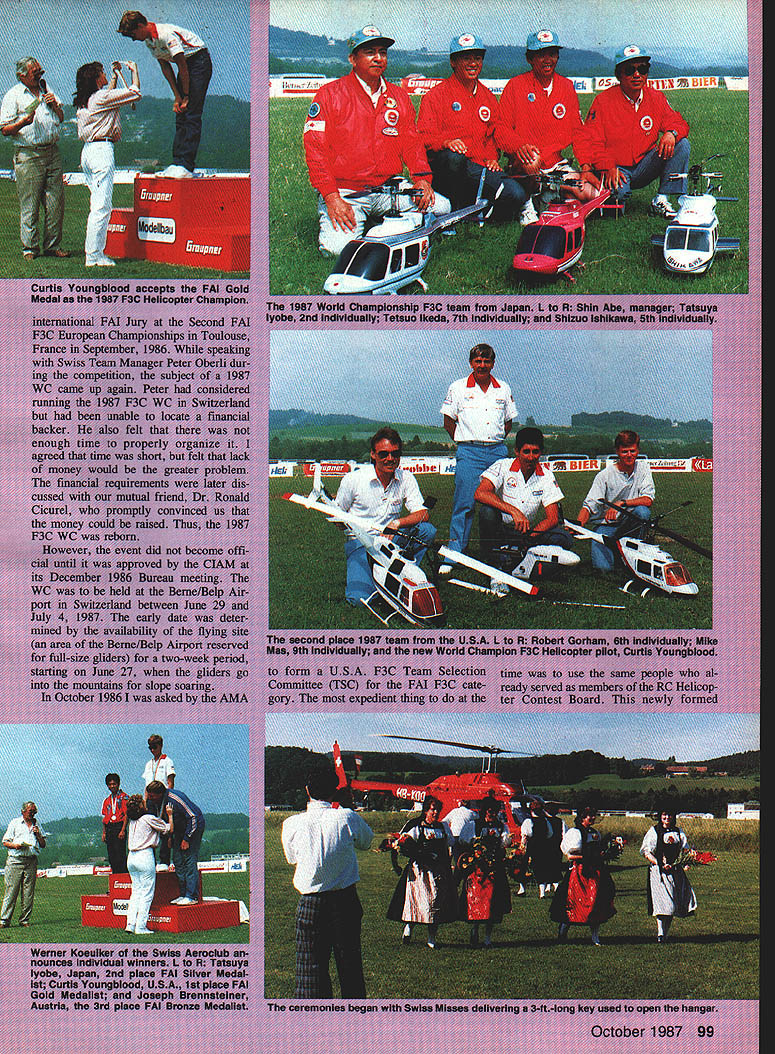
- The F3C Team Trials were held May 13–24, 1987. Robert Gorham, Curtis Youngblood, and Mike Mas were selected as the U.S.A. F3C team.
Judges Course and Practice
- I traveled to Europe one week before the WC to participate as a speaker at the FAI F3C Judges course held the weekend before the contest at Berne/Belp. Twenty-six people from 13 countries attended, including the official WC FAI judges and FAI Jury members.
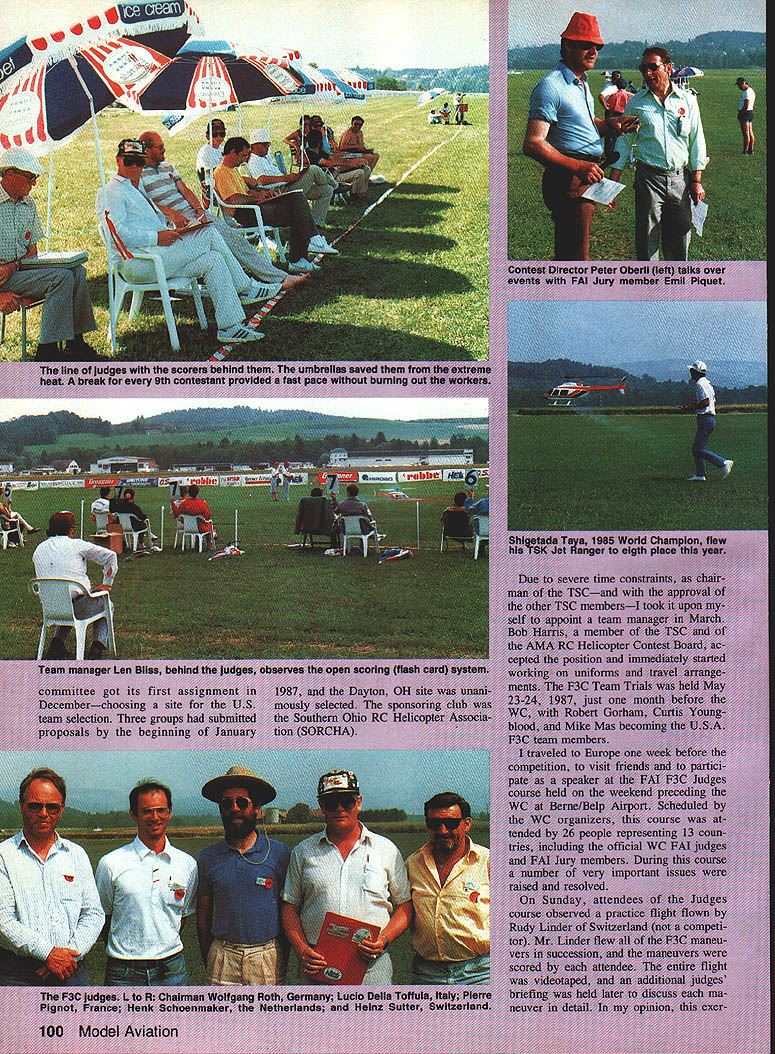
- A videotaped demonstration flight by Rudy Linder (Switzerland, not a competitor) showing all F3C maneuvers in succession was used during judges’ briefings to clarify maneuvers and checkbox scoring. This practice significantly improved the accuracy and consistency of judging.
- Official practice took place on Monday. Each country was assigned a half-hour slot; at the end of each slot models were checked for FAI compliance.
Arrival and Pre-Contest
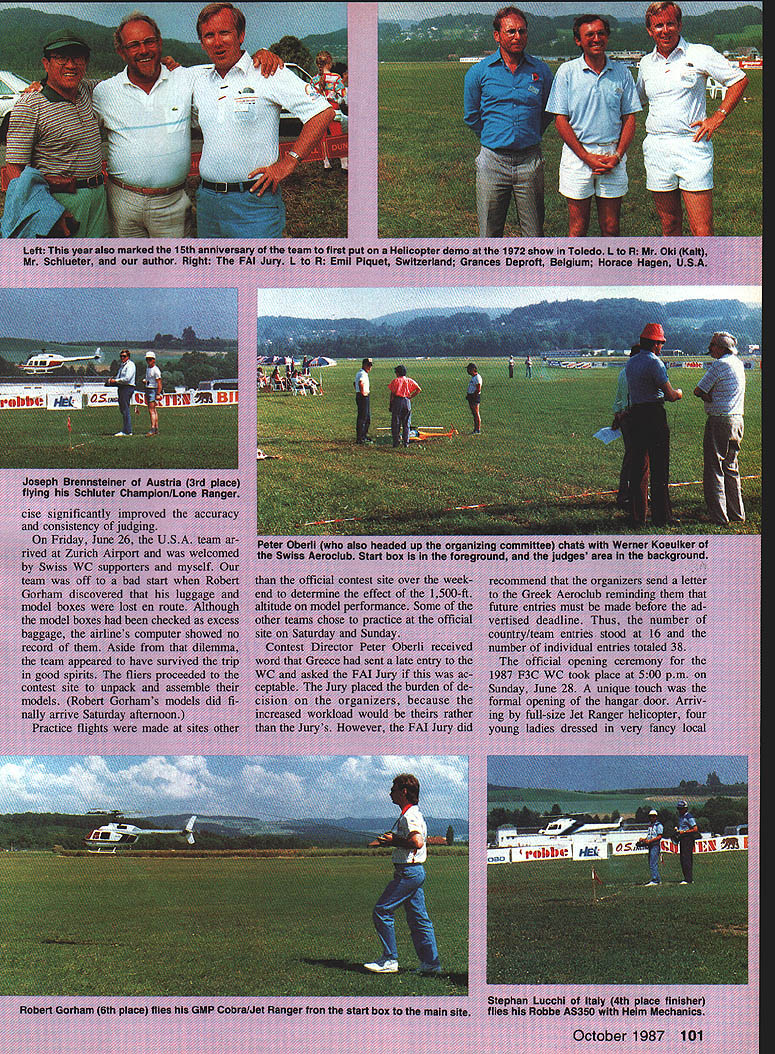
- The U.S.A. team arrived at Zurich Airport on Friday, June 26. Robert Gorham’s luggage and model boxes were lost en route but finally arrived Saturday afternoon.
- Teams practiced at the official site and other nearby sites over the weekend to assess the effect of the 1,500-ft altitude on model performance.
- A late entry from Greece increased the country/team total to 16 and individual entries to 38 after the organizers accepted the late entry (the FAI Jury recommended reminding Greece of future deadlines).
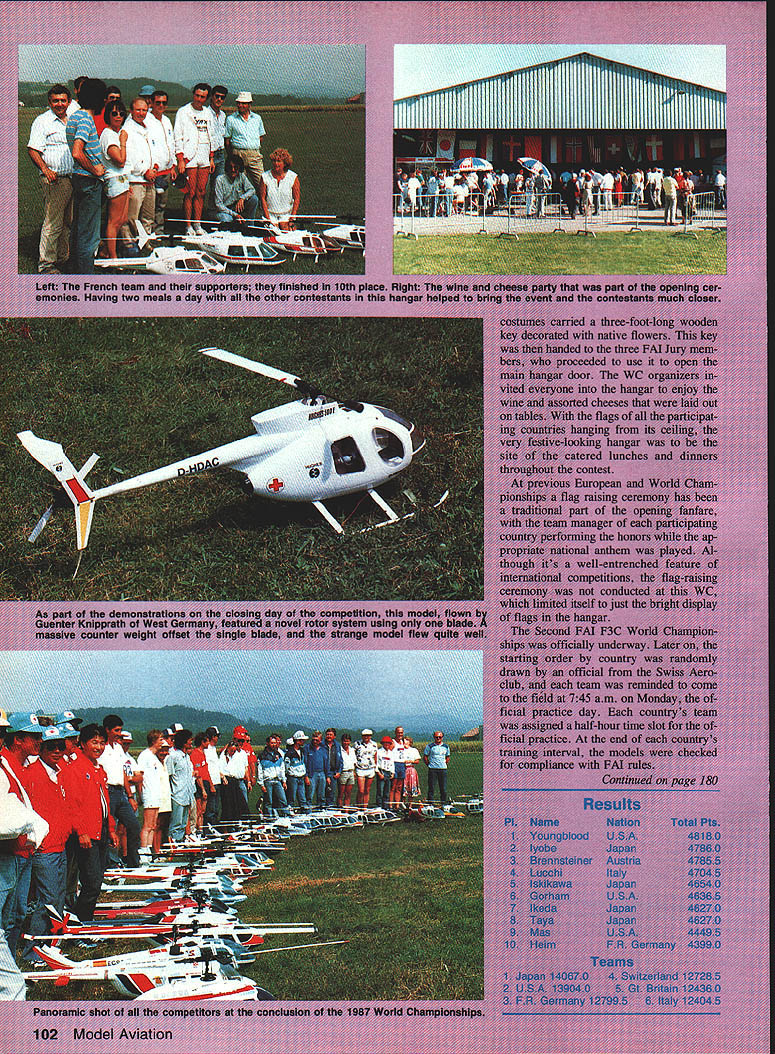
- The official opening ceremony was Sunday, June 28 at 3:00 p.m. A Jet Ranger helicopter brought four ladies in local costumes who presented bouquets and a three-foot-long wooden key decorated with flowers; the key was used to open the hangar door. The hangar—flags of all participating countries hanging from its ceiling—served as the site for catered lunches and dinners.
Competition — Day 1 (Tuesday)
- Competition started Tuesday at 8:00 a.m. with excellent weather: essentially no wind, morning temperatures around 75°F.
- Top pilots during the first round included:
- Josef Brennsteiner (Austria) — 1,558 points
- Taya (Japan) — 1,530 points
- Tatsuya Iyobe (Japan) — 1,525.5 points
- Lucchi — 1,524.5 points
- Robert Gorham (USA) — 1,512 points
- USA pilots Curtis Youngblood and Mike Mas finished the round in 6th and 11th places respectively.
- Team standings after Round 1: Japan first, U.S.A. second, Federal Republic of Germany third.
- As the day progressed temperatures rose to about 95°F. Organizers provided large umbrellas for judges and scorers; the heat also caused some engine flameouts. First-round competition completed around 5:00 p.m.
Competition — Day 2 (Wednesday)
- The day began with mild temperatures and no wind; a thunderstorm was forecast for the afternoon.
- Mas improved his earlier score by 35.5 points. After the judges’ break, Curtis Youngblood recorded 1,564.5 points, the highest score to that point, moving into first place temporarily.
- An early-afternoon thunderstorm interrupted the contest for about 1½ hours. When flying resumed competitors faced somewhat higher winds.
- Robert Gorham exceeded the 10-minute time limit on his flight, which resulted in a zero score for the autorotation maneuver.
- A standout second flight by Iyobe earned him 1,620 points. Brennsteiner improved to 1,576 points.
- Top five after Round 2:
- Tatsuya Iyobe (Japan) — 1,620 points
- Josef Brennsteiner (Austria) — 1,576 points
- Curtis Youngblood (USA) — 1,564.5 points
- Ishikawa — 1,538 points
- Lucchi — 1,533.5 points
- Team standings were unchanged, though Japan’s lead increased.
Competition — Day 3 (Thursday)
- Mild flying weather continued. Pilots to watch: Iyobe, Brennsteiner, Youngblood, Ishikawa, Lucchi, and Taya.
- Youngblood posted 1,599.5 points in his first flight of the day—the second-highest flight score up to that point—which moved him into first place.
- Round 3 results tightened the competition; the point spread among the top pilots was very narrow, reflecting skillful flying and favorable weather.
Final Round and Results (Friday)
- The fourth and final round was tense; the title contenders were Youngblood, Iyobe, and Brennsteiner (with Lucchi, Gorham, and Ishikawa still having outside chances).
- Round highlights:
- Iyobe posted 1,626.5 points—the highest flight score up to that moment.
- Brennsteiner then scored 1,651.5 points but was still short of the lead.
- Lucchi and Ishikawa each improved on their previous bests (Lucchi 1,587.5; Ishikawa 1,563).
- Curtis Youngblood flew a near-perfect final round and scored 1,654 points—the highest flight score of the entire WC.
- Final individual standings:
- Curtis Youngblood (U.S.A.) — 1987 World Champion
- Tatsuya Iyobe (Japan)
- Josef Brennsteiner (Austria)
- Final team standings:
- Japan
- U.S.A.
- Federal Republic of Germany
- The FAI Jury double- and triple-checked the close second- and third-place scores (only half a point apart) before the official release of results.
Public Demonstrations and Awards (Saturday)
- Demonstration flights began at 9:00 a.m., featuring new RC helicopters from manufacturers, home-built twin-rotor helicopters, ducted-fan jets, a large biplane, a single-rotor helicopter, a helicopter towing a sailplane, and a five-helicopter formation. A full-size acrobatic plane flown by the Swiss national champion performed spectacular low aerobatics.
- The public award ceremony took place at 3:00 p.m. Vice-president of the Swiss Aeroclub Werner Koelliker presented gold, silver, and bronze FAI medals to the top three pilots. Each finalist received a large bottle of champagne; Curtis Youngblood performed a champagne celebration.
- Closing banquet attended by approximately 230 people included presentation of WC souvenirs: a piece of natural quartz from the Berner Oberland mounted on a hardwood pedestal. First-, second-, and third-place pilots received larger versions as trophies.
Acknowledgements and Closing
- The Swiss Aeroclub, Peter Oberli and his team of about 40 assistants received congratulations for excellent organization.
- Special thanks to the FAI judges and jury: Lucio Della Toffola (Italy), Pierre Piguet (France), Wolfgang Roth (chairman, Germany), Henk Schoenmaker (Netherlands), and Heinz Suter (Switzerland).
- Thanks to Peter Blommart for the daily computerized newspaper Helisplitter—Daily Whirl; Peter Studer and co-workers for computerized contest results; and Fredy Plüss and staff for excellent food service.
- The Third FAI F3C World Championships was announced to be hosted by the U.S.A., scheduled as part of a combined World Championships (F3A, F3B, F3C, F3D) at NAS Virginia Beach around October 1989.
- The competition ended in the same beautiful weather in which it began. The camaraderie among pilots and teams, and the close competition, made the 1987 event a memorable championship.
Transcribed from original scans by AI. Minor OCR errors may remain.

