
Help Someone Join the Fun
Joseph M. Nunes
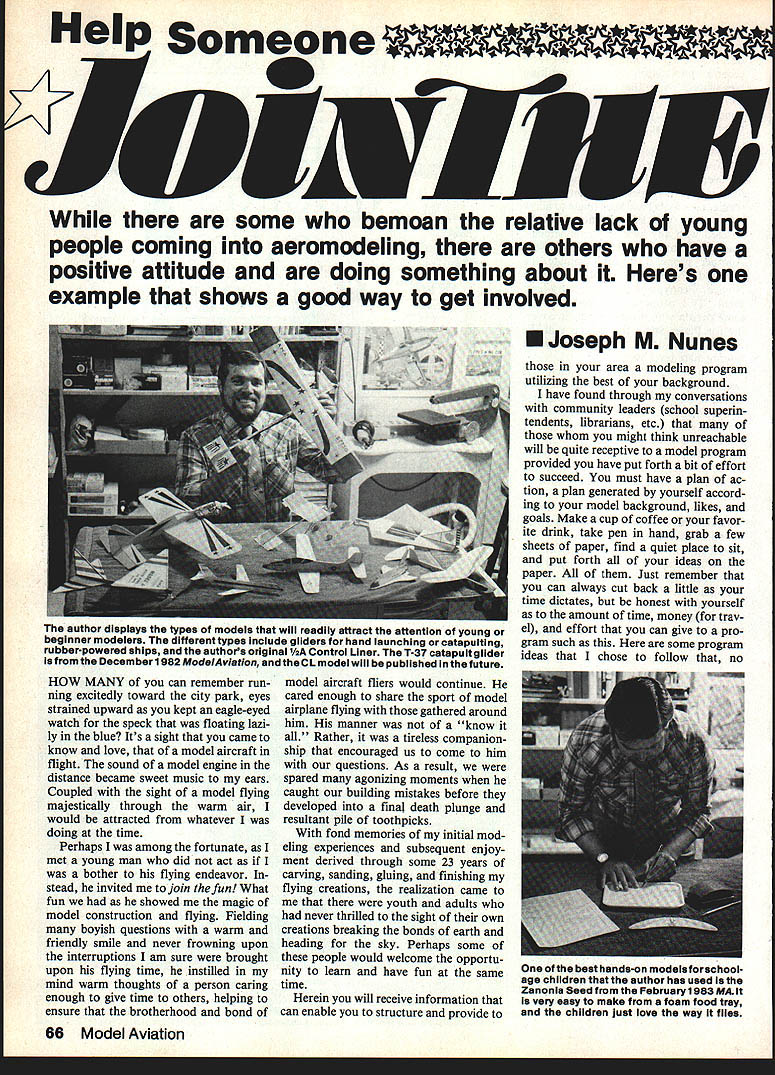
How many of you can remember running excitedly toward the city park, eyes strained upward as you kept an eagle-eyed watch for the speck that was floating lazily in the blue? It's a sight you came to know and love: a model aircraft in flight. The sound of a model engine in the distance became sweet music to my ears. Coupled with the sight of a model flying majestically through the warm air, I would be attracted from whatever I was doing at the time.
Perhaps I was among the fortunate, as I met a young man who did not act as if I were a bother to his flying endeavor. Instead, he invited me to join the fun. What fun we had as he showed me the magic of model construction and flying. Fielding many boyish questions with a warm and friendly smile and never frowning upon the interruptions I am sure were brought upon his flying time, he instilled in my mind warm thoughts of a person caring enough to give time to others, helping to ensure that the brotherhood and bond of model aircraft fliers would continue.
He cared enough to share the sport of model airplane flying with those gathered around him. His manner was not of a "know-it-all." Rather, it was a tireless companionship that encouraged us to come to him with our questions. As a result, we were spared many agonizing moments when he caught our building mistakes before they developed into a final death plunge and resultant pile of toothpicks.
With fond memories of my initial model-building experiences and subsequent enjoyment derived through some 23 years of carving, sanding, gluing, and finishing my flying creations, the realization came to me that there were youth and adults who had never thrilled to the sight of their own creations breaking the bonds of earth and heading for the sky. Perhaps some of these people would welcome the opportunity to learn and have fun at the same time.
Herein you will receive information that can enable you to structure and provide to those in your area a modeling program utilizing the best of your background.
Getting Started: Plan of Action
I have found through conversations with community leaders (school superintendents, librarians, etc.) that many of those whom you might think unreachable will be quite receptive to a model program provided you put forth a bit of effort to succeed. You must have a plan of action — a plan generated by yourself according to your model background, likes, and goals.
Make a cup of coffee or your favorite drink, take pen in hand, grab a few sheets of paper, find a quiet place to sit, and put forth all of your ideas on the paper. All of them. Just remember that you can always cut back a little as your time dictates, but be honest with yourself as to the amount of time, money (for travel), and effort that you can give to a program such as this.
Program Goals
Here are some program ideas that I chose to follow that, no doubt, would be a good starting point for you:
- Teach youth and adults the basic ideas and thoughts behind flight in a fun manner through the utilization of model aircraft.
- Introduce the various sources of information and magazines available to the student and show how to use the information.
- Show the relationship of modeling and future career options.
- Teach proper use and respect for tools used in modeling.
- Build a sense of pride and confidence through the starting and completing of a chosen project.
- Instill the idea of working together, with other students and parents, through building and flying sessions.
- Allow the student to explore his/her interest, and encourage the participant to use his/her own creativity.
- Build proper sportsmanship through the win/lose of competition.
Handling Questions and Curiosity
There are times, when presenting the program, I have found myself having to "revise" things a bit to present modeling in a tactful manner. When little Johnny's mother wants to know what will happen if he puts his fingers into the spinning prop of a 1/2A model, you will know what I mean about having to think fast and be tactful at the same time. You will be asked many questions of this type.
Sometimes the children present a chuckle with their curiosity and very real (to them) questions:
- "Can I just sit in the center of the circle and let the plane fly around if I get dizzy—without hanging on to that handle?"
- "What will happen if I put a grasshopper in my rubber-powered airplane and take him for a ride—will he get all tangled up?"
An Example Program: School Evening Class
How successful has this program been? Upon initial contact with the superintendent of our school system, I was immediately given the go-ahead to conduct an evening class for the fifth grade and up.
We were given the use of a very nice science room, complete with large tables, use of the gym, and use of the reproduction equipment. Our initial response included about 20 youths and parents. We completed four projects as a group, at which time the student was free to choose projects of his/her own liking based on records I had kept as to each individual's workmanship. This latter information was used to help determine suitable projects for each student so the parents would not waste money purchasing models the student could not successfully complete.
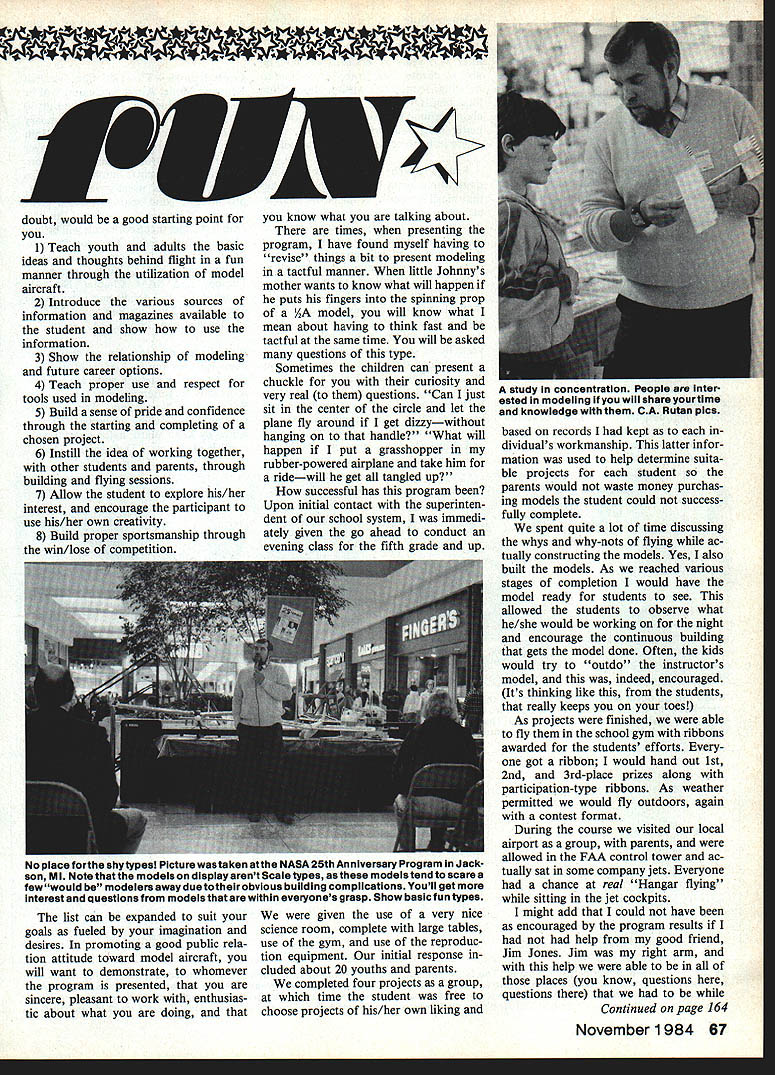
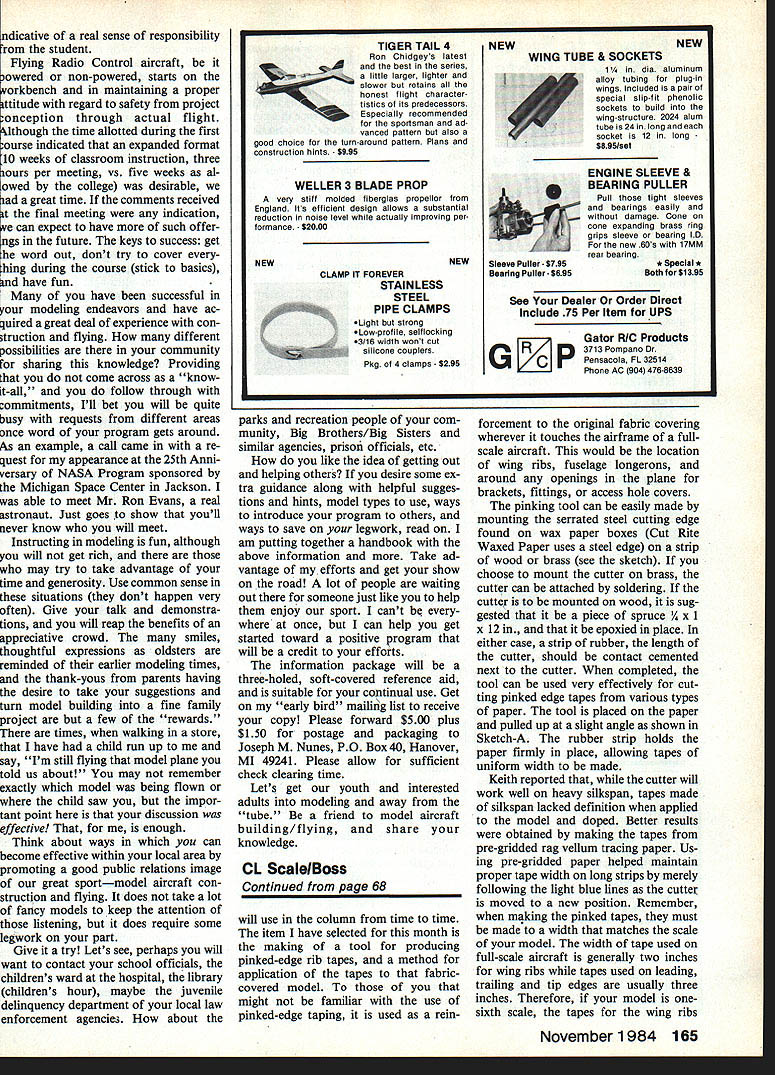
We spent quite a lot of time discussing the whys and why-nots of flying while actually constructing the models. Yes, I also built the models. We reached various stages of completion so I would have the model ready for students to see. This allowed the students to observe what they would be working on for the night and encouraged the continuous building that gets the model done. Often, the kids would try to "outdo" the instructor's model, and this was, indeed, encouraged. It's thinking like this from the students that really keeps you on your toes.
As projects were finished, we were able to fly them in the school gym with ribbons awarded for the students' efforts. Everyone got a ribbon; I handed out 1st, 2nd, and 3rd-place prizes along with participation-type ribbons. As weather permitted, we flew outdoors, again with a contest format.
During the course we visited our local airport as a group, with parents, and were allowed in the FAA control tower and actually sat in some company jets. Everyone had a chance at real "hangar flying" while sitting in the jet cockpits.
I might add that I could not have been as encouraged by the program results if I had not had help from my good friend Jim Jones. Jim was my right arm, and with his help we were able to be in all of those places (you know, questions here, questions there) that we had to be while helping the young modelers. The point is that help from a friend can make this type of program go a lot further.
Some of the building projects we used were borrowed from various modeling magazines. We also offered projects to two special education classes, and the models went over very well. This was an excellent opportunity for me to observe how well the students did on their work and to learn, from their discussions, how much they looked forward to my visiting the classrooms.
Think about this for a moment. There is an opportunity for many of you to help children who often are neglected. I look forward to working with them again, and I'm sure you would enjoy spending an hour or so per week with these children in your area. Contact your school officials and explain your intentions. You may be pleasantly surprised when they ask you to visit their school to explain your program.
Adult Classes and Radio Control Instruction
In addition to my involvement with children, I have instructed and taught a model construction class for adults interested in beginning radio control, at Jackson Community College, Jackson, MI. As the initial class began, I was impressed that there are individuals wanting to become involved with our great sport in a very sincere way. They have a common desire to learn how to construct and fly a model, as safely as possible, in a manner that will allow a positive degree of success. Many of the questions asked were indicative of a real sense of responsibility from the students.
Flying radio control aircraft, be it powered or non-powered, starts on the workbench and in maintaining a proper attitude with regard to safety from project conception through actual flight. Although the time allotted during the first course indicated that an expanded format (10 weeks of classroom instruction, three hours per meeting, vs. five weeks as allowed by the college) was desirable, we had a great time. If the comments received at the final meeting were any indication, we can expect to have more such offerings in the future.
The keys to success:
- Get the word out.
- Don't try to cover everything during the course (stick to basics).
- Have fun.
Benefits, Rewards, and Community Opportunities
Many of you have been successful in your modeling endeavors and have acquired a great deal of experience with construction and flying. How many different possibilities are there in your community for sharing this knowledge? Providing that you do not come across as a "know-it-all," and you do follow through with commitments, I'll bet you will be quite busy with requests from different areas once word of your program gets around.
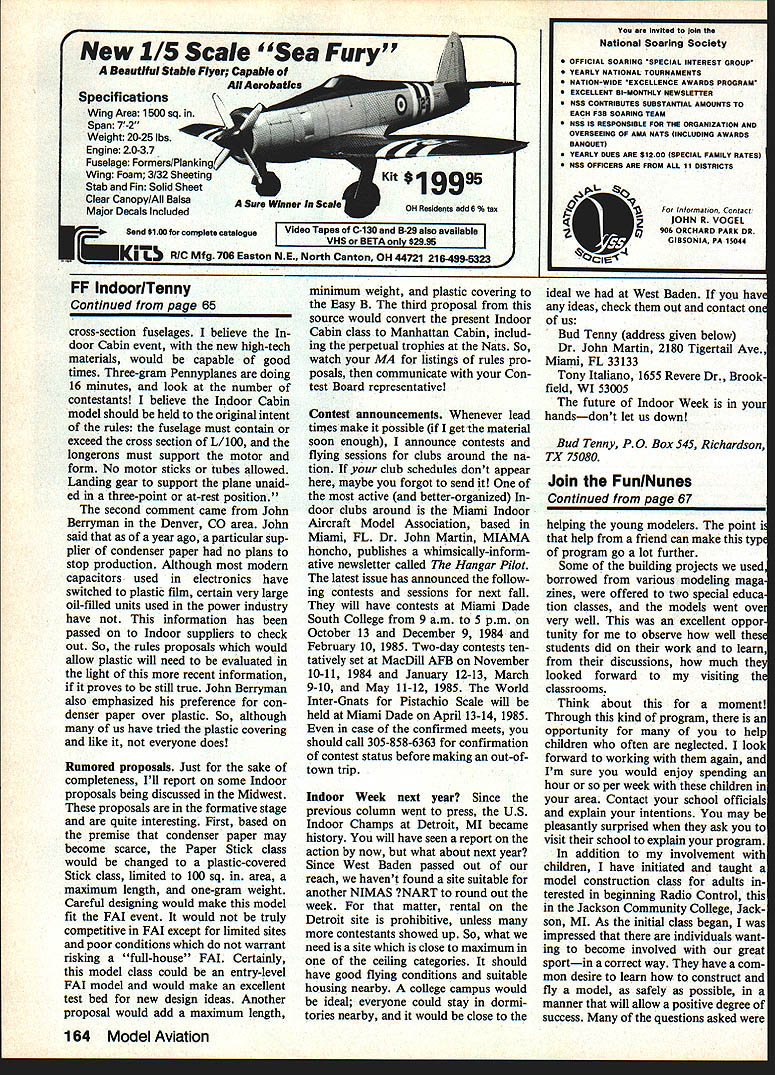
As an example, a call came in with a request for my appearance at the 25th Anniversary of NASA Program sponsored by the Michigan Space Center in Jackson. I was able to meet Mr. Ron Evans, a real astronaut. You never know who you will meet.
Instructing in modeling is fun, although you will not get rich, and there are those who may try to take advantage of your time and generosity. Use common sense in those situations (they don't happen very often). Give your talk and demonstrations, and you will reap the benefits of an appreciative crowd. The many smiles, thoughtful expressions as oldsters are reminded of their earlier modeling times, and the thank-yous from parents who take your suggestions and turn model building into a family project are but a few of the rewards.
There are times, when walking in a store, that I have had a child run up to me and say, "I'm still flying that model plane you told us about!" You may not remember exactly which model was being flown or where the child saw you, but the important point is that your discussion was effective. That, for me, is enough.
Think about ways you can become effective within your local area by promoting a good public relations image of our great sport—model aircraft construction and flying. It does not take a lot of fancy models to keep the attention of those listening, but it does require some legwork on your part.
Give it a try. Contact:
- Your school officials
- The children's ward at the hospital
- The library (children's hour)
- The juvenile delinquency department of your local law enforcement agencies
- The parks and recreation department of your community
- Big Brothers/Big Sisters and similar agencies
- Prison officials
Information Package and Contact
How do you like the idea of getting out and helping others? If you desire some extra guidance along with helpful suggestions and hints, model types to use, ways to introduce your program to others, and ways to save on your legwork, read on. I am putting together a handbook with the above information and more. Take advantage of my efforts and get your show on the road. A lot of people are waiting out there for someone just like you to help them enjoy our sport. I can't be everywhere at once, but I can help you get started toward a positive program that will be a credit to your efforts.
The information package will be a three-hole, soft-covered reference aid, and is suitable for your continual use. Get on my "early-bird" mailing list to receive your copy! Please forward $5.00 plus $1.50 for postage and packaging to:
Joseph M. Nunes P.O. Box 40 Hanover, MI 49241
Please allow for sufficient check-clearing time.
Let's get our youth and interested adults into modeling and away from the "tube." Be a friend to model aircraft building and flying, and share your knowledge.
Transcribed from original scans by AI. Minor OCR errors may remain.

