

HELPING YOUTH
Tri County Aero Club visits the Southwest Indiana Regional Youth Village
Frank Roales
The early afternoon air was about as good as it gets for model flying in October, with temperatures in the mid-60s and a very light southwest breeze in a direction that would allow us to use the longest takeoff and landing distance available. At least that was one thing off our minds as three members of the Tri County Aero Club waited at the 15-foot-high gate with vehicles full of RC models.
We were to fly in the fenced security compound that was the recreational area for the Southwest Indiana Regional Youth Village, Vincennes, IN. We were to put on a flying demo for the youths who make up the population of this facility.
This was the latest in a series of events that had taken place over a two-month period, starting when Gary Graves, science educator of the Village, contacted me for some assistance. He needed help in locating some plans for a simple glider to use in a science class he was teaching at the school. I had none, but Tri County Aero keeps a supply of AMA Cubs on hand for education projects and youth events.
After phone conversations with club president Les Wyrick and secretary-treasurer Pat English, we set up a time to go out to the facility to discuss what we could do to help.
We met Gary in the waiting area of the main building and told him about the box of AMA Cubs we had brought with us, explaining their purpose, simplicity, ease of construction, and how we thought they would fit well into his class.
After these talks, we were joined by Village Executive Director Charlotte Nesbitt, who is a full-scale pilot. She showed us a model of the facility and explained the workings of the organization. She was very supportive and enthusiastic about the idea of using model aircraft at the facility.
Gary accepted our offer of the AMA Cubs and the suggestion of a mini flying contest with them upon their completion. He thanked us and said that the stack of model magazines we had brought with us would also help generate interest. We also talked of the possibility of a flying demo at a later date.
The next time I saw Gary, he was buying a Gentle Lady for himself. He stated that his students were building the Cubs, and our visit, along with the class building, had sparked his own interest. We again talked of a flying demo, and he asked us to come out to the Village and look it over to see that there was an acceptable flying site. Later, three of us went out and decided the high security fencing and trees just beyond could not be a problem.
Gary and another member of the staff met us at the gate and guided us around the buildings to the cart path to the track where we were to fly. We would be doing our takeoffs and landings in the center area, which was covered with very coarse grass and weeds cut to a height of about four inches. It would not be easy to get airborne from this surface.
The first group that was brought out were those who were here for detention, awaiting placement somewhere else. These boys were at the Village for a short time—anywhere from overnight to a month or so.
The first to fly, and his Balsa USA Excalibur, made it into the air after a longer-than-normal run. After an aerobatic flight, the model returned safely.
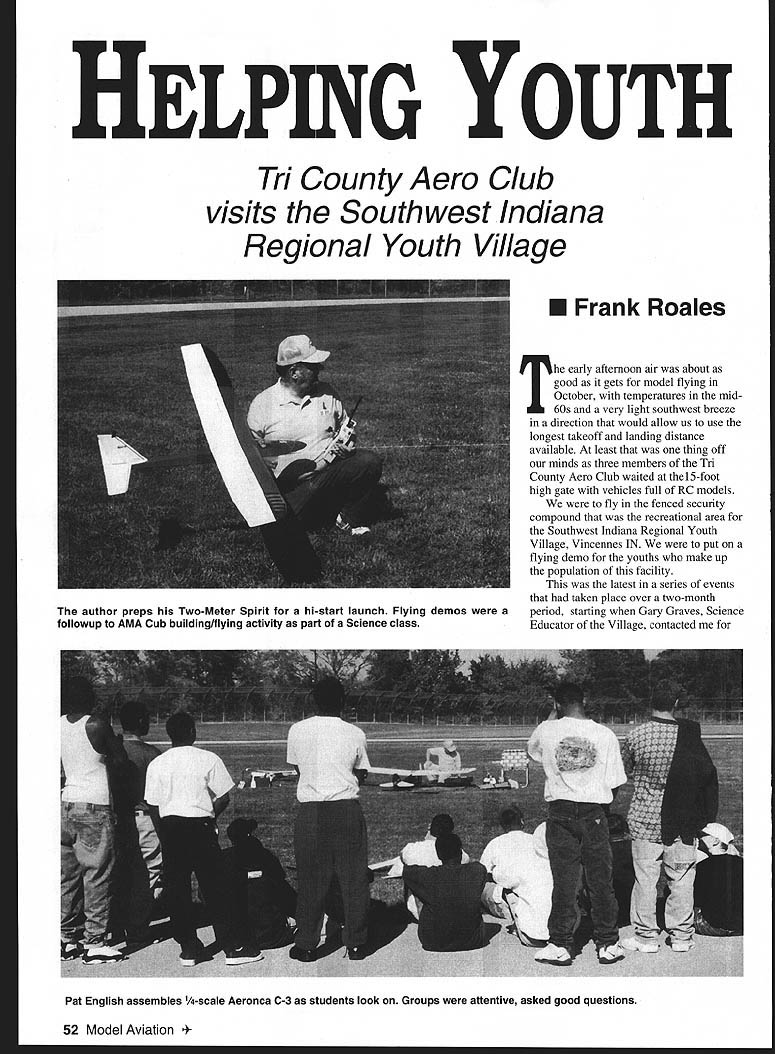
In the meantime, the Hi-Start had been stretched from the far fence across the baseball diamond. I hooked up my Great Planes Spirit Two-Meter glider and released it. As it rushed up in a near-vertical ascent, Pat explained the principles of unpowered flight. As luck would have it, I was able to “work” a small amount of lift generated by the roof of one of the buildings to illustrate the explanation.
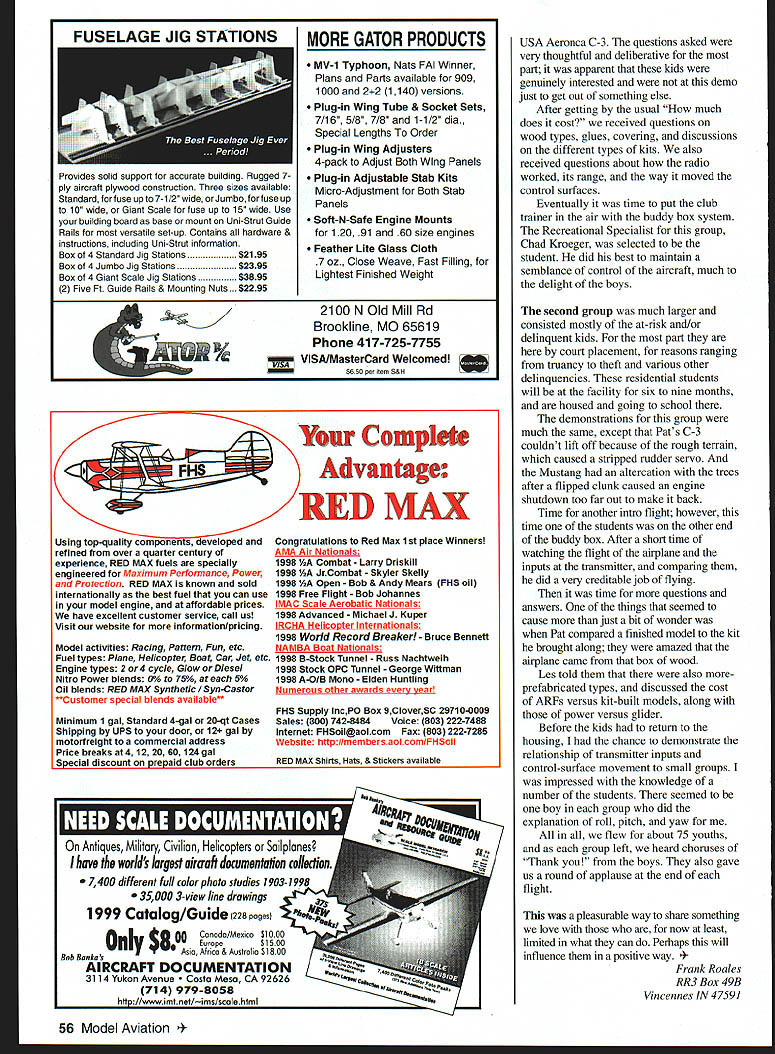
Pat and Les answered questions on a number of topics concerning the airplanes we brought as Pat assembled his 1/4-scale Balsa USA Aeronca C-3. The questions asked were very thoughtful and deliberative for the most part; it was apparent that these kids were genuinely interested and were not at this demo just to get out of something else.
After getting by the usual "How much does it cost?" we received questions on wood types, glues, covering, and discussions on the different types of kits. We also received questions about how the radio worked, its range, and the way it moved the control surfaces.
Eventually it was time to put the club trainer in the air with the buddy-box system. Chad Kroeger was selected to be the student. He did his best to maintain a semblance of control of the aircraft, much to the delight of the boys.
The second group was much larger and consisted mostly of the at-risk and/or delinquent kids. For the most part they are here by court placement, for reasons ranging from truancy to theft and various other delinquencies. These residential students will be at the facility for six to nine months, and are housed and go to school there.
The demonstrations for this group were much the same, except that Pat's C-3 wouldn't lift off because of the rough terrain, which caused a stripped rudder servo. And the Mustang had an altercation with the trees after a flipped clunk caused an engine shutdown too far out to make it back.
Time for another intro flight, however; this time one of the students was on the other end of the buddy box. After a short time of watching the flight of the airplane and the inputs at the transmitter, and comparing them, he did a very credible job of flying.
Then it was time for questions and answers. One of the things that seemed to cause more than just a bit of wonder was when Pat compared a finished model to the kit he brought along; they were amazed that the airplane came from that box of wood.
Les told them that there were also more prefabricated types, and discussed the cost of ARFs versus kit-built models, along with those of power versus glider.
Before the kids had to return to the housing, I had the chance to demonstrate the relationship of transmitter inputs and control-surface movement to small groups. I was impressed with the knowledge of a number of the kids. There seemed to be one boy in each group who did the explanation of roll, pitch, and yaw for me.
All in all, we flew for about 75 minutes, and as each group left, they gave us a round of applause at the end of each flight.
This was a pleasurable way to share something I enjoy with those who are, for now at least, limited in what they can do. Perhaps this will influence them in a positive way.
Frank Roales RR 3 Box 49B Vincennes, IN 47591
Transcribed from original scans by AI. Minor OCR errors may remain.

