
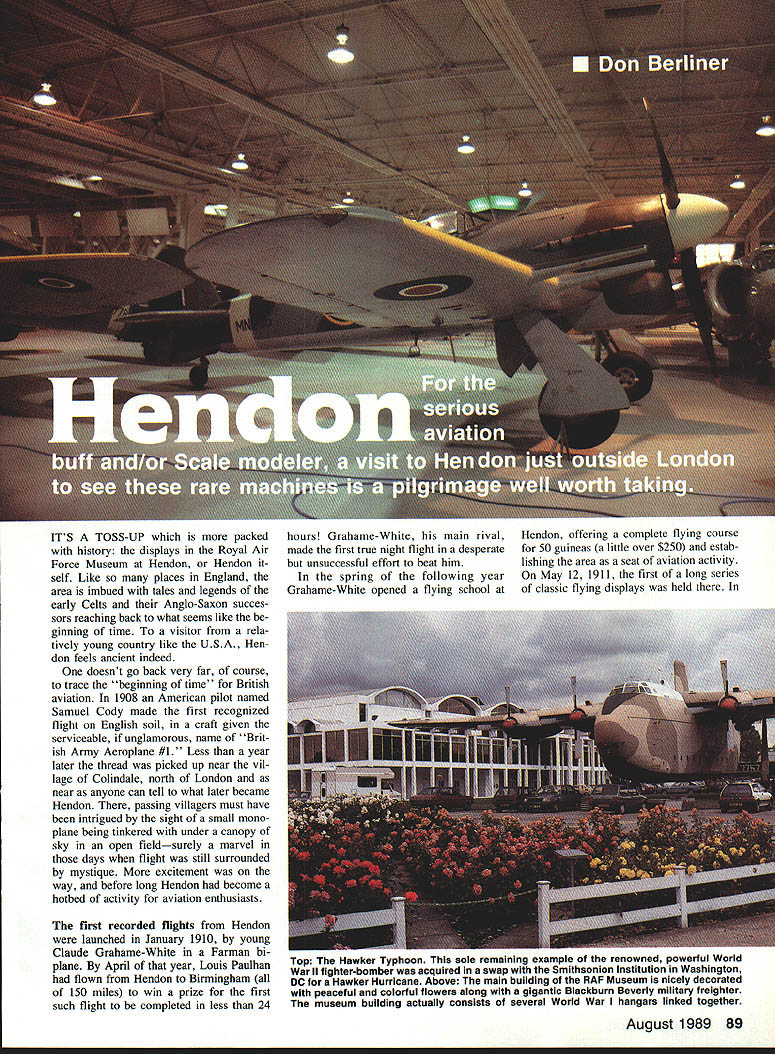
Hendon: For the serious aviation buff and/or scale modeler, a visit to Hendon just outside London to see these rare machines is a pilgrimage well worth taking.
It's a toss-up which is more packed with history: the displays in the Royal Air Force Museum at Hendon, or Hendon itself. Like so many places in England, the area is imbued with tales and legends stretching back to the early Celts and the Anglo-Saxons. To a visitor from a relatively young country like the U.S.A., Hendon feels ancient indeed.
One doesn't go back very far, of course, to trace the "beginning of time" for British aviation. In 1908 an American pilot named Samuel Cody made the first recognized flight on English soil in a craft called the "British Army Aeroplane No. 1." Less than a year later the thread was picked up near the village of Colindale, north of London, at what later became Hendon. Passersby must have been intrigued by the sight of a small monoplane being tinkered with in an open field—surely a marvel in those days when flight was still surrounded by mystique. Before long Hendon had become a hotbed of activity for aviation enthusiasts.
The first recorded flights from Hendon were launched in January 1910 by young Claude Grahame-White in a Farman biplane. By April of that year Louis Paulhan had flown from Hendon to Birmingham (about 150 miles) to win a prize for completing the flight in less than 24 hours. Grahame-White, his main rival, made the first true night flight in a desperate but unsuccessful effort to beat him.
In the spring of 1911 Grahame-White opened a flying school at Hendon, offering a complete flying course for 50 guineas (a little over $250) and establishing the area as a seat of aviation activity. On May 12, 1911, the first of a long series of classic flying displays was held there. In September that year the British air mail service got off to an impressive start, carrying 100,000 letters and cards to commemorate the coronation of King George V. The Aerial Derby made its debut in 1912—an 80-mile race around London beginning and ending at Hendon that drew 45,000 paying customers. The first public demonstrations of parachuting and aerobatics took place in 1913; loops and inverted flying, invented only months earlier, must have been particularly stirring.
By 1914 a number of airplane manufacturers, including the first Handley-Page factory, had set up operations in the Hendon area, making it one of the first major aircraft industrial centers. Shortly after World War I began, Hendon was taken over by the Royal Navy and designated an Air Service Station. Five established flying schools on its airfield were diverted to train military pilots. The government used other sections of Hendon as delivery centers for warplanes such as the de Havilland DH.9, Sopwith Camel and Nieuport.
In 1915–1916 the air war was still in its infancy; pairs of flimsy BE.2s based at Hendon defended London against raids by German zeppelins. By the end of the war in 1918 a sizable proportion of the pilots and airplanes of the Royal Flying Corps (the predecessor of the RAF) had passed at least in part through Hendon. Among the firsts achieved there during the war was the initial testing of a compressed-air catapult, the forerunner of the aircraft carrier.
When wartime demand ended after 1918, aviation production and development temporarily declined. Claude Grahame-White changed to manufacturing airplanes and cars, turning out hundreds of little two-seat runabouts at Hendon. He continued flying and operated several airplanes for joyriding until 1920.
For a brief period between the wars Hendon offered airline service to Birmingham and to Amsterdam. The airfield was also home to groups of surplus SE5a fighters and to pursuits engaged in skywriting. In 1920 the first of the spectacular and very fashionable RAF air displays was held at Hendon, a tradition that endured until 1937. These extravaganzas entertained millions of spectators and raised, over 17 years, almost a million dollars for RAF charities.
In the Second World War Hendon again assumed an important military role as a base for squadrons of Hurricanes and Spitfires during the Battle of Britain. During the war noncombat units equipped with American-built Douglas C-47s—still called "Dakotas" by the British—replaced most of the Spitfires and Hurricanes. In 1944, C-47s flying out of Hendon belonged to the USAAF Air Transport Command. Units moved in and out quickly, two squadrons of Spitfires being among the last operational outfits to call Hendon home.
Postwar housing growth changed Hendon from a bucolic village to a London suburb. As such, extensive flying became unsafe and unpopular. The Hendon airfield was finally closed in November 1957 and remained inactive for 15 years. On November 17, 1972, its celebrated iron gates swung open once again for the dedication of the Royal Air Force Museum. The public was invited to view the inaugural displays.
Spanning the decades from World War I through the postwar years, the extensive aircraft displays at Hendon's Royal Air Force Museum amply reward the aviation buff. The RAF exhibits have roots going back to 1917, when a plan for preserving one example of every type of airplane for eventual official display was first drawn up. The decision to create the current museum was made in 1962. Although the original concept envisioned a collection of 1/4-scale models of some 500 aircraft types flown by the RFC and RAF, that was quickly replaced by a more ambitious plan for a conventional air museum with full-size craft. In assembling the collection, aircraft were gathered from as far as the Middle East and the U.S.A.
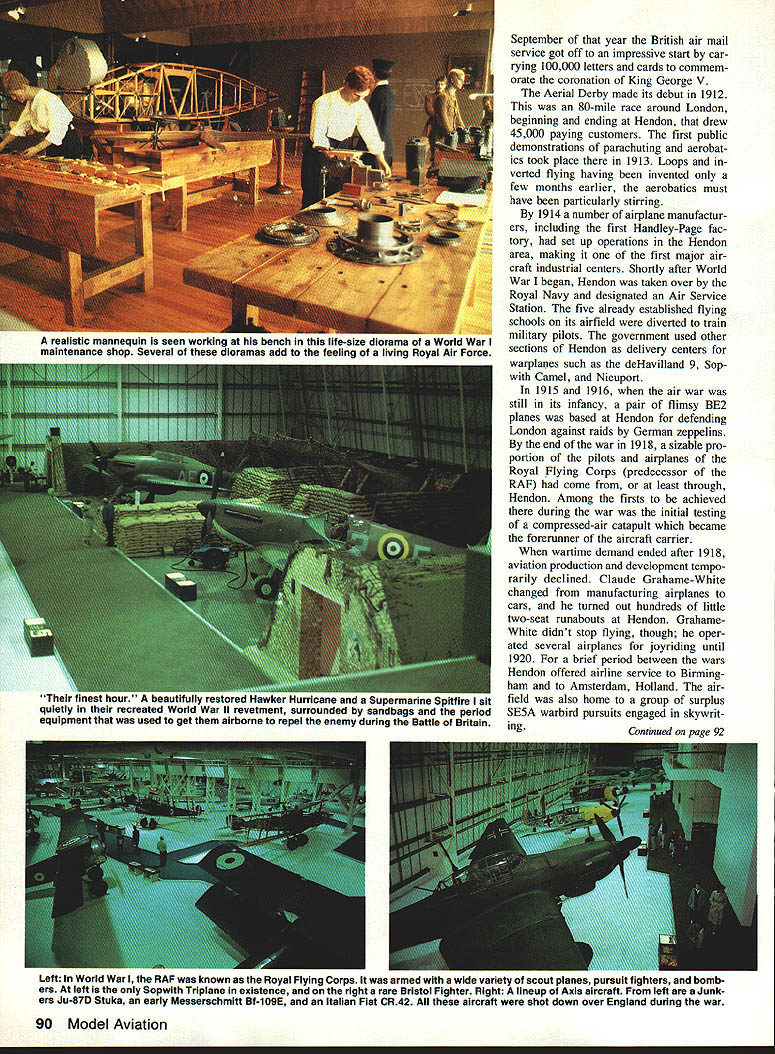
The main museum building, modern in appearance with white arches and pillars, was created by joining together two World War I hangars to make an exhibit hall 540 ft. long by 175 ft. wide. A later addition was built for the Bomber Command Museum, and a second building was erected to serve as the Battle of Britain Museum.
Getting to Hendon from London is fairly simple:
- Travel north to Colindale via the Northern line of the London Underground or take No. 79 bus; it's a short walk from there.
- By car, Hendon is near Junction 2 of the M1 Motorway. Signs are few and traffic can be heavy, so driving is recommended only for the adventurous.
Admission: 3.00 pounds (about $5) for adults and 1.50 pounds (about $2.50) for children and students. Building opening hours:
- Monday through Saturday: 10 a.m. to 6 p.m.
- Sunday: 2 p.m. to 6 p.m.
Closed on Christmas Day, Boxing Day (December 26) and New Year's Day.
Royal Air Force Museum Main Building
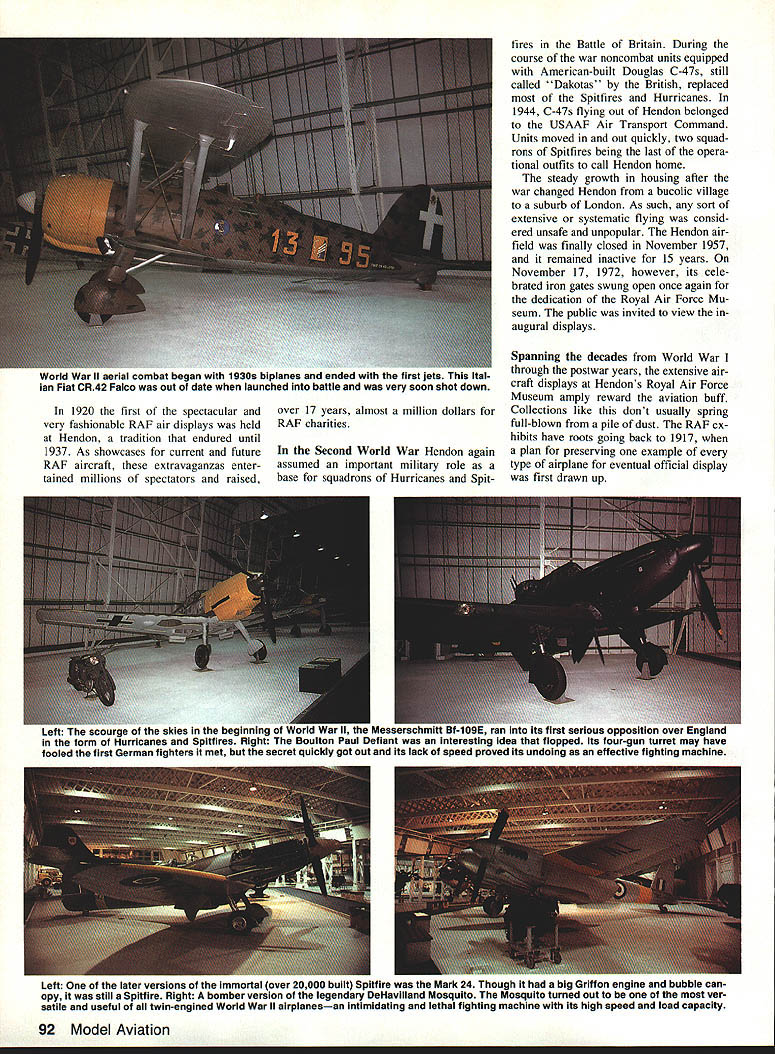
The largest portion of the RAF collection is housed in the main building. There are 36 aircraft displayed on the light-colored floor with only very low barriers to restrain the overcurious from touching. On the second floor are displays of uniforms, medals, support equipment, weapons, and the like, along with a life-size diorama of a World War II maintenance shop.
In the center of the first-floor area is a display honoring the late Sir Sidney Camm of Hawker, to whose design genius many of the airplanes on view can be credited. Notable Hawker designs on display include:
- Hawker Cygnet — a low-powered lightplane.
- Hawker Hart — a two-seat biplane day-bomber (more than 1,000 in service 1930–1939).
- Hawker Hind — used for bombing training until World War II (reclaimed from Afghanistan for the museum).
- Hawker Typhoon — the only surviving example; a powerful World War II fighter-bomber (a gift from the Smithsonian Institution).
- Hawker Tempest — follow-on to the Typhoon, famed for shooting down V-1 buzz bombs.
- Hawker Sea Fury — a late-development piston-engined fighter used by the Royal Navy and one of the last piston fighters produced.
- Hawker Hunter — the RAF's standard subsonic jet fighter from 1954 to 1960; at one point held a world speed record.
- Hawker P.1127 — the experimental forerunner of the Harrier VTOL jet fighter.
One of the most impressive elements of the RAF collection is its display of World War I airplanes. In this section can be seen:
- Avro 504K — the standard rotary-engined trainer (more than 8,000 built).
- Bristol F.2b (Bristol Fighter or "Brisfit") — one of the most important RFC airplanes.
- Caudron G.11 — a French single-engined reconnaissance plane used by the RFC.
- Hanriot HD.1 — designed in France but used mainly by other countries.
- SE5a — one of the very best fighters of World War I.
- Sopwith Camel — the principal British fighter of 1917.
- Reproductions of a Sopwith 1½ Strutter and a Vickers Gunbus (no originals of these types survived).
The museum also offers a small collection from the period between the wars, including:
- Gloster Gladiator — the last of the RAF biplane fighters (this example was recovered from Norway).
- Supermarine Stranraer — a majestic biplane flying boat.
- Cierva C.30A — a mid-1930s ground-support autogyro.
World War II aircraft housed in the main building include:
- Bristol Beaufighter — the only surviving example; one of the first effective radar-equipped night fighters.
- de Havilland Tiger Moth — the RAF's standard primary trainer (many still fly privately).
- Dornier Do 24 — a rare tri-motored German flying boat.
- Lockheed Hudson — patrol-bomber version of the Electra airliner; many were sent to Britain before the U.S. entered the war.
- Sikorsky R-4B — an early American helicopter and the first type used by the RAF.
Postwar aircraft on display include:
- Bristol Belvedere — the first RAF twin-engined, twin-rotor helicopter.
- de Havilland Vampire — one of the first production jet fighters.
- English Electric Canberra — a standard twin-jet medium bomber (also used by the USAF as the Martin B-57).
- English Electric Lightning — a highly swept-wing fighter with vertically stacked engines and the first RAF type to exceed Mach 2.
- Gloster Meteor F.8 — the major RAF day interceptor from 1950 to 1955 and a development of the first non-German jet to see combat.
Bomber Command Museum
The Bomber Command wing contains airplanes originally displayed in the main building, as well as others moved from the branch facility at RAF St. Athan in south Wales after restoration there. Highlights include:
- de Havilland DH.9 — a single-engined World War I bomber (obtained in a trade for a Spitfire with the Polish Air and Space Museum).
- Vickers Vimy — an authentic flying reproduction of the modified twin-engined World War I bomber in which Alcock and Brown made the first nonstop Atlantic crossing in 1919.
- Sopwith Tabloid — a reproduction of a World War I scout developed from a Schneider Trophy racer.
- Avro Lancaster — the RAF's most important heavy bomber of World War II.
- Boeing B-17 Flying Fortress — the major heavy bomber flown by the USAF (also flown by the RAF).
- de Havilland Mosquito (bomber version) — one of the most versatile twin-engined World War II airplanes.
- Handley Page Halifax — another of the RAF's major heavy bombers; this one is displayed unrestored as recovered from Norway.
- North American B-25 Mitchell — a World War II medium bomber used by both the RAF and USAAF.
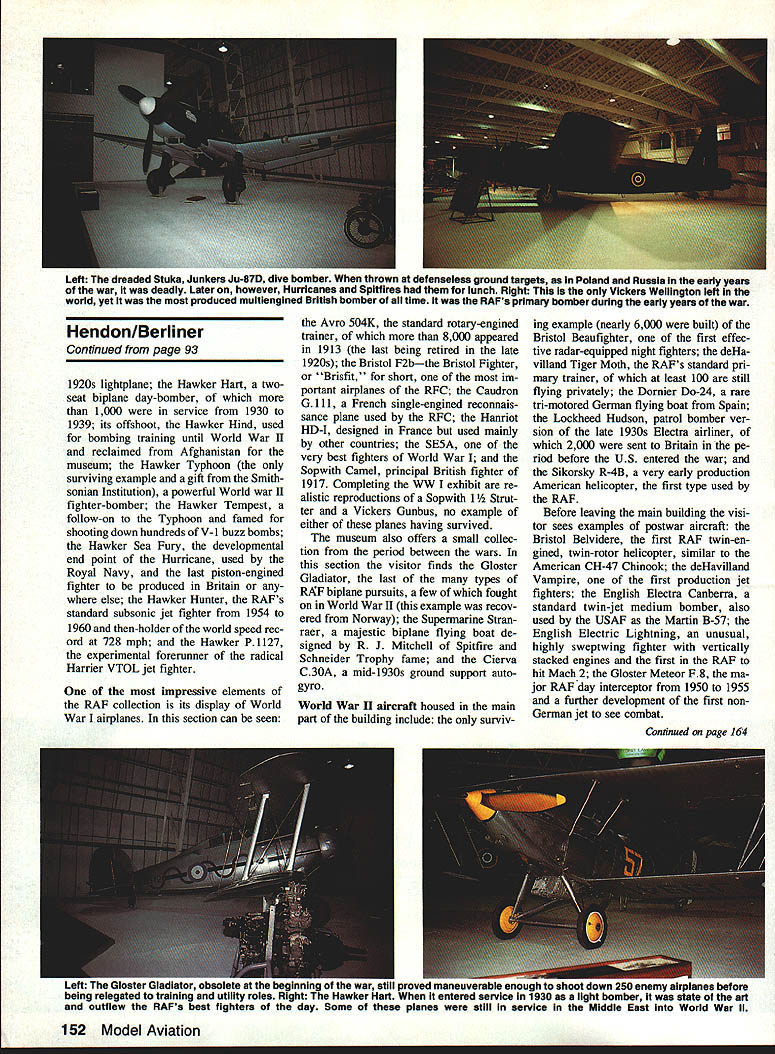
- Vickers Wellington — the sole surviving example of the main British medium bomber of World War II, noted for its geodetic construction.
- Vickers Valiant — one of the earlier RAF four-engined jet bombers.
- Avro Vulcan — an intimidating delta-winged heavy bomber capable of near-sonic speed.
Battle of Britain Museum
This building contains what is possibly the world's finest collection of early World War II aircraft. Exhibits include:
- Supermarine Spitfire I and Hawker Hurricane I — the early versions displayed in simulated revetments with sandbags and support equipment.
- Bristol Blenheim / Bolingbroke — the Blenheim represented by its Canadian-built Bolingbroke equivalent.
- Boulton Paul Defiant — the last surviving example of this turret-equipped fighter.
- Short Sunderland — a large four-engined flying boat that served Coastal Command hunting submarines and rescuing downed airmen (1938–1955).
- Supermarine Seagull — a 1930s single-engined biplane flying boat used for air-sea rescue.
- Westland Lysander — a sturdy aircraft used to drop Allied agents and supplies to resistance forces.
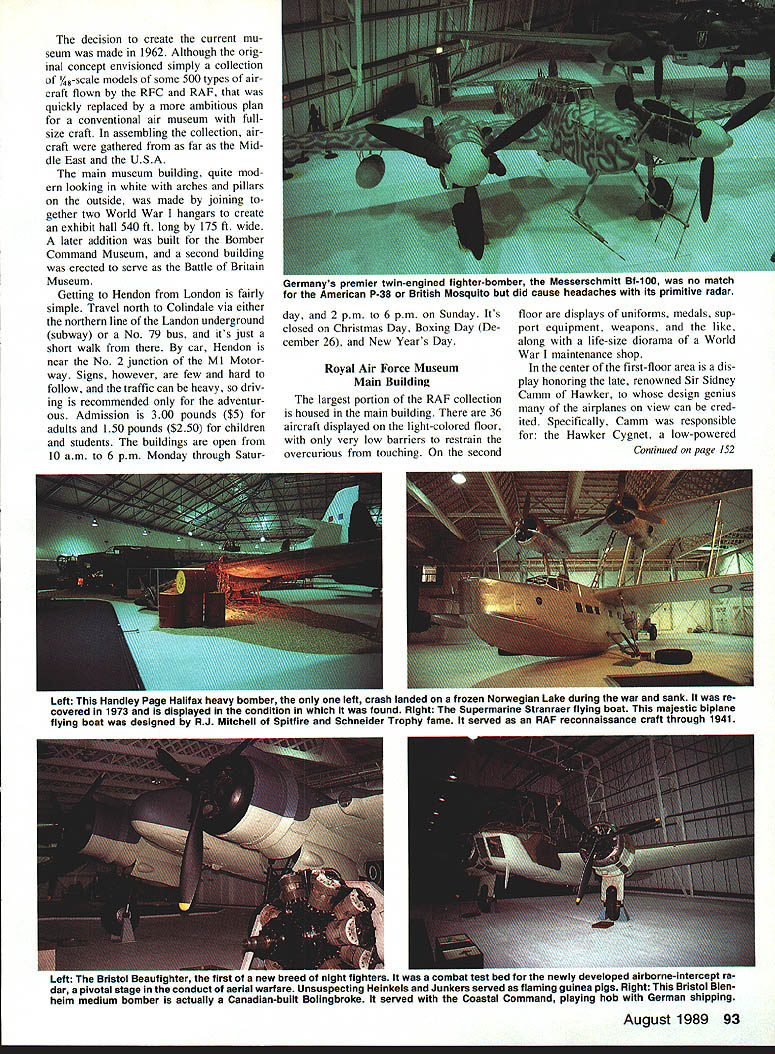
- Fiat CR.42 Falco — an Italian biplane fighter shot down and captured in 1940.
- Heinkel He 111 — a standard German medium bomber.
- Junkers Ju 87 Stuka — one of just two surviving examples of the widely used dive bomber.
- Junkers Ju 88 — regarded as one of the best German medium bombers.
- Messerschmitt Bf 109E — a rare early example, shot down and restored.
- Messerschmitt Bf 110 — a twin-engined German fighter that proved vulnerable to Spitfires and Hurricanes.
The Battle of Britain Museum building, located to the left of the parking lot, also houses the Roundel restaurant where visitors can find snacks or complete meals.
Dedicated scale modelers needing accurate data for a project may want to contemplate a pilgrimage to the RAF Museum. Contacting Richard Simpson, Keeper of Aircraft and Exhibits, should be part of advance planning; with Simpson's permission you may be allowed to cross the spectator barrier for a close-up look at the prototype you're interested in.
If you are interested in supporting the work of the museum you can join its Society of Friends for 5.00 pounds (about $9) per year. Membership details are available from:
- Secretary, Society of Friends
- RAF Museum
- Hendon NW9 5LL
- England
Many of the RAF's huge collection of aircraft are in reserve collections at RAF bases throughout England; some of these can be visited with special permission in advance. All in all, if British military aircraft are what turn you on, the place to see them is Hendon.
Transcribed from original scans by AI. Minor OCR errors may remain.

