
Hey!: Let's Go to the Airport
By Stephen E. Kanyusik
Every so often my grandchildren and I pile in the car and head over to the airport. We live some distance from a large metropolitan area, so the airport is small and accessible.
The children and I take our time strolling amid the various planes. I identify distinguishing features, showing them the difference between a high-wing and a low-wing, explaining why this one's called a taildragger, that one's a tricycle. We talk to the pilots working on their aircraft and chat with other airport watchers.
Caution must be observed, and I try to teach them to be alert for hazards. "Watch out and stay away from the props," I warn on every visit.
When they're lucky the children are permitted to sit in some of the airplanes, and I take snapshots for a future album. I have some mental recollections and photographs of my own.
I grew up in McKeesport, PA in the Twenties and Thirties. Bettis Field was about seven miles from home, not too far to walk, and the Pittsburgh Airport in Allegheny County was just a few miles farther.
I shared a passion for airplanes and models with several of my schoolmates. We all built the Comet Megow kit, and any extra cash that came our way was plunked down for one of the classic Cleveland kits.
In those days aircraft arrival notices were printed in the newspapers. The Daily News also posted arrival dates for military planes. We aviation fanatics kept a close watch on those bulletins.
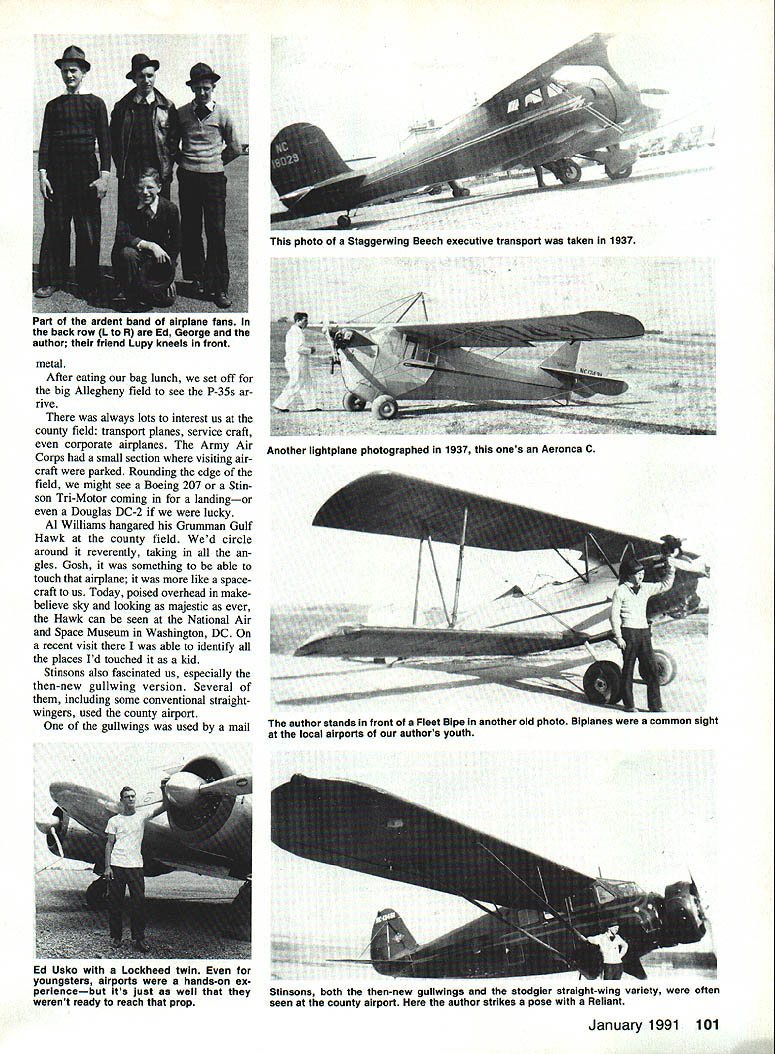
When Ed, Lupy, Glenny, George, Buddy and I saw the arrival notice for the Seversky P-35 at the county airport, we knew we'd be playing hooky the next day. Go to school? Heck, no—it's to the airport we go!
If you spent your boyhood in the Thirties, chances are a walk to the local airport was about as good as it got. And real bliss? That was when a fleet of shiny new fighter planes came thundering in.
On the way to the big airport we stopped at Bettis Field. Our excitement mounted as we climbed Dravosburg Hill.
"Those P-35s are going to replace those biplanes that were in the Army Air Corps." Gosh, it's a low-winger! Biplanes were plentiful in the area (many of their pilots lived around Pittsburgh), but these sleek new all-metal, single-wing aircraft were another breed entirely. We were awed.
Then there was the Curtiss Robin. With its large, boxy wings, flat, slab-sided fuselage and big tail section, complete with Curtiss emblem on the rudder, it looked as if it could fly forever. The Aeronca C-2 was something, too. With its small, pugnacious-looking nose it made us think of a bulldog sniffing the air. We wondered how the pilot managed to sit in that small space so close to the ground.
We loved to touch the smooth fabrics on the planes, but were never denied the privilege. Vandalism wasn't in the script back then. When you went someplace, you were expected to behave—and behave we did.
Once in a while we'd spot a Ryan or a Kinner Sport. These were a newer type of lightplane—low-wingers covered in light metal.
After eating our bag lunch, we set off for the big Allegheny field to see the P-35s arrive.
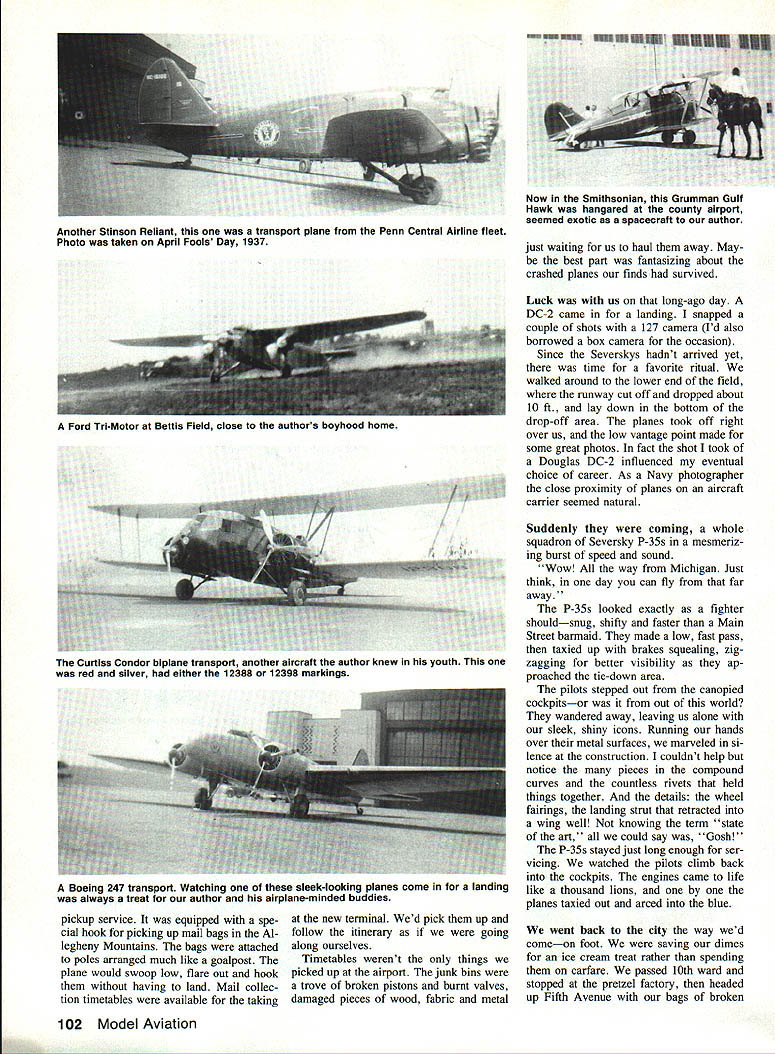
There was always lots to interest us at the county field: transport planes, service craft, even corporate airplanes. The Army Air Corps had a small section where visiting aircraft were parked. Rounding the edge of the field, we might see a Boeing 207 or a Stinson Tri-Motor coming in for a landing—or even a Douglas DC-2 if we were lucky.
Al Williams hangared his Grumman Gulf Hawk at the county field. We'd circle around it reverently, taking in all the angles. Gosh, it was something to be able to touch that airplane; it was more like a space craft to us. Today, poised overhead in make-believe sky and looking as majestic as ever, the Hawk can be seen at the National Air and Space Museum in Washington, D.C. On a recent visit there I was able to identify all the places I'd touched as a kid.
Stinsons also fascinated us, especially the then-new gullwing version. Several of them, including some conventional straight-wingers, used the county airport.
One of the gullwings was used by a mail pickup service. It was equipped with a special hook for picking up mail bags in the Allegheny Mountains. The bags were attached to poles arranged much like a goalpost. The plane would swoop low, flare out and hook the bags without having to land. Mail collection timetables were available for the taking at the new terminal. We'd pick them up and follow the itinerary as if we were going along ourselves.
Timetables weren't the only things we picked up at the airport. The junk bins were a trove of broken pistons and burnt valves, damaged pieces of wood, fabric and metal, just waiting for us to haul them away. Maybe the best part was fantasizing about the crashed planes our finds had survived.
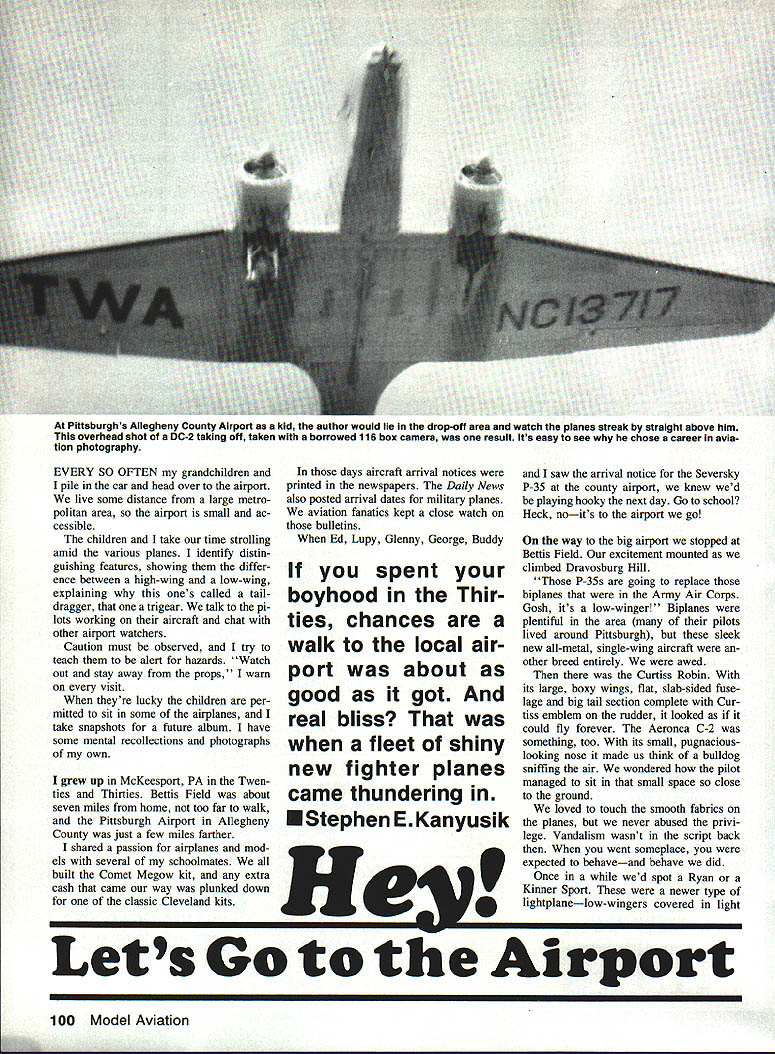
Luck was with us on that long-ago day. A DC-2 came in for a landing. I snapped a couple of shots with a 127 camera (I'd also borrowed a box camera for the occasion).
Since the Severskys hadn't arrived yet, there was time for a favorite ritual. We walked around to the lower end of the field, where the runway cut off and dropped about 10 ft., and lay down in the bottom of the drop-off area. The planes took off right over us, and the low vantage point made for some great photos. In fact the shot I took of a Douglas DC-2 influenced my eventual choice of career. As a Navy photographer the close proximity of planes on an aircraft carrier seemed natural.
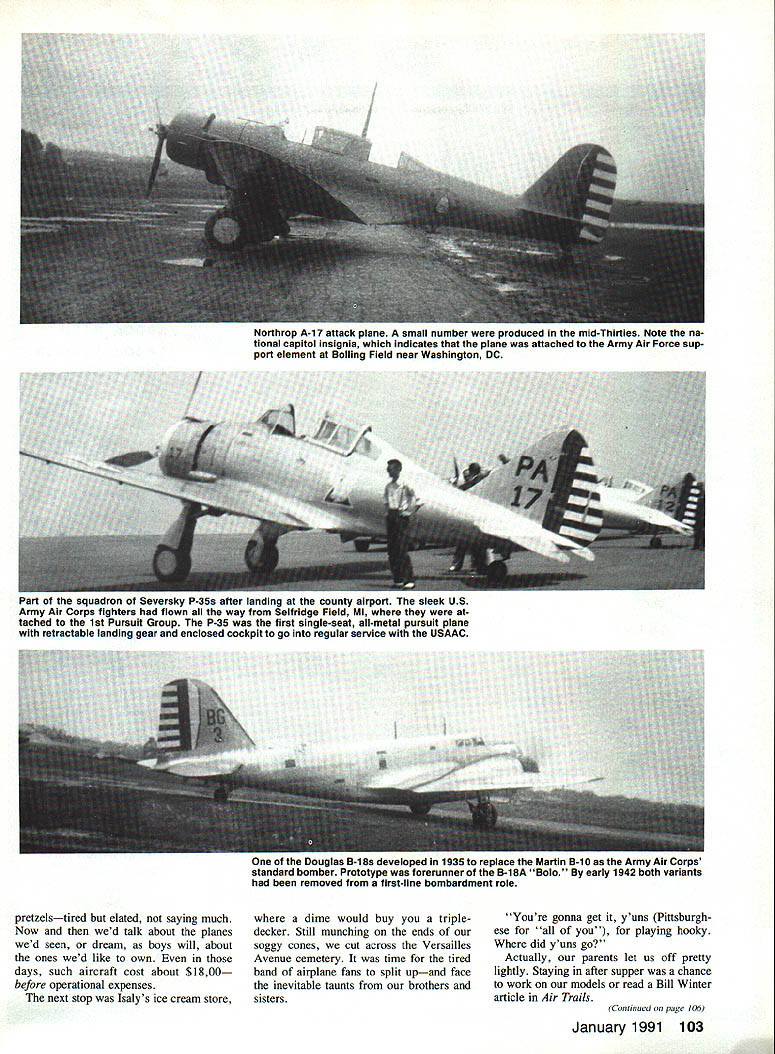
Suddenly they were coming, a whole squadron of Seversky P-35s in a mesmerizing burst of speed and sound.
"Wow! All the way from Michigan. Just think, in one day you can fly from that far away."
The P-35s looked exactly as a fighter should—snug, shifty and faster than a Main Street barmaid. They made a low, fast pass, then taxied up with brakes squealing, zigzagging for better visibility as they approached the tie-down area.
The pilots stepped out from the canopied cockpits—or was it from out of this world? They wandered away, leaving us alone with our sleek, shiny icons. Running our hands over their metal surfaces, we marveled in silence at the construction. I couldn't help but notice the many pieces in the compound curves and the countless rivets that held things together. And the details: the wheel fairings, the landing strut that retracted into a wing well! Not knowing the term "state of the art," all we could say was, "Gosh!"
The P-35s stayed just long enough for servicing. We watched the pilots climb back into the cockpits. The engines came to life like a thousand lions, and one by one the planes taxied out and arced into the blue.
We went back to the city the way we'd come—on foot. We were saving our dimes for an ice cream treat rather than spending them on carfare. We passed 10th Ward and stopped at the pretzel factory, then headed up Fifth Avenue with our bags of broken pretzels—tired but elated, not saying much. Now and then we'd talk about the planes we'd seen, or dream, as boys will, about the ones we'd like to own. Even in those days, such aircraft cost about $18.00—before operational expenses.
The next stop was Isaly's ice cream store, where a dime would buy you a triple-decker. Still munching on the ends of our soggy cones, we cut across the Versailles Avenue cemetery. It was time for the tired band of airplane fans to split up—and face the inevitable taunts from our brothers and sisters.
"You're gonna get it, y'uns," (Pittsburghese for "all of you"), "for playing hooky. Where did y'uns go?"
Actually, our parents let us off pretty lightly. Staying in after supper was a chance to work on our models or read a Bill Winter article in Air Trails. But we weren't home free yet.
While we were off on our adventure, the school attendance officer had been checking with our mothers. We could hear our moms now: "When it comes to airplanes, he won't listen to anything else!"
Setting off for school the next day, we knew we'd be going straight to the principal.
Mr. Bowers's station was outside the auditorium, next to a statue of Abraham Lincoln. We approached him en masse.
John Bowers was a stern-looking principal. He never had much to say, but when he did speak, it was terse and to the point.
"Well, fellas, where did you go yesterday? You know school is important and it's necessary to achieve your goals."
We told him about our experiences. He listened. Then he asked who had driven us to the airport. When we told him that we'd walked both ways, Mr. Bowers didn't hesitate another moment.
"Anyone who will walk that far to see airplanes can get excused by me!"
Whoopee! That's when we knew our adventure really had been fun. Fifty years later I can still recall our euphoria.
Like many others in that era, from an early age I knew I wanted a career in aviation. My friends and I sent penny-postcards to some of the flying schools—Parks in St. Louis, Spartan in Oklahoma, and the Ryan School of Aeronautics.
My choice was the Ryan School. It offered a package deal in which you both received flight training and owned an airplane. I dreamed a lot about that one.
But the Depression threw shadows over those dreams. Jobs were scarce, and after graduating from high school you took whatever was available. I accepted a position with the National Tube Steel Mill, but sure didn't kid myself that it was my life's work.
My escape from the valley, as the area around the steel mill was called, came when our country entered the Second World War.
Enlisting with the Navy, I served on aircraft carriers as a photographer. Though I never became the pilot I'd dreamed about, the aerial assignments taught me the thrill of flight. I recently retired from a 40-year career in photography.
After my stint with the Navy, I continued to do quite a bit of aerial photography. I took aerial photos for real estate companies in the Los Angeles area and recorded the missile scene while employed by General Dynamics Corporation in Pomona, CA.
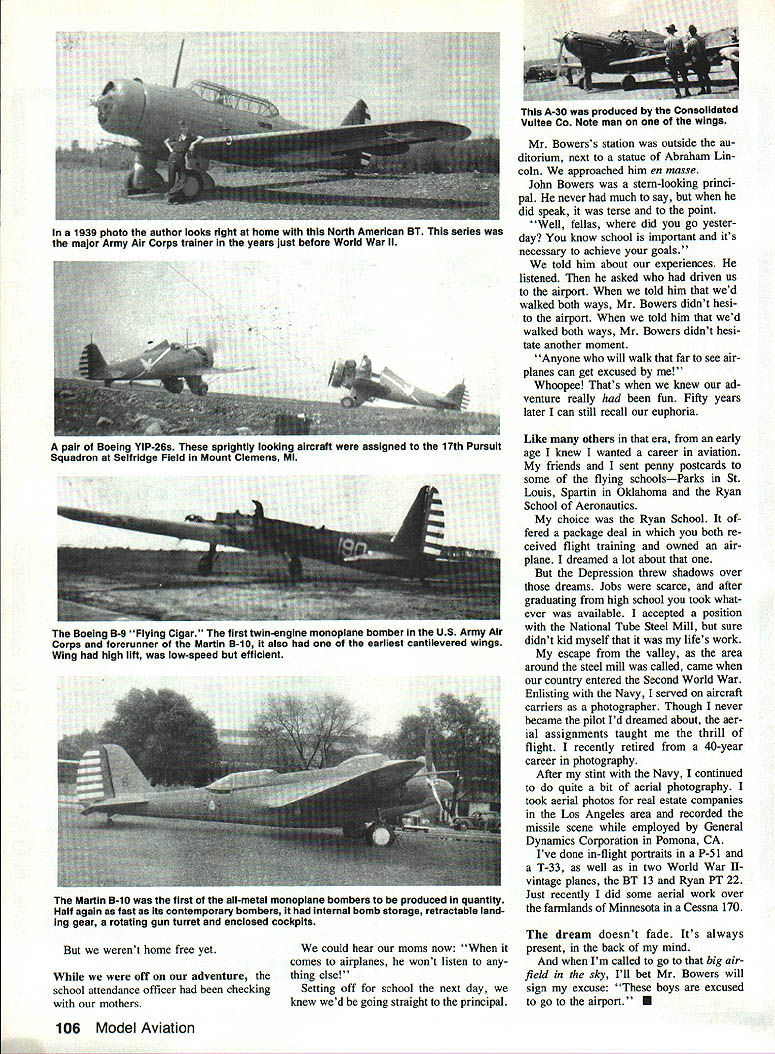
I've done in-flight portraits in a P-51 and a T-33, as well as in two World War II vintage planes, the BT-13 and Ryan PT-22. Just recently I did some aerial work over the farmlands of Minnesota in a Cessna 170.
The dream doesn't fade. It's always present, in the back of my mind.
And when I'm called to go that big air-field in the sky, I'll bet Mr. Bowers will sign my excuse: "These boys are excused to go to the airport."
Transcribed from original scans by AI. Minor OCR errors may remain.

