
Patricia T. Groves
The Hills Are Alive With...
the sound of engines and heart‑throbbing scale machines of history's most beloved aircraft. It's a tale of the Hill Country Flyers, and Morgan Hill.
At last count there are about 1,500 chartered clubs in the AMA. Besides general interest clubs, there are those that specialize in radio control, control line, free flight, scale, and indoor activities. Others have interests that are even more finely defined. To name a few, there are clubs strictly for gliders, rubber‑powered old timers, pylon, pattern, and peanut scale. Club names don't necessarily give you a clue either.
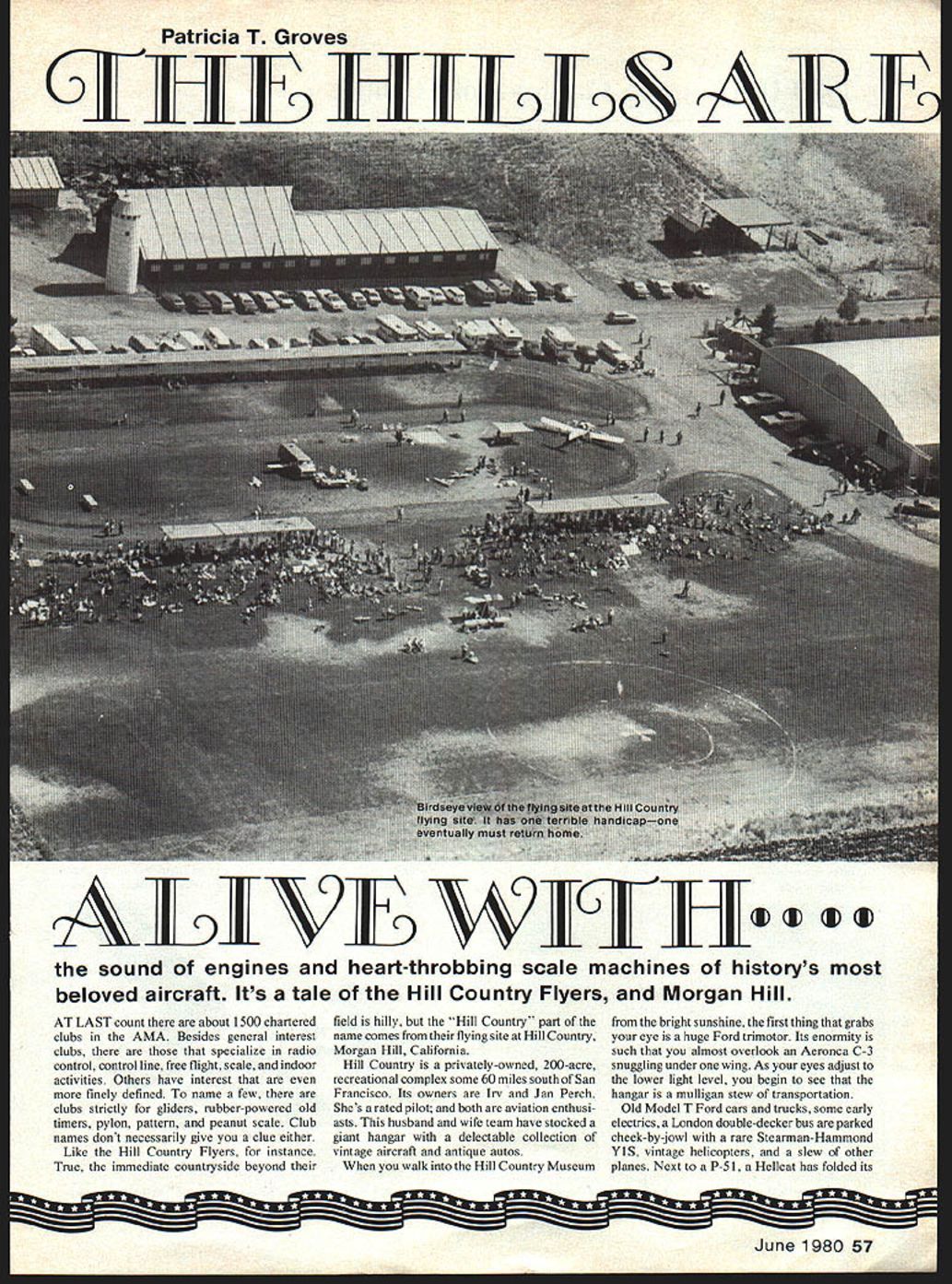
Like the Hill Country Flyers, for instance. True, the immediate countryside beyond their field is hilly, but the "Hill Country" part of the name comes from their flying site at Hill Country, Morgan Hill, California.
Hill Country is a privately owned, 200‑acre recreational complex some 60 miles south of San Francisco. Its owners are Irv and Jan Perch. She's a rated pilot and both are aviation enthusiasts. This husband‑and‑wife team have stocked a giant hangar with a delectable collection of vintage aircraft and antique autos.
When you walk into the Hill Country Museum from the bright sunshine, the first thing that grabs your eye is a huge Ford Trimotor. Its enormity is such that you almost overlook an Aeronca C‑3 snuggling under one wing. As your eyes adjust to the lower light level, you begin to see that the hangar is a mulligan stew of transportation.
Old Model T Fords and trucks, some early electrics, a London double‑decker bus, are parked cheek‑by‑jowl with a rare Stearman‑Hammond Y‑1S, vintage helicopters, and a slew of other planes. Next to a P‑51, a Hellcat has folded its wings to make room for a Klemm 35D. Over here, a Travel Air; there, a Waco 10. And with the recent closing of a small local airport, the Museum has become a sanctuary for some aeronautical refugees named Ryan, Stearman, Fairchild... It's an RC scale modeler's delight.
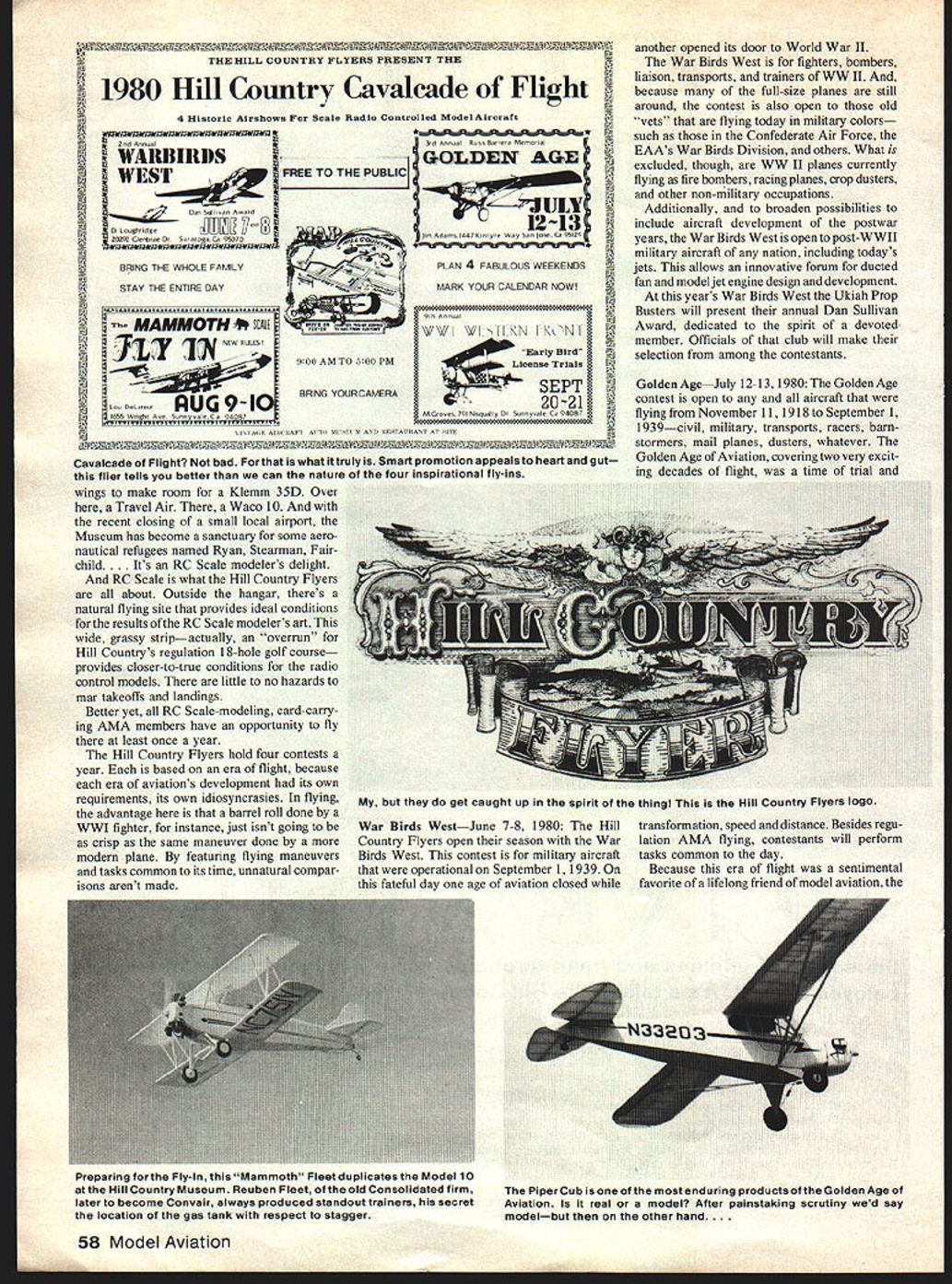
Cavalcade of Flight — not bad. For that is what it truly is. Smart promotion appeals to heart and gut; this flier tells you better than we can the nature of the four inspirational fly‑ins.
And RC scale is what the Hill Country Flyers are all about. Outside the hangar there's a natural flying site that provides ideal conditions for the results of the RC scale modeler's art. This wide, grassy strip — actually an "overrun" for Hill Country's regulation 18‑hole golf course — provides closer‑to‑true conditions for the radio control models. There are little to no hazards to mar takeoffs and landings.
Better yet, all RC scale‑modeling, card‑carrying AMA members have an opportunity to fly there at least once a year.
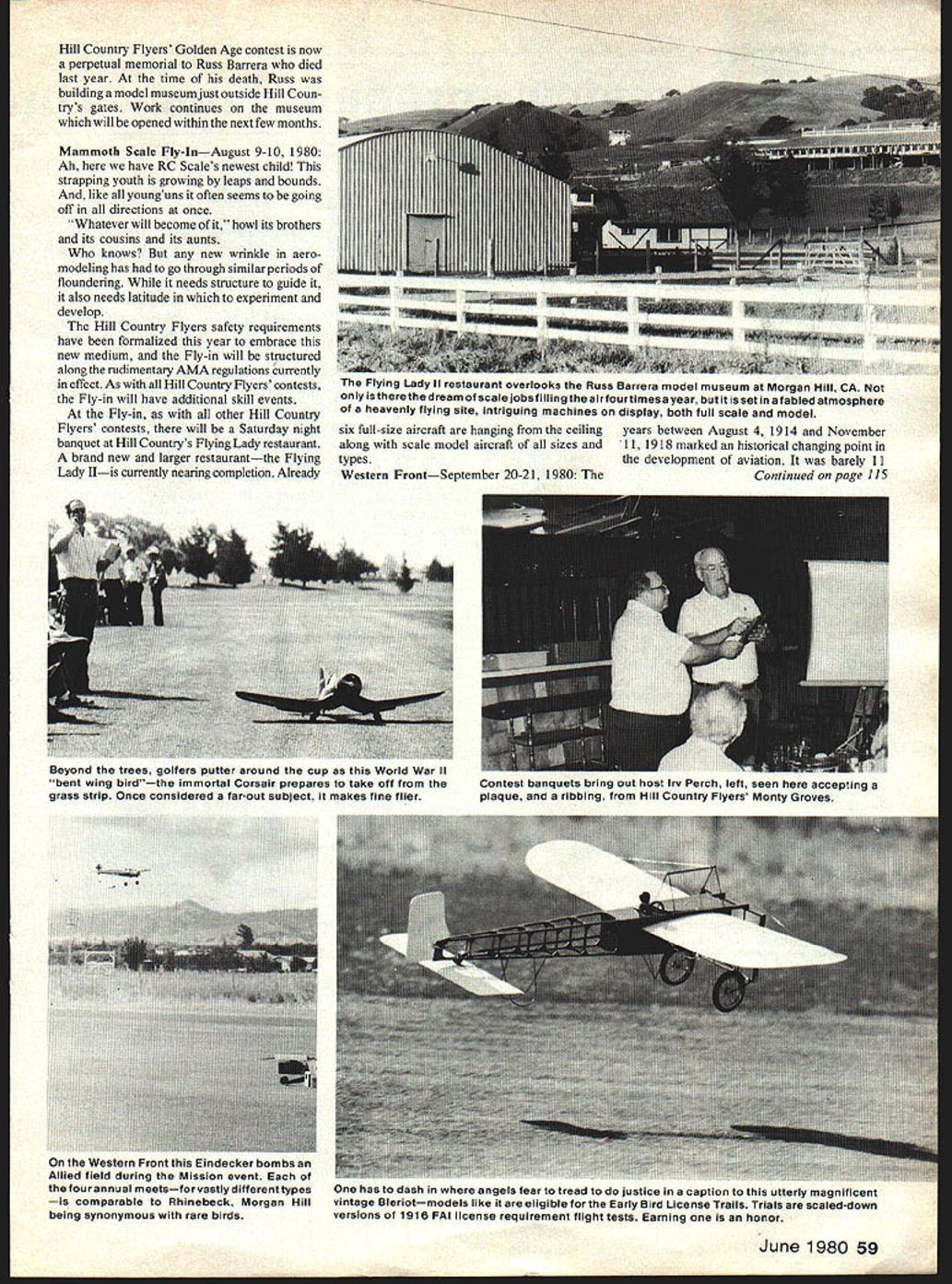
The Hill Country Flyers hold four contests a year. Each is based on an era of flight, because each era of aviation's development had its own requirements and idiosyncrasies. In flying, the advantage here is that a barrel roll done by a WWI fighter, for instance, just isn't going to be as crisp as the same maneuver done by a more modern plane. By featuring flying maneuvers and tasks common to its time, unnatural comparisons aren't made.
War Birds West — June 7–8, 1980
The Hill Country Flyers open their season with War Birds West. This contest is for military aircraft that were operational on September 1, 1939. On this fateful day one age of aviation closed while another opened its door to World War II.
War Birds West is for fighters, bombers, liaison aircraft, transports, and trainers of WWII. Because many full‑size planes are still flying, the contest is also open to those old "vets" that are flying today in military colors — such as those in the Confederate Air Force, the EAA's War Birds Division, and others. Excluded, however, are WWII planes currently flying as fire bombers, racing planes, crop dusters, and other non‑military occupations.
Additionally, to broaden possibilities to include aircraft development of the postwar years, War Birds West is open to post‑WWII military aircraft of any nation, including today's jets. This allows an innovative forum for ducted‑fan and model jet engine design and development. At this year's War Birds West the Ukiah Prop Busters will present their annual Dan Sullivan Award, dedicated to the spirit of a devoted member. Officials of that club will make their selection from among the contestants.
Golden Age — July 12–13, 1980
The Golden Age contest is open to any and all aircraft that were flying from November 11, 1918 to September 1, 1939 — civil, military, transports, racers, barnstormers, mail planes, dusters, whatever. The Golden Age of aviation, covering two very exciting decades of flight, was a time of trial and transformation, speed and distance. Besides regulation AMA flying, contestants will perform tasks common to the day.
Because this era of flight was a sentimental favorite of a lifelong friend of model aviation, the Hill Country Flyers' Golden Age contest is now a perpetual memorial to Russ Barrera, who died last year. At the time of his death, Russ was building a model museum just outside Hill Country's gates. Work continues on the museum, which will be opened within the next few months.
Mammoth Scale Fly‑In — August 9–10, 1980
Ah, here we have RC scale's newest child! This strapping youth is growing by leaps and bounds. And, like all young'uns, it often seems to be going off in all directions at once.
"Whatever will become of it," howl its brothers and cousins and aunts.
Who knows? But any new wrinkle in aeromodeling has had to go through similar periods of floundering. While it needs structure to guide it, it also needs latitude in which to experiment and develop.
The Hill Country Flyers' safety requirements have been formalized this year to embrace the new medium, and the Fly‑In will be structured along the rudimentary AMA regulations currently in effect. As with all Hill Country Flyers' contests, the Fly‑In will have additional skill events.
At the Fly‑In, as with all other Hill Country Flyers' contests, there will be a Saturday night banquet at Hill Country's Flying Lady restaurant. A brand new and larger restaurant — the Flying Lady II — is currently nearing completion. Already six full‑size aircraft are hanging from the ceiling along with scale model aircraft of all sizes and types.
Western Front — September 20–21, 1980
The years between August 4, 1914 and November 11, 1918 marked a historical turning point in the development of aviation. It was barely eleven years old when it went to war, and how the experience changed it.
The Western Front contest is for models of military aircraft of all the participating nations in the 1914–1918 war. Because the Hill Country grounds are ideally suited to the dicey, squirrely planes of WWI, the first Western Front contest was held there nine years ago. Since then it has become perhaps one of the longest‑running of the Hill Country contests.
Transcribed from original scans by AI. Minor OCR errors may remain.

