
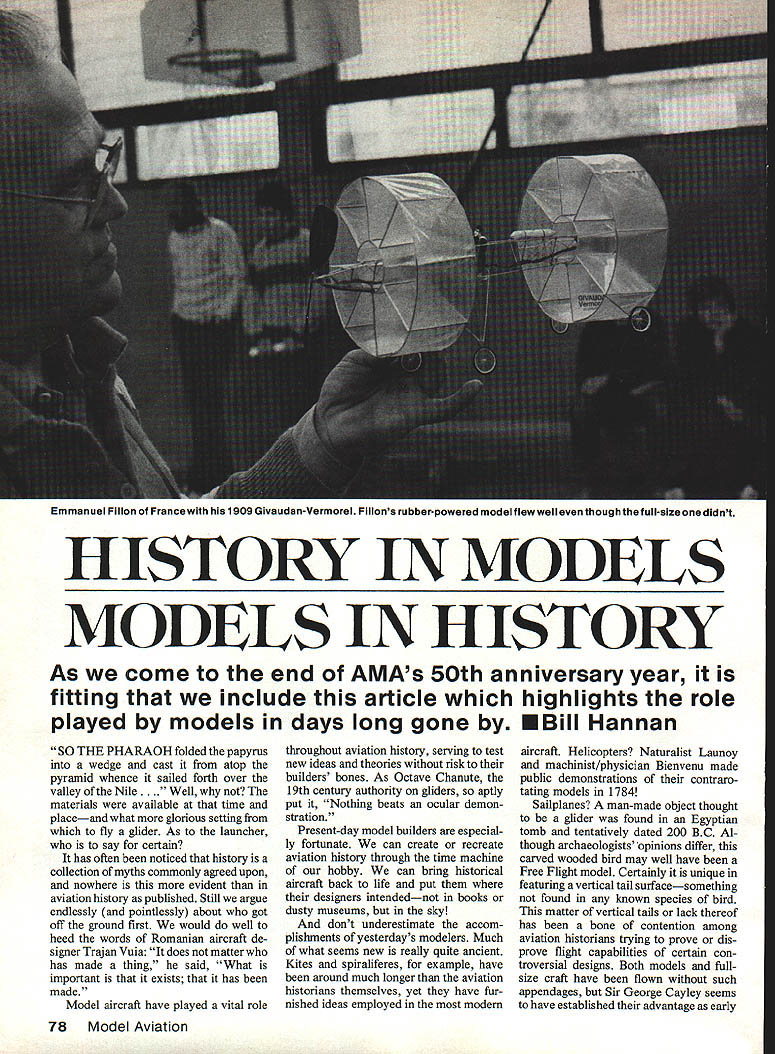
HISTORY IN MODELS — MODELS IN HISTORY
by Bill Hannan
As we come to the end of AMA's 50th anniversary year, it is fitting to include an article that highlights the role played by models in days long gone by. Models have tested ideas and theories without risking builders' bones, and they have helped inventors demonstrate concepts where words and drawings alone could not. As Octave Chanute, the 19th‑century authority on gliders, observed, "Nothing beats an ocular demonstration." Traian Vuia put it another way: "It does not matter who has made a thing; what is important is that it exists; that it has been made."
Early examples and ancient antecedents
- The image of a pharaoh folding papyrus into a wedge and launching it from a pyramid is as plausible as it is romantic: the materials and setting were available, and such scenes underscore how long humans have experimented with flying forms.
- Kites and spiralifers (kitelike devices) have supplied ideas long before formal aviation history began.
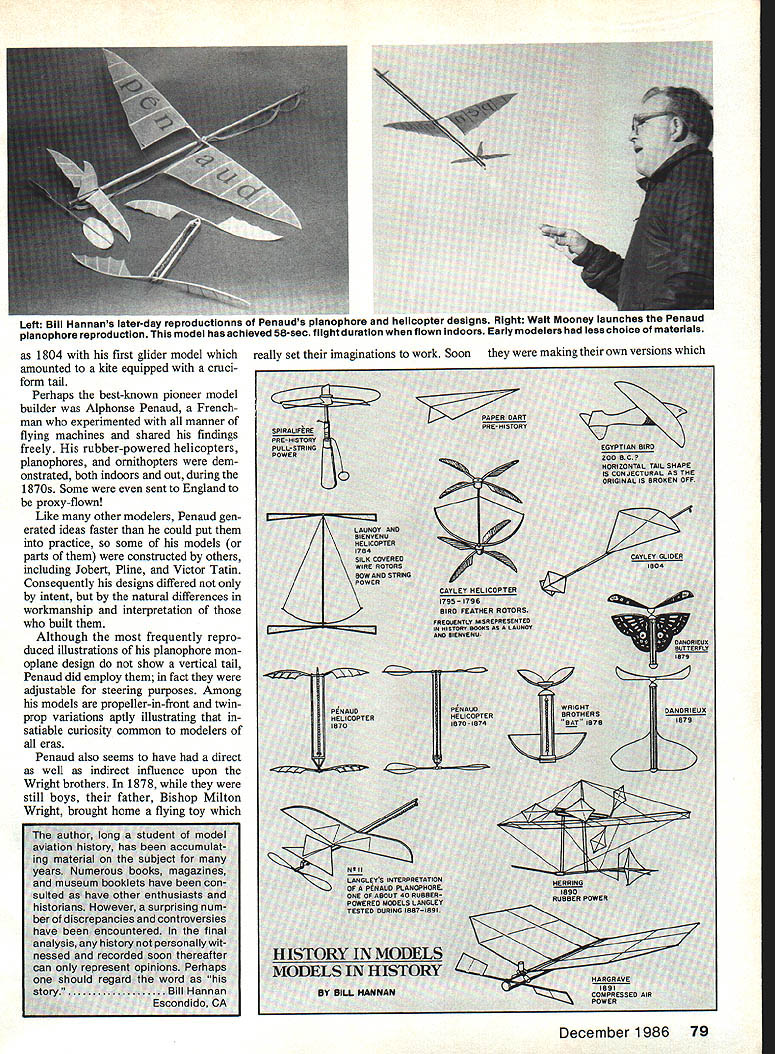
- Helicopterlike models: Naturalist Launoy and machinist/physician Bienvenu publicly demonstrated contra‑rotating models in 1784.
- Sailplanes: A carved wooden bird, found in an Egyptian tomb and tentatively dated to about 200 B.C., may have been a free‑flight model. It uniquely features a vertical tail surface—something that sparked debate among historians about the practicality of certain ancient designs.
- Sir George Cayley early established advantages of vertical tails. In 1804 he produced a glider model that amounted to a kite with a cruciform tail.
Alphonse Pénaud and the flowering of model experimentation
Perhaps the best‑known pioneer model builder, Alphonse Pénaud of France, experimented widely and generously shared his findings. In the 1870s he demonstrated rubber‑powered helicopters, planophores (rubber‑driven monoplanes), and ornithopters both indoors and out; some models were sent to England to be flown by proxy.
- Pénaud’s designs were varied: propeller‑in‑front and twin‑prop variations, adjustable steering surfaces, and planophore monoplane types.
- Because he often generated ideas faster than he could build them, parts or entire models were sometimes constructed by others (e.g., Jobert, Pliné, Victor Tatin), introducing differences of workmanship and interpretation.
- Pénaud appears to have influenced later pioneers, including the Wright brothers.
The Wrights, toys, and formative experiments
In 1878, while still boys, Orville and Wilbur Wright received a flying toy from their father, Bishop Milton Wright. This toy—reported by Orville later to have been based on a Pénaud design—helped kindle their lifelong fascination with flight and led them to build their own flying devices and models.
Leonardo, Dick Johnson, and reconstructing historical designs
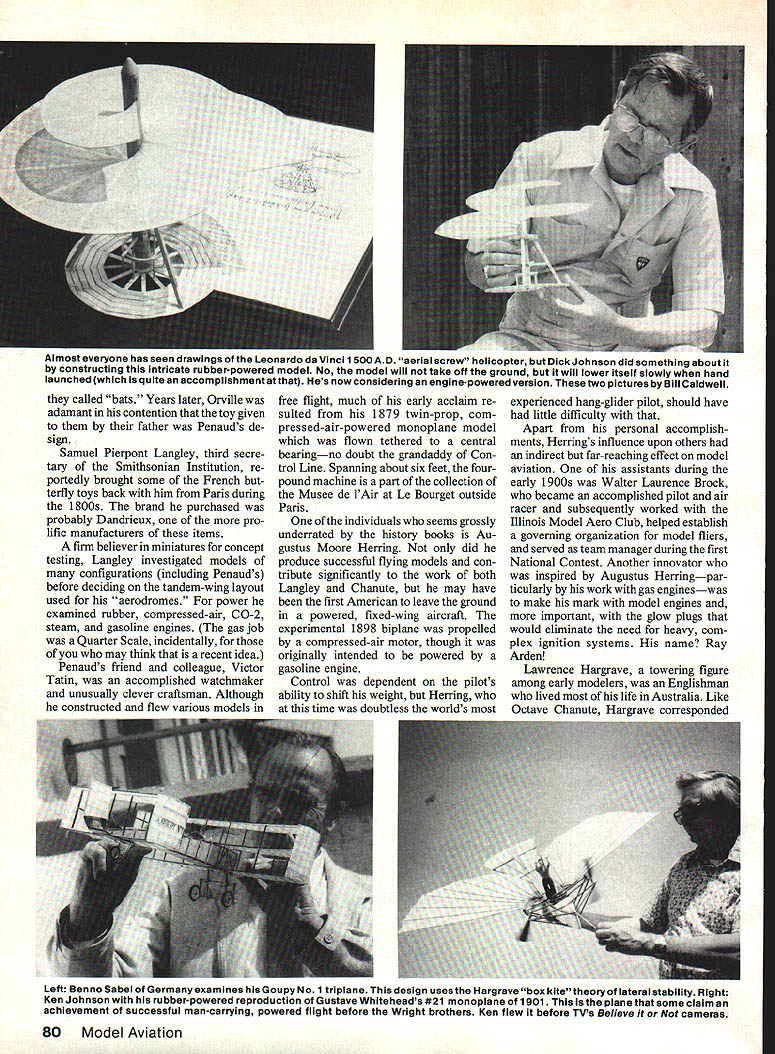
Leonardo da Vinci’s c.1500 aerial screw has inspired modelers. Dick Johnson (Dallas, TX) built an intricate rubber‑powered Peanut model of Leonardo’s helicopter design. Although no model of the aerial screw will lift off under its own power, Johnson’s model lowers itself slowly when hand‑launched—an achievement that proves the model can demonstrate aspects of the design. He is now exploring engine power for further experimentation.
Samuel Pierpont Langley and Victor Tatin
- Samuel Pierpont Langley (third secretary of the Smithsonian) believed in using miniatures for concept testing. He acquired French butterfly toys (probably manufactured by Dandrieux) and studied many configurations—Pénaud’s among them—before settling on the tandem‑wing layout for his "aerodromes." Langley investigated rubber, compressed‑air, CO2, steam, and gasoline power for models; the gasoline‑powered model was essentially a quarter‑scale demonstration of larger ideas.
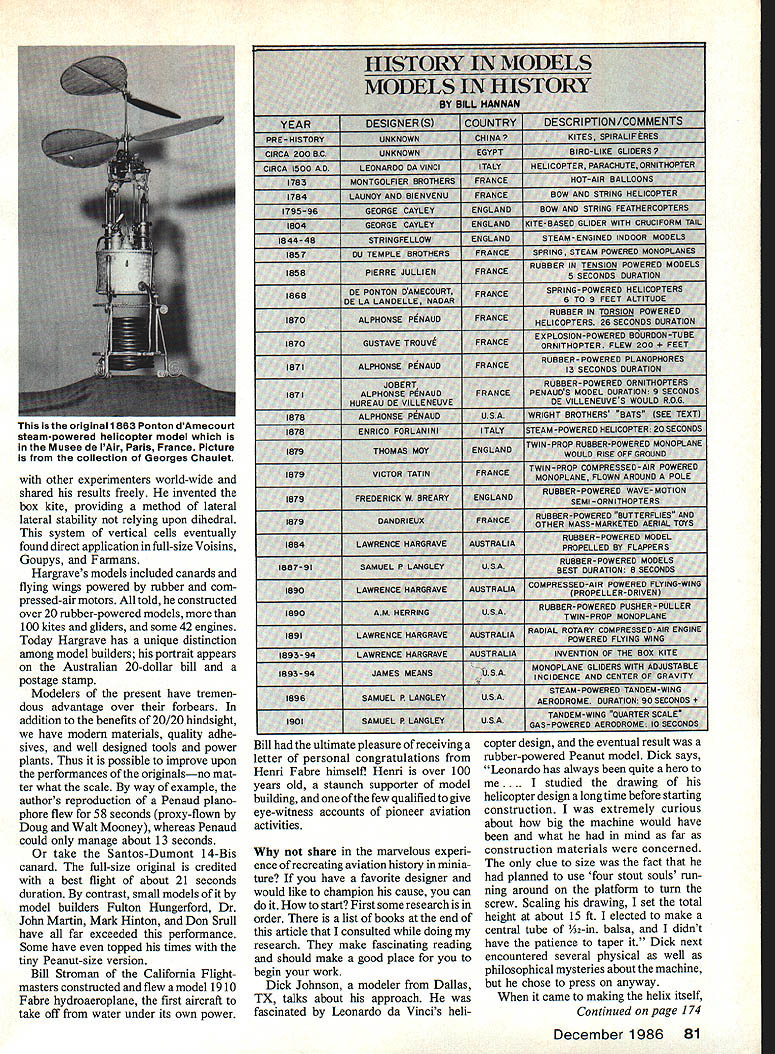
- Victor Tatin, a skilled watchmaker and craftsman, built many free‑flight models. In 1879 he created a twin‑prop, compressed‑air‑powered monoplane model that flew tethered to a central bearing—an antecedent to control‑line models. The six‑foot, four‑pound machine is part of the Musée de l'Air collection at Le Bourget.
Augustus Moore Herring and early powered attempts
Augustus Moore Herring produced successful flying models and contributed to the work of Langley and Chanute. He may have been the first American to leave the ground in a powered, fixed‑wing craft: an experimental 1898 biplane propelled by a compressed‑air motor (originally intended to use gasoline). Control relied on the pilot shifting his weight—a method Herring, an experienced hang‑glider pilot, could manage. Herring also influenced others who shaped model aviation, including:
- Walter Laurence Brock — assistant to Herring, later an accomplished pilot, air racer, and organizer in model aviation.
- Ray Arden — inspired by Herring’s engine work and later influential in developing model engines and glow‑plug ignition.
Lawrence Hargrave and the box‑kite tradition
Lawrence Hargrave, an Englishman who spent much of his life in Australia, corresponded with many inventors and perfected box‑kite types that inspired later full‑size designs (including those used by the Wrights). Hargrave experimented with man‑carrying kite systems, canards, flying wings, and many rubber‑ and compressed‑air‑powered models. His output included over 20 rubber‑powered models, more than 100 kites and gliders, and some 42 engines. Hargrave’s portrait even appears on the Australian $20 note.
Modern modelers, reproductions, and surpassing originals
Present‑day modelers benefit from hindsight, modern materials, better adhesives, improved tools, and more reliable powerplants. This allows small reproductions to sometimes outperform their full‑size prototypes:
- A reproduced Pénaud planophore (proxy‑flown) achieved a 58‑second flight, compared with about 13 seconds reported for Pénaud’s original.
- Models of Santos‑Dumont’s 14‑Bis canard have exceeded the original full‑size best flight of about 21 seconds—across several builders and even in Peanut‑scale versions.
- Bill Stroman (California Flightmasters) built and flew a model of the 1910 Fabre hydroaeroplane, the first aircraft to take off from water under its own power. Henri Fabre personally congratulated Stroman.
Scale modeling abroad and recent events
Scale modelling remains alive worldwide. Notable examples include work from Czechoslovakia:
- Lubomir Koutny and colleagues produced high‑quality scale ships and aircraft.
- At the Czech/Soviet Cup contest in Nove Mesto Hall (Slovakia), Koutny’s models and others posted impressive times. Indoor meets in Prague, Boleradice, and Hradec Kralove were well attended and featured a wide variety of subjects, including seaplanes competing for special awards.
Getting started: research and reconstruction
If you want to recreate aviation history in miniature:
- Do some research first. Consult books, museum booklets, and published plans to understand original designs and materials.
- Decide on scale and intent (static display, free flight, rubber power, engine power).
- Be prepared to interpret or adapt unclear details—many historical accounts contain discrepancies or opinion rather than hard fact.
- Join model clubs or contact enthusiasts and historians for advice and proxy‑flying help when appropriate.
A few practical notes and contacts mentioned in contemporary circles (historical reference):
- Rev. W. O. Anderson used to offer three‑page rubber plans for a small model (JC‑24C) for a small fee.
- Bill Warner (Santa Monica, CA) has been active in model circles.
Acknowledgments
The author extends thanks for research assistance to:
- Richard Miller
- Domenick Pisano
- George Chaulet
- Hewitt Phillips
- J.F. Frugoli
- Leo Opdycke
- Bert Pond
- Eugene Husting
- Lauren S. McCready
- Reg Parham
- John Brown
- Dr. Robert B. Allen
- Bill Stroman
- Dick Johnson
- Bruce Carmichael
Selected bibliography
- Progress in Flying Machines, Octave Chanute, 1894 (reprinted 1976).
- Lawrence Hargrave: Explorer, Inventor & Aviation Experimenter, W. Hudson Shaw and Olaf Ruhen, 1977.
- J'ai vu naître l'Aviation, Henri Fabre, 1980.
- The Complete Book of Model Aircraft, Louis H. Hertz, 1967.
- Sir George Cayley's Aeronautics 1796–1855, C.H. Gibbs‑Smith, 1962.
- James Means and the Problem of Man‑Flight, James Howard Means, 1964.
- Langley: Memoir on Mechanical Flight, Part I, S.P. Langley, 1911.
- Commemorative Book, Semi‑Centennial of Model Aviation, Bert Pond, 1976.
- Alphonse Pénaud's Letters on Aeronautics, Pearl I. Young, 1968.
- Langley's Model Aero Engine of 1903, Robert B. Meyer, Jr., 1976.
History is often part fact, part story. Models let us test, demonstrate, and sometimes correct that story by putting designs where their makers intended—up in the sky.
Transcribed from original scans by AI. Minor OCR errors may remain.

