
History of RC Flying
Walt Good
The Popularity
Radio-control (RC) model aircraft are an exciting hobby and are unquestioned in popularity today. Types range from simple gliders to detailed scale models. Not long ago, however, the RC hobby did not exist — it had to be invented.
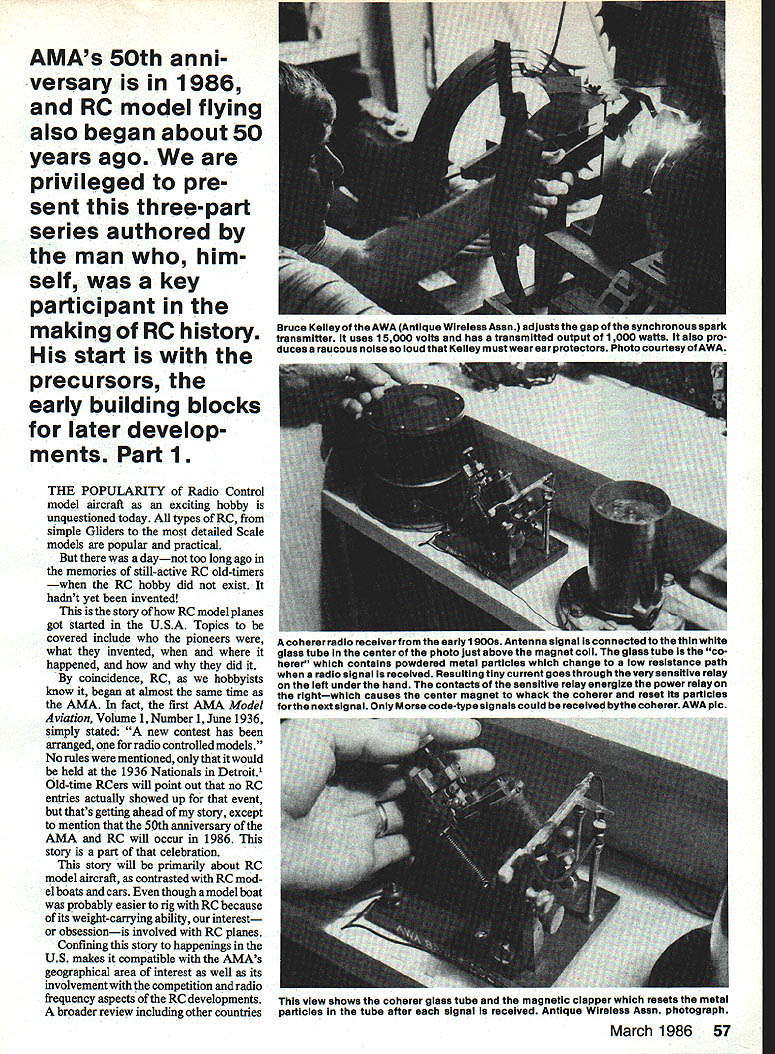
This article recounts how RC model planes got started in the U.S.A.: who the pioneers were, what they invented, when and where it happened, and why. By coincidence, hobby RC began almost the same time as the Academy of Model Aeronautics (AMA). The first issue of AMA Model Aviation (Volume 1, Number 1, June 1936) noted, "A new contest has been arranged: radio controlled models." No rules were given; the event was to be held at the 1936 Nationals in Detroit. Old-time RCers will point out no RC entries actually showed up that year.
This series focuses on RC model aircraft (as contrasted with RC boats and cars). Although model boats were probably easier to rig for RC because of their greater weight-carrying ability, the obsession here is with planes. The story is confined to happenings in the U.S. to align with the AMA’s geographic and regulatory interests. A global review would be interesting but is beyond the immediate scope.
To understand the invention of hobby RC we first review the precursors and early developments that provided the building blocks: the state of model airplanes in the early 1930s, the status of control radio (military and commercial), and the amateur radio activity that supplied much of the practical equipment and technical know-how.
Status of Model Aviation in the Early 1930s
In 1930 model aircraft were primarily rubber-powered free flights or gliders. With a little balsa, tissue, Ambroid cement, and a length of rubber you could enter contests. Despite the Depression, local and national contests continued.
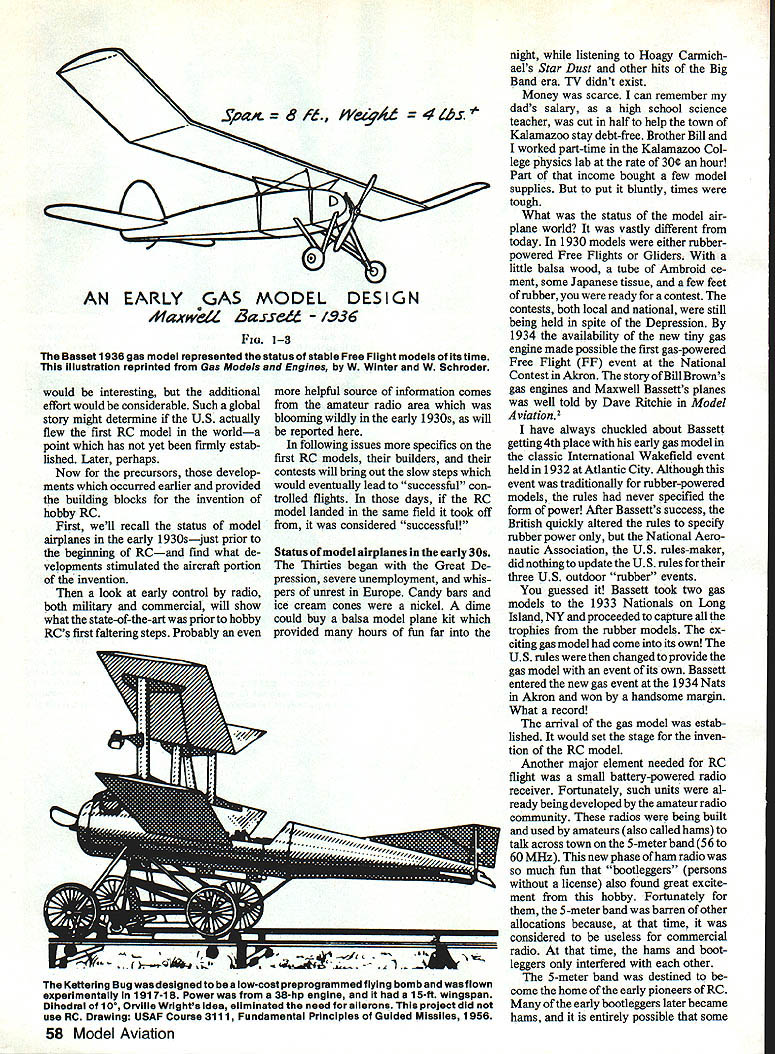
By 1934 the availability of small, lightweight gas engines enabled the first gas-powered free-flight events at the National Contest in Akron. Maxell Bassett and Bill Brown were notable figures in the early gas-model era. Bassett famously placed fourth in the classic International Wakefield event in 1932 even though the event was traditionally for rubber models—the rules had not specified the form of power. The British changed their rules afterward, but in the U.S. the arrival of reliable gas models led to a separate gas event at the Nationals. Bassett dominated the early gas contests and helped establish the gas model as a major element leading toward RC experimentation.
Another essential element for RC flight was a compact, battery-powered radio receiver. Such units were being developed by the amateur radio community on the higher-frequency bands (notably the 5-meter band, 56–60 MHz), which soon became home to early RC experiments.
Military RC Projects (around the early 1920s)
Military developments in 1916–1924 provide useful background because they demonstrate some early technical approaches and challenges.
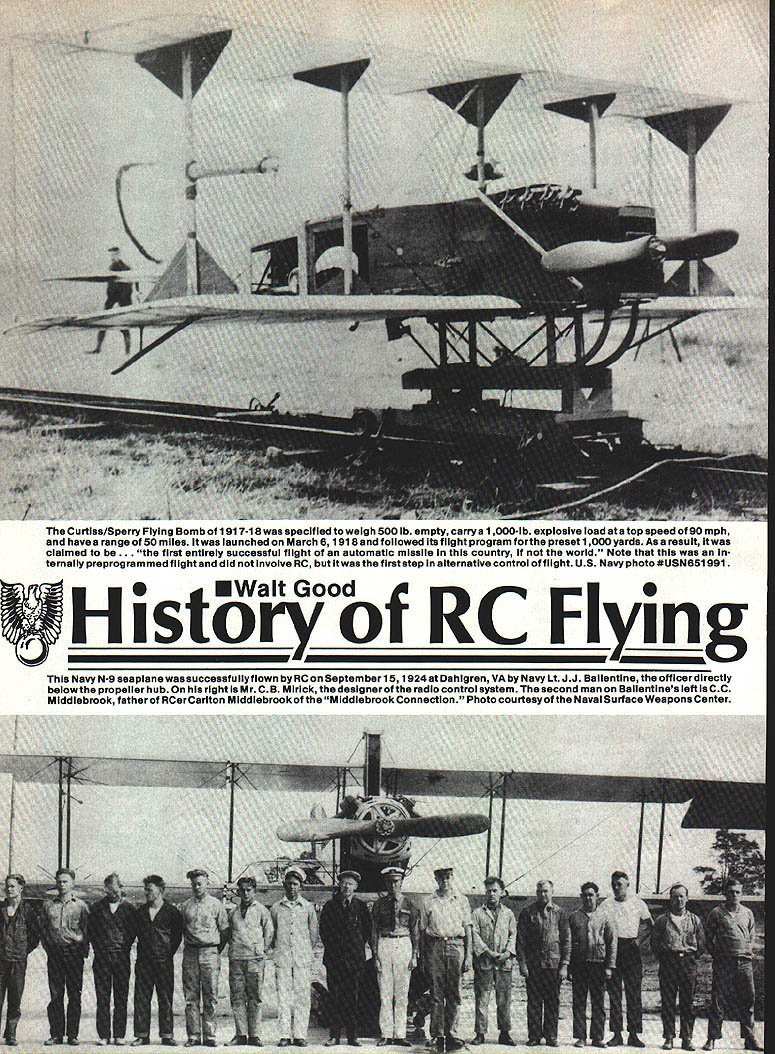
- Curtiss/Sperry Flying Bomb (1916–1918): Elmer Sperry and Peter Cooper Hewitt developed an automatic, preset-control hydroplane in 1916 that demonstrated gyro stabilization and automatic climb and heading control. The Navy contracted $200,000 in 1917 for the Curtiss/Sperry Flying Bomb. On March 6, 1918, a test flight followed its preset program for 1,000 yards and was heralded as a successful automatic missile test. This was a terminally preprogrammed flight, not radio control, but it was an important early step toward alternative flight control.
- Kettering "Bug" (1917–1919): Charles Kettering led a team (Orville Wright on the airframe, DePalma on the engine, Sperry and Kettering on controls) to produce low-cost, one-shot aerial torpedoes. The "Bugs" used gyros and player-piano pneumatic control components, had large dihedral wings for stability (eliminating ailerons), carried substantial payloads, and cost relatively little. After initial test failures, one Bug demonstrated a successful target run on October 22, 1918. Further testing in Florida produced limited success; overall these internally programmed vehicles were important stepping stones.
- Navy N9 Seaplane "Wild Goose" (1922–1924): The Navy added radio control to a gyro-equipped N9 seaplane at the Dahlgren Proving Ground under C. B. Mirick. Early tests used vacuum-tube transmitters and receivers and an Morkrum selector switch. Initial trials used an airborne pilot to monitor responses while ground-based operators sent signals. The early selector tore control cables during vigorous rudder inputs and was redesigned using tuned reeds to allow simultaneous control of multiple surfaces. On September 15, 1924, the "Wild Goose" made the first unmanned RC flight: it took off, circled for about 12 minutes up to 500 ft, responded to commands out to two to three miles, and landed (although the pontoon later cracked and the airplane sank). The project was then terminated, but this was a significant professional demonstration of RC flight.
There are personal connections in the RC community to these early projects: Charles Middlebrook (civilian engineer) adjusted gyros on the Wild Goose, and his son Carlton later participated in RC model activities at Dahlgren.
Commercial Radio Origins
Commercial radio pioneers invented basic circuits and detectors that later fed into hobby RC development.
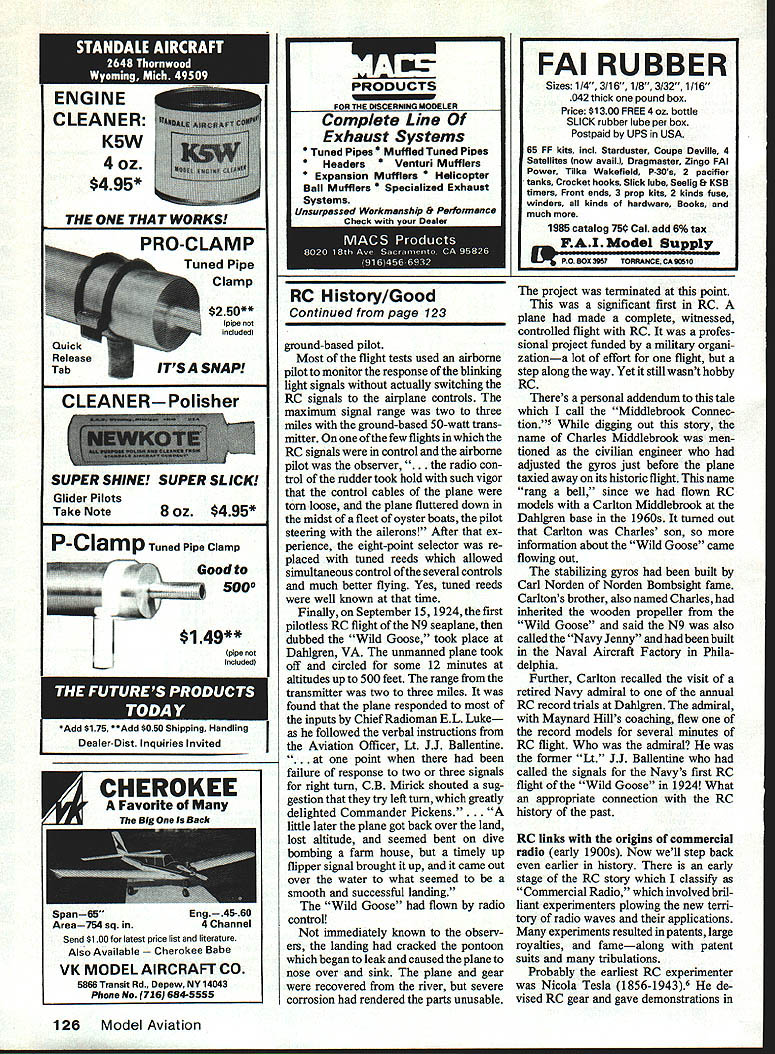
- Nikola Tesla (1898): Tesla publicly demonstrated radio-controlled model boats at Madison Square Garden and received U.S. Patent No. for "Method of and Apparatus for Controlling Mechanism of Moving Vessels or Vehicles" (patent date November 8, 1898). His patent mentioned boats, carriages, and balloons as possible vehicles.
- Patent disputes and industry development: Marconi, Tesla, and others were engaged in patent battles over radio inventions. The early commercial radio industry (General Electric, Westinghouse, RCA, etc.) grew during this period.
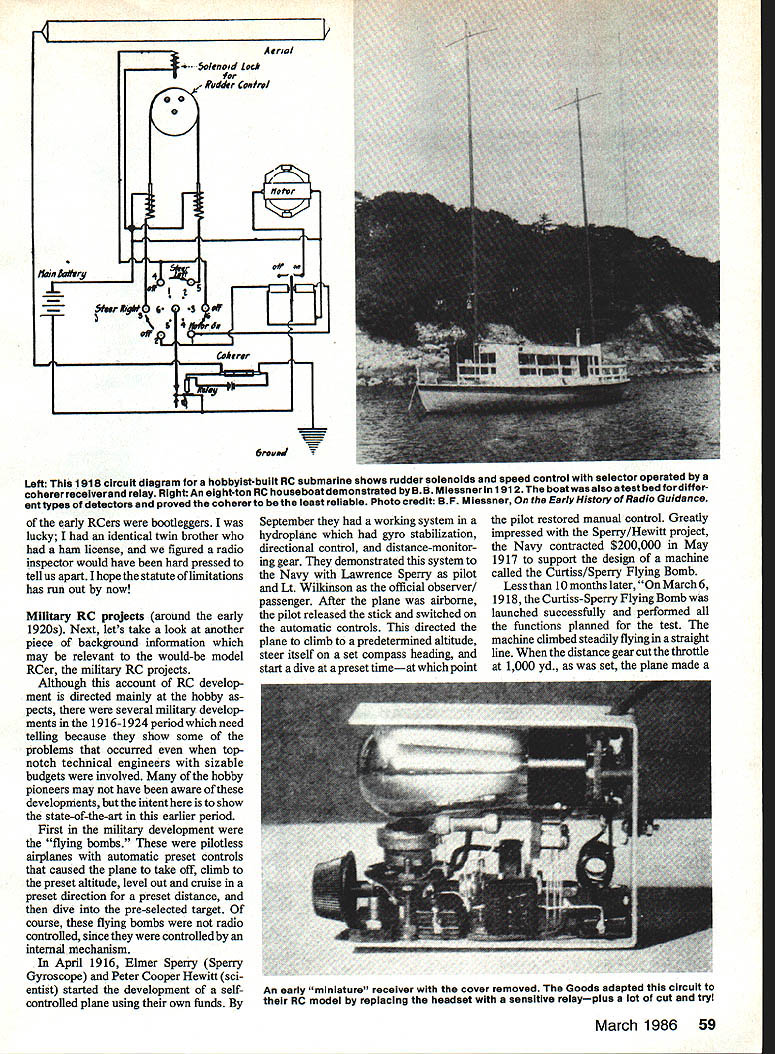
- B. F. Miessner (1912–1916): Miessner demonstrated radio control of a large houseboat in 1912 using a 1,000-watt shore transmitter and various detectors. He found the coherer detector unreliable, the crystal detector effective to about a half-mile, and the vacuum-tube detector effective to about three miles. He later published Radio Dynamics (1916) and made contributions (and patent claims) in receiver design and FM—controversies aside, these commercial and experimental developments supplied key circuit ideas and components for later hobby RC.
Contributions from Amateur Radio
Although commercial and military work provided technology and proofs of concept, the RC model airplane was largely invented by hobbyists: modelers and amateur radio operators (hams).
- Amateur licensing and practice: Amateur radio required licenses obtained by examination in Morse code and radio theory. By 1936 there were about 20,000 active amateurs in the American Radio Relay League (ARRL).
- Frequency allocations: After early spectrum reorganizations (notably 1912 and later the 1927 World Radio Conference), amateurs gained access to higher frequencies. In 1929 the government assigned, among other slices, a four-MHz segment starting at 56 MHz (the 5-meter band). Only a few hundred or thousand hams explored this band initially, making it relatively free for experimental work. This band became the main one used for RC models from the mid-1930s until the early 1950s, when the AMA secured explicit frequencies for RC use. After World War II the band was shifted and is now commonly called the 6-meter band (50–54 MHz).
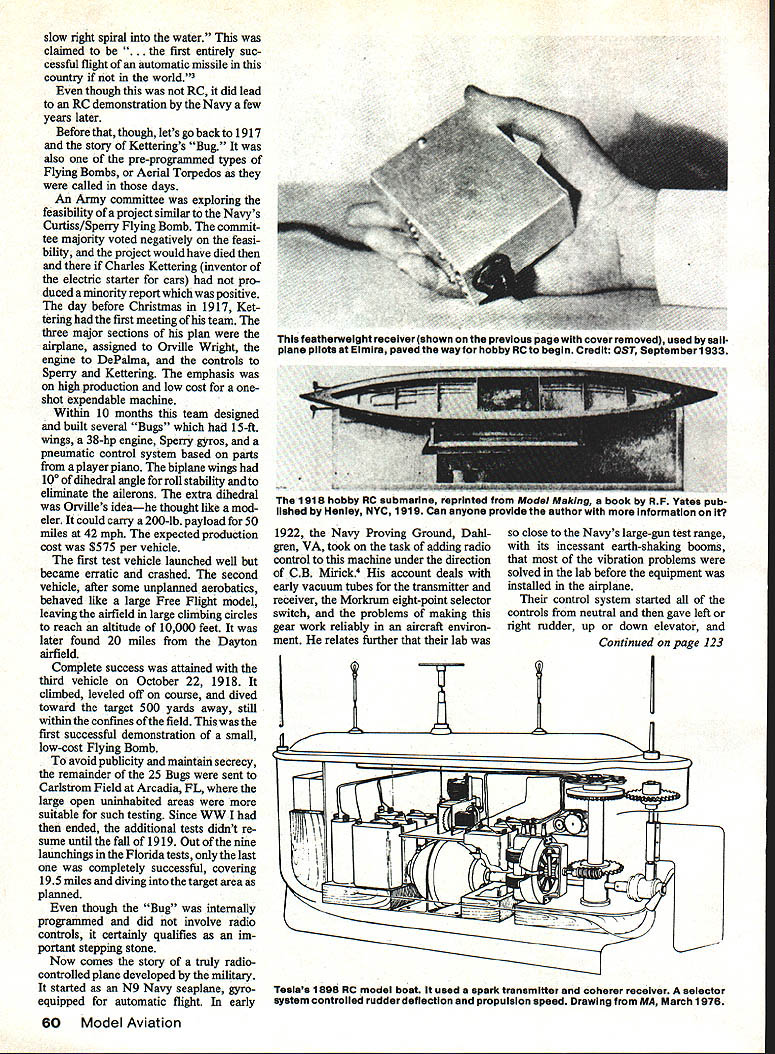
- Practical gear: Tiny one-tube receivers and small transmitters developed by hams were adapted by modelers (for example, glider pilots used tiny receivers at Elmira which were later converted for RC applications).
Clinton B. DeSoto’s 1936 book 200 Meters and Down documents the early amateur experience and the technical state of the art prior to RC model adoption. DeSoto himself entered an RC plane in the 1938 AMA Nationals and later wrote extensively on RC topics.
Anecdote: the author recalls his twin brother obtaining a ham license in 1932 and the practicality of ham-operated radios and the 5-meter band for early RC experiments. Bootleg transmitters (unlicensed operators) also experimented on these high frequencies in the early days.
The First Hobby RC Projects
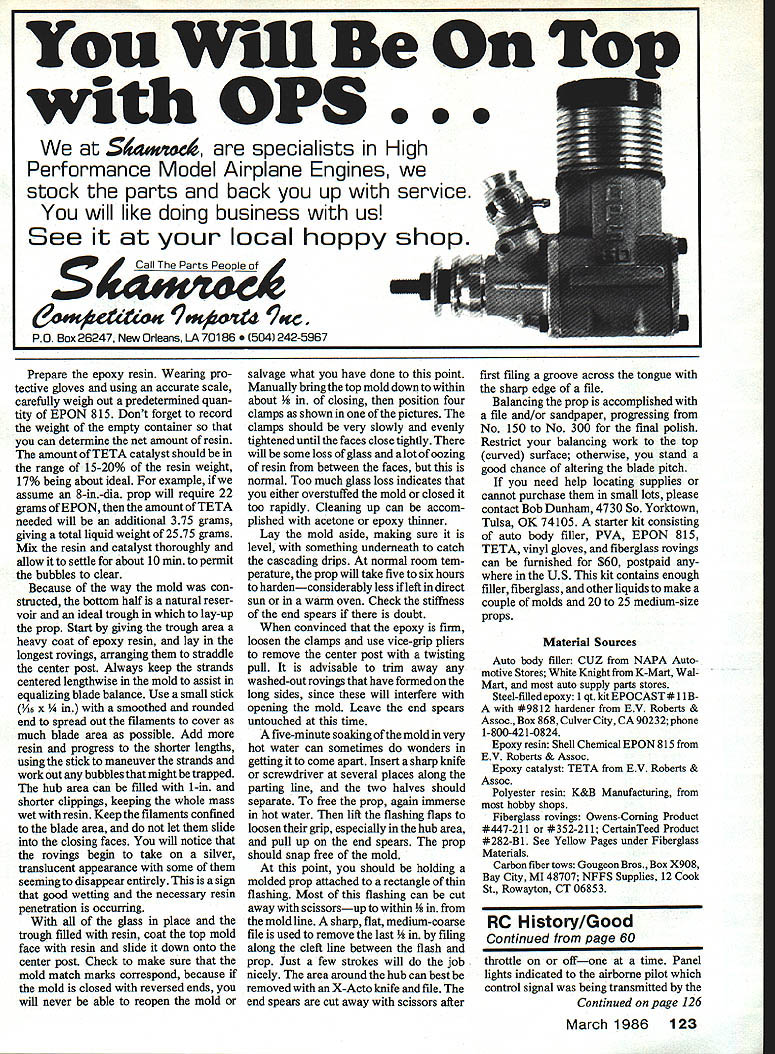
One early heavy RC hobby project was an 8-ton, 175-lb. model submarine described in Modelmaking (edited by Raymond F. Yates). The model used spark-gap transmission and a coherer receiver, with a reported maximum range of about 300 feet. The article likely dates to 1917–1918 and may have been constrained by wartime wireless prohibitions. While an interesting example of early hobby RC, its heavy gear made it unsuitable for aircraft use.
The first dedicated RC hobby model airplane activity in the U.S. emerged in the mid- to late-1930s when modelers and amateur radio operators combined small gas-powered models with compact radio gear on the 5-meter band. The 1937 National Contest in Detroit is notable as an early competition that included RC entries and marks the beginning of organized hobby RC trials.
Summary
Precursors that set the stage for hobby RC model airplanes:
- Gas engines and gas-powered model aircraft (early 1930s) provided suitable airframes and propulsion capable of carrying RC gear.
- Amateur radio operators developed compact transmitters and receivers and provided the frequency access and practical know-how at a hobby level.
- Military RC projects (1916–1924) demonstrated technical feasibility and highlighted practical problems, but did not directly transition to hobby RC.
- Commercial radio pioneers invented many of the circuits, detectors, and components that hobbyists later adapted.
Modelers and hams blended these elements into working RC model airplanes. The next installment will recount early stumbling steps and the first-ever RC competition at the 1937 National Contest in Detroit.
References
- Zaic, Frank. Junior Aeronautics Year Book. New York: Model Aeronautics Publications, 1934.
- Ritchie, Dave. "Maxwell Bassett: First Gas Model Champion." Model Aviation, September 1983.
- Fahrney, D. S., Rear Admiral, USN (ret), and Robert Strobell. "America's First Pilotless Aircraft." Aero Digest.
- Mirick, C. B. "A Wild Goose Chase." U.S. Naval Institute Proceedings, Vol. 72, Whole No. 521, July 1946.
- Middlebrook, Carlton. Interview, February 28, 1985.
- Sosic, G. V. "Tesla, The Father of RC." Model Aviation, March 1976.
- Miessner, B. F. On the Early History of Radio Guidance. San Francisco: San Francisco Press, 1964.
- DeSoto, Clinton B. 200 Meters and Down. West Hartford: The ARRL, Inc., 1936.
- Yates, Raymond F., ed. Modelmaking. New York: Norman W. Henley Publishing Co., 1919.
Transcribed from original scans by AI. Minor OCR errors may remain.

