
History of RC Flying
Walt Good
This is the story of how radio-controlled model aircraft got started in the U.S. It tells of the pioneers who developed the RC hobby by combining their knowledge and skills with the related experiences of earlier inventors.
The background prior to the invention of hobby RC was presented in an earlier article. The gas model and the gas engine were two of the essential ingredients that arrived during the early 1930s. Ham radio, with its compact homemade receivers and transmitters, also came during the same period. Military and commercial interests had demonstrated the feasibility of RC in large boats and aircraft during the 1920s. All the technical ingredients were in place for clever, dedicated, and inspired modelers to invent hobby RC aircraft.
An important stimulus came in June 1936 when the newly formed AMA announced that an RC event would be added to the 1936 National Contest in Detroit. No RC models appeared at the 1936 event, but rumors were rampant that RC ships were being secretly built. The 1937 AMA Nationals were different: six RC models actually appeared, causing great excitement and expectations. Whether this was the first RC contest in the world is not known. The following account describes the RC event at the 1937 Nats (again in Detroit), the first-ever RC contest in the U.S.
Sunday, July 11, dawned warm and clear at Detroit Wayne County Airport. Ground tests of the controls were made during preflight; written notes promised afternoon showers, but none were observed. Hundreds of Free Flight modelers, contest judges, novices, and pioneers were at the meet. Six models in various events were accepted as eligible in the RC category after demonstrating radio control operation on the ground. Official flying attempts were scheduled for the morning but were postponed; the six RC models were to commence early afternoon.
The following account of the flights and ground demonstrations is based on magazine reports, interviews with surviving participants (including Patrick Sweeney, Chester Lanzo, Elmer Wasman, Walter Good, Leo Weiss, and B. Schiffman), and the author's memory.
The entrants and equipment
The radio-judge planes ranged from 8 to 14 feet in span and weighed from about 6 to 16 pounds. Controls varied from rudder-only to full-house (rudder, ailerons, elevator, and engine cutoff). No two systems were alike; all were original designs. Receivers were typically home-built, using vacuum tubes in super-regenerative or regenerative circuits. Batteries were heavy and short-lived—especially the 45-volt "B" batteries used for tube plate supplies.
The first three places were awarded on the basis of flight performance. The last three placements were based only on ground demonstrations, because those entries did not attempt flight.
Patrick J. (Pat) Sweeney — first attempt
Patrick J. Sweeney, a Chicago modeler in his late thirties, was the first entrant to attempt flight. His cabin-type design had a 10-ft span, 18-in chord, and total weight of about 9 lb. The radio gear weighed about 3 lb and the batteries almost 2 lb; the receiver needed 90 volts, which meant two 45-volt "B" batteries.
Pat ran a hobby store in Chicago, had plenty of materials, and had been flying gas models in competition. His radioman, Ben F. Porter, built a three-tube receiver using a super-regenerative detector on the 5-meter band (56–60 MHz). Rudder control was provided by a spring-wound alarm-clock mechanism with a four-point cam and switch that stepped the rudder through neutral, right, neutral, left, etc., each time the transmitter push button was pulsed.
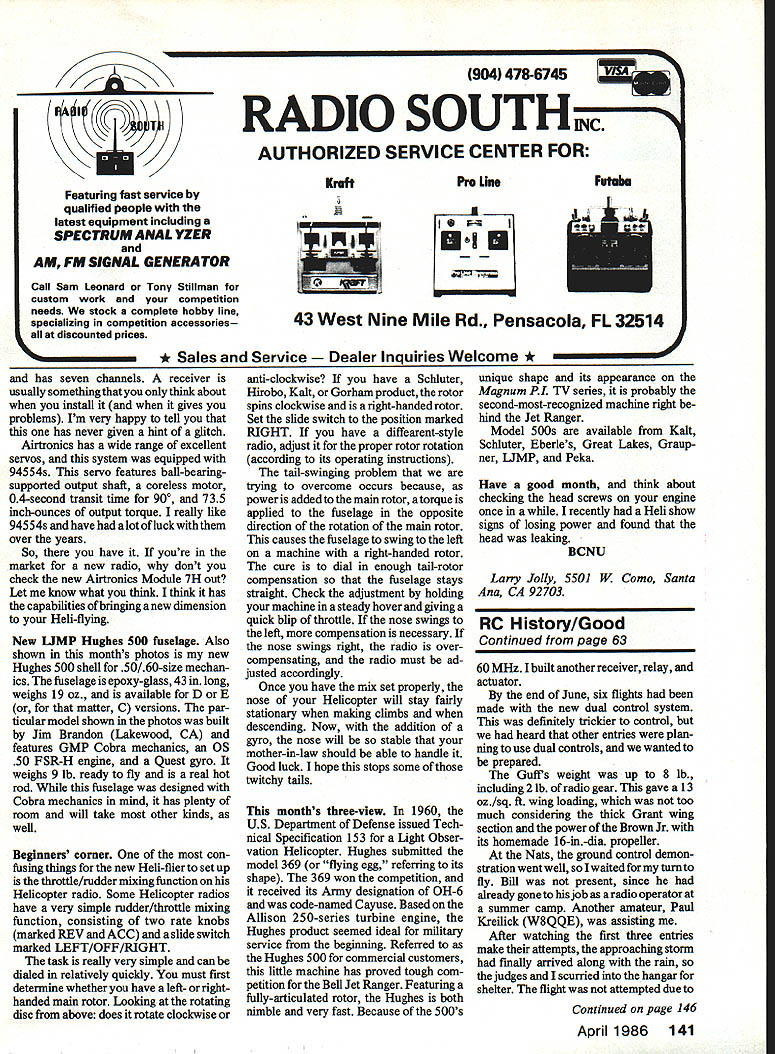
Reporter Phil Zecchella described the attempt: with the transmitter established at a distant point and the receiving set tested, Sweeney warmed his engine and launched. The model lifted but then went into a high climb from which it could not recover, stalled onto its left wing, and crashed. The flight lasted about five seconds; a wingtip was demolished and the motor mount slightly injured. The cause was judged to be a center-of-gravity too far aft. Sweeney made no further attempts. He is credited with the first attempted RC flight at a National Contest.
Elmer Wasman — the "White Mystery"
Elmer Wasman of Jacksonville, FL, entered an 11-ft-span model nicknamed the White Mystery because of a wind-driven propeller mounted on the front of the fin—its purpose was not obvious to observers. Elmer had an industrial arts degree and taught aeronautics in junior high school. His ship weighed about 14 lb with radio gear and used a 16-in prop with a high-power transmitter; climb was marginal but safe. Controls included rudder/aileron, elevator, and ignition cutoff. The engine ignition type required spark coil and batteries.
Elmer's control system was elaborate. The airborne receiver operated relays and a sequential selector switch. A four-bladed air-driven propeller mounted at the front of the vertical fin powered a rotating shaft. The radio signal closed a relay contact to activate a sequential selector wiper that connected the signal to one of five electromagnets; these engaged the rotating shaft to move the selected control surface. The selector had five positions: left rudder, right rudder, up elevator, down elevator, and engine cutoff. A sequence of pulses from the transmitter would stop the selector on the desired contact (e.g., one pulse = left rudder, two pulses = right rudder, three = up elevator, four = down elevator, five = engine cutoff). Only one control function was available at a time (a sequential system), and the control was held until the pilot selected the next function.
Elmer also installed navigation lights to indicate control: red for left rudder, green for right rudder, and white for down elevator, giving the pilot a visual indicator of which control was selected. His receiver was a three-tube regenerative detector on the 5-meter band, and the whole control system weighed about 3.5 lb. He used a smaller model as a test bed to check components before mounting them in the big ship.
At the Nats a thunderstorm approached and gusty air prevailed. During launch, the big plane stalled and sagged to the ground due to tail-heavy trim and lack of sufficient test flying beforehand. The flight ended abruptly; Elmer placed third. He later reflected that he should have entered a smaller ship with a simpler control for that first meet.
Chester (Chet) Lanzo — first-place winner
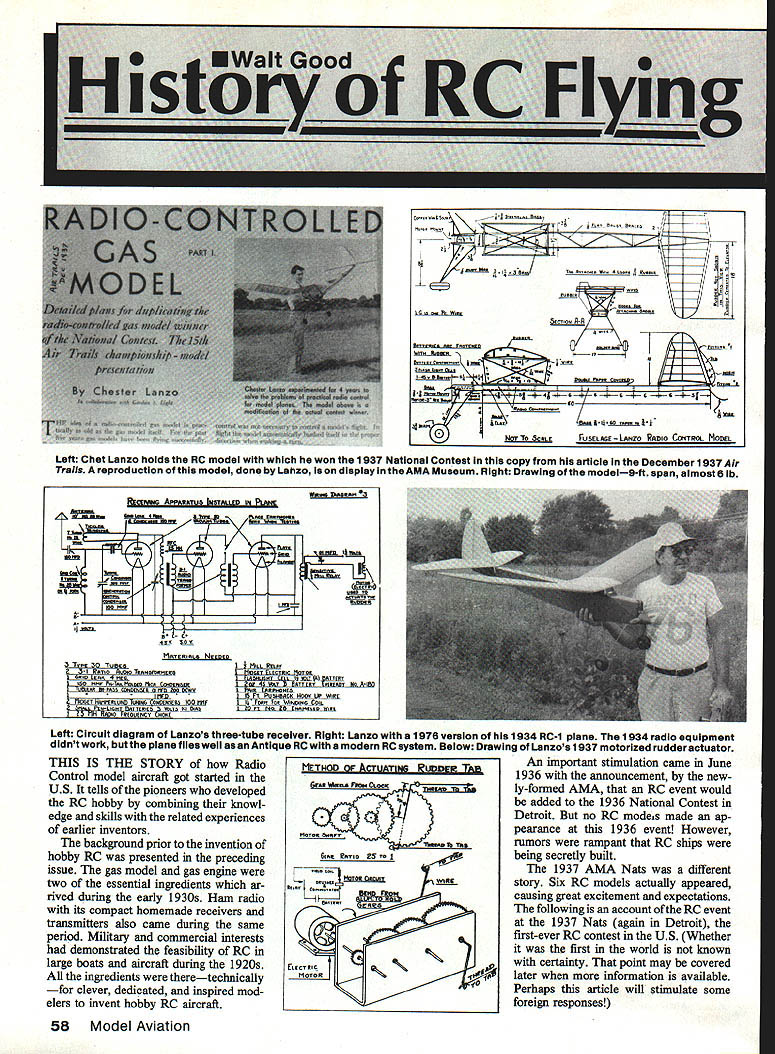
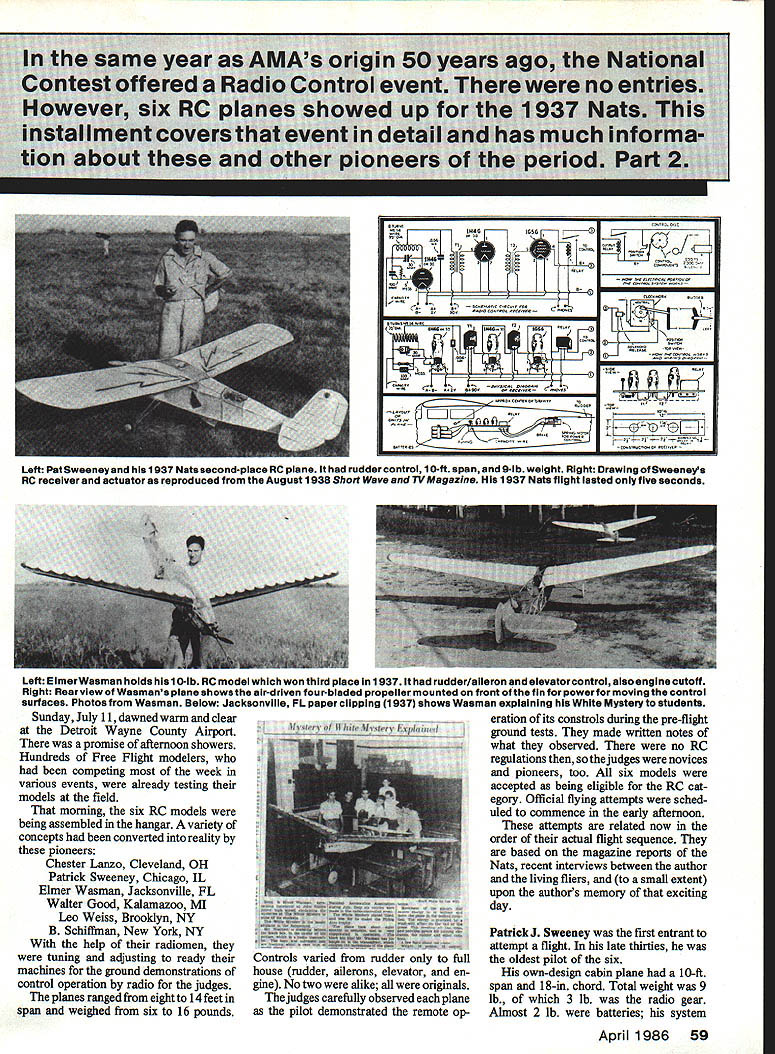
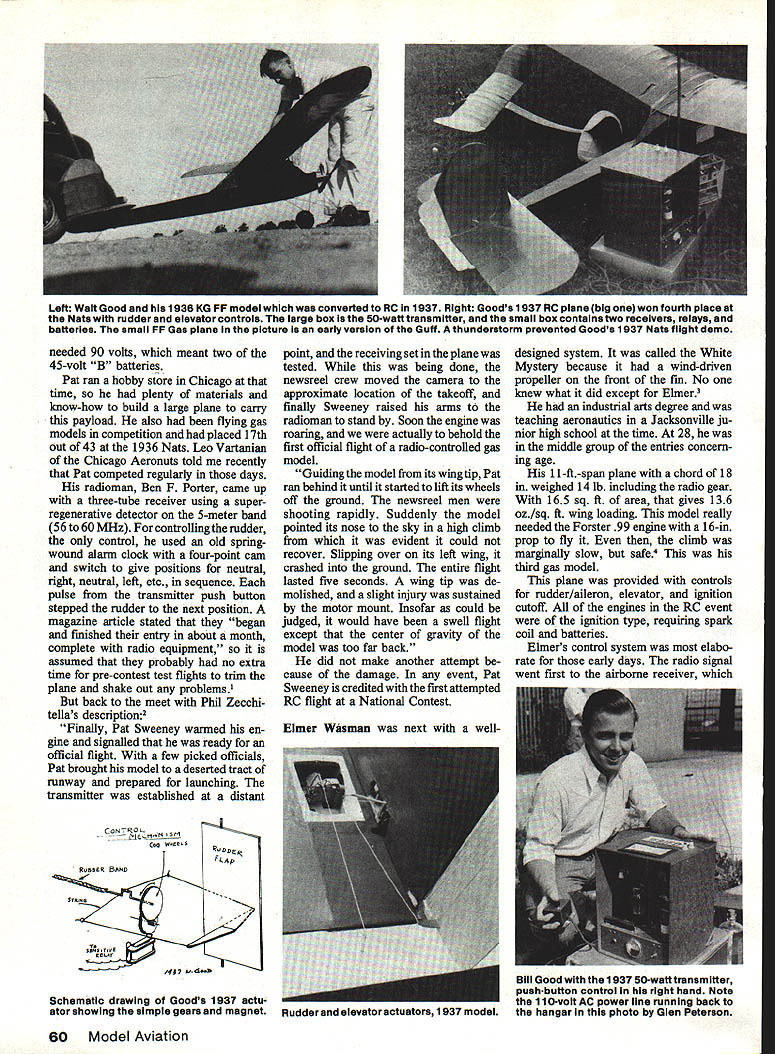
Chester Lanzo of Cleveland entered the lightest plane in the contest, just under 6 lb including 2 lb of radio gear. He had flown the model without radio several times to obtain proper balance, tail angle, and engine downthrust before adding radio equipment—an approach he recommended.
Chet's design was basic and functional: a 9-ft span wing with 14-in chord and generous dihedral, with the fuselage a shallow tray to which radio parts were fastened to maintain balance and accessibility. His receiver was home-built with three vacuum tubes operating a super-regenerative detector; it drove a relay that operated a small geared motor to cycle the rudder through positions neutral→right→neutral→left→etc. While the transmitter key was held down the rudder would oscillate; releasing the key at the moment of full deflection allowed the rudder to hold and the plane to turn. The system required piloting practice but was simple and effective.
Battery supply was a recurring problem for all entrants. Chet found a tiny 2-oz. 45-volt battery made for weather sondes in Cleveland; its life was short but weight-saving. His two-tube transmitter required 500 volts on the output tube and a 110 VAC source at the flying site; a helpful spectator provided a long extension cord so the transmitter could be powered.
During final preparations a stray free-flight model elicted a frightened spectator who stepped on Chet's wing and damaged a few ribs; Pat Sweeney helped with quick repairs. In flight his plane climbed in a slow circle, zigged and zagged, then the engine quit and the model landed in a parking lot at the edge of the airfield after about two minutes. Lanzo's ground demonstrations and flight performance earned him first place — the historical honor of being the first winner in the first RC National Contest in the U.S.
Chet was 23 at the time. He later donated a replica of his 1937 RC winner (complete with Baby Cyclone engine and working rudder control) to the AMA Museum in November 1984.
Walt Good (the author) and Bill Good — "Guff"
The author, Walt Good, entered an 8-ft span model built in 1935 as a close copy of the Kovel-Grant KG-8 and powered by a Brown Jr. engine. It had been tuned for stable free flight and placed 36th in FF Gas at the 1936 Nats.
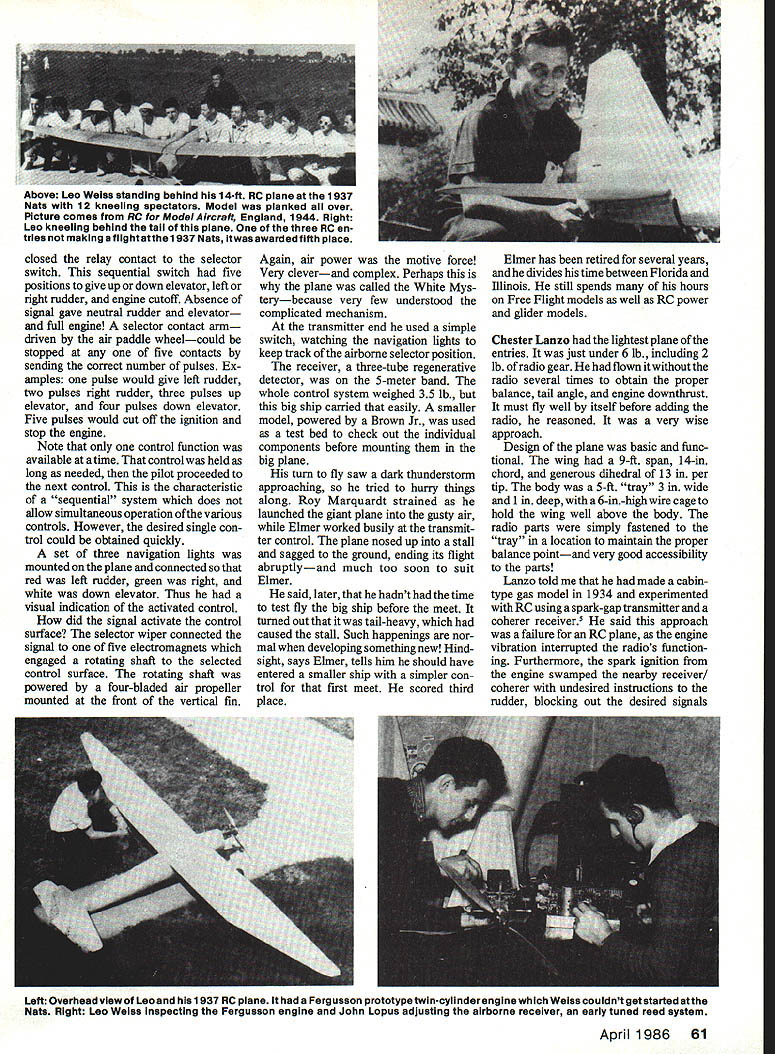
Walt's twin brother Bill (a radio ham) had been developing an RC system. They converted a one-tube super-regenerative circuit to operate a sensitive relay instead of headphones by adding a variable resistor in the grid circuit. By November a bench system was working and a bread-board receiver/relay system was mounted in the plane. The rudder actuator was a rubber-banded gear train driven by a small electromagnet operated by the relay. Later they added a second receiver and control for elevator using a second transmitter frequency (56 and 60 MHz) so the plane could have two controls.
By late June they had made a dozen test flights with the dual-control system, though the control response was slow (about three seconds neutral-to-full rudder) and the pilot had no direct feedback on rudder position except by watching the plane.
At the Nats the ground demonstration went well, but weather had deteriorated. Rain and lateness of the day prevented an official flight. The Guff was awarded fourth place. Walt later felt that sticking to rudder-only would have simplified matters for an early contest but recognized many learning steps were involved in early RC development.
Walt later retired to Port Richey, FL, remained active with RC history articles, RC sailplanes, AMA committees and clubs, and ham radio. Bill lived in Liverpool, NY as a ham operator and power boater.
Leo Weiss — the giant high-tech entry
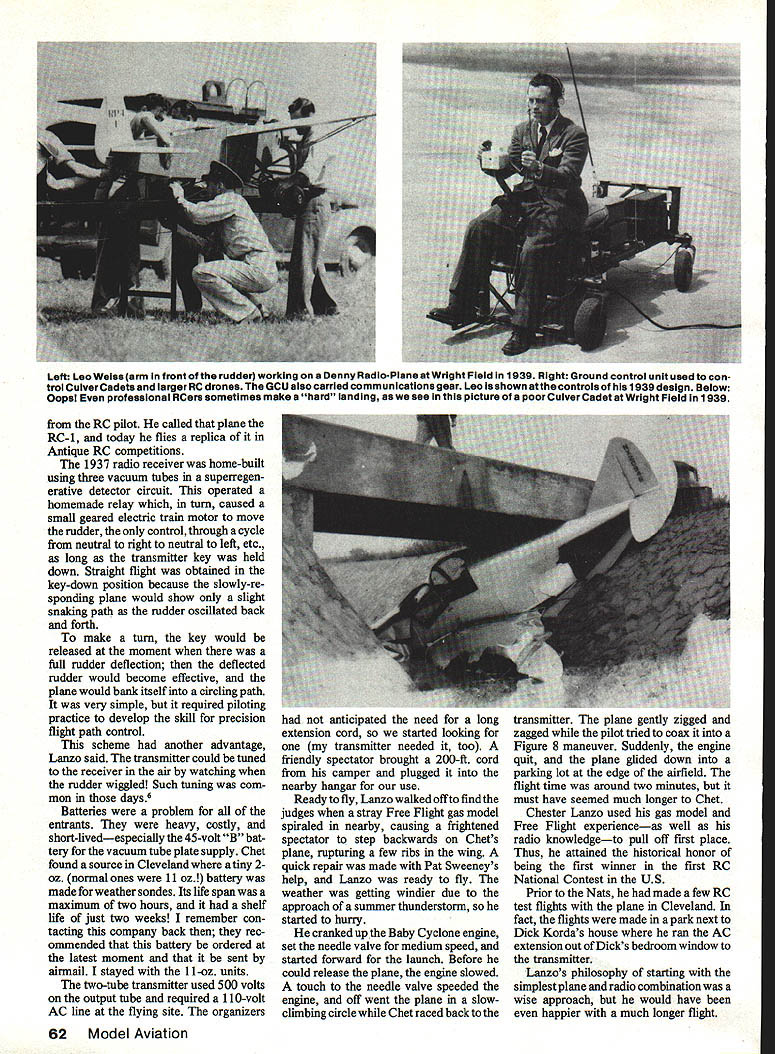
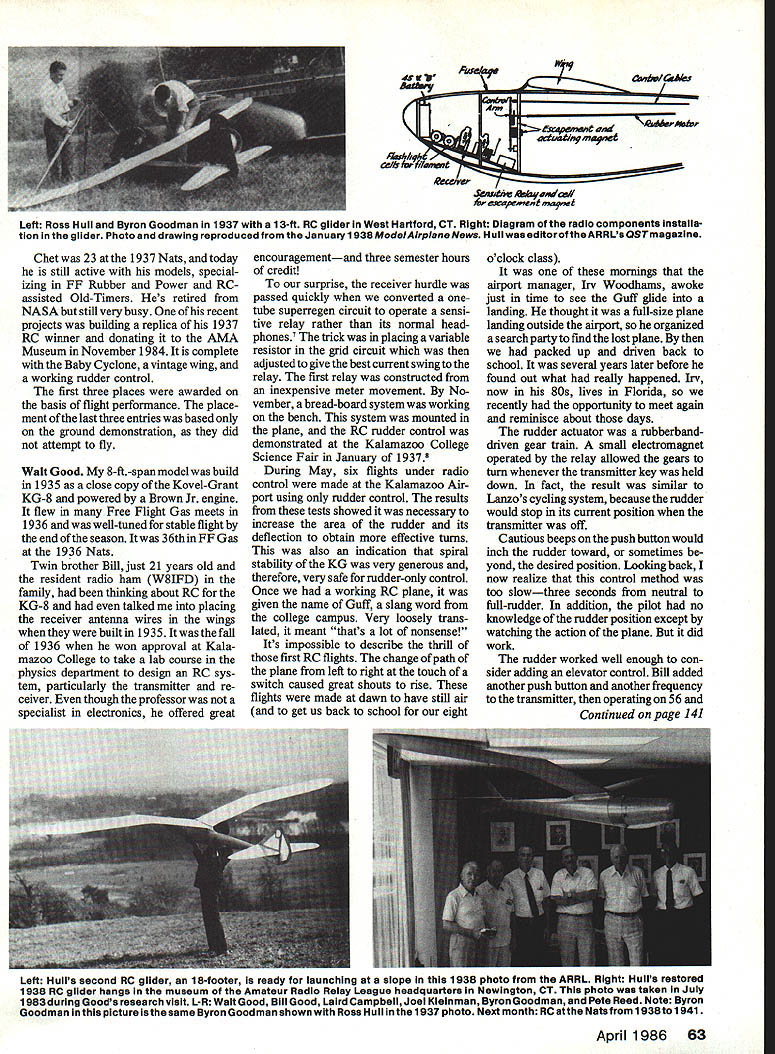
Leo Weiss, the youngest entrant at 18, brought the largest and most sophisticated RC plane: a 14-ft wing planked with sheet balsa and a streamlined monocoque body. The ship weighed about 16 lb including radio gear; 6 lb of that was radio equipment. Power was a prototype two-cylinder Fairbanks-Morse 2-cycle engine rated about 3/4 hp.
Leo's radio system was advanced for its time: three control channels for rudder, elevator, and engine were driven by three electric motors. Six tuned reeds selected the desired commands by responding to six different audio tones — a reed system that later became popular in the 1950s. John Lopus (W8LUS), an electrical engineering student, was Leo's radio specialist. The 56 MHz transmitter was battery-powered, and the control box had three lever-switches for rapid multi-channel operation.
Leo had been a seasoned free-flight competitor; his third free-flight model had won the Texaco event at the 1935 St. Louis Nationals. At the 1937 Nats his giant model could not be started — the special twin engine would not run — so he was unable to fly and was scored fifth. Leo went on to a career in aeronautical engineering and professional RC work, including contributions to target drones and later manufacturing aeronautical instruments.
B. Schiffman — the mystery entry
B. Schiffman (believed to be Bernie Schiffman) entered a model but did not fly it. Published accounts are scant. Chester Lanzo recalled seeing Schiffman's plane standing in the rain with the bamboo paper covering soaked and water dripping from the bottom. A "B" battery was reported sitting in the fuselage; weight-saving had apparently involved chipping tar from the cells. Little more is known; Schiffman was scored sixth. Further information about him or his 1937 RC plane would be welcome.
Ross Hull and the ARRL group — glider experiments
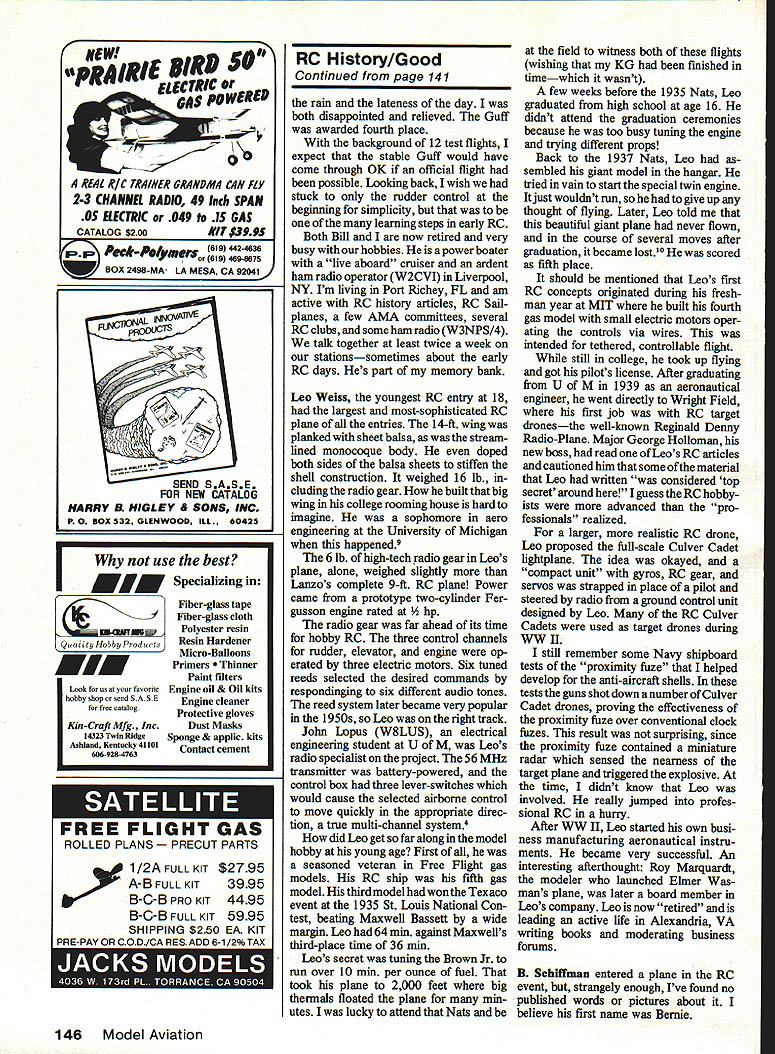
Beyond the 1937 Nats entries there were other pioneers experimenting with RC. One well-documented group was led by Ross Hull in Connecticut. Hull, associate editor of QST magazine and an experienced radio designer, assembled a team including Clinton B. DeSoto (assistant secretary of the ARRL), Roland Bourne, Byron Goodman, and Hamer Selvidge. They planned an RC project for a 10-ft span gas model in spring 1937 but first became interested in glider experimentation.
At the Soaring Society of America national meet in Elmira in early July 1937, Carl W. Thompson, Jr. demonstrated a 13-ft glider with RC gear built by H. M. Plummer (W3DIA). That simple system gave off signal = right rudder and on signal = left rudder; the ship made several successful hops before an untimely crack-up ended the experiment. Hull acquired the remains and took them back to Hartford. There his group concentrated on RC glider work.
Their system used a three-tube super-regenerative receiver, a sensitive relay, and a four-pole escapement powered by four feet of twisted rubber strands that furnished power to turn the rudder. The escapement advanced one-quarter turn with each carrier pulse, giving a sequence N–L–N–R. The rudder cycled rapidly; pilots learned to remember the sequence or used a "rudder stick" that automatically sent the correct number of pulses.
By October the ARRL glider had amassed over 100 flights and 15 crashes; equipment was rebuilt repeatedly. Microphonics in the tubes and escapement synchronization problems sometimes caused unintended pulses and crashes. In 1938 the group built a larger 18-ft span glider with a formed-plywood monocoque body, demonstrated on the Elmira slopes. Attempts to enter the glider in regular soaring competition were rejected because the rules required a man in the cockpit.
The glider survived several years. In 1980 it was rescued from ARRL storage and, after restoration, now hangs in the ARRL museum in Newington, CT. Ross Hull died in August 1938 from an accidental electrocution during a television receiver experiment; his contributions to RC were significant. DeSoto carried on the RC efforts.
Summary
The first RC Nationals in 1937 provided a definite step forward in the development of controllable RC planes. All six entries demonstrated proper control movements on the ground. In the air, one of the six (Lanzo) showed the potential of sustained controlled flight; two others crashed at launch due to tail‑heavy trim that might have been prevented by pre‑contest test flights and proper adjustments; at least one other had completed numerous pre‑contest test flights but was stopped by bad weather.
Lessons learned:
- Keep the system simple.
- Get plenty of practice flights and shake out problems before contest day.
- Use a stable model with appropriate center-of-gravity and control authority.
- Reliable components and pilot skill are essential.
In the next installment we will review more RC pioneers and the National Contest entries from 1938 through 1941, and watch the RC invention stumble less and grow more.
References:
- B. Porter and P. Sweeney. Short Wave & TV Magazine, August 1938.
- P. Zecchella. Flying Aces, October 1937.
- Wasman, Elmer. Interview, February 8, 1985.
- Weiss, Leo. Model Airplane News, October 1937.
- Lanzo, Chester. Interview, March 23, 1985.
- Lanzo, Chester. Air Trails, December 1937 and January 1938.
- Hull, Ross. QST, September 1933.
- Kalamazoo Gazette, January 13, 1937.
- Weiss, Leo. Interview, December 1, 1984.
- Weiss, Leo. Correspondence, December 2, 1984.
- Hull, Ross, and Bourne, Roland. QST, October 1937.
- DeSoto, Clinton B. Model Airplane News, January 1938.
- McEntee, Howard G. Air Trails Model Annual, 1952.
Transcribed from original scans by AI. Minor OCR errors may remain.

