
History of RC Flying
Walt Good
Newcomers arrived to bolster the ranks of early radio-controlled (RC) model flying, and although no one person entered all five prewar Nats RC events, a core of repeaters at each meet developed a camaraderie that lasted for decades. Over the five years from the first RC event through the final prewar meet in 1941, equipment and techniques advanced rapidly—from multi-receiver rigs and escapements to early proportional control experiments. The following reviews the top fliers, their equipment, and key developments at the 1938–1941 AMA Nationals.
1938 Nationals
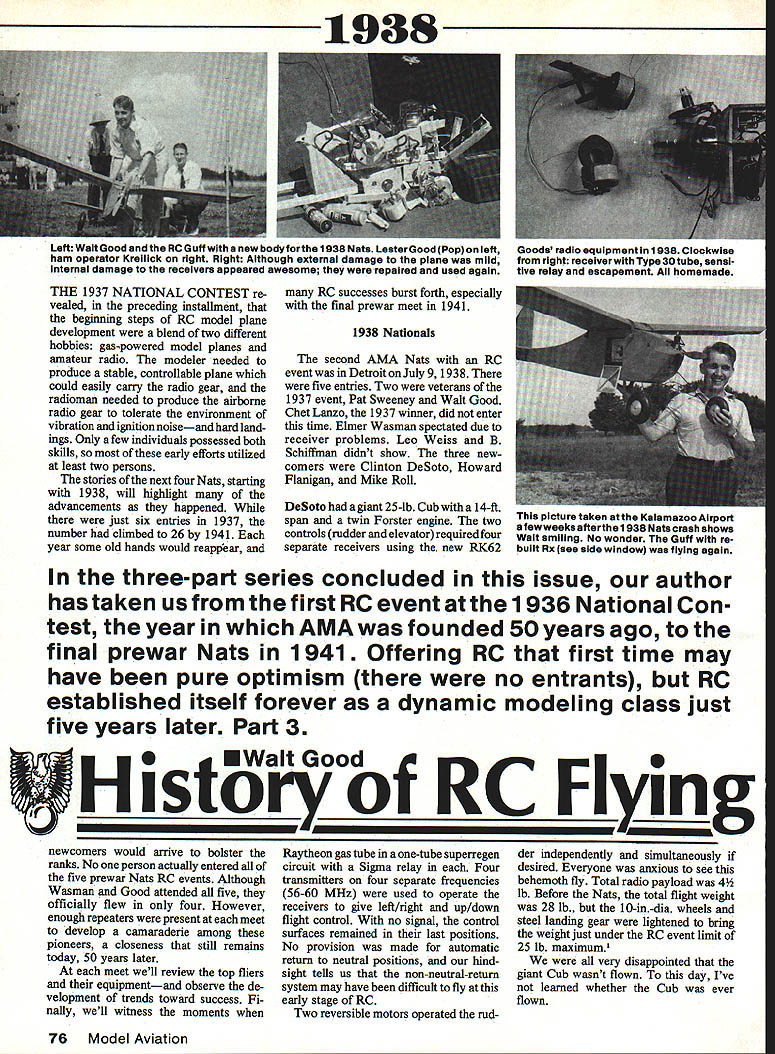
The second AMA Nationals RC event was held in Detroit on July 9, 1938. There were five entries; two veterans from 1937 (Pat Sweeney and Walt Good) entered, while Chet Lanzo (the 1937 winner) did not. Elmer Wasman spectated because of receiver problems; Leo Weiss and B. Schiffman did not show. Three newcomers were Clinton DeSoto, Howard Flanigan, and Mike Roll.
Clinton DeSoto
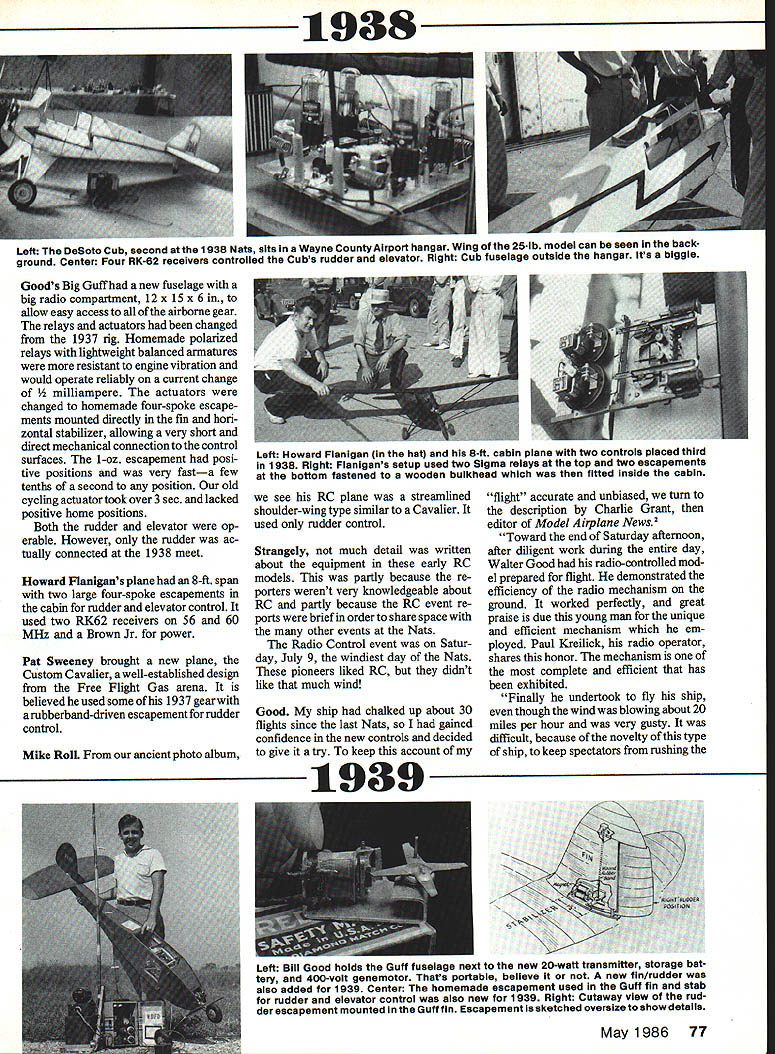
- Brought a giant Cub: 25 lb, 14 ft span, twin Forster engines.
- Two controls (rudder and elevator) required four separate receivers using RK62 Raytheon gas tubes in one-tube superregen circuits with Sigma relays.
- Four transmitters on separate frequencies (56–60 MHz) were used to operate the four receivers.
- Total radio payload was about 4.5 lb. The model was trimmed down from 28 lb to just under the RC event limit of 25 lb by lightening wheels and landing gear.
- The Cub was not flown at the meet; it remains unclear whether it ever flew.
Walt Good (Big Guff)
- New fuselage with large radio compartment (12 x 15 x 6 in.) for easy access to airborne gear.
- Relays and actuators upgraded from the 1937 rig: homemade polarized relays with lightweight balanced armatures tolerant of engine vibration; actuators changed to homemade four-spoke escapements mounted directly in the fin and horizontal stabilizer for short, direct mechanical linkages.
- Escapements: ~1 oz, positive and fast (a few tenths of a second); replaced older cycling actuators that took over 3 seconds and lacked positive home positions.
- Both rudder and elevator were operable, but only the rudder was connected at the 1938 meet.
Howard Flanigan
- 8 ft span model, two large four-spoke escapements for rudder and elevator, used two RK62 receivers on 56 and 60 MHz.
Pat Sweeney
- Flew a Custom Cavalier design; likely used some 1937 gear with rubber-band-driven escapement for rudder control.
Mike Roll
- Streamlined shoulder-wing type similar to a Cavalier; used rudder-only control.
The event day was very windy (about 20 mph gusty). Walt Good attempted a flight; Charlie Grant (Model Airplane News editor) described the attempt:
"Toward the end of Saturday afternoon, Walter Good had his radio-controlled model prepared for flight. The mechanism worked perfectly on the ground. Finally he undertook to fly his ship, even though the wind was blowing about 20 miles per hour and was very gusty. On the first attempt the machine struck the ground and suffered internal damage to the receivers. The apparatus, however, was repaired and used again.
"The motor started, and it took off. Unfortunately, the grass was quite long, and some of it caught on the elevator flap and deflected the takeoff so that the model immediately went into a stall, from which it recovered. However, a second stall after a zoom turned it over on its back, and it made a complete loop.
"In the meantime, Walter was endeavoring to run back to the operating mechanism to remedy the conditions of flight. At the bottom of the loop the model hit the ground just before Walter could control the ship. The radio apparatus inside looked as if someone had stirred it around in a concrete mixer. The tail and part of the mechanism were damaged, and the nose was pushed in. In spite of this damage and the hours of work which had gone into the model, Walter still had his smile."
Good later noted that the launch method (wing-tip-assisted at shoulder height) tended to drop a wing and that being at the controls immediately after launch would have prevented the stall. The judges awarded final ground-demonstration-based standings as follows:
- Walt Good, Kalamazoo, MI
- Clinton DeSoto, Granby, CT
- Howard Flanigan, Detroit, MI
- Pat Sweeney, Chicago, IL
- Michael Roll, Dearborn, MI
Although Good was given first place, the meet offered little convincing demonstration of full RC maneuvers. Still, equipment innovations (Raytheon gas tubes, one-tube superregen circuits, Sigma relays, homemade polarized relays, escapements) pointed the way forward.
Technical notes from 1938
- Early systems often left control surfaces in the last commanded position with no automatic return-to-neutral feature—making control more difficult.
- Two reversible motors were sometimes used to operate the rudder independently.
- Receivers and relays added significant payload and complexity; airborne electronics were experimental and tuning-sensitive.
1939 Nationals
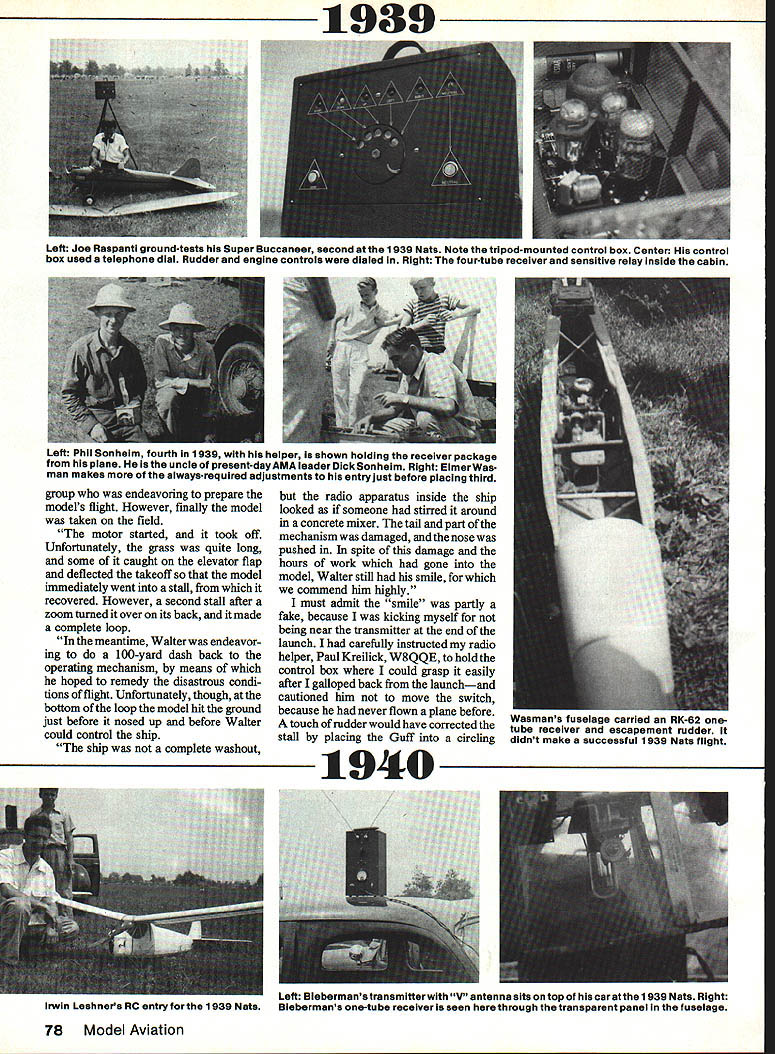
The 1939 Nats at Wayne County Airport, Detroit, showed growth: 16 entries were listed and 11 actually showed up. Four repeaters returned from prior years (Flanigan, Good, Lanzo, Wasman); newcomers included Bieberman, Leshner, Mende, Raspante, Rose, Seigfried, and Sonheim.
New features
- Judges used a point system for the first time: workmanship and control operation on the ground, then maneuver scores in flight (cross-country and return, circles left and right, Figure-8, etc.). A perfect score was 100.
- Judges called out maneuvers in advance to prevent post-hoc claims.
- Equipment trend: most models had rudder control only; several used the single RK62 gas-tube receiver and Sigma relay with escapement actuators.
Walt and Bill Good (the Guff)
- Weather was nearly perfect (light breeze). Bill Good piloted; Walt launched by wing tip.
- The Guff had rebuilt receivers (Type 30 tube), batteries mounted separately on the fuselage floor (lesson learned from 1938 crash), and lighter escapements. Over 60 flights had given the team confidence.
- Flight highlights: left circle, right circle, cross-country and return (reached half-mile point), Figure-8, and an optional spiral dive/stall—all executed successfully with rudder-only control; engine stopped at 6 minutes as expected, then glide control was used. Final approach and spot landing were excellent—landing within 100 ft of the judges.
- Score: 89/100. Zaic’s 1939 Nats Book praised the flight.
Joe Raspante
- Flown an 11-ft Super Buccaneer with a four-tube receiver and rudder control; used a telephone-dial control box with five commands (up/down, right/left, stop engine). Flight lasted almost 4 minutes and scored 11 points; some accounts cite radio interference causing an early engine cutoff.
Elmer Wasman
- Short flight at the meet; reported a better RC demonstration later at a new airport dedication in southern Georgia.
Pilots and placements (1939)
- Walt and Bill Good, Kalamazoo, MI — 89 points
- Joe Raspante, Brooklyn, NY — 11 points
- Elmer Wasman, Jacksonville, FL — 9 points
- Philip Sonneheim, Nilesville, WI — 8 points
- Charles Seigfried, Wickliffe, KS — 8 points
- Robert Mende, Flint, MI — 8 points
- Erwin Leshner, Philadelphia, PA — 6 points
- Jesse Bieberman, Philadelphia, PA — 6 points
- Howard Flanigan, Detroit, MI — 1 point
- Chester Lanzo, Cleveland, OH — 1 point
- Robert Rose, Highland Park, MI — 0 points
1940 Nationals
Held in Chicago, the 1940 Nats saw more entries and actual flights. Of 16 entries, 11 planes appeared and at least seven made scored flights. Six entries were repeaters, five were newcomers.
Charlie Seigfried (Siggy)
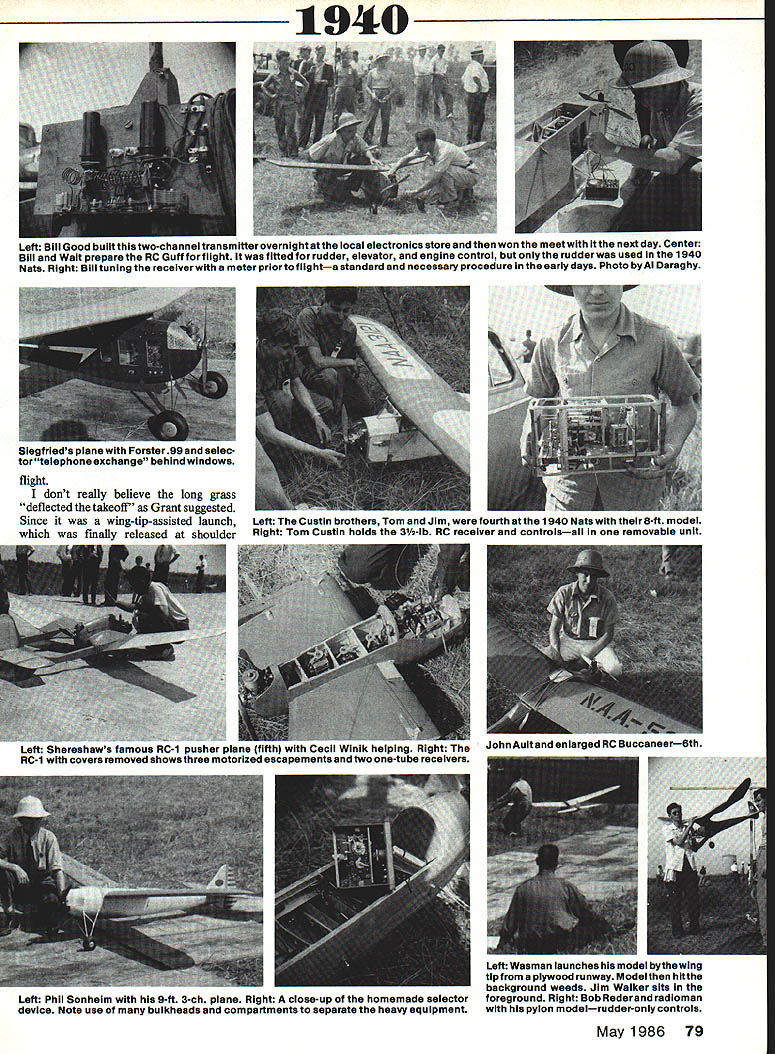
- Largest plane at the meet: 15 ft span, 13½ lb, Forster .99 engine.
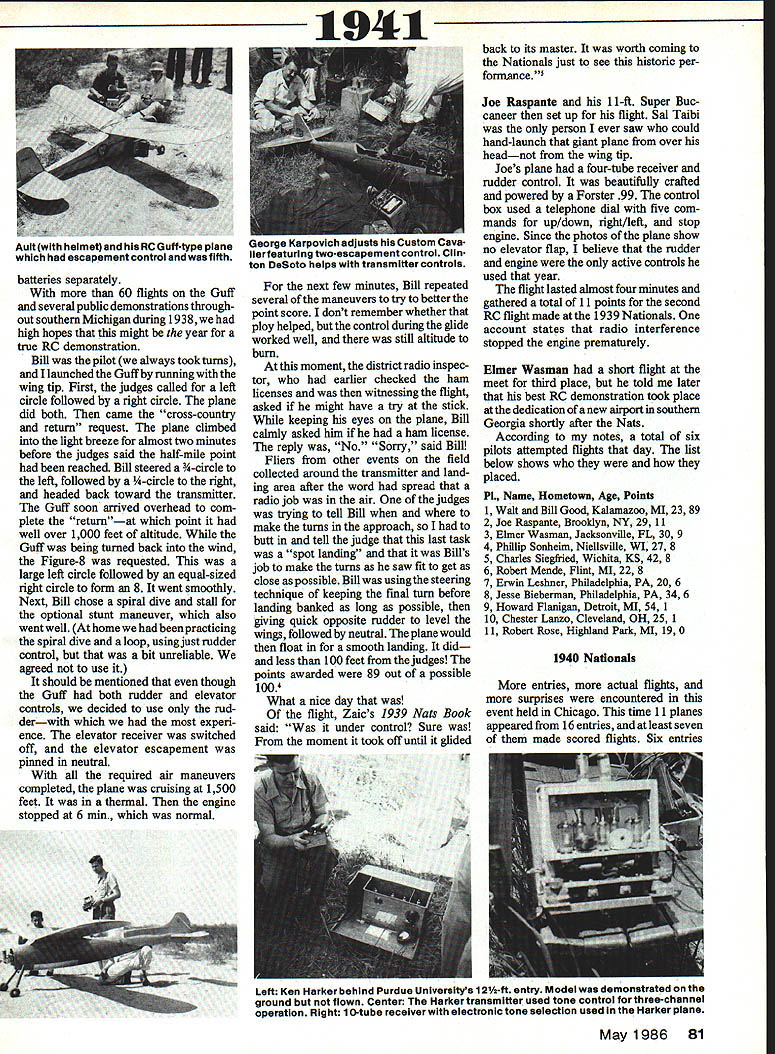
- Control system nicknamed "the telephone exchange": dial-telephone-like selector used pulses to energize motors for rudder, elevator, and engine. When signal was turned off, rudder and elevator returned to neutral; engine throttle remained at last set position.
- Airborne electronics, motors, gears, selector, and batteries weighed about 3½ lb. The control box was like a small suitcase with a neck strap; transmitter was a 50-watt rig carried in the trunk of his car.
- Siggy’s flights included required maneuvers but he tended to drift downwind and was not a spot-landing specialist. He finished second in the event.
Joe Raspante
- Placed third with his Super Buccaneer.
Jim and Tom Custin
- 8 ft cabin plane, about 10 lb, powered by a twin-cylinder engine by Ed Schunke (Forster .99 proved underpowered).
- Tom built a radio system controlling rudder and engine using a sequenced-selector-pulse system—almost proportional; receiver used RK62 and a homemade polarized relay; servos were Pitman permanent-magnet motors with lead-screw speed reduction. Their system used a "whatfield" control box with many relays to generate pulses. Official flight ended when their plane struck the ground; they placed fourth.
Ben Sheesley
- Flew an unusual twin-boom pusher called the RC-1 with three-function controls (rudder, elevator, motor).
Phil Sonheim
- 9 ft mid-wing REM ship with a compact homemade selector and electric motor system; placed fifth.
Walt and Bill Good
- Arrived to find theft and damage to the Guff after hotel stay; Bill quickly built an "overnight" transmitter from parts and they repaired the wing. They chose to fly rudder-only and had many practice flights during the meet, finally perfecting an inside-loop-like maneuver using rudder control alone (a tightening left spiral with opposite rudder to recover to level flight—a pear-shaped loop). Engine quit at the top of the stall on one attempt, but they landed within 20 ft of the spot.
- This meet featured stricter judging and slightly lower point totals overall.
Placings (1940)
- Walt and Bill Good — Controls: R — Points: 65
- Charles Seigfried — Controls: REM — Points: 49
- Joe Raspante — Controls: REM — Points: 34
- Jim and Tom Custin — Controls: REM — Points: 23
- Ben Sheesley — Controls: REM — Points: 20
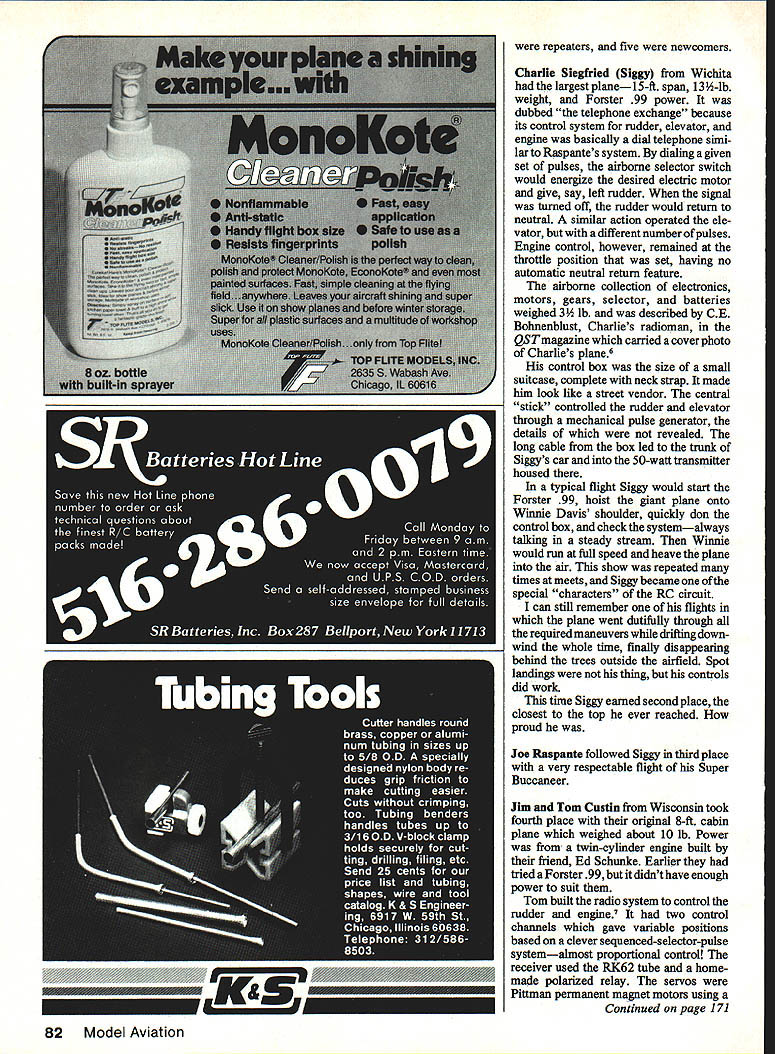
- John Ault — Controls: R — Points: 17
- Phil Sonheim — Controls: REM — Points: 13
- Elmer Wasman — Controls: R — Points: 12
- Lester Helle — Controls: R — Points: 11
- Jesse Bieberman — Controls: R — Points: 10
- Bob Reder — Controls: R — Points: 6
Legend: R = rudder only; REM = rudder, elevator, motor
1941 Nationals
The 1941 Nats in Chicago (July 1–6) were the fifth RC event and the last before WWII. This was the largest and best-attended prewar RC meet: 26 RC entries, 12 scoring pilots, three repeaters (Seigfried, Ault, Reder), and many newcomers. For the first time, extra days were set aside for tuning and preparations—a response to earlier experiences where one day proved insufficient.
Walt and Bill Good attended as spectators (Bill on his honeymoon; Walt finishing PhD work) and did not enter a plane.
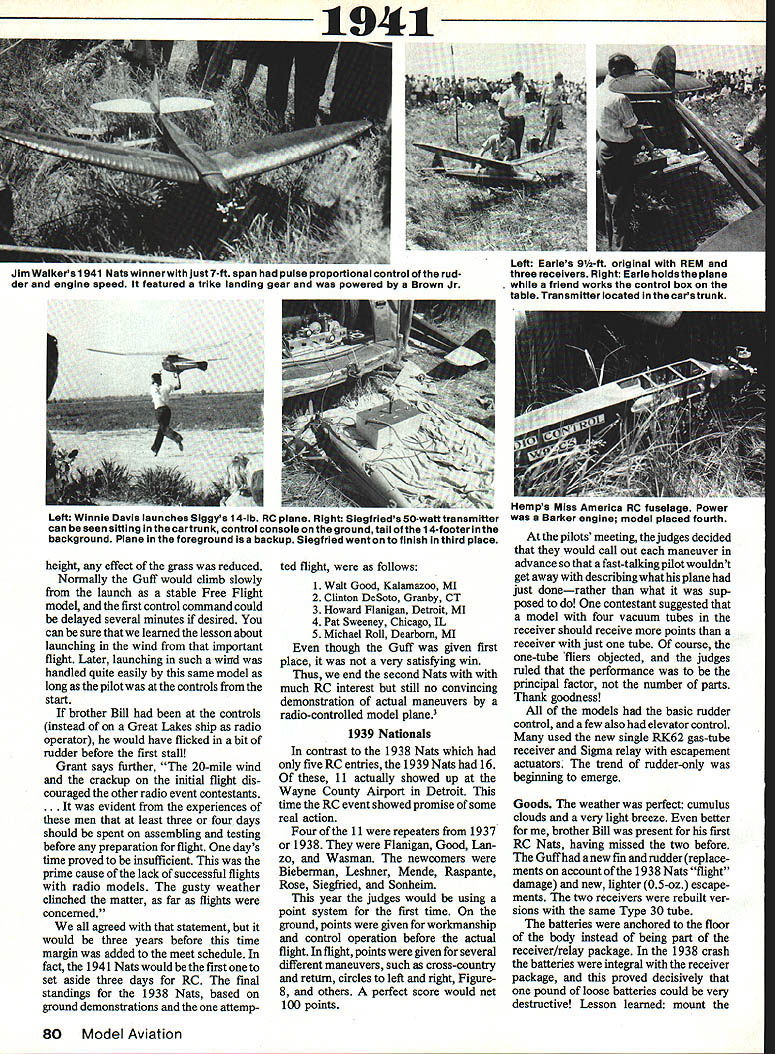
Jim Walker (Portland, OR)
- Newcomer Jim Walker, known for Fireball control-line work, won first place.
- Walker had been observing RC closely in 1940 and reportedly worked on a system called "proportional control."
- His entry was a small 7 ft ship with proportional rudder and proportional engine speed. He used two standard RC receivers and relays in a clever arrangement: engine control used a single-pole two-throw switch with two sets of breaker points for high and low speed. By leading the primary spark coil wire through relay contacts, signal "off" gave low speed, signal "on" gave high speed.
- His proportional pulsing system was ahead of its time and demonstrated effective control capability.
The 1941 meet marked a maturing of RC as a contest class: more flights, better preparation time, and the appearance of early proportional-control concepts that would influence future development.
Receivers, Relays, and Control Systems (Prewar Technical Overview)
Receivers
- Airborne radio gear was experimental and finicky. Tuning and adjustments consumed much contest time.
- Single-tube receivers (Type 30 vacuum tube and RK62 gas tube) could be coaxed to work; superregenerative operation resisted ignition noise.
- Multi-tube sets were more fragile in the air due to vibration.
Relays
- Commercial relays were heavy, expensive, and vibration-sensitive. Homemade relays tailored to the receiver were often superior.
- The homemade DG-6 polarized relay (described by Bill Good in QST, 1940) was widely requested; later Sigma and other commercial relays became available.
Control systems — main categories used in the period
- Escapements
- Sizes from 1/2 oz to 4 oz, rapid and positive in many models.
- Used for single or multiple channels (rudder, elevator, motor).
- Escapements remained in use for many years.
- Sequential selector systems (dial-telephone type)
- Used by Seigfried, Wasman, Sonheim, and others.
- A group of pulses would select a control; an electric motor moved the surface.
- Gave multiple controls on a single channel but was slow and single-operation at a time.
- Non-sequential selectors
- Examples: Weiss' tuned reed (1937) and Harker's electronic tone selector.
- Faster selection (fraction of a second) and conceptually closer to later multi-channel electronics, but complex and ambitious for the time.
- Proportional pulsing
- Jim Walker’s proportional pulsing system demonstrated effective proportional rudder and engine control.
- Ahead of its time, it foreshadowed later proportional RC systems.
Summary
From 1936 through 1941 the RC class matured from a handful of experimental entries into a recognized and competitive modeling discipline. Innovations included more reliable relays and escapements, improved receiver designs, selector systems, and the first demonstrations of proportional control. The camaraderie among repeat competitors and the accumulation of practical lessons—about launch technique, component mounting, testing time, and interference management—helped make RC a lasting part of model aviation.
References
- DeSoto, Clinton B., QST, October 1938; Trails, May 1939.
- Grant, C.H., Model Airplane News, September 1938.
- Good, Walter, Air Trails, January 1939; Air Trails, November–December 1940, January 1941.
- Good, William, QST, March 1940.
- Zard, Frank, and Walter Fraynk, The National Model Airplane Meet in Pictures, 1939.
- Bohnenblust, C.E., QST, August 1940.
- Custin, James R., Model Airplane News, August & September 1947; Interview, Sept. 18, 1985.
- DeSoto, Clinton B., QST, September 1941.
- Davis, Al., Model Airplane News, September 1941.
- Kulick, Harold, Model Airplane News, October 1941.
Transcribed from original scans by AI. Minor OCR errors may remain.

