
Home Grown Plug Analyzer
By Ray Teliczan
Got an old transmitter RF meter lying around just getting in the way? Use the meter for this simple device and learn a lot about the condition of your glow plug as an aid in engine starting.
Materials Needed
- 4 ft. of No. 14 extension cord
- One pair of alligator clips with boots
- Two solder lugs
- One Ace SPST switch
- One old transmitter RF panel meter
- A battery to light the glow plug
- Electrical tape, cyanoacrylate (CyA) glue
Preparation
- Extension cord:
- On one end, shorten one conductor to about 1½ to 2 in. Install the boots and solder on the alligator clips.
- On the other end, shorten one conductor by 8 in.; save this 8-in. scrap.
- Panel meter:
- Remove all of the fine copper windings from the rear of the meter.
Assembly
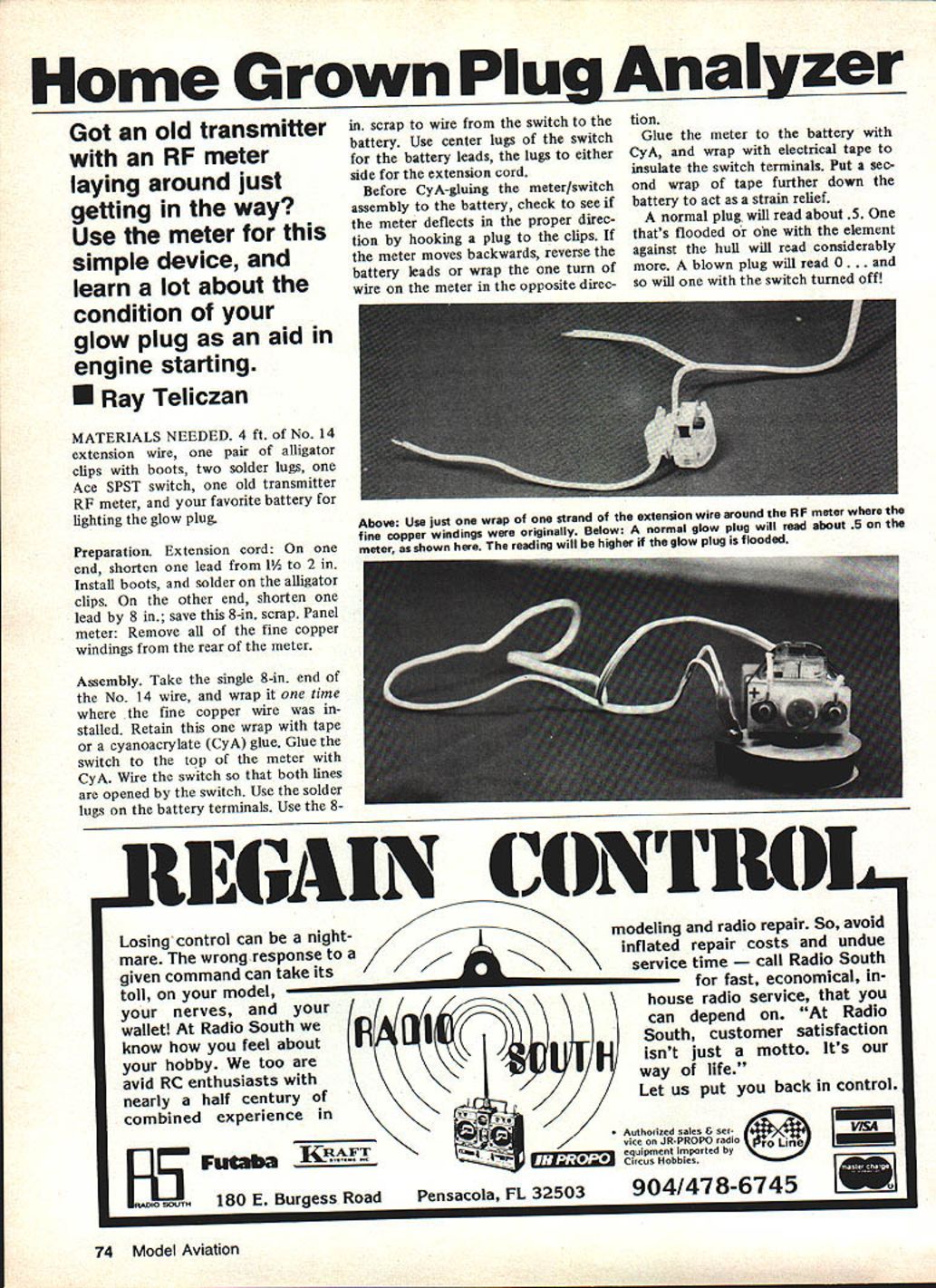
- Take the single 8-in. conductor (the shortened end) and wrap it one turn around the meter where the fine copper winding was removed. Secure this one turn with tape or CyA glue.
- Glue the switch to the top of the meter with CyA.
- Wire the switch so that it opens both conductors (both lines are broken by the switch).
- Use solder lugs on the battery terminals for solid connections.
- Use the 8-in. scrap to connect the switch to the battery.
- Connect the battery leads and extension cord leads to the switch lugs so the switch interrupts the circuit between the battery and the clips.
- Before permanently gluing the meter/switch assembly to the battery, check meter deflection by attaching a glow plug to the alligator clips:
- If the meter deflects in the wrong direction, reverse the battery leads or wrap the single turn of wire on the meter in the opposite direction.
- Glue the meter to the battery with CyA, then wrap the assembly with electrical tape to insulate the switch terminals.
- Add a second wrap of tape further down the battery to act as a strain relief.
Operation / Testing
- A normal glow plug will produce a meter reading of about 0.5 (meter units).
- A flooded plug or one whose element is against the plug shell will read considerably higher.
- A blown plug will read 0 (no deflection) — as will the meter when the switch is turned off.
Transcribed from original scans by AI. Minor OCR errors may remain.

