
How to Clean Pots
Photo Essay by L. F. Randolph
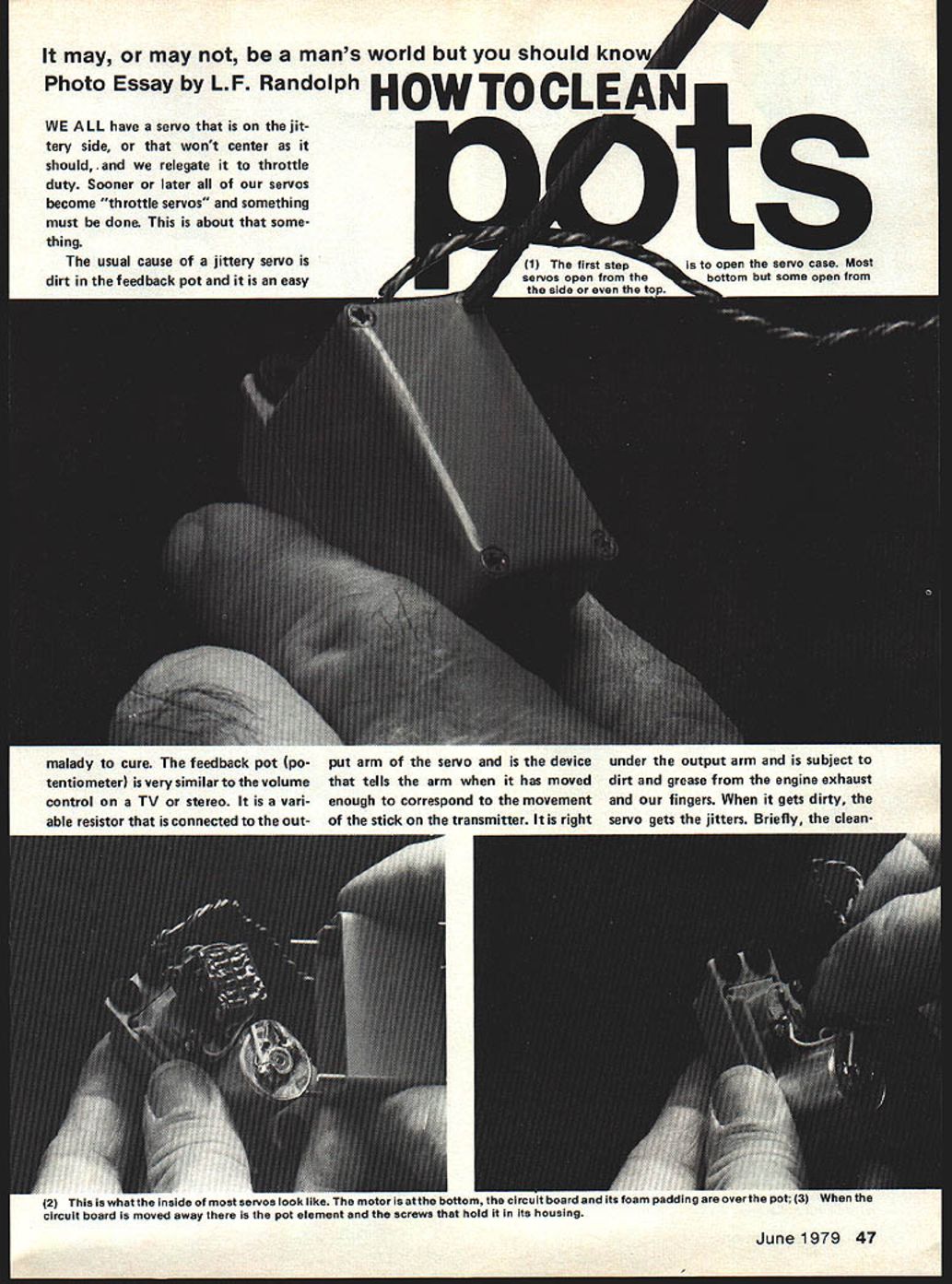
We all have a servo that is jittery or won't center as it should, and we relegate it to throttle duty. Sooner or later many servos become "throttle servos" and something must be done. The usual cause of a jittery servo is dirt in the feedback pot (potentiometer), and this is an easy malady to cure.
The feedback pot is similar to the volume control on a TV or stereo: a variable resistor connected to the servo output arm that tells the arm when it has moved enough to match the transmitter. The pot sits right under the output arm and is exposed to dirt and grease from engine exhaust and from our fingers. When it gets dirty, the servo gets the jitters. Briefly, the cleaning procedure is: open the servo case, clean the pot, and reassemble the servo. The job is not difficult and saves a lot of downtime and money.
The photos show a Kraft KPS-15 servo. Most servos are similar inside, though there are variations in circuit-board mounting and pot construction. Some pots have plastic elements; check your manual — they may not need lubricant after cleaning. Pot lubricant is available at Ace, Radio Shack, or your hobby shop.
Tools and materials
- Small screwdriver set (appropriate for servo screws)
- Felt-tip pen (for marking alignment)
- Q‑Tip or swab
- Isopropyl alcohol
- Pot lubricant (very thin; check manual if plastic element)
- Clean workspace and good lighting
Procedure
- Open the servo case.
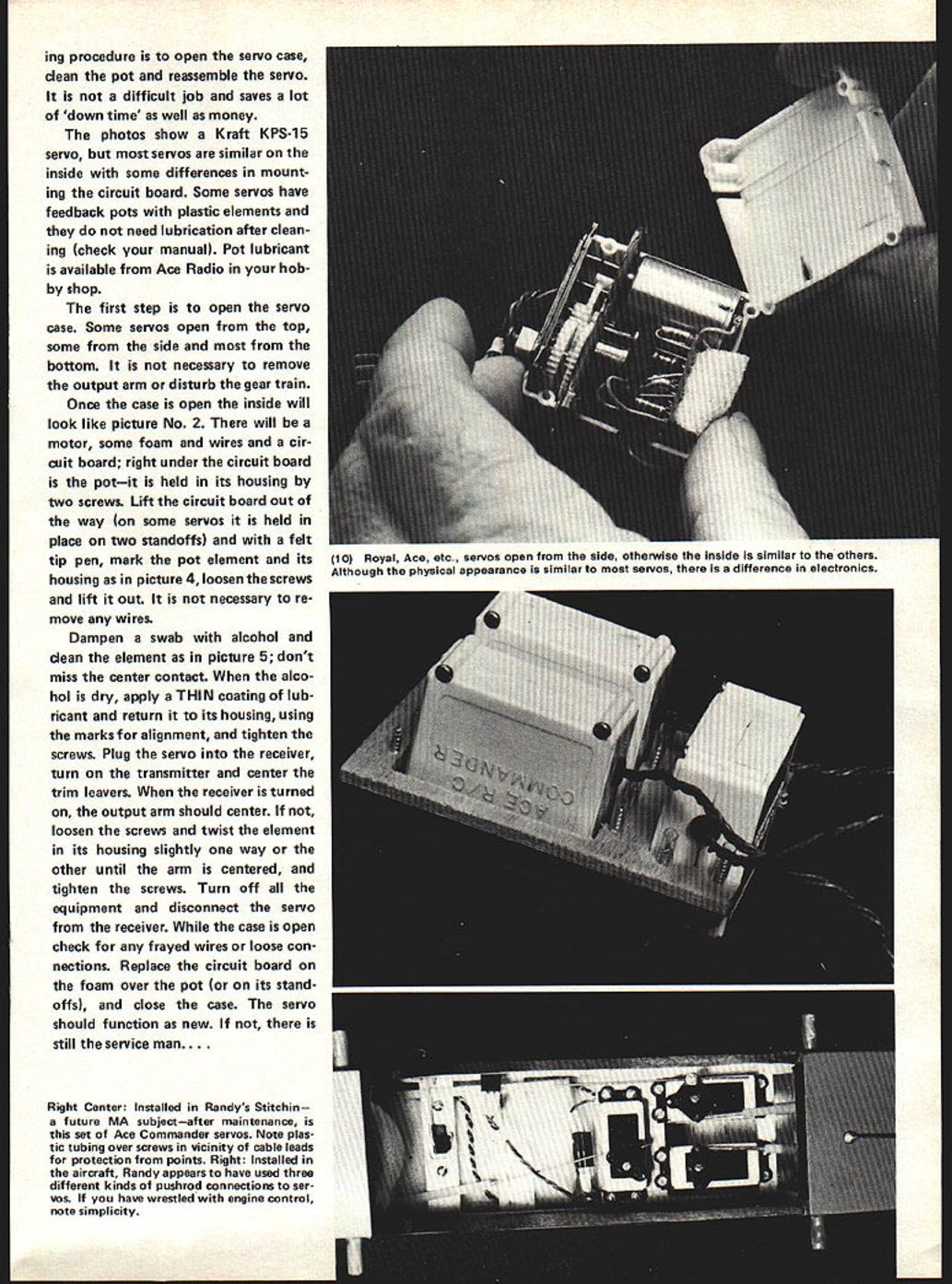
- Servos open from the top, side, or bottom. In some models you may need to remove the output arm to avoid disturbing the gear train.
- Inspect the interior.
- You should see the motor, circuit board (often with foam padding), wires, and the pot beneath the board. The pot is usually held in its housing by two screws.
- Mark alignment.
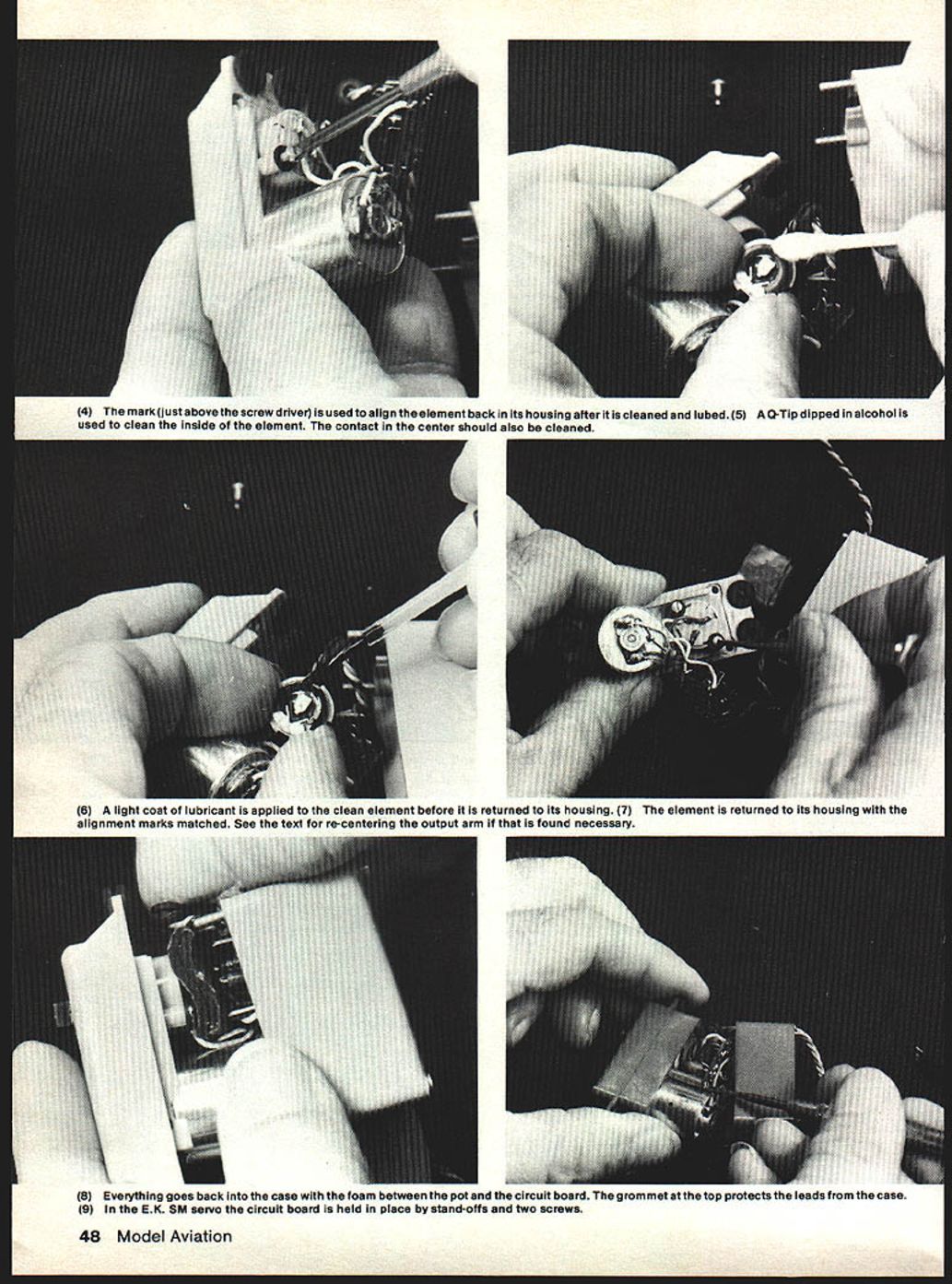
- Use a felt-tip pen to mark the pot element relative to its housing so you can return it to the same position after cleaning.
- Remove the pot.
- Loosen the retaining screws and lift the pot out of its housing. On some servos you may need to remove or move the circuit board first (many boards are held on standoffs).
- Clean the element.
- Dampen a Q‑Tip or swab with alcohol and clean the pot element thoroughly, including the center contact. Allow the alcohol to dry completely.
- Lubricate lightly (if required).
- If the pot element requires lubrication (check your manual), apply a VERY THIN coat of pot lubricant to the element before returning it to its housing. If the element is plastic and the manual says no lubricant, do not apply any.
- Reinstall and align.
- Return the element to its housing using your alignment marks and tighten the screws.
- Center the servo.
- Plug the servo into the receiver, turn the transmitter on, and center the trim levers. With the receiver on, the output arm should center.
- If the arm is not centered, loosen the pot screws slightly and rotate the element a small amount one way or the other until the arm centers; then retighten the screws.
- Final checks and reassembly.
- Turn off equipment and disconnect the servo. With the case open, check for frayed wires or loose connections. Replace the circuit board and any foam padding, secure standoffs, close the case, and reinstall the output arm if removed.
- Test.
- Reconnect and test the servo. If it still misbehaves, the problem may require professional service.
Notes and examples
- The Kraft KPS-15 servos are used in the photos, but the internal layout is similar across many brands.
- Some servos (e.g., E.K. SM) hold the circuit board in place with stand‑offs and two screws; others vary.
- Pot lubricant is sold at common hardware and hobby stores.
Photo captions
- The mark (just above the screwdriver) is used to align the element back in its housing after it is cleaned and lubed.
- A Q‑Tip dipped in alcohol is used to clean the inside of the element. The contact in the center should also be cleaned.
- A light coat of lubricant is applied to the clean element before it is returned to its housing.
- The element is returned to its housing with the alignment marks matched; see the text for re‑centering the output arm if necessary.
- Everything goes back into the case with the foam between the pot and the circuit board. The grommet at the top protects the leads from the case.
- In the E.K. SM servo the circuit board is held in place by stand‑offs and two screws.
If the servo still does not function properly after cleaning, it's time to consult the service technician.
Transcribed from original scans by AI. Minor OCR errors may remain.

