

How To Do It: Battery Management
Robert Hoff
Introduction — Why batteries matter
You might ask: "Why all the flap about batteries? I charge my batteries overnight before I fly, and I haven't had any problems."
The "why" is that you might forget to plug the charger in, or the charger might not be functioning; you might wait a few days after charging to fly; or your battery might have deteriorated so that it did not get a full charge. Any of these can cause battery failure during use; proper battery management can prevent this.
Batteries running down during flight is probably the most common cause of crashes, following pilot error. The bad news is that batteries wear out due to chemical action, and this wear is accelerated by overcharging and charging at extreme temperatures. The good news is that the onset of battery failure can usually be detected, so a battery can be replaced before causing an inflight catastrophe.
Battery management means periodically testing before and during a flying session, conducting periodic cycling and self-leakage testing, recording results to detect signs of deterioration, and avoiding the deteriorating effects of overcharging by using a safe charging method.
Ni-Cd discharge characteristics
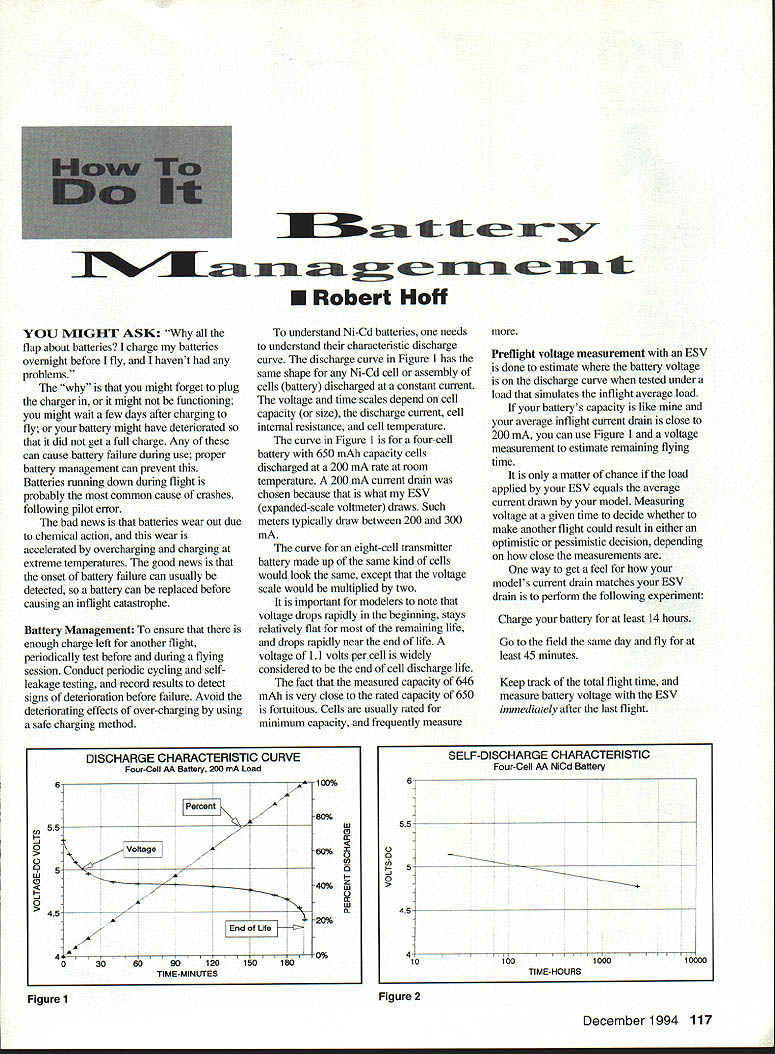
To understand Ni-Cd batteries, one needs to understand their characteristic discharge curve. The discharge curve in Figure 1 has the same shape for any Ni-Cd cell or assembly of cells (battery) discharged at a constant current. The voltage and time scales depend on cell capacity (or size), the discharge current, cell internal resistance, and cell temperature.
The curve in Figure 1 is for a four-cell battery with 650 mAh cells discharged at a 200 mA rate at room temperature. A 200 mA current drain was chosen because that is what my ESV (expanded-scale voltmeter) draws. Such meters typically draw between 200 and 300 mA.
The curve for an eight-cell transmitter battery made up of the same kind of cells would look the same, except that the voltage scale would be multiplied by two.
It is important to note that voltage drops rapidly at the beginning, stays relatively flat for most of the remaining life, and drops rapidly near the end of life. A voltage of 1.1 volts per cell is widely considered to be the end of cell discharge life.
The fact that the measured capacity of 646 mAh is very close to the rated capacity of 650 mAh is fortuitous. Cells are usually rated for minimum capacity and frequently measure more.
Preflight voltage measurement
Preflight voltage measurement with an ESV is done to estimate where the battery voltage is on the discharge curve when tested under a load that simulates the inflight average load. If your battery's capacity is like mine and your average inflight current drain is close to 200 mA, you can use Figure 1 and a voltage measurement to estimate remaining flying time.
It is only a matter of chance if the load applied by your ESV equals the average current drawn by your model. Measuring voltage at a given time to decide whether to make another flight could result in either an optimistic or pessimistic decision depending on how close the measurements are.
One way to get a feel for how your model's current drain matches your ESV drain is to perform the following experiment:
- Charge your battery for at least 14 hours.
- Go to the field the same day and fly for at least 45 minutes.
- Keep track of the total flight time, and measure battery voltage with the ESV immediately after the last flight.
- When you return to the shop, connect your 200 mA ESV to your battery and measure the time it takes for the voltage to drop to 4.4 volts (time to end of life). The time is a measure of the capacity remaining in the battery at the time you stopped flying.
If your model draws an average of about 200 mA, the time measured should be close to the time on Figure 1 that corresponds with the voltage you measured at the end of your last flight (subtracting it from the total life of the battery).
For example, if the last-flight voltage was 4.7 volts, Figure 1 shows that 28 minutes of battery life remains (194.3 - 166.3), with no allowance for error. If the time to end of life after your flying session was greater than 28 minutes, your model draws less than an average of 200 mA and you can use Figure 1 to estimate remaining flight time with confidence.
If the time to end of life measured after your last flight was much less than 28 minutes, your model draws more than 200 mA so you must not rely too much on your estimate of remaining battery life. In any case, it might be prudent to stop flying when the voltage reaches 4.7 volts.
If your ESV draws a current other than 200 mA, you can run your own discharge curve (similar to Figure 1) and proceed with the estimating process just described.
Battery cycling (capacity testing)
Battery cycling determines whether battery capacity in mAh is substantially the same as when it was new and erases any voltage depression, or "memory."
Put a constant-current load on the battery and measure how long the voltage of a fully charged battery takes to drop to 1.1 volts per cell. The time (measured in hours) multiplied by the current drain in mA during cycling gives capacity in mAh.
A 20% reduction of capacity (time to 1.1 volts per cell) from the value when the battery was new is a signal that it should be retired to non-critical duty. We are fortunate that the onset of battery failure is usually signaled by a gradual reduction in capacity, rather than sudden failure.
It has been noted that cycling a battery several times will sometimes restore some of its capacity. This likely means that some aspect of deterioration has been temporarily reversed, but the battery has not been "fixed." I don't feel good about keeping such a battery in service, though others may disagree.
Self-leakage testing
Testing battery self-leakage is important. Self-leakage is the property of a battery that causes it to slowly discharge while sitting on the shelf with no load. Self-leakage increases at elevated temperatures and decreases at low temperatures.
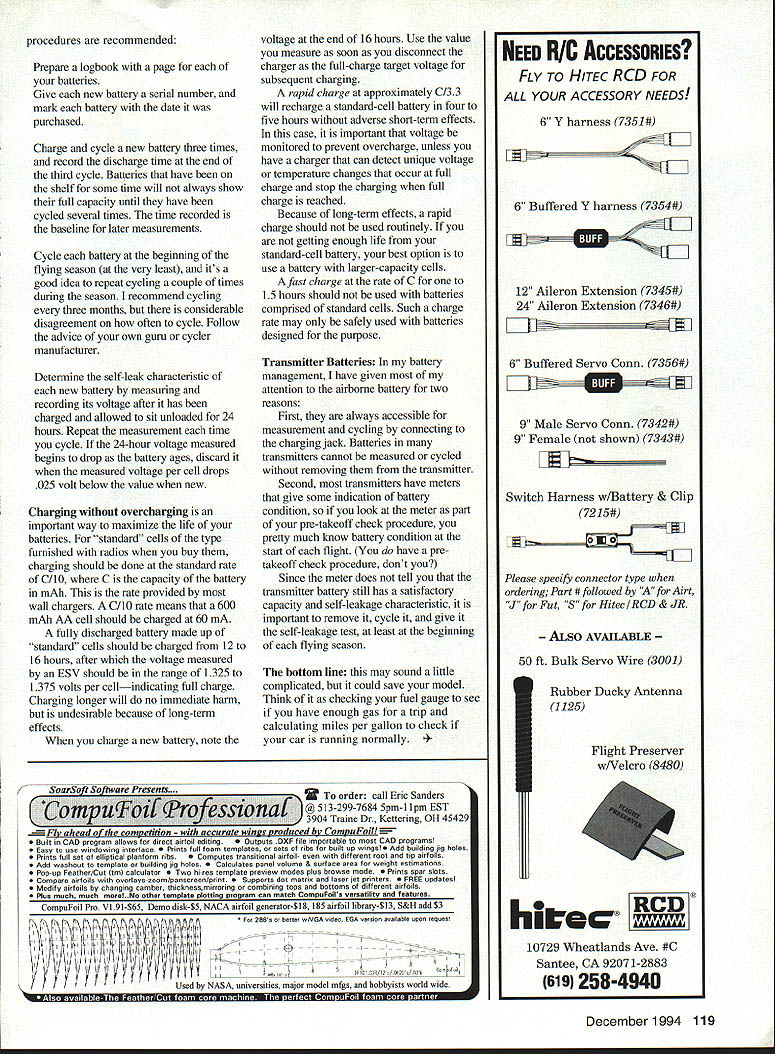
My experiments show that a normal AA, four-cell battery self-discharges at room temperature according to the curve in Figure 2. Measurements were made with an ESV that applied a 200 mA load. Do not extrapolate the curve to shorter or longer times.
Calculations from this curve show the battery will lose about 9% of its initial capacity in 24 hours and about 24% of its capacity in eight days. So if a battery has been charged and left standing for a week or more, you should definitely check it with an ESV before flying.
Batteries of greater or lesser capacity probably have a similar self-discharge curve, but I have not run tests to confirm this.
It is not safe to assume that a battery that checks out at normal capacity after cycling will have normal self-discharge. During cycling, capacity is measured immediately after charging and is affected very little by self-discharge.
Measurements of self-leakage require only an ESV:
- Charge the battery.
- Let it sit unloaded for 24 hours.
- Measure the voltage. A new battery should have less than 1.275 volts per cell after 24 hours. If it does not, you may have abnormal self-leakage and should be especially diligent about testing battery voltage with your ESV before you fly.
Recordkeeping — battery logbook
Recording results during cycling and self-leakage measurements is essential to good battery management. Recommended procedures:
- Prepare a logbook with a page for each battery.
- Give each new battery a serial number, and mark each battery with the date it was purchased.
- Charge and cycle a new battery three times, and record the discharge time at the end of the third cycle. Batteries that have been on the shelf for some time will not always show their full capacity until they have been cycled several times. The time recorded is the baseline for later measurements.
- Cycle each battery at the beginning of the flying season (at the very least). It is a good idea to repeat cycling a couple of times during the season. I recommend cycling every three months, but there is disagreement on the optimal frequency. Follow the advice of your own guru or your cycler manufacturer.
- Determine the self-leak characteristic of each new battery by measuring and recording its voltage after it has been charged and allowed to sit unloaded for 24 hours. Repeat the measurement each time you cycle. If the 24-hour voltage measurement begins to drop as the battery ages, discard it when the measured voltage per cell drops 0.025 volt below the value when new.
Charging without overcharging
Charging without overcharging is an important way to maximize battery life.
For "standard" cells furnished with radios, charging should be done at the standard rate of C/10, where C is the capacity of the battery in mAh. This is the rate provided by most wall chargers. A C/10 rate means that a 600 mAh AA cell should be charged at 60 mA. A fully discharged battery made up of "standard" cells should be charged for 12 to 16 hours, after which the voltage measured by an ESV should be in the range of 1.325 to 1.375 volts per cell—indicating full charge. Charging longer will do no immediate harm, but is undesirable because of long-term effects.
When you charge a new battery, note the voltage at the end of 16 hours. Use the value you measure as soon as you disconnect the charger as the full-charge target voltage for subsequent charging.
A rapid charge at approximately C/3.3 will recharge a standard-cell battery in four to five hours without adverse short-term effects. In this case, it is important that voltage be monitored to prevent overcharge, unless you have a charger that can detect the unique voltage or temperature changes that occur at full charge and stop charging when full charge is reached.
Because of long-term effects, a rapid charge should not be used routinely. If you are not getting enough life from your standard-cell battery, your best option is to use a battery with larger-capacity cells.
A fast charge at the rate of C for one to 1.5 hours should not be used with batteries comprised of standard cells. Such a charge rate may only be safely used with batteries designed for the purpose.
Transmitter batteries
In my battery management I have given most attention to airborne batteries for two reasons:
- They are always accessible for measurement and cycling by connecting to the charging jack. Batteries in many transmitters cannot be measured or cycled without removing them from the transmitter.
- Most transmitters have meters that give some indication of battery condition, so if you look at the meter as part of your pre-takeoff check procedure, you pretty much know battery condition at the start of each flight.
Since the meter does not tell you that the transmitter battery still has satisfactory capacity and self-leakage characteristics, it is important to remove it, cycle it, and perform the self-leakage test, at least at the beginning of each flying season.
Conclusion — the bottom line
This may sound a little complicated, but it could save your model. Think of it as checking your fuel gauge to see if you have enough gas for a trip and calculating miles per gallon to check if your car is running normally.
Transcribed from original scans by AI. Minor OCR errors may remain.

