
How to Start a Schnuerle-Ported Engine
The Problem
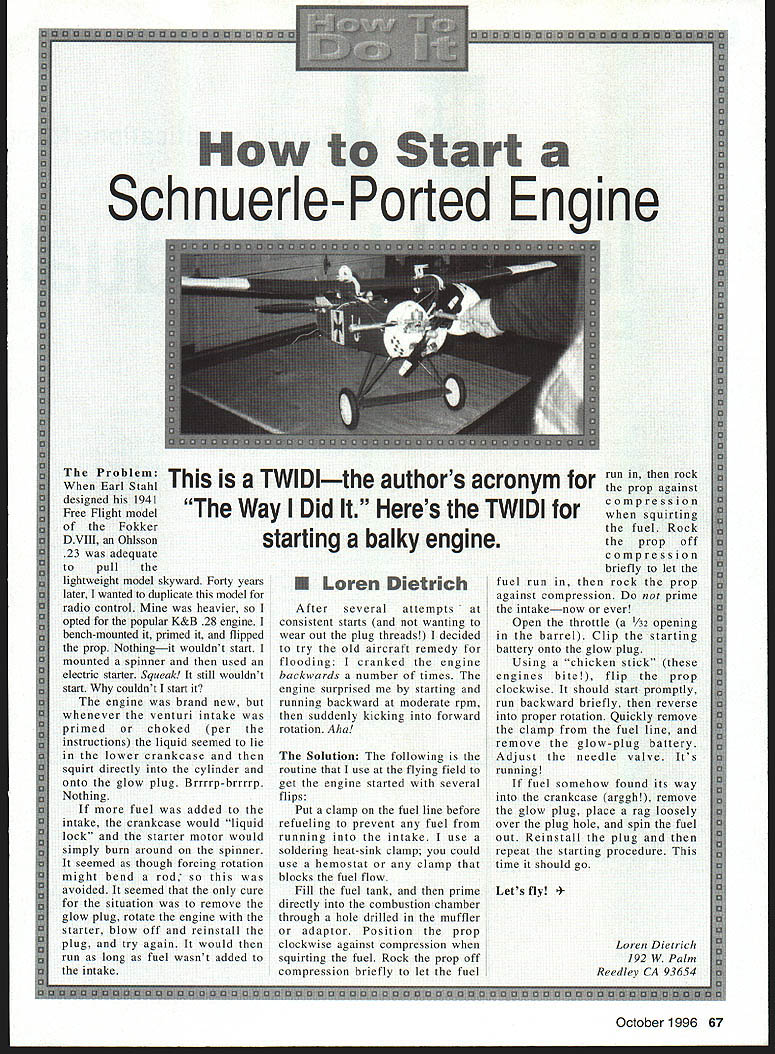
When Earl Stahl designed his 1941 free-flight model of the Fokker D.VIII, an Ohlsson .23 was adequate to pull the lightweight model skyward. Forty years later, I wanted to duplicate this model for radio control. Mine was heavier, so I opted for the popular K&B .28 engine. I bench-mounted it, primed it, and flipped the prop. Nothing—it wouldn't start. I mounted a spinner and then used an electric starter. Squeak! It still wouldn't start. Why couldn't I start it?
The engine was brand new, but whenever the venturi intake was primed or choked (per the instructions) the liquid seemed to lie in the lower crankcase and then squirt directly into the cylinder and onto the glow plug. Brrrrp-brrrrp. Nothing.
If more fuel was added to the intake, the crankcase would "liquid lock" and the starter motor would simply burn around the spinner. It seemed as though forcing rotation might bend a rod; so this was avoided. It seemed that the only cure for the situation was to remove the glow plug, rotate the engine with the starter, blow off and reinstall the plug, and try again. It would then run as long as fuel wasn't added to the intake.
This is a TWIDI—the author's acronym for "The Way I Did It." Here's the TWIDI for starting a balky engine.
Loren Dietrich
After several attempts at consistent starts (and not wanting to wear out the plug threads!) I decided to try the old aircraft remedy for flooding: I cranked the engine backwards a number of times. The engine surprised me by starting and running backward at moderate rpm, then suddenly kicking into forward rotation. Aha!
The Solution
The following is the routine that I use at the flying field to get the engine started with several flips:
- Put a clamp on the fuel line before refueling to prevent any fuel from running into the intake. I use a soldering heat-sink clamp; you could use a hemostat or any clamp that blocks the fuel flow.
- Fill the fuel tank.
- Prime directly into the combustion chamber through a hole drilled in the muffler or adapter. Do not prime the intake—now or ever!
- Position the prop clockwise against compression when squirting the fuel.
- Rock the prop off compression briefly to let the fuel run in, then rock the prop against compression while squirting. Repeat this rocking action as needed to get a small amount of fuel into the chamber without flooding the crankcase.
- Open the throttle (about a 1/32" opening in the barrel).
- Clip the starting battery onto the glow plug.
- Using a "chicken stick" (these engines bite!), flip the prop clockwise. It should start promptly, run backward briefly, then reverse into proper rotation.
- Quickly remove the clamp from the fuel line and remove the glow-plug battery.
- Adjust the needle valve as needed. It's running!
If the crankcase is flooded
- If fuel somehow found its way into the crankcase, remove the glow plug, place a rag loosely over the plug hole, and spin the engine to expel the fuel.
- Reinstall the plug and then repeat the starting procedure. This time it should go.
Let's fly!
Loren Dietrich 192 W. Palm Reedley, CA 93654
Transcribed from original scans by AI. Minor OCR errors may remain.

