
The Myth of the Terraced Airfoil
Jim Petro
There are as many airfoil shapes as there are tax laws. Each one has two versions: the pure plot of curves generated by wind-tunnel tests, and the expressed impressions after the airfoil/wing/flying machine components are combined. Anyone can begin a myth of aeronautical achievement.
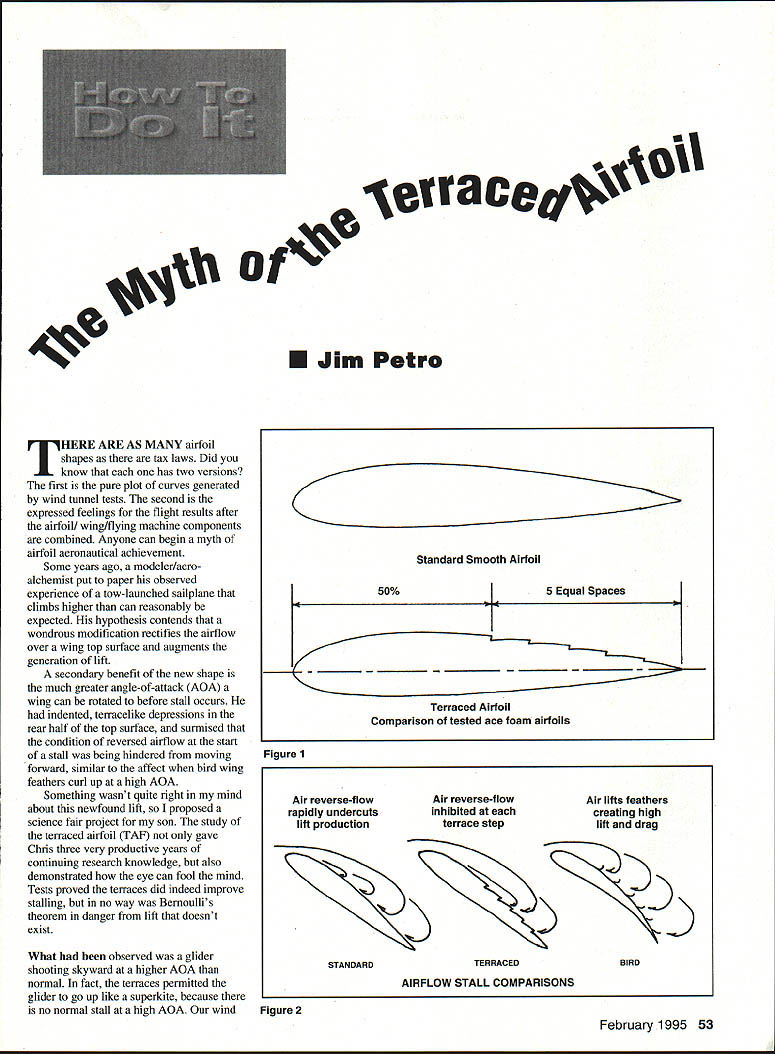
Some years ago a modeler—a sort of aero-alchemist—put to paper his observed experience of a tow-launched sailplane that climbed higher than reasonable expectation. His hypothesis contended that a wondrous modification rectified the airflow over a wing's top surface and augmented lift generation. A secondary benefit claimed was a much greater angle-of-attack (AOA) before stall. He had indented, terracelike depressions in the rear half of the top surface and surmised the reversed airflow at stall onset was being hindered from moving forward, similar to the effect when bird wing feathers curl at a high AOA.
Something wasn't quite right about this newfound lift, so I proposed a science-fair project for my son. The study of the terraced airfoil (TAF) not only gave Chris three productive years of continuing research knowledge, but also demonstrated how the eye can fool the mind. Tests proved the terraces did indeed improve stalling characteristics, but in no way did they create lift beyond what Bernoulli's theorem predicts.
What had been observed was a glider launching into the sky at a higher AOA than normal. In fact, the terraces permitted the glider to behave like a superkite: there was no abrupt, normal stall at the higher AOA.
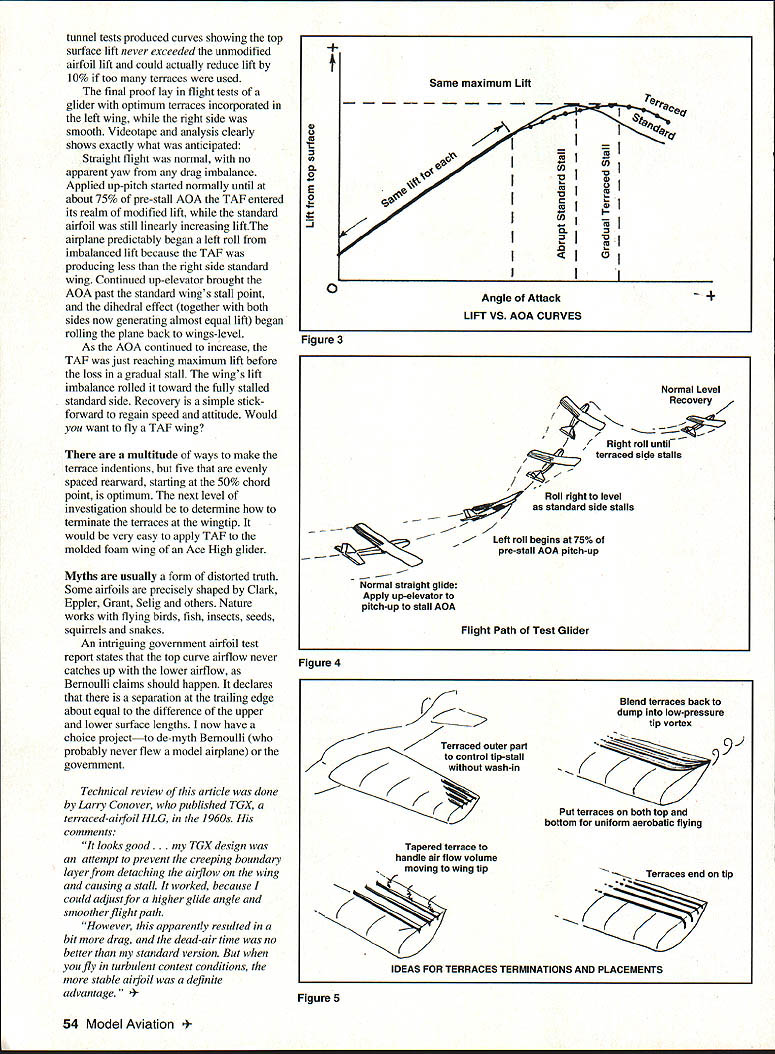
Wind-tunnel tests produced curves showing the top-surface lift never exceeded the unmodified airfoil's lift; terraces could actually reduce lift by about 10% if too many were used. The final proof lay in flight tests of a glider with optimum terraces on the left wing while the right wing remained smooth. Videotape and analysis clearly showed the expected behavior.
Flight test sequence:
- Straight flight was normal, with no apparent yaw or drag imbalance.
- Applied up-pitch started normally until about 75% of the pre-stall AOA, when the TAF entered its realm of modified lift while the standard airfoil's lift was still increasing linearly.
- The airplane predictably began a roll toward the terraced side because the TAF was producing less lift than the standard wing.
- Continued up-elevator brought the AOA past the standard wing's stall point; the dihedral effect, with both sides now generating almost equal lift, began rolling the plane back toward wings-level.
- As AOA increased further, the TAF reached its maximum lift and then lost it in a gradual stall; the wings' lift imbalance then rolled the model toward the fully stalled standard side.
- Recovery was simple: push the stick forward to regain speed and attitude.
Would I want to fly a TAF wing? There are a multitude of ways to make terrace indentations. Based on tests, recommendations include:
- Five terraces, evenly spaced rearward, starting at the 50% chord point seems optimum.
- Investigate whether to terminate terraces short of the wingtip.
- Terraces are easy to apply to molded-foam wings such as the Ace High glider.
Myths usually form from distorted truth. Some airfoils are precisely shaped—Clark, Eppler, Grant, Selig and others. Nature works: flying birds, fish, insects, seeds and even squirrels and snakes exhibit airfoil-like surfaces.
An intriguing government airfoil test report states that the top-curve airflow never catches up to the lower airflow, contrary to a simplistic reading of Bernoulli; it declares separation at the trailing edge is about equal to the difference in upper and lower surface lengths. You now have a choice: a project to de-myth the terraced airfoil (or Bernoulli, who probably never flew a model airplane) would be worth doing.
Technical review
Technical review of this article was done by Larry Conover, who published the TGX terraced-airfoil HLG in the 1960s. His comments:
"It looks good. My TGX design was an attempt to prevent the creeping boundary layer from detaching the airflow on the wing and causing a stall. It worked, because I could adjust for a higher glide angle and smoother flight path.
"However, this apparently resulted in a bit more drag, and the dead-air time was no better than my standard version. But when you fly in turbulent contest conditions, the more stable airfoil was a definite advantage."
Transcribed from original scans by AI. Minor OCR errors may remain.

