
How to Obtain a Flying Field in Two Moves
Finding & Keeping Flying Fields
Neil Gibbins
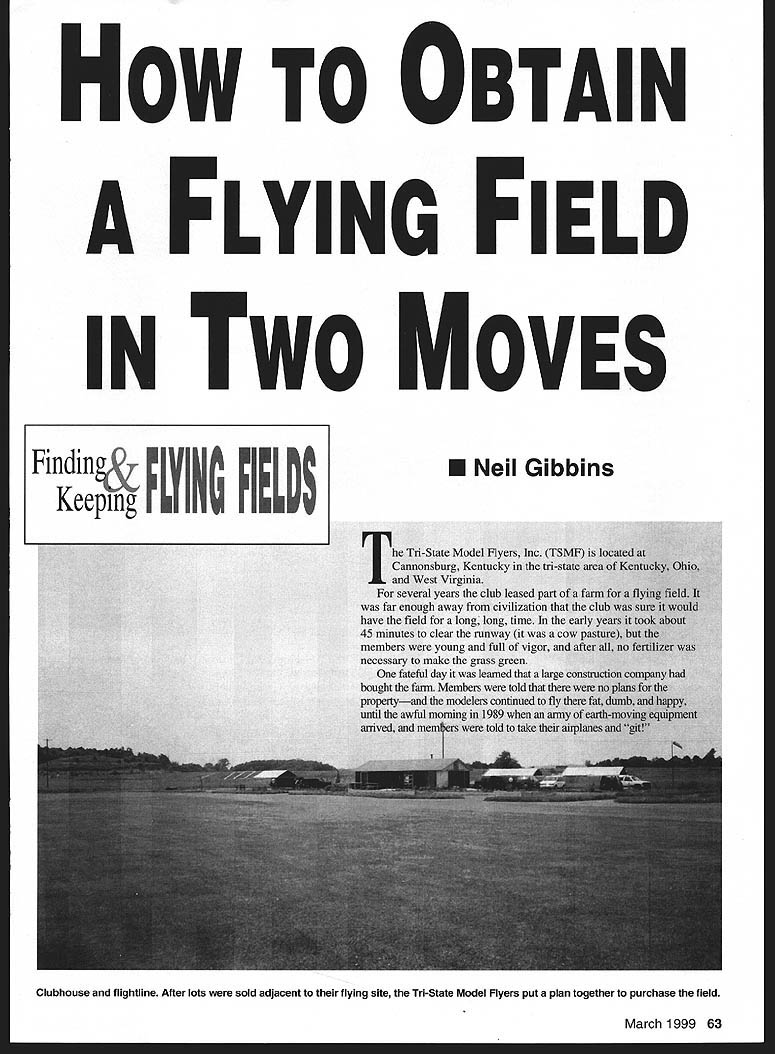
The Tri-State Model Flyers, Inc. (TSMF) is located at Cannonsburg, Kentucky, in the tri-state area of Kentucky, Ohio, and West Virginia.
For several years the club leased part of a farm for a flying field. It was far enough away from civilization that the club was sure it would have the field for a long, long time. In the early years it took about 45 minutes to clear the runway (it was a cow pasture), but the members were young and full of vigor, and after all, no fertilizer was necessary to make the grass green.
One fateful day it was learned that a large construction company had bought the farm. Members were told that there were no plans for the property—and the modelers continued to fly there, fat, dumb, and happy, until the awful morning in 1989 when an army of earth-moving equipment arrived, and members were told to take their airplanes and "git"!
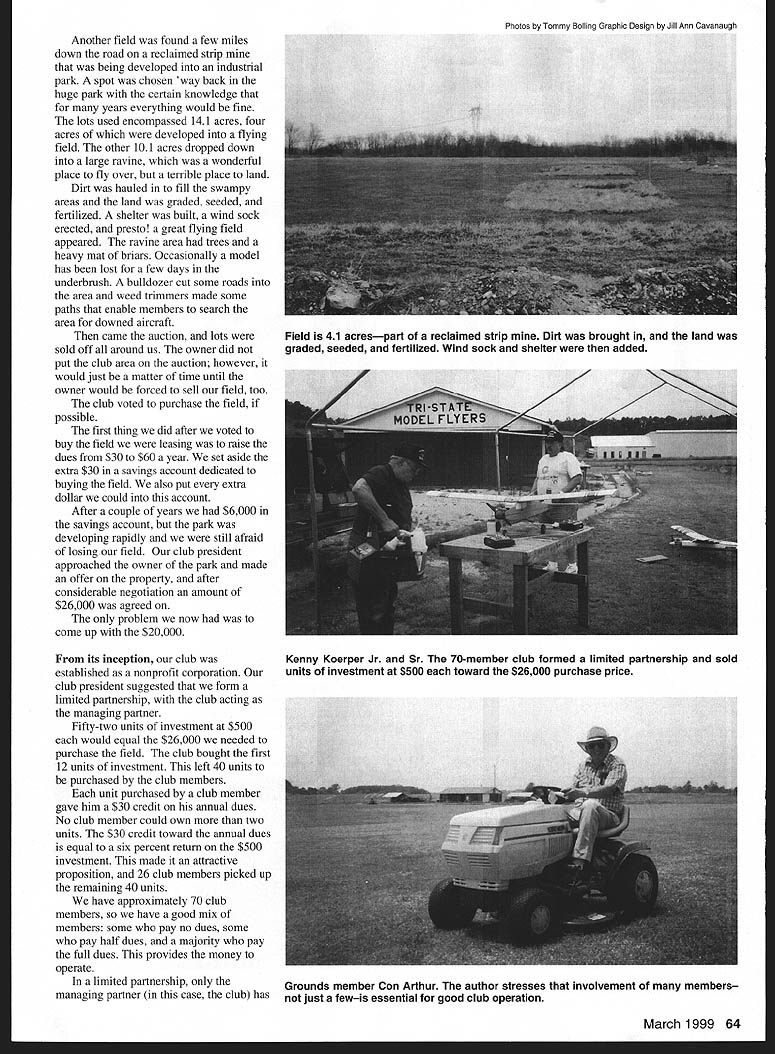
Another field was found a few miles down the road on a reclaimed strip mine that was being developed into an industrial park. A spot was chosen way back in the huge park with the certain knowledge that for many years everything would be fine. The lots used encompassed 14.1 acres, four acres of which were developed into a flying field. The other 10.1 acres dropped down into a large ravine, which was a wonderful place to fly over, but a terrible place to land.
Dirt was hauled in to fill the swampy areas and the land was graded, seeded, and fertilized. A shelter was built, a wind sock erected, and presto! — a great flying field appeared. The ravine area had trees and a heavy mat of briars. Occasionally a model has been lost for a few days in the underbrush. A bulldozer cut some roads into the area and weed trimmers made some paths that enable members to search the area for downed aircraft.
Then came the auction, and lots were sold off all around us. The owner did not put the club area on the auction; however, it would just be a matter of time until the owner would be forced to sell our field, too.
The club voted to purchase the field, if possible.
The first thing we did after we voted to buy the field we were leasing was to raise the dues from $30 to $60 a year. We set aside the extra $30 in a savings account dedicated to buying the field. We also put every extra dollar we could into this account.
After a couple of years we had $6,000 in the savings account, but the park was developing rapidly and we were still afraid of losing our field. Our club president approached the owner of the park and made an offer on the property, and after considerable negotiation an amount of $26,000 was agreed on.
The only problem we now had was to come up with the $20,000.
From its inception, our club was established as a nonprofit corporation. Our club president suggested that we form a limited partnership, with the club acting as the managing partner.
Fifty-two units of investment at $500 each would equal the $26,000 we needed to purchase the field. The club bought the first 12 units of investment. This left 40 units to be purchased by the club members.
Each unit purchased by a club member gave him a $30 credit on his annual dues. No club member could own more than two units. The $30 credit toward the annual dues is equal to a six percent return on the $500 investment. This made it an attractive proposition, and 26 club members picked up the remaining 40 units.
We have approximately 70 club members, so we have a good mix of members: some who pay no dues, some who pay half dues, and a majority who pay full dues. This provides the money to operate.
In a limited partnership, only the managing partner (in this case, the club) has the responsibility of the operation; liability of the limited partners is limited to the amount of their investment. Included in the partnership agreement should be that if the property is sold, the investor would have his original investment returned. The club's intention is to acquire the units of any members who wish to sell. Two units are purchased a year and the savings account is kept for that purpose.
Although now metal buildings are adjacent to the property, the end of the field is about 700 feet from the main runway. The 4.1 acres of undeveloped ground that we fly over is now worth three or four times the purchase price because the park now has water, electricity, gas, and sewer. A recent sale of industrial park property amounted to $86,000 for a parcel smaller than that owned by TSMF. If the club ever does have to move, the land may be worth enough that next time we can buy. We still say we bought a farm.
The AMA has advisory assistance programs. A reasonably sized club with at least a strong leader can have its own field. A member must take the lead.
Contact for details on the limited partnership:
- Lloyd Wagner, TSMF President
- Address: 529 Camden Road, Huntington, WV 25705
- Tel: (W) 304-429-6727, (H) 304-453-3500
Author:
- Neil Gibbins
- Address: 6128 Gideon Rd., Huntington, WV 25705
Transcribed from original scans by AI. Minor OCR errors may remain.

