
How to Run a Successful Model Air Show
Mark J. Feist
WHAT DOES IT TAKE
Ever been called on to demonstrate your model flying to the public—or thought about doing a demo to bolster the club's finances? The lessons learned by this club in Ohio will help to get you started.
What does it take to put on a two-day, four-hour-a-day air show featuring 22 events? A show that includes almost 100 airplanes, 60 pilots, static display booths, and multiple refreshment stands—and one which will attract thousands of spectators? What does it take to never have the show run more than two minutes off schedule, and to be able to speed up or slow down the schedule to create extra time, or make up for lost time if needed? Does it take an AMA show team or professional modelers? Not necessarily. Weekend sport pilots, if they've been highly organized, are more than capable of pulling off a well-thought-out, efficiently planned air show.
For the Greater Cincinnati Radio Control Club (GCRCC), whose members have been orchestrating this caliber of show for the past 27 years, it's a proven working plan.
Called the Flying Circus Model Air Show, it's our only fund-raising event of the year. The show provides us with the income to pay the rent, maintain the flying site, and build up our savings account. It's also the GCRCC's opportunity to promote model aviation in our city, and at the same time to give something back to the community in which we've flourished for the past 30 years.
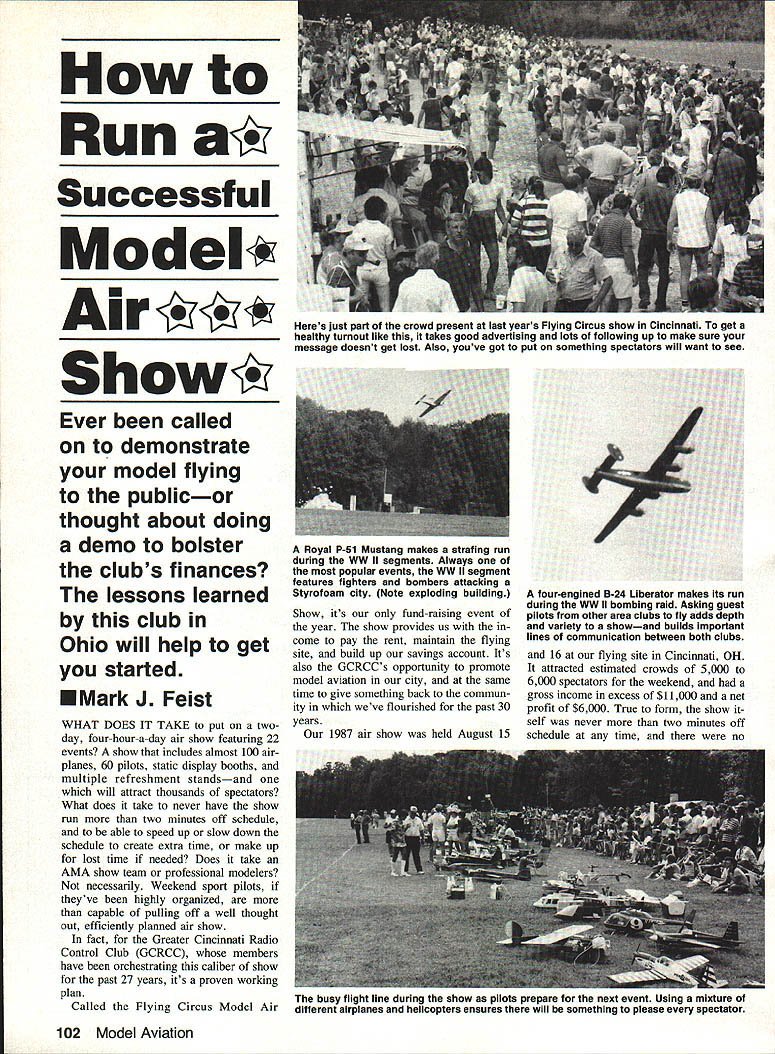
Our 1987 air show was held August 15 and 16 at our flying site in Cincinnati, OH. It attracted estimated crowds of 5,000 to 6,000 spectators for the weekend, had a gross income in excess of $11,000, and produced a net profit of $6,000. True to form, the show itself was never more than two minutes off schedule at any time, and there were no safety-related incidents during the entire weekend.
We hope other clubs may be inspired to organize their own air shows. The GCRCC would like to pass on some experience we've accumulated over the years in putting on the Flying Circus show. The vast majority of the pilots on the show team are competition fliers, although people who are invaluable sources of information rather than weekend sport pilots performing shows once a year are also important. Weekenders need to be molded into show-team sorts, and we also have committees and committee chairmen who help organize the various aspects of the show.
Following is a listing of the committees with a brief explanation.
Circus Chairman
In addition to coordinating activities and making final decisions, the circus chairman develops the flight-line schedule and the event program. Fast-moving events should be alternated with calmer ones when possible. The show should have a finale. The chairman is also responsible for contacting pertinent officials—the police, paramedics, the club's landlord, neighboring field owners—and points of contact concerning leasing, parking areas, guest pilots, and other area clubs.
Flight Line Chairman
The flight-line chairman is the circus chairman's right-hand person and is in charge of flight-line and pit-area activities during the show. The flight-line chairman appoints three or four event directors to be in charge of specific events. Event directors line up pilots who will fly the events two events in advance and keep everything and everyone on schedule. The flight-line chairman is also responsible for lining up props used during events, such as balloons and streamers. He should appoint a starter/flagman to indicate when pilots take off and land and the direction of airplane operations. Scheduling decisions to cut short or lengthen events are made official by the flight-line chairman.
Qualifications Committee
All pilots and airplanes must qualify in advance of the show. This is accomplished by having all planes and pilots perform before a qualifications committee of at least two pilots. They must perform as they would during the actual show. The planes will also be checked out on the ground at this time. This double-qualifying procedure ensures the safety of the aircraft and, as far as possible, measures the ability of the pilot to perform under pressure. All pilots and planes are then signed up in advance, allowing time to resolve frequency conflicts days before the show. As you can see, qualifying is a very important facet both of safety control and overall show organization.
Ground Crew
The function of the ground crew is to provide assistance in the pit area whenever necessary. They should have plenty of starters, batteries, fuel, and tools available.
Spotters
A spotter system should be developed to ensure that all pilots have knowledgeable spotters at all times during a flight. Spotters must be competent pilots in case of an emergency.
Safety
The safety committee chairman establishes safety guidelines such as flight patterns, pilot boxes (follow AMA guidelines), and frequency control (third-order interference, etc.). He arranges boundary lines and fencing, if needed. In advance of the show, the safety chairman works closely with the circus chairman, qualifications chairman, and the flight-line chairman. Once the show has started, all safety-related decisions become the responsibility of the flight-line chairman or the circus chairman.
Impound
The proper administration of whatever transmitter and frequency flag/pin system your club uses plays a substantial role in both show-time coordination and safety. The impound chairman is in charge of this area before, during, and after the show each day.
Raffle
The raffle is the chief moneymaker at most events, and guarantees income even if the show is rained out. The GCRCC raffles off a complete ready-to-fly model airplane. The raffle chairman coordinates acquisition, distribution, and collection of tickets and money.
Publicity
The success of an air show usually is judged by the size of the crowd and the amount of money generated, and of course you can't have one without the other. The GCRCC is proud of the coverage the Flying Circus receives from the local media. Extensive newspaper and television coverage is obtained each year by contacting the media as much as five months in advance of the show.
To be successful, letters to the media must show enthusiasm and imagination in going beyond the mere facts—the who, the when, the where, and the why. Include colorful, descriptive text and photos whenever possible. Send tickets and posters to schools and civic organizations. Presentations to service clubs and civic groups will encourage attendance and support. Radio and television spots will bring a good turnout. The GCRCC also gives out free admission tickets to civic and service groups to encourage advance attendance.
If a letter to a newspaper is limited to dry facts, the most you can hope for is a mention of your event in the paper's weekly calendar. Circulate letters that contain highlights of your show, a history of your club, and human-interest angles (charity benefits or donations). Stress the uniqueness of your hobby and its appeal to the media’s viewers and readers.
Follow up these letters with phone calls to the editors, and you'll increase your chances of getting the positive results you want—that is, feature articles, stories, and TV news coverage before the show. The key is to be so energetic and persistent that you don't slip out of the media's view. Other equally important facets of PR are posters, handouts at shopping malls and hobby shops, and word of mouth.
There are a number of other details that require advance planning. Committees should be formed to handle:
- Financing
- Setting up before the show
- Tearing down after the show
- Parking (the GCRCC has free parking for the show, but charges $1 admission with children under 13 admitted free)
- Static display booths
- Food and drink booths
- Ordering booths and portable toilets from rental firms
- Printing of programs, raffle tickets, and club member pit and parking passes
- Building the raffle plane
- Pit police for patrolling the crowd line so only pilots and ground crew are in the pit area
- A search-and-rescue crew to find airplanes lost during events
- The sound system and coordination of background music with events (for example, Top Gun music with the ducted fans)
- Announcers
- Clowns who hand out free candy to children in the crowd
- Conducting a contest for the selection of a Flying Circus pin design, and having the pins made
Organizing the Flying Circus air show obviously takes a great deal of work, but time and again our club has seen its extensive preparations pay off. When the big weekend arrives, all the participants know what's expected of them both in the air and on the ground. Our weekend pilots are able to really enjoy putting on a show for the crowd—and we even make some good money in the process.
Flying Circus weekend never fails to be the most memorable two days of the entire year. All the hard work on a myriad of details such as airplanes, publicity, and booths—and all the general organization—meshes into a show which is enjoyed by large numbers of people, year after year. That gives you a great feeling.
We hope you'll find this to be a helpful guide to staging your own air show—one which is as fun, safe, profitable, and successful as the Greater Cincinnati Radio Control Club's annual Flying Circus!
If you'd like additional information or have any questions, feel free to call (513) 353-4772.
Transcribed from original scans by AI. Minor OCR errors may remain.

