
How to Select an Old-Timer
You can't judge by track records in the SAM free-flight (FF) events to predict what designs will beat out the competition in AMA's RC Electric Event 618.
Electric-powered RC flying is fast growing in popularity, with more and more contests and fun-flies scheduled on club and regional calendars. In 1991 the category was offered for the first time at the AMA National Aeromodeling Championships. (See Frank Korman's fine report in the November 1991 Model Aviation.)
The most popular event seems to be Class A Sailplane (Event No. 610). This event restricts the battery pack to a maximum of seven Ni-Cd cells. Class A Sailplane was flown at the 1991 Nationals with a 30-second motor run, an 8-minute maximum flight time, and points for landing inside a designated area.
Probably second in popularity at most club contests is AMA Event No. 618—Class A Old-Timer, Limited Motor Run. In this event, intended for pre-1943 designs, the motor run is increased to 40 seconds. Otherwise, Class A Old-Timer uses the same rules as Class A Sailplane at the 1991 Nationals.
The purpose of this article is twofold: to analyze what makes an Old-Timer design competitive in Event 618, and to identify models with desirable characteristics. Please understand that the rules for this event differ from those used for Society of Antique Modelers (SAM) events. General remarks on selecting designs for SAM events appear later in the article.
The noncompetitive flier can be happy flying any design that appeals to him. Maybe he has some roots in the design, or maybe he just likes the way it looks. If you want to win contests, though, emotion alone won't do. When winning is your goal, you have to think logically.
Early free-flight gas designs were large, low-powered, and very stable. During the 1930s and 1940s, as the climb got faster and the engine run shorter, designs changed rapidly to stay competitive. To win in free flight you needed a model with a high ratio of power to weight, a low ratio of weight to wing area, and a configuration that could handle the large trim changes between power-on and power-off.
The early designs had the center of gravity (CG) at about 30% of MAC (mean aerodynamic chord), large rudders, nonlifting stabilizers, and relatively large angles of positive incidence between wing and stabilizer—free flight folk call this decalage. Under high power, the models simply went nuts, either spiral diving or looping themselves to death. To satisfy requirements for faster climbs and shorter engine runs, free-flight designers introduced large, airfoil-sectioned lifting stabilizers and small fins.
Large lifting stabilizers accomplished two things: they dictated the CG move aft, typically to 50%–75% chord, and they reduced decalage. This arrangement made the model vulnerable to the dreaded spiral dive. Spiral diving could usually be kept within tolerable limits by reducing rudder area to the point of producing Dutch roll. Before long, competitive designs—Zippers, Interceptors, Strato Streaks and various derivatives—had eclipsed the sort-of-looks-like-a-real-airplane predecessors.
Would a Zipper or Interceptor be competitive in AMA Event 618? They could be. Remember, though, the RC Electric event has different requirements than modern-era SAM free-flight events. Designs unlikely to win the latter events could prove competitive or superior in RC events. Variety at contests can be a good thing.
It is appearance, characteristics, and performance that make a man love an airplane, and they, told truly, are what put the emotion into one.
You love a lot of things if you live around them, but there isn't any woman and there isn't any horse, nor any before nor any after, that is as lovely as a great airplane, and men who love them are faithful to them even though they leave them for others. ... Ernest Hemingway
Event 618 emphasizes duration with a short motor run—eight minutes is a long time to fly on 40 seconds of climb. At the 1991 Nationals, points also were awarded for landing in a designated area. If you couldn't come back upwind and land near the area of launch, you lost points.
Four performance factors affect a model's success in this event—climb, glide, controllability, and penetration. Let's examine each in turn.
Climb
We increase the climb rate primarily by increasing the ratio of power to weight. To get lots of power in a short time, we place large loads on the geared motor, drawing current from the seven-cell battery at a rate of 40 amps or more. That brings the nominal .05 motors, usually flown at about 120 watts (17 amps x 7 cells), up to about 280 watts of power (40 amps x 7 cells).
The Astro cobalt motors will stand this load for short runs; I don't think you'd want to run them for five minutes at that level. Fliers at the 1991 Nationals achieved this power increase by using propellers with diameters of up to 14 in.; with an 11-in. prop, you'll seldom exceed 20 amps.
Low weight
Low weight is as important as high power. Two factors are involved—airframe weight and the other equipment weight.
First, the other stuff. The radio receiver, servos, etc., must be light. You need an on/off controller with a brake to stop the propeller, and you might consider a battery eliminator circuit (BEC) as well.
Jomar and High Sky both make an on/off controller with BEC. I've been using Jomar's recently, and I like it. I also like the older High Sky device without BEC, so I'd expect the new version to work well, too. Though a controller with BEC is only about an ounce lighter than one without BEC, an ounce can make a difference in this event.
When it comes to airframe weight, the design itself is more critical than wood selection. Some designs simply call for more wood—more pieces, more parts, more weight. You can reduce weight to a limited extent by using low-density wood, but only where strength considerations allow—longerons, spars, and leading edges need to be tough.
The classic box fuselage exemplifies lightweight airframe design. It's hard to get lighter than a four-longeron box. Add lots of formers and stringers, and you add weight. As Hank Struck put it years ago: "Simplicate and add lightness."
Take the Goldberg Sailplane—a wonderful design, but it tends to get heavy when you scale it down. At the original size (about 72-in. span and probably about 900 sq. in. of wing area), the Sailplane can handle a lot of power (I flew one with a white-case McCoy .60), making it highly competitive in free flight. But if you scale the wing area down to, say, 550–600 sq. in. (which seems about right for our 40-second-motor-run event), you'd have a hard time compensating for all those extra pieces by using low-density wood.
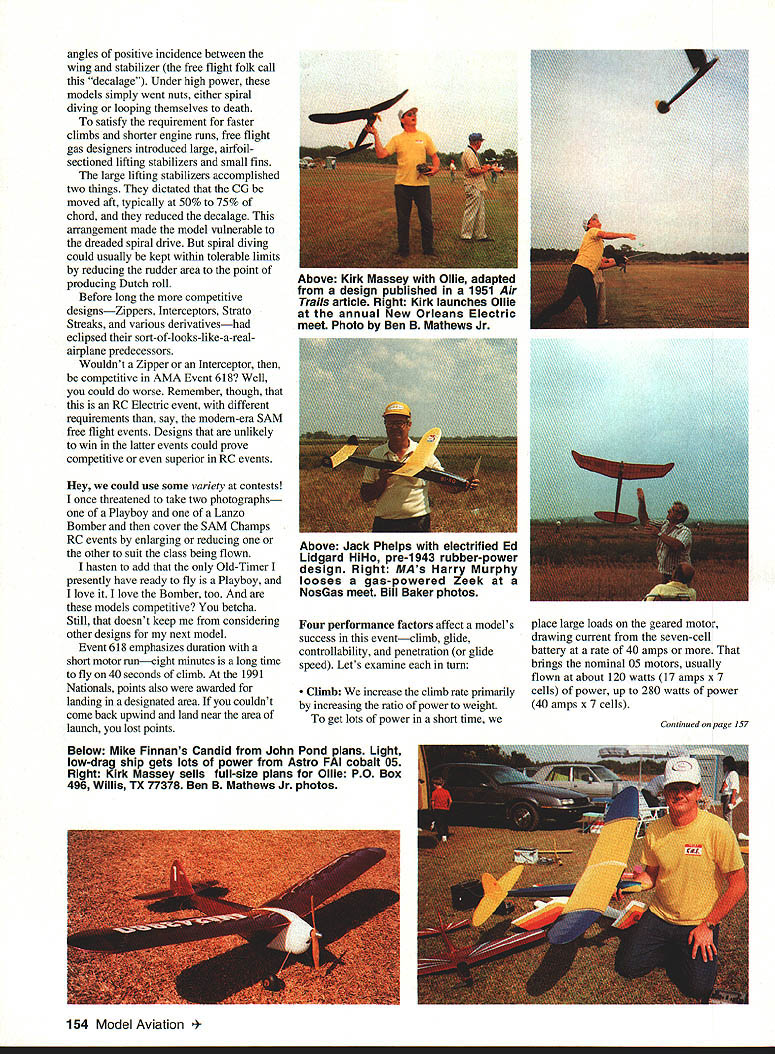
Other designs with too many parts to scale down light are the Henry Struck-designed New Ruler and the Zipper. The Playboy, Strato Streak, and Lanzo Bomber, on the other hand, scale down fine; their low parts count makes them easy to build light. That's why the Strato Streak dominated .02 Replica free flight. Though the Playboy has four main longerons and four "assistant" longerons, using softer wood keeps the weight down.
Glide
The factors that benefit an aircraft's glide are fairly complex, but the major ones are low wing loading and low drag — and low weight is of the greatest importance. The smaller a model gets, the lower the wing loading has to be to match the original glide.
The large cross section of many Old-Timer designs promotes high drag. Although some of these designs featured cleaner, lower-drag fuselages, landing gears, wheels, and some of the airfoils had high drag (along with high lift). Some of the models had one-wheel landing gear; others had single-wheel, retractable gear.
What about airfoils? Should the airfoil be flat-bottom or undercambered, thick or thin? The critical factor is the mean camber line.
High-camber airfoils fly more slowly and may have a very low sink rate. With power on, however, the drag increases rapidly, slowing the climb and reducing the ability to penetrate—that is, to glide back upwind. Obviously, trade-offs are involved. You might choose a Clark Y-type airfoil (flat-bottom with raised entry), for example, over the deeply undercambered type used in a Playboy or a Goldberg Sailplane, sacrificing a bit of sink rate for the sake of better climb and penetration.
That's what's fun about designing airplanes or selecting from among the older designs—the choices, compromises, trade-offs. Do you make the model bigger to glide better, or do you give up some glide for a better climb? If the rules should change to shorten the motor run, I foresee a swing to greater emphasis on climb and less emphasis on glide.
Penetration
The low drag of an aerodynamically clean modern RC sailplane makes the craft seem almost frictionless as it moves through the air. To increase penetration on windy days or for the speed task, a modern sailplane simply adds weight (ballast).
That doesn't work with Old-Timer sailplanes, because such designs have high drag. Drag increases as the square of an increase in speed. Therefore, if you add weight to a high-drag ship in an attempt to improve its penetration, you are penalized by a big increase in drag for only a small gain in speed. The added weight also hinders climb and glide.
You're probably wondering whether the big lifting airfoil-section stabilizer doesn't help to hold the model up. No — there's no free lunch: no lift without drag. Glide is improved with the CG at about 30% and a nonlifting stabilizer. The only way the lifting stabilizer benefits a free-flight model is by controlling the pitch-trim change between power-on and power-off.
Controllability
Controllability is of lesser concern in selecting an RC Electric for Event 618. Any design should steer fine with rudder and elevator. (I know of nothing in the rules that prevents the use of ailerons and spoilers — but camber-changing flaps would likely get you unpopular at large meets.) At the same time, the older designs with large fins, which spell quick death for high-powered free flight, will make sense in this RC event.
In general, locating the CG forward of the free-flight position by about 10% chord will improve controllability in a lifting-stabilizer design. If the free-flight position of the CG isn't shown on the plans, use the formula and graph from an article by Bogart and Rhodes in the January 1959 Model Airplane News, reprinted in the Frank Zaic Yearbook for 1959–1961.
So it looks pretty good for the Strato Streak and the Interceptor in Event 618. With thin flat-bottom airfoils, they should outpenetrate my Playboy. Not that the Playboy isn't a good floater; on a low-wind day it would be hard to beat. But how many contests are flown under ideal conditions?
Other designs deserve serious consideration — the Miss America, for example, designed by Frank Zaic for Scientific Models. This design has a four-longeron box fuselage, a Clark Y airfoil, and a nonlifting stab. Although the cabin has a windshield, the windshield's slope manages to preserve much of the profile's integrity. The one negative I see is the draggy landing gear. Trade-offs again.
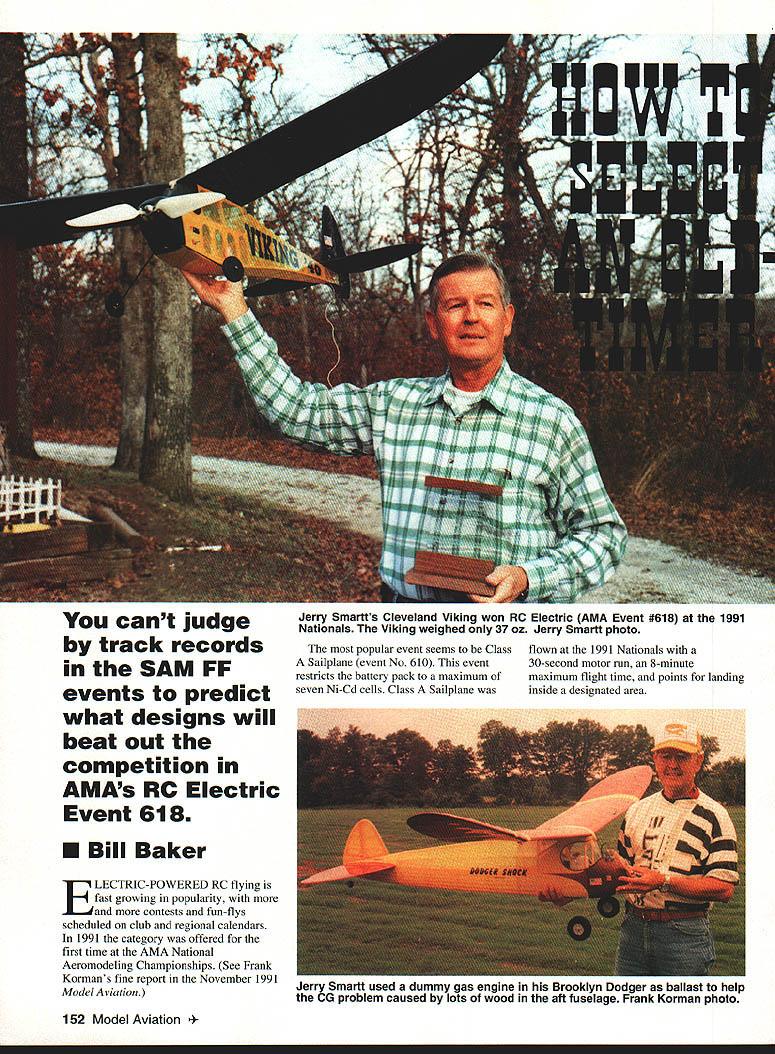
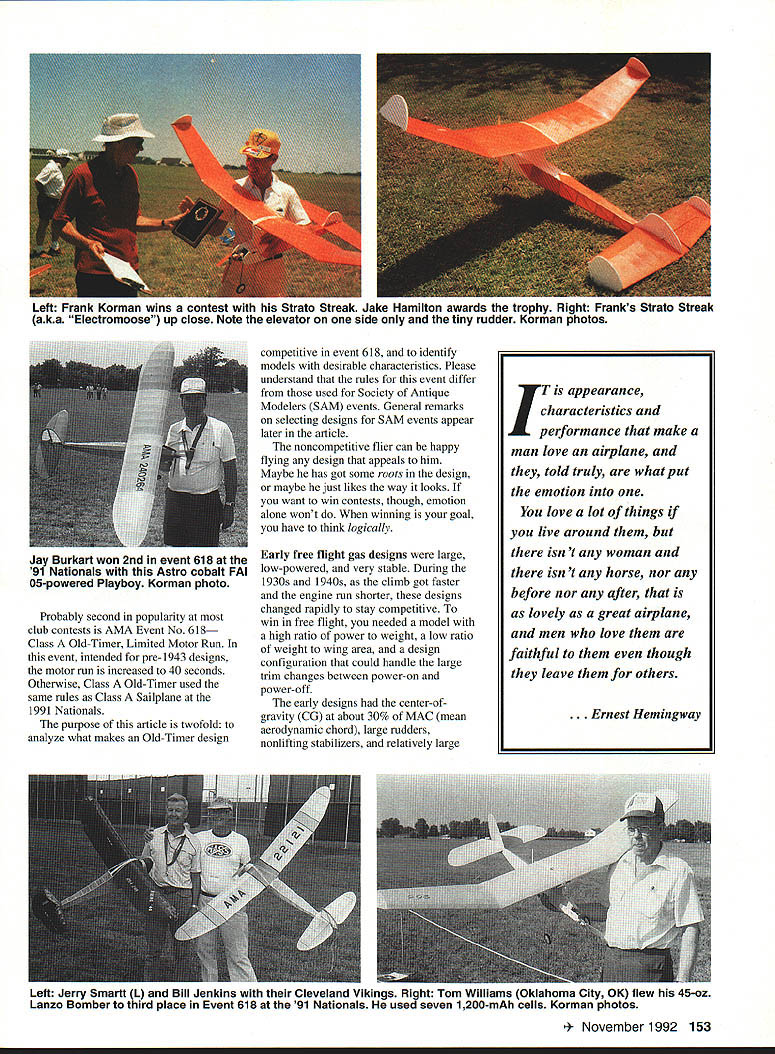
In the real world — at the 1991 Nationals — Jerry Smartt won Event 618 with a Cleveland Viking. The Viking has a four-longeron cabin-style fuselage, a nonlifting stab (I think), and the lowest weight of the models listed in Frank Korman's coverage of the event. Most of the competitive models weighed about 45 oz; Jerry's was 37 oz.
Jerry used the largest propeller listed for the fliers competing on the day he won. This means that he had a very high current draw and could have made an absolutely vertical climb. Jerry also used 650-mAh cells; with a short motor run there's no need to carry the weight of 900- or 1,200-mAh cells. It is important to use the larger-diameter C-cell-size high-current cells (SCR) rather than pencil-diameter 800-mAh AR cells.
I haven't told you what to build, but I've given you the facts on which to base a logical decision. With the compromises and trade-offs possible, there's no reason we should all fly the same design. Designs that are unlikely to win in the SAM free-flight events should be competitive in the AMA Class A Old-Timer event.
The SAM event for electrics, by the way, seems to be gaining support more slowly than the AMA event. I think this is because the rules limit performance too sharply. Folding propellers are prohibited and a low-performance (800-mAh AR) battery pack must be used—this despite the use of a 90-second motor run! The differences in rule-making procedures probably guarantee that the two events will evolve in different directions.
By the way, while my Playboy is set up for relaxed sport flying—inexpensive ferrite motor; 800-mAh AR cells; a 3:1 MAS gearbox for a long, slow motor run—it does use an 11 x 8 folding propeller so that I can get back upwind.
Old-Timer / Baker
What of the SAM RC events for glow-powered engines and ignition engines? My only suggestion for improvement is that penetration would be enhanced by using a design with a Clark Y airfoil and a nonlifting stabilizer. It's possible, however, that the lifting stab helps to control the extreme pitch-trim change that accompanies high power levels, offsetting its otherwise negative effect on performance.
And SAM free flight? Stick with what works. The well-known models use a proven formula: small fin, large lifting stabilizer, aft CG location, large dihedral. Use a lot of power in a Quaker or a Log Cabin or a Miss America, and you probably won't be able to control that power. On the other hand, these models make fine RC ships.
A word on scaling down your model: this really isn't hard to do with pencil, paper, and calculator. Nowadays, though, most of us simply go to the photocopy shop and say, "I want this reduced to 73%."
How do you find the reduction or enlargement factor? Take the square root of the wing area you desire and divide that by the square root of the area you have chosen. Multiply this resultant by your multiplicative factor. Multiply this factor by all the linear dimensions of the original plan to create your new, larger or smaller plan.
As a look at the AMA rule book shows, the other RC Electric events are flown, too. These include Class B — in which the battery pack must have more than seven but less than 30 cells — and events for pre-1960 free-flight designs. (The latter have unfortunately been called "oldie" designs. Were all the good names taken? Or was the term "nostalgia" avoided for fear it might be confused with the Nostalgic events of the National Free Flight Society (NFFS)? A rose by any other name...)
What I find interesting is that there are three ways to compete. Besides the Limited Motor Run (LMR) events, one can enter the Battery Allotment and Texaco events.
- In Battery Allotment, competitors are required to make three flights without recharging.
- In Texaco, you have an unlimited motor run on a single battery pack.
Both variations would require changes in propeller, battery pack, gearing—lots of things. But offhand, I'd think you'd want to use the same designs as in the LMR events.
Wait a minute! Come to think of it, there's no need to climb fast. Hmmm.
Transcribed from original scans by AI. Minor OCR errors may remain.

