

Hungarian Rhapsody
Who says you can't go home again?
- George G. Siposs
Background
For the first time I held a model airplane in my hands in Hungary 52 years ago. Shortly after I began building models I took part in my first contest. My indoor models, covered with microfilm, took first place. As a member of a club, we made microfilm in the family bathtub and also built outdoor models—gliders and rubber-powered planes.
A high-school classmate introduced me to his uncle, George Benedek, the top modeler in Hungary at the time. Benedek won many contests; his innovative designs appeared in the illustrated magazine Young Flier. I had heard about his famous exploits—he set record after record. His disciple, Ferenc Cavalloni, a physics teacher, and his students became prominent modelers in Hungary.
Later Benedek developed a line of cambered wing sections for slow-flying outdoor gliders. During the war there was a shortage of supplies—spruce, thin plywood, drafting paper—so we covered models with dope. After the war Benedek lived in Slovakia and competed in the international contest in Prague, escaped through the Iron Curtain, lived in Salzburg and also competed there. Eventually he moved to southern California, and later lived and competed in Toronto, Canada.
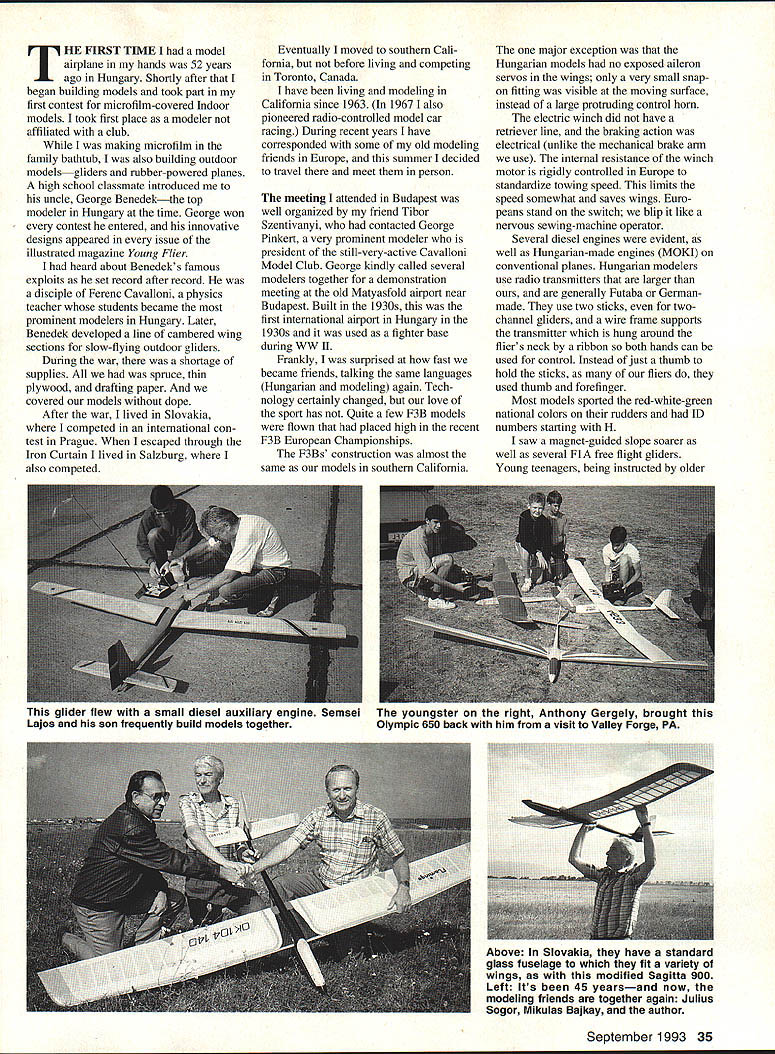
I have been living and modeling in California since 1963. In 1967 I also pioneered radio-controlled model car racing. During recent years I corresponded with some old modeling friends in Europe and this summer decided to travel to meet them in person.
Budapest meeting at Mátyásföld
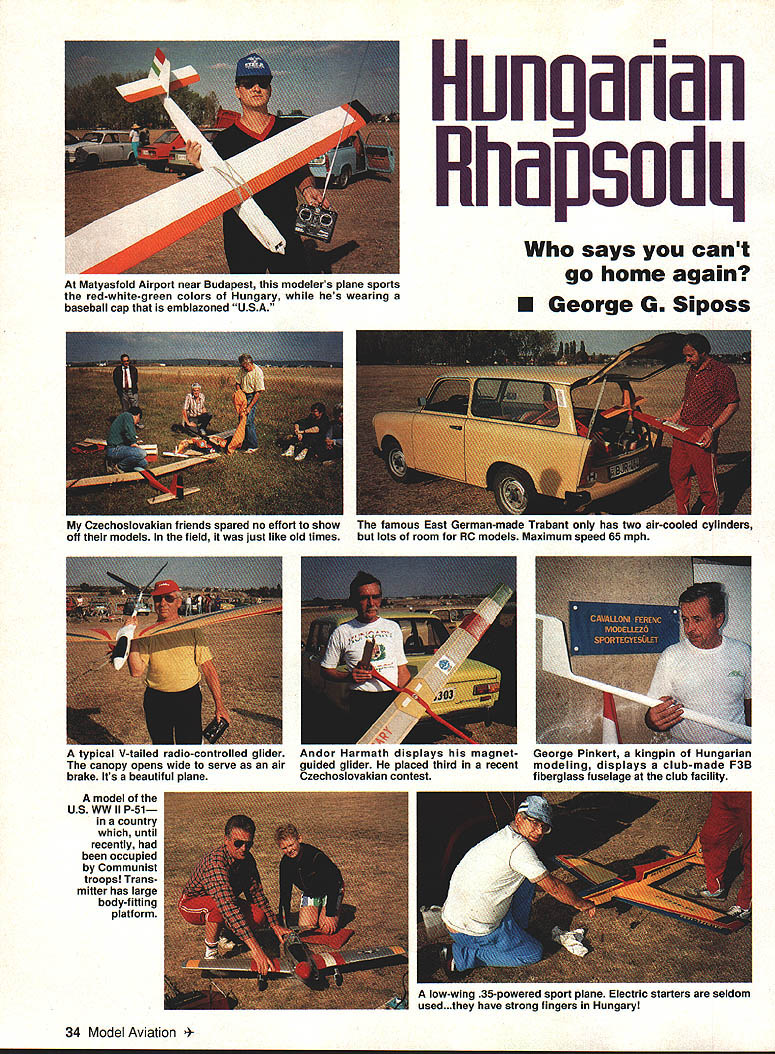
A well-organized friend, Tibor Szentivanyi, contacted George Pinkert, a very prominent modeler and president of the still-very-active Cavalloni Model Club. George kindly called several modelers together for a demonstration meeting at the old Mátyásföld airport near Budapest. Built in the 1930s, it was the first international airport in Hungary and was used as a fighter base during World War II.
Frankly, I was surprised how fast we became friends, talking the same language—Hungarian—and enjoying modeling again. Technology certainly has changed, but the love of the sport has not. Quite a few F3B models were flown that had placed high in the recent F3B European Championships.
Modeling practices and equipment observed
The F3B construction was almost the same as in Southern California; the major differences I noted included:
- Hungarian models show no exposed aileron servos; the moving surface used a very small snap-on fitting instead of a large protruding control horn.
- The electric winch used electrical braking (internal resistance in the winch motor) rather than a mechanical brake arm; Europe standardizes towing speed, which helps save wings. Europeans operate the switch with a rapid blip.
- Several diesel engines were in evidence, including Hungarian-made engines and MOKI.
- For conventional planes, Hungarian modelers generally use larger radio transmitters—Futaba or German-made—using two sticks for two-channel control. For gliders, a wire-frame support allows the transmitter to be hung around the flier's neck so both hands can be used for control; pilots generally hold the sticks with thumb and forefinger rather than just the thumb.
- Most models sported the national colors—red, white and green—and rudder ID numbers beginning with H. I also saw a magnet-guided slope soarer and several FAI free-flight gliders.
The modelers were enthusiastic. Young teenagers were being instructed by older modelers, and the sense of continuity and friendship among modelers was evident.
Cavalloni Model Club and facilities
I visited the Cavalloni Model Club facilities, where materials are available to modelers (although not for free as it used to be during the Communist era). The models exhibited a very high level of workmanship. Although instruction in aerodynamic theory is available on a semi-formal basis, model building is done mainly in members' homes rather than in a club workshop.
The club had a wood lathe and several machine tools for more complicated tasks. An oak cabinet was full of cups and trophies won by members of the Cavalloni club. Cavalloni and Julian Nagy, another Hungarian physics teacher who imbued students with the love of the hobby, had died a few years earlier, but their followers are keeping the flame alive. They organize local, regional, national, and international contests regularly. The club also has a trailer with living accommodations that members use when they travel to contests throughout Europe.
Benedek is still active, recently specializing in CO2-powered free flight models and competing with an Austrian modeler for top honors. He is also in close contact with Fred Militky, a pioneer of electric flight.
During the Communist regime, supplies were available only through—and doled out by—state-controlled clubs to reliable modelers. Now it is privatized, with three hobby stores in Budapest and a few cottage-industry shops supplying high-quality kits such as FAI gliders.
Other flying fields and Košice visit
While in Budapest I visited other flying fields. At one of them I met a young fellow, Anthony Gergely, who had recently been in the United States visiting his uncle in Philadelphia. While visiting the modeling club at Valley Forge, Pennsylvania, Anthony apparently helped rescue someone's plane from a tree; as a reward he was given a dilapidated Olympic 650, which he repaired and now flies successfully.
There are also full-size glider airports in Budapest, and the Museum of Flight contains many historic aircraft and gliders from the 1930–1960 era, including models that represented milestones in the Hungarian modeling community. The Hungarians were preparing for a commemorative indoor flying contest to celebrate the 50th anniversary of their first contest in the large indoor Sports Hall. (They often fly in the huge lobby of the Technical University.)
After visiting Hungary, I drove to Košice, Slovakia, where I used to build Wakefield rubber models. My first engine-powered model used a 1.8 cc Atom diesel made in Czechoslovakia; I also had a six-foot glider that thermaled for 15 minutes on September 8, 1946—one never forgets such dates. When it landed, a Russian soldier ran up to me, pointed a Thompson submachine gun at me, and demanded that I give it to him. Would you argue with him?
My old friends in Košice were happy to arrange a demonstration of their models. We walked out to the tarmac of the now-large local airport. The models bore large ID numbers on their wings preceded with "OK," the international symbol for Czechoslovakian aircraft of all sizes. The far portion of the airfield is used to train military jet pilots, but since it was Sunday there was no activity. Sports parachutists and full-size gliders were active on the far side of the field.
We set up on the grass, hand-towed a six-foot RC glider for several five-minute flights, then moved the receiver into a motorized glider with a small diesel engine and flew it. RC systems are very expensive, and in a country where gasoline is costly, one has to economize. They also successfully flew a three-foot, .1 Enya-powered Cessna-like plane for me. A fourth modeler launched a large glider without a preflight check; it went up about 40 feet and then crashed because the servos weren't properly installed. Technical problems recognize no state borders.
There is a high-class modeling journal published in Prague that deals with model airplanes, boats, and cars. While RC equipment is expensive, some modelers find ways to purchase it. A few hobbyists are of very high caliber and could easily compete in U.S. contests.
Closing thoughts and contacts
I vowed to go back again. While our hair had become whiter, everything else stayed much the same. Friendships and model airplanes remain when there are creative minds, busy hands, and people of good will.
If you wish to correspond with the kingpin of Hungarian modeling, George Pinkert, write to: P.O. Box 16, Budapest H-1625, Hungary. Information is also available through the technical journal published every three months.
If you have roots or friends in a foreign country, cement your relationship with them by visiting their flying sites. It's been an incredibly satisfying experience for me.
Transcribed from original scans by AI. Minor OCR errors may remain.

