
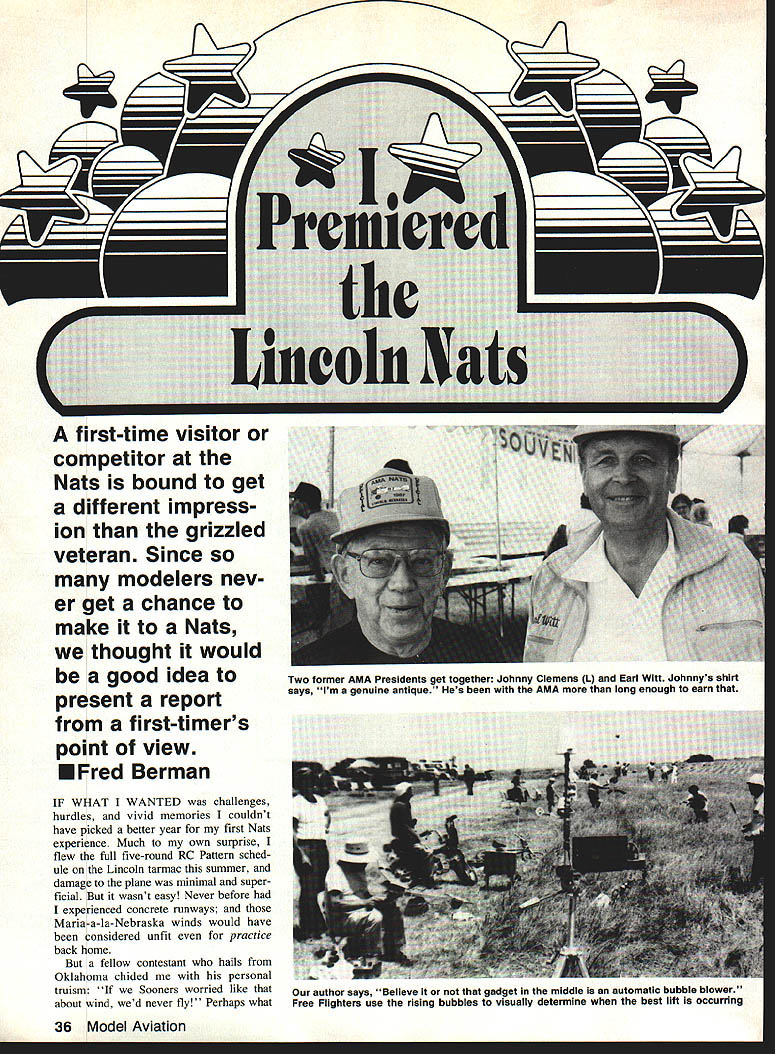
I Premiered the Lincoln Nats
A first-time visitor or competitor at the Nats is bound to get a different impression than the grizzled veteran. Since so many modelers never get a chance to make it to a Nats, we thought it would be a good idea to present a report from a first-timer's point of view. —Fred Berman
First impressions
If what I wanted was challenges, hurdles, and vivid memories, I couldn't have picked a better year for my first Nats experience. Much to my own surprise, I flew the full five-round RC Pattern schedule on the Lincoln tarmac this summer, and damage to the plane was minimal and superficial. But it wasn't easy! Never before had I experienced concrete runways; and those Nebraska winds would have been considered unfit even for practice back home.
A fellow contestant from Oklahoma chided me with his personal truism: "If we Sooners worried like that about wind, we'd never fly!" Perhaps what he was really saying is that senior citizens belong a-rocking on their front porches waiting for the mailman to drop off their Social Security checks instead of mixing it up with the hawk-eye-in-the-sky, nimble-gambol crowd.
The Super Kaos episode
Well, this thin-thatched Pattern apprentice did get some "help." A couple of well-meaning Californians decided that my Super Kaos needed re-rigging: less aileron and more rudder. Also, on arriving at the pits I realized I had neglected to extend the plane's landing gear before relinquishing my transmitter to the impound. "No problem," they said, "we'll power down the servo by hand—do it all the time!" You guessed it: the next flight was a near-disaster! The takeoff run looked more like a snake dance, and in-flight rolls simulated those of a tipsy albatross.
What's more, on extending the gear prior to landing, the right wheel made like a clock pendulum! My helper had unwittingly forced the pushrod connector out of engagement. But I was lucky—the strut locked down long enough for an eggcrate-style touchdown. For my next round, of course, all was back to normal.
Super Kaos and flier are now back home, the ship safely nestled in its hangar and the pilot's (the real one, not that little plastic pilot with a full head of hair) minor case of concrete rash neatly medicated.
Pattern contest and organization
But what an unforgettable experience it was! A word of praise is due Pattern Director John Embry. Anything but a fearsome martinet, John was a mild-mannered helpmate who was ever ready to pour oil on troubled waters whenever the waves kicked up.
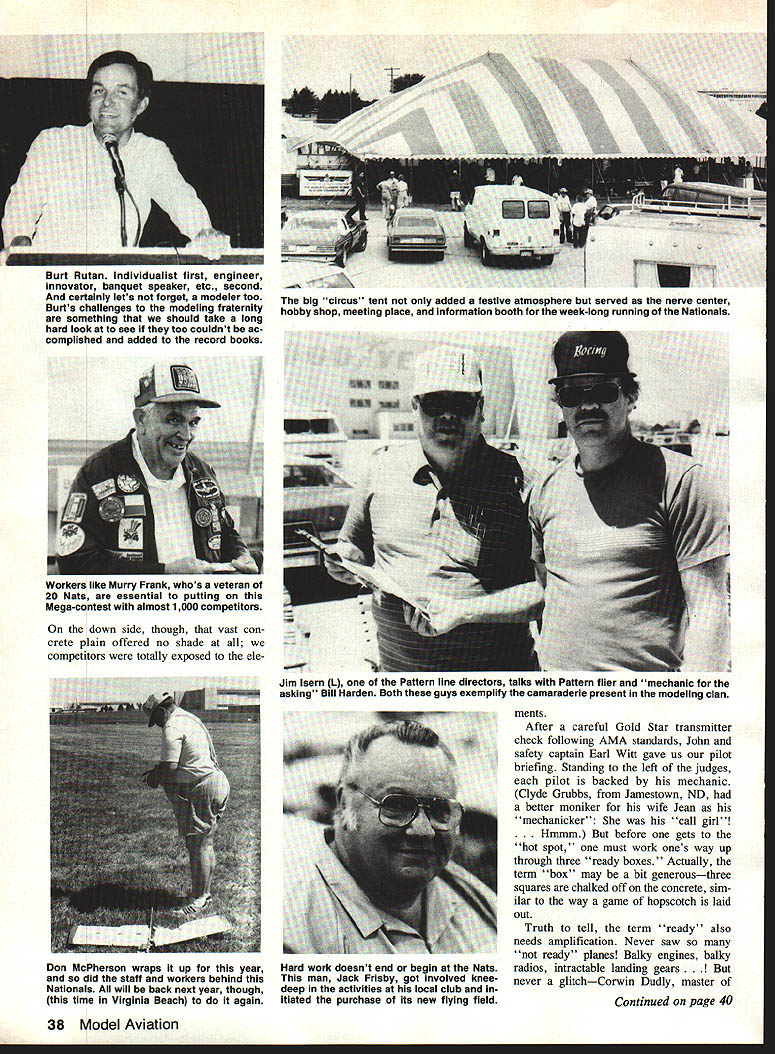
All our flying took place on one side of an active airport. We were sort of a sideline, and when pairs and trios of F-4 Phantoms roared overhead there was a noticeably muffling effect on the noise our airplanes made. Our two-strokers sounded fairly innocuous in that environment. The tarmac was just huge—what an expanse of concrete. There was so much room, in fact, that staking down the tent flies for the judges and the transmitter impound was no problem at all. On the down side, though, that vast concrete plain offered no shade at all; we competitors were totally exposed to the elements.
After a careful Gold Star transmitter check following AMA standards, John and safety captain Earl Witt gave us our pilot briefing. Standing to the left of the judges, each pilot is backed by his mechanic. Clyde Grubbs, from Jamestown, ND, dubbed his wife Jean his "mechanicker": she was his "call girl"! (… Hmmm.) But before one gets to the "hot spot," one must work one's way up through three "ready" boxes. Actually, the term "box" may be a bit generous—three squares are chalked off on the concrete, similar to the way a game of hopscotch is laid out.
Truth to tell, the term "ready" also needs amplification. Never saw so many "not ready" planes! Balky engines, balky radios, intractable landing gears...! But never a glitch—Corwin Dudley, master of the impound, saw to that. He used a scanner to check every transmitter, making certain its channel was clear before handing it out. Corwin was one of over 200 volunteers without whom there wouldn't be a Nats. And so was Jim Isom, from Norman, OK, our jovial line director. He staged the fliers and routed the score sheets between the judges and the computer terminal. He was also the keeper of the frequency clips—and there was not a single case of radio crosstalk.
People like Corwin and Jim forego their own Nats participation so that the roughly 1,000 registered contestants can do their thing. Ah yes, the Thing . . . the Nats . . . the model Olympics. Those tiny, gyrating specks carving enormous geometrical forms into the ozone have to be less photographic than Mary Lou doing the vault.
Incidents and other events
Control Line Combat is a different story, naturally—especially when, as a result of a midair, one of the combatants lost his grip on the handle. The model took off and dragged the steel wires across a set of nearby power lines, setting off fireworks and causing a loss of house-power to a number of local businesses. The utility line crews responded quickly and undid the damage in their accustomed professional manner—after they closed off the main roadway to the Nats site!
Competitors and camaraderie
"Sooner" practice in the winds does pay off. So do talent, youth, and perseverance. A young man from Oklahoma City, Michael Wilson, finished high among the S4 Sportsman competitors. A systems engineer for IBM, Mike ably represented the Baxter Field Flying Club. Amazingly, he started flying only two years ago, but practices seven days a week. Mike is a trophy-bound flier, for sure. He was also a willing mechanic for anyone needing such service. William Harden, from Derby, KS, was another such. Bill taught me some of the ropes from the judges' vantage point. For example, aim for level entry and level exit with every maneuver. Bill was the condenser for my evaporative memory regarding maneuver sequence and became a relief valve for that competition boiler pressure.
This is just a sampling of the warm camaraderie among contestants. It was astounding. Mutual cooperation, rather than every man for himself, was the rule. Of course, some fliers thought their performance fell below their norm. Terry Tengler, an architect from Spring, TX, believed that he did not really find the groove until his final round. Clyde Grubbs, another first-time competitor, decided that his Astro-Hog (whose ancestor won the Nats in 1957) was overwhelmed by the Nebraska breezes. He withdrew after Round Two, but surely will be back at the next Nats, prepared for whichever way it may be blowing with a more wind-navigable Pattern bird.
With the exception of three Super Kaos models, all the entrants were purebred Pattern ships. All the Super-K models seemed to experience some difficulty with stall turns—and there were no single-stick transmitters in the impound for the Sportsman/Advanced competition.
Spectators and club stories
Some come to the Nats as spectators only. One such, John Ulivi from Union Lake, MI, recounted a sad but familiar story. His 110-member flying club is "between" flying sites. Special noise precautions, charity flying events, and community involvement notwithstanding, the club lost its original flying field, which had been on state lands. It took only a single petitioner to arouse the inhabitants of a nearby subdivision, and political response to such a petition is utterly predictable. RC models, especially at short range, don't turn everyone on—or at least not the same way. Our country's population growth is like a game of musical chairs in reverse. The number of seats stays the same, but the group of game sitters wanting to sit down grows with each round. And the overflow may tend to claim our "vacant" flying sites!
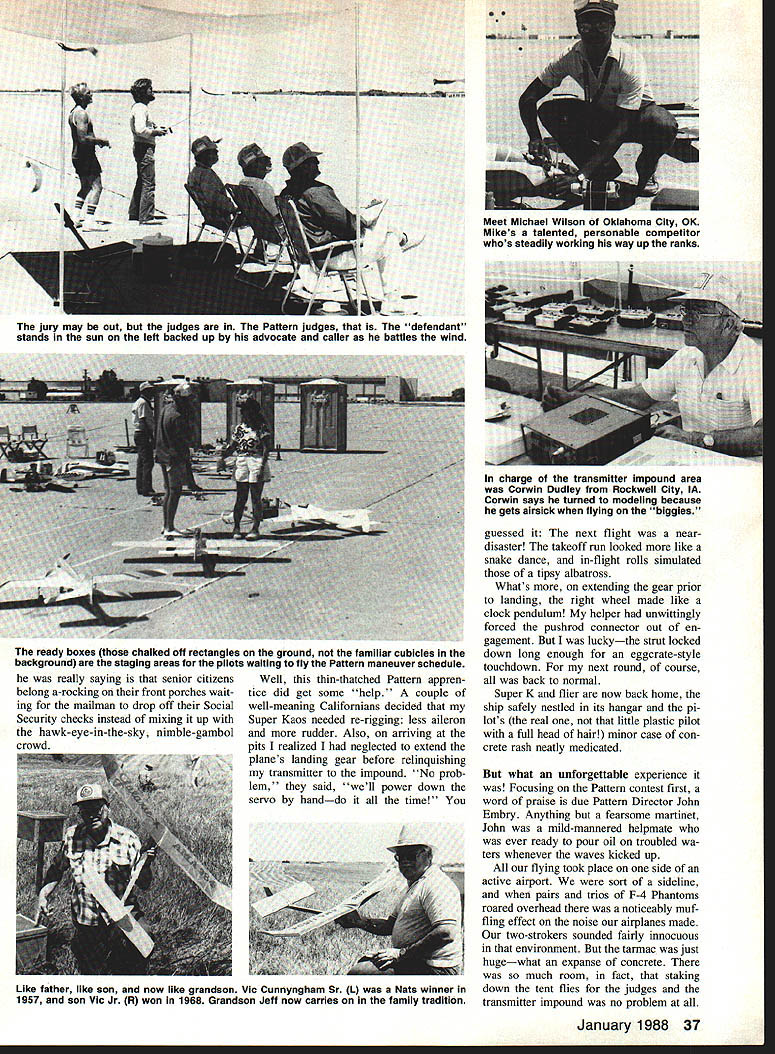
A sentimental old pro like Johnny Clemens can hardly be classed as a mere spectator when he journeys to a Nats. Johnny who? Texas John, the Man from the Big "D." That irrepressible little guy who's a giant in disguise. His T-shirt proclaims him to be a historic sight—and he certainly is! John has helped to make AMA history for the bulk of its 50-year existence—as vice-president, as president, as general handyman and especially as upbeat drummer.
Only his closest friends know of the physical handicaps Johnny conceals so gallantly. Why, in Lincoln he had to spend a night in the hospital when he hemorrhaged from accidentally reopening an old operation and lost perhaps a third of his blood. But he was vertical the following day and back at the AMA tent with his Texas humor fully intact. With that deep-in-the-heart twinkle, he announced that AMA had elected a new Lowe. That's not a misspelling; that's Johnny's way of approving of the AMA's new president, Don Lowe. Johnny has been for years a gallant pillar of our hobby/sport, and when we think of all the people who have suffered setbacks yet returned to the sport, we are reduced to humbly tipping our hats to him.
Johnny's fellow Texan, Murry Frank, was another nostalgic volunteer worker making it all possible. A former District 8 vice-president from Wichita Falls, Murry dryly asserted that his town had to build a full-sized runway so it could honestly wear its name. Murry is attending his 20th Nats. His son, Dr. Sandy Frank, caught the modeling bug and flies a wide variety of models. As Free Flight category director, Sandy was another member of the Lincoln volunteer regiment.
Murry reflected on the history of Model Aviation magazine. The mag started life as an eight-page, 6 × 9-in. newsletter. It later became an insert in a hobby magazine called American Modeler. When that periodical folded in the mid-Seventies, there was a temporary hiatus in AMA contact with members. During the Clemens presidency (which coincided with Murry's term of office), sometime around 1974, the AMA Executive Council authorized AMA HQ and Carl Wheeley to put out a full-fledged magazine. Today, what you hold in your hands attests to the effort's eminent success.
Murry, who was tending the Nats hobby shop, wore a shirt embroidered with "C.L. Category Contest Director." He laughingly admitted that the shirt was dated, and that a gal named Bev Wisniewski owns the 1987 title.
Anecdotes from the field
"What'll I do now?" gasped a frenzied voice, as the model flared in too high above the runway and was about to dive into the weeds beyond. "Why, just pour on the coals and go 'round!" came the advice. The first voice was that of Major Tom Brown of the USAF, who served as personal pilot to Lyndon Johnson during the latter's vice-presidency. The friendly counsel came from Jack Frisby, AMA No. 6138. Frisby related this story to me after a 27-year silence based on Major Brown's threat of wreaking mayhem upon anyone snitching on him.
Our anecdotist is a retired chief scientist now living in Miami, OK, and another delightful member of that multitude of AMA loyalists. Jack is a veteran modeler with a string of records to his credit. "Jack, how do you store your 30 planes? Surely not this way..." (Jack's wife manufactures "Guaranteed Recovery Kits," which she sells for a dollar. The kits consist of a large paper bag and a crying towel.)
Free Flight: 1/2A Gas and Wakefield Rubber
Braving a trip over unmarked country roads, my reward was seeing the Free Flight site in action. Here, Linda Brown ruled as event director. Free Flight may seem to some to be a low-adrenaline event, but it's still an ultra-precise and physically demanding contest.
The program the day I watched was 1/2A Gas and Wakefield Rubber. Simple, stick-type models carry a Cox .049 engine in their noses. Pressurized fuel tanks are fashioned from baby pacifier nipples. Then there is an adjustable, spring-wound timer with an arm that pinches off the fuel line after a predetermined number of seconds. But there is more. The horizontal stabilator is spring loaded to pop up at around a 30° angle. A trigger latched by a rubber band secures the cocked stabilator in level attitude. A sneaky little fuse with a slow, two-minute burn is designed to creep up on the rubber band and burn it in half.
Key components:
- Cox .049 engine
- Pressurized fuel tanks made from baby pacifier nipples
- Adjustable, spring-wound timer to pinch the fuel line
- Spring-loaded horizontal stabilator with rubber-band latch
- Two-minute slow-burning fuse designed to sever the latch
When fully prepared, the contestant checks in with the CD, who assigns an individual to act as timer. At his leisure the contestant lights the fuse, cranks up the .049, and tosses the plane vertically into the sky. If all goes well, the plane climbs straight up until the engine cuts out after about 10 seconds. Now the plane levels out and becomes a glider. If airborne the full time (two minutes being optimal), the fuse has its chance; the rubber band is zapped, the stabilator pops up, and the cruiser DTs. In the ideal course of things, the ship descends gently, sometimes with a porpoising motion, and lands not too far away. That is, if the Nebraska winds behave—which they mostly didn't. Retrieval became a matter of a strenuous cross-country trek, which many resourceful Free Flighters eased by saddling up on motorbikes and ATVs. Few midair worries in this contest!
For the Cunningham family, 1/2A Gas is challenging enough to have bridged the generation gap. Vic Sr., AMA No. 984, won the Nats in 1957. Vic Jr. repeated the feat in 1968 at Olathe, KS, with a plane of his own design. Now grandson Jeff is showing every sign of being primed for the same distinction. Guess some of us have to be shown that planes can fly without radio stuffing!
Presentations, records, and side shows
Elsewhere at the Nats there were presentations and record attempts. A high-profile talk by Burt Rutan came across as personable, articulate, utterly scientific, inspiring, and humorous. He charged the avionics industry with being slow to change, afraid to innovate, and shackled by the country's legal system. Burt's suggested remedies for the latter dilemma best remain unreported. His "imaginuity" is nothing short of legendary. He suggested, for instance, that a nonstop RC flight from New York to San Francisco is achievable. He even touched on a project of human-powered flight capable of attaining earth orbit—probably tongue-in-cheek, but thought-provoking.
Rumor had it that Burt Rutan, Hazel Sig Hester, and Maxey Hester were flying CL Combat with borrowed ships! Tsk, tsk, tsk! But it was quite a show, we hear.
Also mentioned were some grueling long-duration efforts: a Voyager-type project left pilots Dick and Jeana battered and bruised after extended flights created by wing flexure. The motion curtailed sleep, which averaged 1½ hours daily for nine days. All this, and the Voyager was in the clouds for less than 30 minutes total. The pilots confessed that, despite their resolve and the record-setting hopes, they would never repeat such an adventure.
Why the Nats exist
Why does the Nats exist? Why do we have competition and games? Throughout recorded history (and probably earlier) sports have been important in human society. Looking at the western world alone, we see a changing pageant of competitors: from Greek Olympians, to Roman gladiators, to medieval jousting knights, to Spanish bullfighters. Today, the list of international, national, and local contests could fit inside a Manhattan phone directory. People, loving though he likes to consider himself, seeks to test his mettle, to rank himself against his fellows—or at least to take sides in a competition if he is not personally engaged. Our support of ball teams, jockeys, racers, pugilists, golfers, and athletic contests attests to our game spirit. Directly or vicariously, man is contest-minded; and that even includes verbal contests.
Yes, we have heard the cry, "Why use everybody's AMA money for a Nats where at best 1% of members participate?" Hold everything for just a minute! I've got it straight from the horse's mouth (with my apology to Don Lowe) that the aim is for the Nats to be self-supporting. What's more, this has happened, though not regularly. More often, there is a deficit of a few grand. But at the maximum per-member cost of 25 cents, and usually only a fraction of that, would you really vote to squelch the model Olympics? Why, I can even envision car and boat competitions in the future!
Let me make it clear that I am in no way obligated to the AMA, or to this magazine, to extol the virtues of the Academy; nor do I aspire to someday become one of its officers. Mine is a spontaneous tribute. To put on a Nats just seems a tremendous achievement. Finding a suitable site, a willing host club, the hundreds of volunteer workers, gambling on attendance, the weather, and the finances—all these make the Nats the valiant, admirable undertaking that it is.
Personal reflections and plans
With the same heap of dollars that went into my entry fees and trip expenses I could have purchased a fancy, completely outfitted Pattern ship. But what good is such a plane if you can't loft it at the likes of a Nats? Yes, that's me taking the—uh—chump role, the inept person of modeldom, the one ranked 49th among 54 entrants in my category! A stranger to concrete, to semi-scales, to fancier, higher-speed maneuvers, and with only a quasi-suitable Super Kaos as space vehicle. Oh, there are even more excuses than that.
But do you know something? Now that I've premiered the Nats I wouldn't miss another one! The battle cry is, "Just wait till next year!" I'll have an Aurora just like Steve Helms' and Chip Hyde's. And meanwhile, I'll practice, practice, practice—but only when the wind sock stands out straight sideways! Come to think of it, maybe I'd better build at least two Auroras!
When responding to advertisers, mention that you read about them in Model Aviation.
Transcribed from original scans by AI. Minor OCR errors may remain.

