
1985 NATS: CL Aerobatics
Lou Dudka
Overview
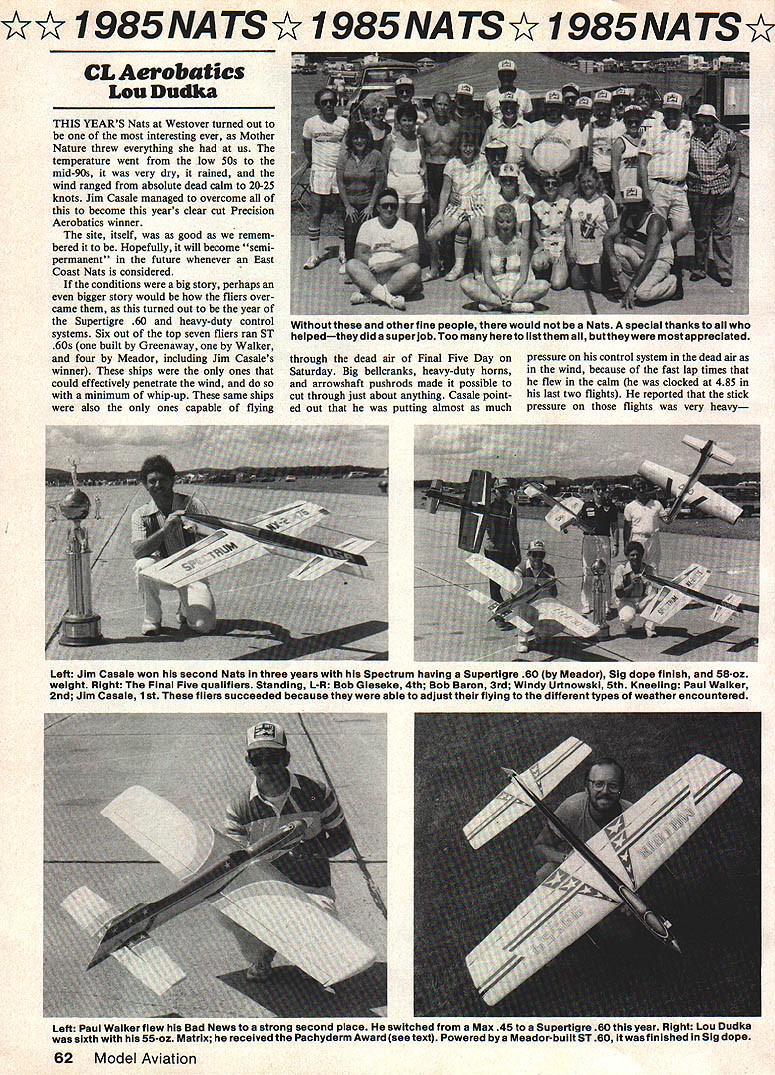
This year's Nats at Westover turned out to be one of the most interesting ever. Mother Nature threw everything at us: temperatures ranged from the low 50s to the mid-90s, it was very dry, it rained (three to five inches locally), and winds varied from dead calm to 20–25 knots. Jim Casale managed to overcome these conditions to become this year's clear-cut Precision Aerobatics winner.
The site itself was excellent and will be well remembered. Hopefully it will become a semi-permanent venue whenever the East Coast Nats are considered.
Conditions and how fliers adapted
- Weather changed quickly; a flier's ability to make instant trim adjustments often separated the successful from the unsuccessful.
- Many arrived and got a practice round on Wednesday before the heavy rain. Wednesday's second round and Thursday morning's flights were followed by two long, tiring rounds.
- When the rain cleared Thursday, winds picked up and some fliers prudently left planes in their cars. Six or seven ships were lost; quite a few fliers were happy just to get through the pattern.
- After the dust settled, the Top 20 competition (including five rookies and several first-time qualifiers) produced some of the best flying of the week.
Equipment trends
It turned out to be the year of the Supertigre .60 (ST-60) and heavy-duty control systems. Six of the top seven fliers ran ST-60s (built by Greenaway, Walker, and Meador, including Jim Casale’s winner). These ships:
- Could effectively penetrate wind with minimum whip-up.
- Were capable of flying through the dead air encountered on Final Five Day.
- Featured big bellcranks, heavy-duty horns, and arrow-shaft pushrods to provide the required control authority.
Casale noted that he put almost as much pressure on his control system in dead air as in wind because of the fast lap times. He was clocked at 4.85 seconds on his last two flights and reported very heavy stick pressure on those flights.
Competition highlights
- Jim Casale’s very strong first flight allowed him to qualify despite running out of fuel over the clover when he miscalculated on another flight.
- The Final Five came down to Casale and Paul Walker, with Walker providing close competition. There often seems to be one flight on Finals Day that "wins the Nats" for a flier; Casale’s second of three final flights was that crucial performance.
- Paul Walker finished a strong second after switching to a Max .45 Super Tigre this year.
Top finishers
- Jim Casale — Champion
- Paul Walker — Runner-up
- Bob Baron — Third (flew an Avanti powered by a Max .40 FSR; the only non-.60 in the Finals)
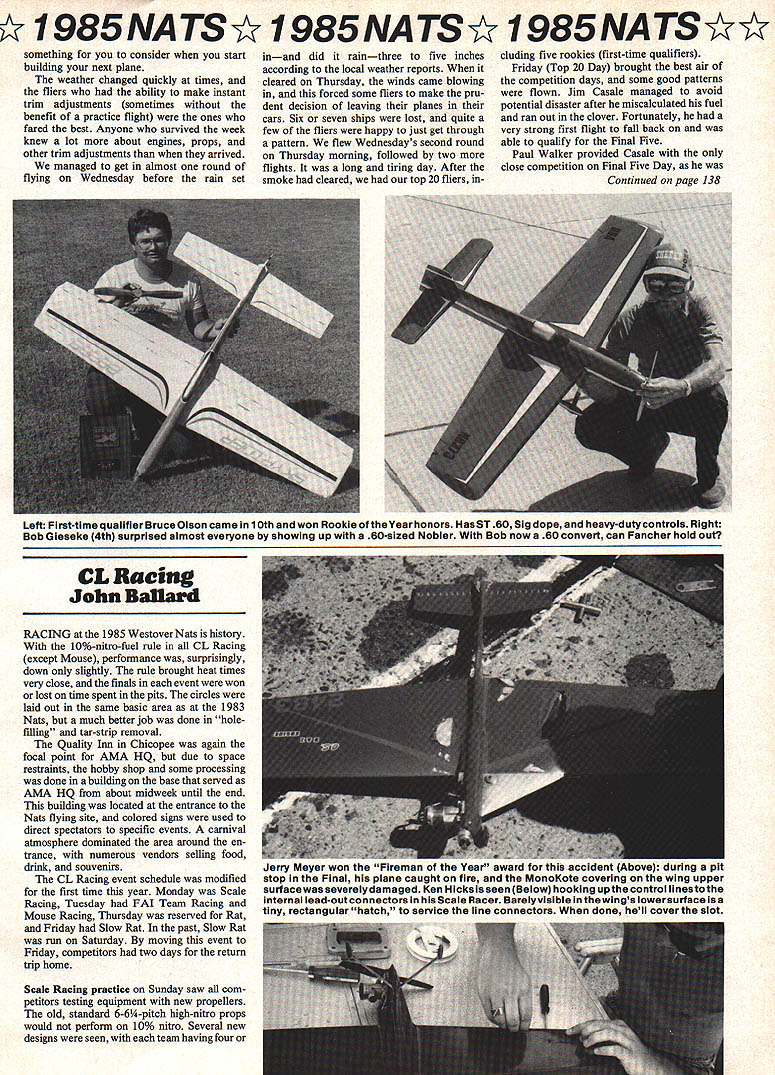
- Bob Gieseke — Fourth (arrived with a .60-sized Nobler but was restricted by tank size on Final Five Day)
- Windy Urtnowski — Fifth (flew a .60-powered Bee-Jay, an El-Jay of about 780 sq. in.)
- Lou Dudka — Fell from a third-place qualifying spot after losing pattern points on Top 20 Day (counting error during loops) and missed higher placement by only two points
- Glen Meador — Seventh (his best Nats finish yet; had some problems in strong air)
- Stan Powell — Eighth (lost his Number One ship a week before the Nats; finished respectably with an older airplane and a borrowed engine)
- Tom Dixon — Ninth (looked his best with a new .60-powered bird but gave up appearance points)
- Bruce Olson — Tied for tenth and named Rookie of the Year (first Open Nats)
- Dave Hemstrought — Tied for tenth (consistent top finisher and graciously offered Bruce Olson the trophy)
Rookies and first-time qualifiers
- First-time qualifiers included five rookies: Bruce Olson, Pete Bergstrom, George Higgins, Karl Seifert, and Jim Cochran.
- Jim Cochran had the misfortune of running out of fuel in the clover on Top 20 Day; he is a flier to watch for the future.
Appearance and club accomplishments
- The Garden State Circle Burners dominated both flying and appearance awards: four of the top seven placers were Circle Burners, including Jim Casale.
- Four of the top five airplanes in appearance were also Circle Burners. Glen Meador’s "Eagle" was awarded 19.5 appearance points, the second-highest-ever at a Nats (surpassed only by Gene Martine’s "Marine" with 20 points in Seguin).
- Windy Urtnowski (also a Circle Burner) was awarded the Concours d’Elegance Trophy.
Volunteers and judging
- Betty Adamsim and Doris Carvelle (Dick’s new bride) did an excellent job tabulating and running the scorer’s table, filling much of the gap left by Sharon Fancher’s absence.
- Judging this year was among the best in memory. "Big Art" Adamsim did an excellent job training judges. Marie Adamsim and Mary Hazell served as assistant women judges and both judged the finals, along with Archie Adamsim (whose son Arch was a runner).
- The Adamsim family’s contributions to the hobby were especially notable and appreciated.
Final notes
- Many fliers who succeeded knew a lot about engines, props, and trim adjustments — knowledge that proved essential given the rapidly changing weather.
- The event was made successful by many volunteers and helpers; thanks to all who contributed.
Transcribed from original scans by AI. Minor OCR errors may remain.

