
1985 NATS: CL Combat
Charlie Johnson
IT WAS AFTER 8:00 p.m. by the time we dragged into the dorms at Elms College. Everyone else had finished dinner and was taking it easy. We were hungry, dirty, and tired when a voice called out, “How come you guys always finish so late?” After years of doing this, I should have had an answer, but any sense of reason escaped me during those weakened periods. We spent more time out at the flying field than any other group, and by Saturday we were ready to go back home and rest up for another Nationals.
Despite the good intentions of the officials, Combat events almost always run long. Rich Lopez did a good job in Reno despite difficult conditions, but the general pace of recent Nationals has been slow. Slow pace means more time out on the field for officials and contestants, more opportunities to miss a call or get crabby, and a tendency to just “try and get it over with.”
Like last year, events were flown double elimination — two losses put anyone out. The flying site was user-friendly and the weather mostly cooperated except for rain on Wednesday and strong winds Thursday. A modest pace would have easily gotten us through eliminations, but there were other problems: a few protests, a jury system that tended to slow things down, and an epidemic of people getting chopped by propellers — not just small cuts but some nasty slashes that needed stitching.
Incidents and protests
In one of the first matches, junior contestant Joe Saitta released the handle of his model. The model flew out of the circle, hit the dirt, and struck Larry Driskill on the left arm, causing deep lacerations. Normally a contestant who loses control of the handle would be disqualified. At a pilots’ meeting the decision was voted on and the consensus was that disqualification was too severe; the Junior was allowed to continue but lost that match.
Soon after, another Junior released a handle and, in a freak sequence, the lines became tangled so that one plane was on 60-foot lines and the other on 120-foot lines. The pilot ran back to the opposite side of the circle to avoid overflying spectators and judges. Several other contestants — Juniors, Seniors, and Opens — also let go of handles during the meet.
A debris incident after two models hit directly over the pilots’ circle produced one of the more dramatic moments of the meet: debris fell into the circle and caught fire. A fire extinguisher had to be rushed to the center to put out the flames so the match could continue with spare models.
Jury system and reflys
The new jury system slowed things down more than in past years. Anything put before a jury tended to be moderated; when in doubt they often voted for a refly. Safety procedures and start-signal disputes were subject to veto. One refly was granted because a team didn’t hear the start signal; they were second up and eventually lost the refly because of a misfire and fewer air points. The opponent refused a second refly, saying he had already won the match once. Much of the confusion stemmed from pit-crew procedures — in several matches it came down to which pit crew got an engine started first.
Notable flying and results
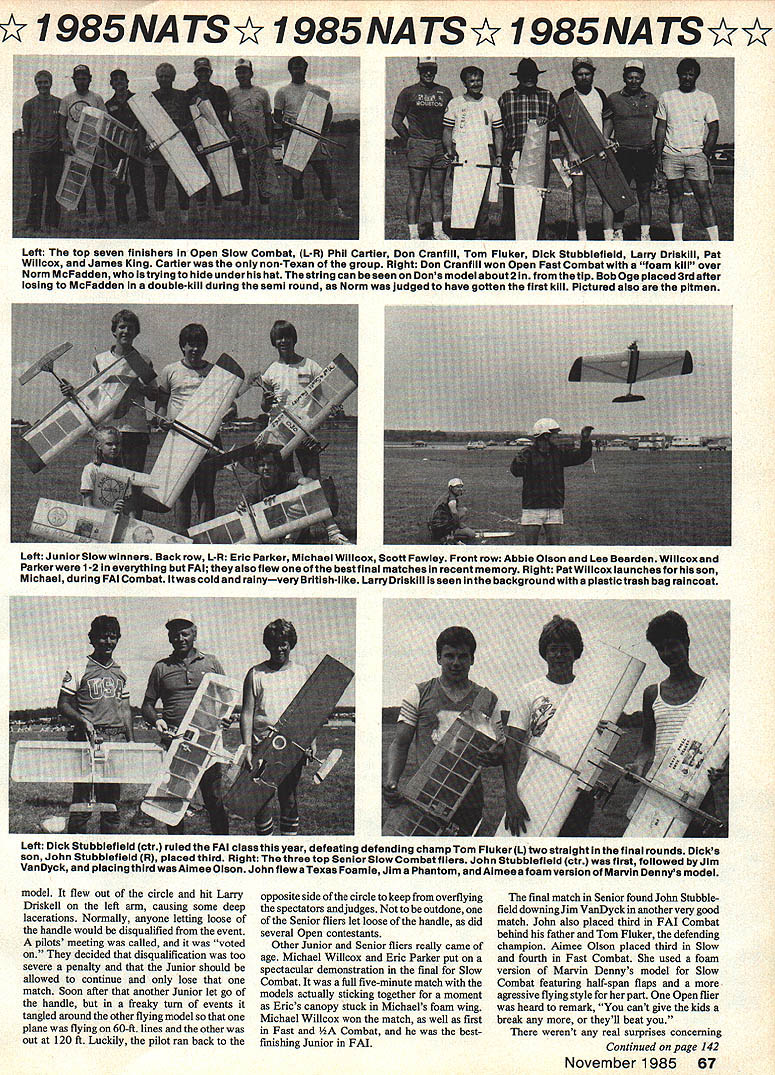
Other Junior and Senior fliers put on spectacular demonstrations. Michael Willcox and Eric Parker gave a memorable five-minute Slow Combat final where the models actually stuck together briefly as Eric’s canopy snagged Michael’s foam wing. Michael Willcox won that match and also took first in Fast and 1/2A Combat; he was the best-finishing Junior in FAI Combat.
In Senior competition John Stubblefield downed Jim VanDyck in a very good match. John also placed third in FAI Combat behind his father, Dick Stubblefield, and Tom Fluker, the defending champion. Aimee Olson placed third in Slow Combat and fourth in Fast Combat, flying a foam version of Marvin Denny’s model with half-span flaps and a more aggressive style. One Open flier was heard to remark, “You can’t give the kids a break any more, or they’ll beat you.”
Local TV Channel 22 used the Bud Bozdich vs. Tom Fluker match as backdrop for their 6:00 p.m. news. Bud tried to put on a show for the cameras, but Tom won the fiercely contested five-minute match. Also on hand was a National Geographic photographer, who quipped that it was the only assignment he’d ever had where there were only hunters and no prey.
Junior and Senior .21 A Combat produced only one cut in all the matches, likely due to the windy conditions keeping planes spaced.
Equipment and mechanics
- Henry Nelson flew a Slow Combat model powered by a .15 engine and made it through three rounds against larger .36-powered models. Although his model flew well and turned tightly, the power disadvantage was apparent; a .15 with pressure fuel might even the field.
- The Super Tigre S-36 appeared in many models; Bob Oge used one to finish third in Fast Combat.
- The Cipolla .15 showed up in FAI but was generally overwhelmed by larger engines.
Pat Willcox showed his skills as both a pit repairer and an innovative engine man. When a borrowed engine wouldn’t restart because it was hot and loose, Pat put a lotion-like liquid into the venturi and the engine fired instantly. The “suntan lotion” turned out to be a half-and-half mixture of STP and Marvel Mystery Oil.
Tactics
Some of the tricky styles used by Meyer and Wakeman at the World Championships have been adopted by a few American fliers. Dick Stubblefield combined an outside loop to inverted flight, a faux to an outside, and a “jog” maneuver: flying straight down from level flight and pulling out very low but still level. The fake-inverted sequence works best against a pilot who is good at following — the trailing pilot expects an inverted continuation and commits, but when the leader pulls upright the follower often has no time to react. The tactic was very effective at the World Championships and useful at the Nats for getting an opponent off your tail.
Personnel and thanks
There were many dedicated officials who gave their time and effort. A special note of appreciation goes to:
- Patty Sasnett — Event Director (sidelined for two days when the scoreboard toppled in high winds)
- Judy Curtis — filled in admirably for Patty
- Don Miles — circle marshal for the entire six days, never missing a match
- Sandy Frost — ran the pits
- Gayle Foster — judge
- Malcolm Pawley — judge
- and many others who helped judge and run events
Thanks to all of you for making the 1985 Nationals CL Combat possible.
Transcribed from original scans by AI. Minor OCR errors may remain.

